Mark Cuban Cleared As Court Dismisses Voyager Digital Investor Lawsuit

bitcoinistОпубликовано 2026-01-03Обновлено 2026-01-03

Введение

A US federal judge dismissed a class-action lawsuit against Mark Cuban and the Dallas Mavericks brought by former Voyager Digital customers. The court ruled it lacked personal jurisdiction in Florida, as the defendants were not conducting business in the state. The lawsuit stemmed from Voyager's 2021 bankruptcy, where customers lost funds and alleged misleading statements. Plaintiffs argued Cuban's promotion of Voyager, including a fan incentive offer, encouraged platform use. The dismissal was based solely on jurisdictional grounds and did not address the case's merits. Plaintiffs may refile in another court.

A US federal judge has tossed a class-action lawsuit brought by former Voyager Digital customers against billionaire Mark Cuban and the Dallas Mavericks, ruling the court did not have the power to hear the case.

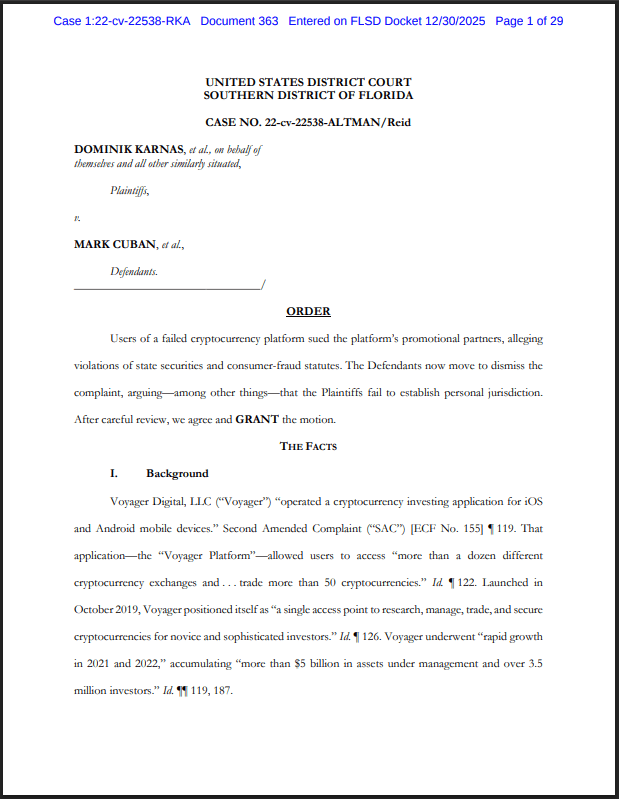
The order, entered at the end of December, dismissed the suit in its entirety after finding the plaintiffs failed to show the defendants were subject to personal jurisdiction in Florida.

Mark Cuban Vs. Voyager: Judge Cites Lack Of Personal Jurisdiction

According to the court filing, Judge Roy K. Altman concluded that Mark Cuban and the Mavericks did not “carry on a business or business venture in Florida” in a way that would let the Miami-area court preside over the matter.

The decision follows extensive jurisdictional discovery and multiple amended complaints that, the judge said, still fell short of establishing the necessary legal ties to Florida. The defense team hailed the ruling as a complete win for their clients.

Source: Courtlistener

The suit traces back to 2022, when Voyager Digital filed for Chapter 11 protection after a sharp market downturn and loan defaults. Voyager’s bankruptcy and the fallout led to a wave of litigation by users who said they lost access to funds and were misled by the company’s statements. Reports have noted the firm had roughly $1.3 billion in customer crypto assets implicated during restructuring talks.

Image: www.mak.kg

Promotion And The $100 Fan Offer

Based on reports from earlier coverage, the dispute focused on a 2021 promotion in which Cuban and the Mavericks partnered with Voyager and offered fans incentives tied to deposits and trading.

Bitcoin is currently trading at $89,299. Chart: TradingView

Plaintiffs argued the partnership and public backing helped convince customers to use the platform. Other defendants in related Voyager litigation have settled; Cuban and the Mavericks maintained they would fight the claims.

Legal experts say the outcome highlights the limits of suing public figures in forums far from where those figures are based. Courts increasingly demand concrete evidence that a defendant targeted a state before allowing local lawsuits to proceed. This dismissal does not decide whether the promotional statements were true or false; it addresses only where the case could be heard.

Plaintiffs’ Options And Wider Litigation

Reports have not shown an immediate refiling in another court by the named plaintiffs. Because the judge dismissed the complaint for lack of jurisdiction, the plaintiffs were denied the chance to proceed in that Florida court but may pursue claims elsewhere if they choose.

Featured image from MediaNews Group via Getty Images, chart from TradingView

Связанные с этим вопросы

QWhy was the class-action lawsuit against Mark Cuban and the Dallas Mavericks dismissed?

AThe lawsuit was dismissed because the US federal judge ruled that the court did not have personal jurisdiction over Mark Cuban and the Dallas Mavericks in Florida, as they did not 'carry on a business or business venture in Florida' in a way that would allow the Miami-area court to preside over the case.

QWhat was the central argument made by the plaintiffs in the lawsuit?

AThe plaintiffs argued that the partnership and public backing from Mark Cuban and the Dallas Mavericks helped convince customers to use the Voyager Digital platform, and they were misled by the company's statements, leading to financial losses.

QWhat event precipitated the wave of litigation against Voyager Digital and its partners?

AThe wave of litigation was triggered after Voyager Digital filed for Chapter 11 bankruptcy protection in 2022 following a sharp market downturn and loan defaults, which caused users to lose access to their funds.

QDoes the court's dismissal rule on the truthfulness of the promotional statements made by Mark Cuban and the Mavericks?

ANo, the dismissal does not decide whether the promotional statements were true or false; it addresses only the issue of jurisdiction and where the case could be heard.

QWhat are the legal options for the plaintiffs following this dismissal?

AThe plaintiffs were denied the chance to proceed in the Florida court but may choose to pursue their claims by refiling the lawsuit in another court that has proper jurisdiction over the defendants.

Похожее

MoneyGram: Why Did We Launch Our Own Stablecoin?

MoneyGram, a global leader in cross-border remittances for over 80 years, has launched its own stablecoin, MGUSD. The initiative aims to evolve from single-transaction services to becoming a more integral part of users' financial lives. By allowing customers to hold a stable US dollar balance within the MoneyGram app, MGUSD enables not only remittances but also everyday spending, currency exchange, cash access, and future financial services. Targeting the billions globally who face challenges like currency volatility or lack of bank accounts, MGUSD leverages Stellar blockchain technology with a self-custody wallet architecture. This gives users control over their assets while providing a secure, compliant experience through a trusted brand. The approach focuses on solving existing customer pain points within MoneyGram's established network, rather than competing for broad crypto market liquidity. A key advantage is MoneyGram's hybrid model, combining digital services with the world's largest physical network for crypto-to-cash conversions. The stablecoin also modernizes the company's internal infrastructure, streamlining treasury management and partner settlements, with annual forex volume via stablecoins already reaching $2 billion. The project was delivered in about a year, driven by a reorganization into agile, cross-functional teams that operate with startup-like speed while leveraging decades of institutional expertise. Partners include Stablecoin (issuance), Crossmint (wallet APIs), Fireblocks (enterprise treasury), m0 (smart contracts), and the Stellar network. MoneyGram emphasizes that enhancing direct consumer offerings strengthens its partner ecosystem. The future direction is clear: to provide users worldwide with stable value storage, better financial tools, and greater control over their funds through a trusted, existing network.

Foresight News39 мин. назад

MoneyGram: Why Did We Launch Our Own Stablecoin?

Foresight News39 мин. назад

BIP-110 Controversy Intensifies: Bitcoin May Face Its Most Divisive Hard Fork Battle in Years

Bitcoin is approaching a critical block height of 961,632, which could activate the controversial BIP-110 proposal. This proposal aims to restrict the amount of non-financial data, such as inscriptions and other large data payloads, within Bitcoin transactions. Supporters, including some node operators and Bitcoin purists, argue that BIP-110 is necessary to preserve Bitcoin's core function as a monetary settlement layer by reducing network congestion and node operational burdens caused by non-essential data. They frame it as a correction to keep the network true to its original purpose. However, critics, including prominent figures like Blockstream's Adam Back and developer Jameson Lopp, warn that the proposal's implementation mechanism is dangerously flawed. They highlight that its low 55% miner signaling threshold, coupled with a contentious enforcement mechanism allowing nodes to unilaterally reject non-compliant blocks, significantly increases the risk of a chain split. Opponents argue this sets a dangerous precedent for transaction censorship, undermines Bitcoin's protocol neutrality, and creates excessive uncertainty for developers and businesses, especially since the rule is proposed as a temporary one-year measure. Market analysts, such as those from Bitfinex, suggest a full-scale network split is unlikely due to a lack of broad economic consensus. Major mining pools remain neutral, and adoption of the new rules is minimal. They view the situation more as a governance stress test. The primary risk is operational disruption: if a minority chain persists, major exchanges and custodians may need to temporarily suspend Bitcoin deposits and withdrawals to manage security and liquidity, potentially unsettling newer institutional investors. While BIP-110 is not expected to succeed in overtaking the main chain, its approach has ignited a significant debate about Bitcoin's governance, core values, and resilience.

Foresight News1 ч. назад

BIP-110 Controversy Intensifies: Bitcoin May Face Its Most Divisive Hard Fork Battle in Years

Foresight News1 ч. назад

NEAR to Airdrop 330,000 Tokens, Betting on TVL Reaching $70 Million

On June 11th, NEAR Protocol launched the Near@3.33 Milestone Incentive Program, targeting users of its Confidential Intents privacy cross-chain execution feature. The program will distribute 333,333 milestone tokens when the Confidential Intents Total Value Locked (TVL) reaches $70 million. Users must have conducted Confidential transactions on near.com and maintain a Confidential balance above $100 in any asset to qualify, with a single wallet capped at 2% of the current airdrop pool. The milestone tokens will be locked upon receipt and cannot be sold or transferred. They can only be converted 1:1 to NEAR tokens once NEAR's Volume Weighted Average Price (VWAP) maintains $3.33 or higher for three consecutive trading days. As of the report, Confidential Intents TVL exceeds $20.69 million, needing roughly a 3x increase to trigger the airdrop. Confidential Intents, launched in February 2026, is NEAR's privacy execution layer designed to prevent MEV, front-running, and strategy leaks by building confidentiality directly into the execution environment. Its TVL has grown from zero to approximately $15 million in about three months. NEAR token price, which surged from around $1 in April to a peak of $3.08, currently trades near $2. The program aims to boost user activity for Confidential Intents, with future incentive rounds planned as community engagement increases.

Foresight News2 ч. назад

NEAR to Airdrop 330,000 Tokens, Betting on TVL Reaching $70 Million

Foresight News2 ч. назад

Торговля

Спот
Фьючерсы
活动图片