Macro Black Swans and On-Chain Selling Pressure: A Guide to Navigating Crypto Market Risks Next Week

marsbitОпубликовано 2026-01-26Обновлено 2026-01-26

Введение

Hotcoin Research's Market Analysis: Crypto Market Downturn and Key Events (Jan 26 - Feb 1, 2026) The cryptocurrency market is experiencing significant volatility, with a market cap of $3.1T. BTC (-6.87% weekly and ETH (-11.6%) led a broad downturn, though assets like AXS saw gains (+122.1%). Key metrics show a neutral RSI (44.24) and a Fear & Greed Index of 25. Core trading ranges are identified: BTC ($88K-$92K), ETH ($2.9K-$3.3K), and SOL ($124-$137). Macro events are heavily influencing sentiment. A market "flash crash" occurred on Jan 19. US Bitcoin spot ETFs saw a net outflow of $1.32B, with GBTC outflows totaling $25.539B to date. US economic data, including lower-than-expected unemployment claims, is being watched closely. The probability of a Fed rate cut in January remains low at 5.7%. Political statements from Donald Trump have caused immediate market reactions. Looking ahead, the report highlights several key events for the coming week: * **Macro Events:** The US Fed and Canadian central bank interest rate decisions on Jan 29 and Jan 28, respectively. * **Token Unlocks:** Significant unlocks are scheduled for JUP ($10.53M), TREE ($8.5M), OP ($9.88M), and SUI ($65.29M), which could create selling pressure. * **Project Updates:** The closure of the Defiance Ethereum ETF (Jan 26), the Infinex TGE (Jan 30), and the shutdown of Ready Player Me after its acquisition by Netflix (Jan 31). * **Regulation:** New South Korean restrictions on unregistered overseas cr...

Author: Hotcoin Research

Crypto Market Performance

Currently, the total cryptocurrency market capitalization is $3.1 trillion, with BTC accounting for 59.2%, at $1.83 trillion. The stablecoin market cap is $308.1 billion, decreasing by 0.75% in the last 7 days, with USDT making up 60.57%.

Among the top 200 projects on CoinMarketCap, most declined while a few rose, including: BTC down 6.87% in 7 days, ETH down 11.6% in 7 days, SOL down 11.2% in 7 days, AXS up 122.1% in 7 days, ZRO up 34.8% in 7 days.

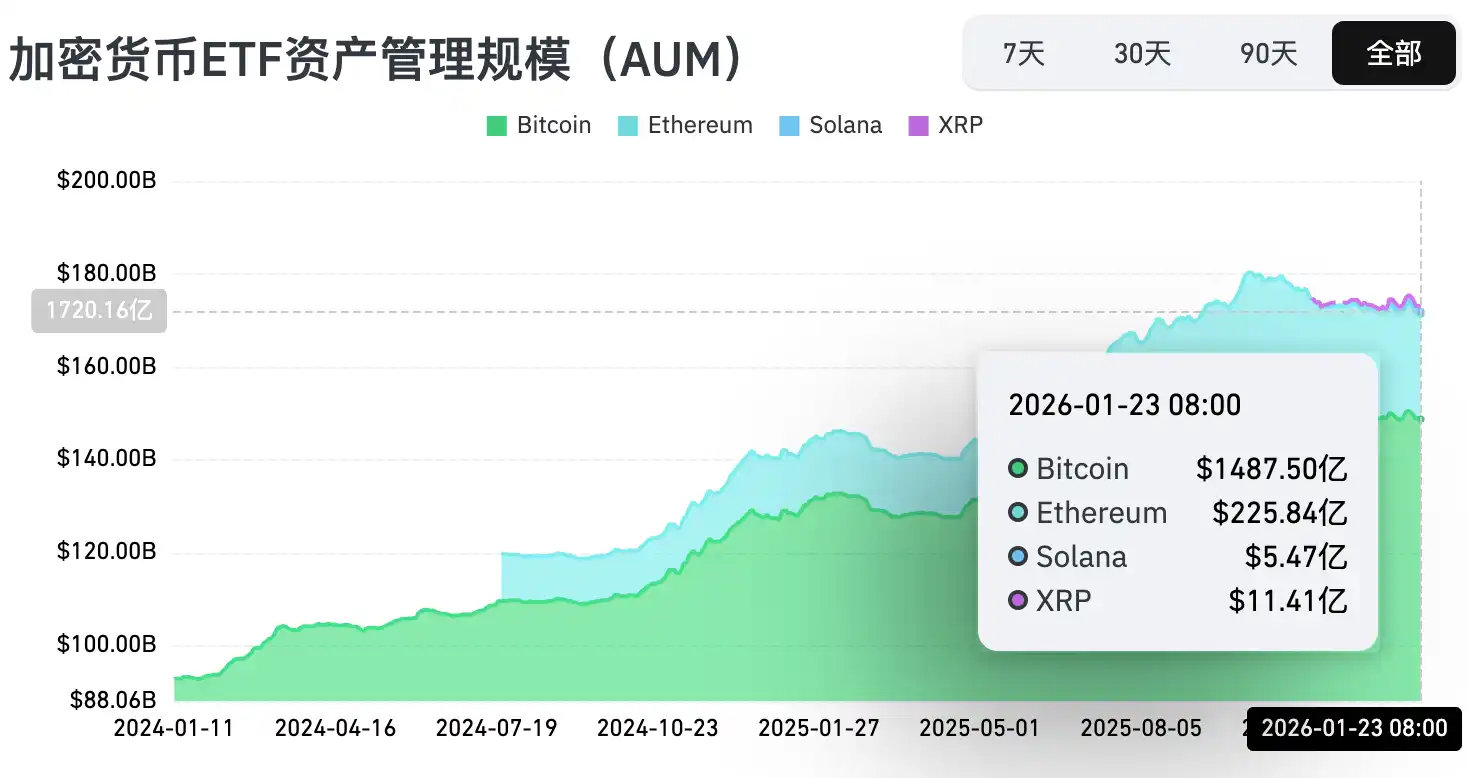
This week, US Bitcoin spot ETFs saw a net outflow of $1.32 billion; US Ethereum spot ETFs saw a net outflow of $600 million.

Market Forecast (January 26 - February 1):

The current RSI index is 44.24 (neutral zone), the Fear & Greed Index is 25 (re-entering fear zone), and the Altcoin Season Index is 39 (neutral, higher than last week).

BTC core range: $88,000-92,000, short-term bias is towards high volatility.

ETH core range: $2,900-3,300, awaiting directional selection.

SOL core range: $124-137, technical signals are mixed, waiting for new catalysts. Solana's "Alpenglow" network upgrade, expected in Q1 2026, could be a significant price catalyst.

The cryptocurrency market is currently highly volatile, with short-term trends very sensitive to news. Pay special attention to Trump's foreign tariff policies and signals from the Federal Reserve's monetary policy, as these will impact the overall risk appetite of the crypto market.

Understanding the Present

Review of the Week's Major Events

  1. On January 19, the cryptocurrency market experienced a "flash crash" on Monday morning, with Bitcoin dropping up to 3.79% in nearly an hour, falling from around $95,500 to $91,900, now recovering to around $92,800;
  2. On January 18, Sonic stated, "As planned, through fully permissionless smart contract execution, successfully burned 16,027,929.41 S tokens, which were unclaimed airdrop allocations from Season 1;";
  3. On January 18, according to Defillama data, Meteora's revenue in the past 24 hours reached $1.33 million, surpassing Pump.fun's $1.16 million revenue in the past 24 hours, second only to Tether ($16.45 million) and Circle ($6.60 million);
  4. On January 19, according to an update on Paradex's official status page, its blockchain status resumed operation at 20:13;
  5. On January 20, Japan's 40-year government bond yield rose 5.5 basis points to 4% on Tuesday, hitting its highest level since its issuance in 2007, and marking the first time in over thirty years that a Japanese government bond yield has reached this level. This signifies the first time since December 1995 (when the 20-year yield touched 4%) that Japanese government bond yields have climbed above the 4% mark;
  6. On January 21, according to Bitget market data, spot gold surged 10% in 20 days, breaking through $4,800/ounce for the first time, with a year-to-date increase of over $480;
  7. On January 21, the crypto wallet Rainbow announced that the RNBW token airdrop snapshot will take place on January 26 at 16:20 EST, with the official airdrop occurring on February 5;
  8. On January 22, Trump stated he would not impose tariffs on Greenland, causing cryptocurrencies to rebound briefly in response;
  9. On January 22, North Korean hackers returned, attacking over 3,100 IP addresses using fake job interviews;
  10. On January 23, according to the Financial Times, Musk's rocket company SpaceX is seeking Wall Street investment banks for a "super" IPO, expected to be one of the largest IPOs in history;
  11. On January 22, cryptocurrency custody service provider BitGo (BTGO.US) officially listed on the NYSE, marking the first crypto IPO of the year.

Macroeconomics

  1. On January 22, US initial jobless claims for the week ending January 17 were 200,000, against an expectation of 210,000, with the previous figure revised from 198,000 to 199,000;
  2. On January 23 at 23:00, the US released the January University of Michigan Consumer Sentiment Index at 56.4, against a forecast of 54, previous 54.
  3. On January 23, according to CME "FedWatch" data, the probability of a 25 basis point Fed rate cut in January is 5.7%, and the probability of maintaining rates is 94.3%.

ETFs

According to statistics, during January 19-24, US Bitcoin spot ETFs saw a net outflow of $1.32 billion; as of January 24, GBTC (Grayscale) has seen a total outflow of $25.539 billion and currently holds $14.414 billion, while IBIT (BlackRock) currently holds $69.721 billion. The total market capitalization of US Bitcoin spot ETFs is $120.315 billion.

US Ethereum spot ETFs saw a net outflow of $600 million.

Foreseeing the Future

Industry Conferences

  1. Consensus Hong Kong 2026 will be held in Hong Kong, China, from February 11 to 12;
  2. ETHDenver 2026 will be held in Denver, USA, from February 17 to 21;
  3. EthCC 9 will be held in Cannes, France, from March 30 to April 2, 2026. The Ethereum Community Conference (EthCC) is one of Europe's largest and longest-running annual Ethereum gatherings, focusing on technology and community development.

Project Developments

  1. Defiance will close its Nasdaq-listed Ethereum ETF: Defiance Leveraged Long and Yield Ethereum ETF (ETHI) on January 26;
  2. The first batch unlock claim deadline for Base network Perp DEX protocol RollX is January 26. The genesis airdrop totals 180 million tokens, eligible addresses include Trade & LP points holders and contributors from activities like Binance Wallet, Bitlayer, Galxe, etc.;
  3. The Aster Phase 4 airdrop claim window opens on January 28, 2026;
  4. The TON ecosystem project Catizen game Pixel Ninja will be taken offline on January 29, 2026;
  5. The cross-chain aggregation DeFi platform Infinex TGE is scheduled for January 30. The public sale had 868 participants, raising 7.214 million USDC, allocating approximately $5 million (5% of INX supply), and refunding about $2.21 million;
  6. Coinbase suspends services in Argentina. Starting January 31, 2026, Coinbase will no longer support buying or selling USDC with Argentine Pesos, but deposit and withdrawal functions will remain unaffected;
  7. The metaverse avatar platform Ready Player Me, acquired by Netflix, will cease services on January 31, 2026, with the entire team joining Netflix.

Important Events

  1. South Korea's FIU will restrict unregistered overseas crypto exchanges and wallets from listing on Google Play starting January 28. Application requirements include an anti-money laundering (AML) system and an Information Security Management System (ISMS) certification from the Korea Internet & Security Agency (KISA). Apps not complying with the policy will be blocked in South Korea from January 28, preventing new installations, and existing users may face usability issues due to inability to update;
  2. On January 28 at 22:45, Canada will announce its bank rate decision for January 28;
  3. On January 29 at 03:00, the US will announce the Federal Reserve interest rate decision (upper limit) for January 28;
  4. On January 29 at 21:30, the US will announce initial jobless claims for the week ending January 24 (in thousands).

Token Unlocks

  1. Jupiter (JUP) will unlock 53.45 million tokens on January 28, worth approximately $10.53 million, 1.7% of circulating supply;
  2. TreeHouse (TREE) will unlock 85.85 million tokens on January 29, worth approximately $8.5 million, 39.41% of circulating supply;
  3. Zora (ZORA) will unlock 168 million tokens on January 30, worth approximately $5.23 million, 4% of circulating supply;
  4. Kamino (KMNO) will unlock 228 million tokens on January 30, worth approximately $11.22 million, 3.68% of circulating supply;
  5. Optimism (OP) will unlock 31.34 million tokens on January 31, worth approximately $9.88 million, 1.62% of circulating supply;
  6. Sui (SUI) will unlock 43.52 million tokens on February 1, worth approximately $65.29 million, 1.15% of circulating supply;
  7. EigenCloud (EIGEN) will unlock 36.82 million tokens on February 1, worth approximately $12.53 million, 8.88% of circulating supply.

About Us

Hotcoin Research, as the core research arm of Hotcoin Exchange, is dedicated to transforming professional analysis into your practical tool. We dissect market trends through "Weekly Insights" and "In-Depth Reports"; with our exclusive column "Hotcoin Selection" (dual screening by AI + experts), we help you identify potential assets and reduce trial costs. Every week, our researchers also engage with you face-to-face through live streams, interpreting hot topics and forecasting trends. We believe that warm companionship and professional guidance can help more investors navigate cycles and seize the value opportunities of Web3.

Связанные с этим вопросы

QWhat is the current total market capitalization and Bitcoin's dominance, according to the article?

AThe current total cryptocurrency market capitalization is $3.1 trillion, with Bitcoin's dominance at 59.2%, equivalent to $1.83 trillion.

QWhat were the 7-day price performances of BTC, ETH, and SOL mentioned in the report?

ABTC had a 7-day decline of 6.87%, ETH fell 11.6%, and SOL decreased by 11.2%.

QWhat significant macroeconomic event is scheduled for January 29th that could impact the market?

AThe US Federal Reserve's interest rate decision (upper limit) is scheduled for 03:00 on January 29th.

QWhich token has the largest value unlock scheduled for the upcoming week, and what is its value?

ASui (SUI) has the largest value unlock scheduled for February 1st, with 43.52 million tokens worth approximately $65.29 million.

QAccording to the article, what two external factors should traders pay special attention to as they highly influence short-term market sentiment?

ATraders should pay special attention to former President Trump's foreign tariff policies and signals regarding the Federal Reserve's monetary policy, as they significantly impact the crypto market's risk appetite.

Похожее

When Doing Cryptocurrency Payment, the First Thing is Licenses, What is the Second?

When launching a crypto payment business, obtaining the necessary licenses is the crucial first step. However, the second, and arguably more critical, step is designing a comprehensive operational framework that forms a coherent business loop. This loop must be clearly understood and executable by all stakeholders: banks, payment partners, exchanges, on-chain analytics providers, regulators, and your internal team. Many projects mistakenly believe a single license permits all operations. Licenses merely grant entry; they don't define how the specific business functions. The real challenge lies in detailing every aspect of the workflow. This involves clarifying the customer base, the flow of fiat and crypto assets, the settlement process, and establishing clear lines of responsibility for risks like AML compliance, sanctions screening, chargebacks, and regulatory inquiries. A robust framework must answer seven core questions: Who are the clients and merchants? Who collects fiat and crypto? Who handles conversion and custody? And who is ultimately accountable for compliance and risk management? Projects often fail not from a lack of licensing, but during due diligence when they cannot convincingly explain these operational details. Therefore, beyond securing licenses, the priority must be constructing a closed-loop system. This system ensures the business model is transparent, risks are managed, responsibilities are delineated, contracts are aligned, and the entire process is comprehensible to partners and regulators. The true competitive edge in crypto payments lies not in acquiring a license quickly, but in integrating licensing, banking, compliance, and operations into a sustainable and executable whole.

marsbit23 мин. назад

When Doing Cryptocurrency Payment, the First Thing is Licenses, What is the Second?

marsbit23 мин. назад

Arthur Hayes Analysis: AI Bubble Nears Burst, Crypto Market Faces Short-Term Pressure

Arthur Hayes argues that the current AI market is a bubble poised to burst, which will exert downward pressure on the crypto market in the near term. The core trigger is rising oil prices due to the US-Iran conflict and a blockade of the Strait of Hormuz. Higher energy costs directly increase the operational expenses of AI data centers, squeezing profit margins for companies like Google, Anthropic, and OpenAI. Hayes predicts that persistent inflation from high oil prices will force Trump, in a bid to win the November election, to turn public sentiment against the AI industry. He may propose regulations and taxes on data centers and AI companies to appeal to voters concerned about costs and job displacement. Such political rhetoric could shatter market confidence. Furthermore, the market is unlikely to healthily absorb the massive concurrent IPOs of SpaceX, Anthropic, and OpenAI, which together seek valuations in the trillions. The combination of soaring energy costs, overwhelming equity supply, and negative political pressure will puncture the AI bubble. Hayes notes that nearly all new USD liquidity since 2022 has flowed into AI, leaving crypto like Bitcoin behind. When the AI bubble bursts, liquidity will contract sharply, pulling down all risk assets, including cryptocurrencies. In response, Hayes's fund, Maelstrom, has sold all AI-related stocks and non-core cryptocurrencies. It maintains core positions in Bitcoin and Ethereum while increasing exposure to energy sector equities, betting on rising oil and gas prices. He expects Bitcoin to bottom after the AI-led market decline, before rallying again with future monetary easing.

Foresight News37 мин. назад

Arthur Hayes Analysis: AI Bubble Nears Burst, Crypto Market Faces Short-Term Pressure

Foresight News37 мин. назад

To C, To B, and the Next Big Thing Called To A

After To C and To B, the Next Wave is To A: Serving AI Agents In a recent quarterly earnings call, Meituan's Wang Xing introduced a new concept: To A (To Agent), signifying that future business services will increasingly target AI Agents as primary clients, not just consumers or merchants. This shift implies that internet giants must now consider how to make their services more appealing for AI Agents to recommend, fundamentally altering traditional distribution logic. This "To A era" is prompting an unusual trend of alliances among major tech companies. Unlike previous competitive battles, firms like Meituan, Tencent, JD.com, Huawei, OPPO, and OpenAI are rapidly forming partnerships. The reason is strategic: as AI Agents become the primary user interface, handling tasks from a single command (e.g., "Book a Japanese restaurant for tomorrow"), the risk for platforms is being bypassed entirely. Companies are positioning themselves within this new value chain. Three primary strategies are emerging: 1. **Super-Entry Points + Service Providers:** Platforms like Tencent's Yuanbao, WeChat, and ChatGPT aim to be the first-stop Agent, integrating various services (food delivery, shopping, travel) from partners like Meituan and JD.com. 2. **Apps as Callable Services:** Companies like Meituan, JD.com, and Uber are ensuring their core services remain accessible and callable by external Agents, shifting from front-end apps to back-end capabilities. 3. **System-Level Agent Entry Points:** Smartphone makers (Huawei, Honor, OPPO) are leveraging their OS-level AI assistants to control the initial user command, redistributing it to relevant service apps. While alliances offer mutual benefit—entry points gain service capabilities, and service providers gain traffic—inherent conflicts of interest exist. A dominant Agent platform could eventually attempt to connect directly with suppliers (restaurants, hotels), bypassing current aggregators like Meituan or Ctrip. Other unresolved challenges include the potential for Agent recommendations to become a new form of paid ranking and unclear accountability for faulty recommendations. The current rush to form alliances is a defensive move by service providers to secure their position before the landscape solidifies. In this To A-driven restructuring, the greatest risk is not losing the race but failing to hear the starting gun.

marsbit46 мин. назад

To C, To B, and the Next Big Thing Called To A

marsbit46 мин. назад

The More Lifelike the Robot, the More Terrifying? Unveiling the 'Uncanny Valley Effect' in the Era of Humanoid Robots

As humanoid robots become increasingly lifelike, they confront a significant psychological barrier known as the "Uncanny Valley Effect," a concept proposed by Japanese roboticist Masahiro Mori in 1970. This phenomenon describes a dip in human comfort and acceptance when robots appear almost, but not perfectly, human. Minor imperfections in facial expressions, eye movements, or skin texture trigger a subconscious sense of unease, as the brain detects something trying, yet failing, to mimic a person. Examples range from the controversial human-like robot Sophia to animated characters in films like *The Polar Express*. The effect poses a key design challenge for robotics companies. Some, like Boston Dynamics, avoid it entirely by creating highly capable but visibly mechanical robots. Others, like Hanson Robotics, push for greater human likeness despite the risk. For consumer robots, especially in homes, most manufacturers opt for stylized or clearly mechanical designs to ensure broader acceptance. While the Uncanny Valley remains a powerful force, its impact may diminish over time through technological advancements that achieve near-perfect realism or through generational familiarity as people grow accustomed to interacting with humanoid machines. Ultimately, navigating this psychological frontier requires as much understanding of human perception as of robotics technology itself.

marsbit46 мин. назад

The More Lifelike the Robot, the More Terrifying? Unveiling the 'Uncanny Valley Effect' in the Era of Humanoid Robots

marsbit46 мин. назад

Торговля

Спот
Фьючерсы
活动图片