Less Than a Year in Office and Leaving Again: Why Are Core Figures of the Ethereum Foundation Departing Once More?

marsbitОпубликовано 2026-02-14Обновлено 2026-02-14

Введение

Tomasz Stańczak, the co-executive director of the Ethereum Foundation (EF), has announced his resignation, just 11 months after taking the role. He was appointed alongside Hsiao-Wei Wang in March 2025, replacing long-time leader Aya Miyaguchi amid community criticism that EF was too slow and disconnected. Stańczak, founder of core Ethereum client Nethermind, was brought in to make EF more decisive and execution-focused. During his tenure, he streamlined operations, refocused strategy on Layer-1 scaling, accelerated upgrade timelines, and pushed new initiatives in AI integration and privacy. His departure hints at internal tension. In his statement, Stańczak suggested his ability to operate independently within EF diminished as the leadership became more self-sufficient. He expressed a desire to return to hands-on product building, specifically in AI/blockchain convergence, echoing Ethereum’s early experimental spirit. He is replaced by Bastian Aue, a low-profile internal figure focused on "principled" decision-making aligned with "cypherpunk values," signaling a potential shift back towards a coordination-focused rather than execution-driven approach. This leadership change comes at a critical time. EF is preparing to release key proposals on "Lean Ethereum" and future roadmaps, while Ethereum faces intense competition, Layer-2 fragmentation, and market pressure—with its price risk falling below inflation-adjusted 2018 levels.

The Ethereum Foundation (EF) once again finds itself at a crossroads of personnel turmoil.

Tomasz Stańczak, the co-executive director of the Ethereum Foundation, has announced that he will step down at the end of this month. This comes just 11 months after he and Hsiao-Wei Wang jointly succeeded the long-standing leader Aya Miyaguchi in March last year to form a new leadership core.

He will be succeeded by Bastian Aue. There is very little public information about this individual; his X account was registered just eight months ago and has almost no record of posts. He will continue to co-lead this organization, which controls the core resources and direction of the Ethereum ecosystem, alongside Hsiao-Wei Wang.

This seemingly sudden personnel change is actually an inevitable result of the interplay of internal conflicts, external pressures, and strategic transformation within the Ethereum Foundation.

Stepping Up in a Crisis: A Turbulent Year

To understand Stańczak's departure, one must first return to the context of his appointment.

In early 2025, the Ethereum community was in a period of anxiety. At that time, the overall cryptocurrency market was rising after the U.S. election, with Bitcoin repeatedly hitting new highs, and competing chains like Solana gaining strong momentum. However, Ethereum's price performance was relatively weak, and the Ethereum Foundation itself became a target of criticism.

The criticism was directed squarely at then-Executive Director Aya Miyaguchi. The developer community complained that the Foundation was severely disconnected from frontline builders, had conflicting strategic interests, and was insufficiently promoting Ethereum. Some questioned whether the Foundation was too "passive," and in its gentle posture of acting as a "coordinator" rather than a "leader," was letting Ethereum lose its first-mover advantage.

As the "central bank" of Ethereum, the Foundation was being asked not to govern by inaction, but to strike out forcefully.

Amid this storm of public opinion, Miyaguchi stepped back into a board role. Stańczak and Wang were thrust into the spotlight to take charge.

Stańczak was not an outsider. He is the founder of Nethermind, a company that is one of the core execution clients of the Ethereum ecosystem, playing a key role in infrastructure construction. He understands technology, has entrepreneurial experience, and has a firsthand understanding of the community's pain points.

In his own words, the directive he received upon taking office was clear: "The community is calling out—you are too chaotic, you need to be a bit more centralized, a bit faster, to deal with this critical period."

What was done this year?

The combination of Stańczak and Wang did bring visible changes.

First, organizational efficiency. The Foundation laid off 19 employees, streamlined its structure, and attempted to shed its bureaucratic label. The strategic focus shifted from Layer 2 back to Layer 1 itself, with a clear statement prioritizing the scaling of the Ethereum mainnet over letting L2s operate independently. The upgrade pace noticeably accelerated, and the promotion of EIPs became more decisive than before.

Second, an adjustment in posture. The Foundation began publishing series of videos on social media, proactively explaining Ethereum's technical roadmap and development direction to the public. This "outreach" communication style contrasted with its previous relatively closed and mysterious image.

In terms of strategic layout, Stańczak promoted exploration in several new directions: privacy protection,应对量子计算威胁 (responding to quantum computing threats), and the integration of artificial intelligence with Ethereum. Particularly regarding AI, he explicitly stated he saw the trend of "agentic systems" and "AI-assisted discovery" reshaping the world.

Financially, the Foundation began discussing more transparent budget management and fund allocation strategies, attempting to address external doubts about the efficiency of treasury use.

Vitalik Buterin's evaluation of Stańczak was: "He helped greatly improve the efficiency of multiple departments within the Foundation, making the organization more agile in responding to the external world."

Reading Between the Lines of the Resignation Statement

Why leave after less than a year?

Stańczak's resignation statement was quite candid and somewhat thought-provoking. He provided several key points of information:

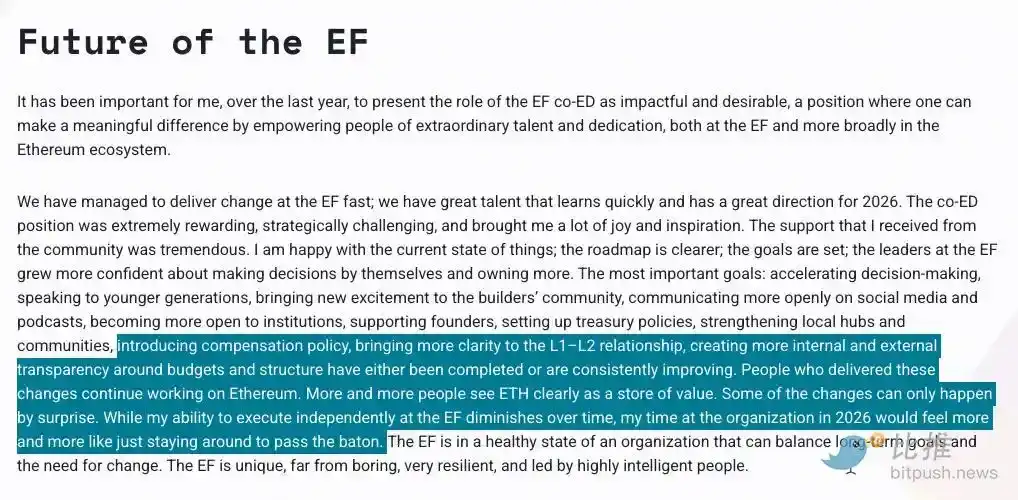
First, he believes the Ethereum Foundation and the entire ecosystem are "in a healthy state." The time for handing over the baton has come.

Second, he wants to return to being a "hands-on product builder," focusing on the combination of AI and Ethereum. He said his current mindset is similar to when he founded Nethermind in 2017.

Third, and most intriguingly: "The leadership layer of the Foundation is increasingly confident in making their own decisions and taking control of more matters. Over time, my ability to execute independently within the Foundation has diminished. If I stayed on, in 2026 I would mostly just be 'waiting to hand over the baton.'"

This sentence reveals two layers of meaning: first, the new leadership team has developed self-drive and no longer needs his involvement in everything; second, his actual sphere of influence may have been shrinking. For someone accustomed to getting hands-on and with a strong entrepreneurial temperament, this feeling was clearly not a good fit for him.

He also mentioned, "I know many current ideas about agentic AI might be immature, even useless, but it is this kind of playful experimentation that defined the innovative spirit of early Ethereum."

This statement carries a hint of implicit criticism of the status quo: as the organization becomes more "mature" and decisions become more "stable," will that wild, experimental spirit be lost?

Stańczak's departure,表面上 (on the surface) a personal choice,背后 (behind it) lies the long-standing dilemma faced by the Ethereum Foundation.

Since its inception, this organization has been in an awkward position. Theoretically, Ethereum is decentralized, and the Foundation should not be a command-and-control power center. But in practice, it controls significant funds, core developer resources, and has a coordinating voice in the ecosystem, objectively承担着 (bearing) the dual roles of "central bank" and "economic planning agency."

This identity paradox has long placed the Foundation in a double bind: doing too much draws accusations of centralization; doing too little invites criticism for inaction. The Miyaguchi era leaned towards a "coordinator"定位 (positioning), resulting in criticism of weakness; Stańczak attempted to shift towards an "executor" role, efficiency did improve, but the internal distribution of power within the organization naturally became more concentrated.

Stańczak's resignation statement恰恰暴露了 (precisely exposes) this tension: as the organization became more efficient and decisions more decisive, the personal maneuvering room for founding team members was反而压缩 (instead compressed). For an ecosystem that needs to balance "decentralized spirit" and "market competition efficiency," this internal friction is almost unavoidable.

What kind of person is Bastian Aue, who is replacing Stańczak?

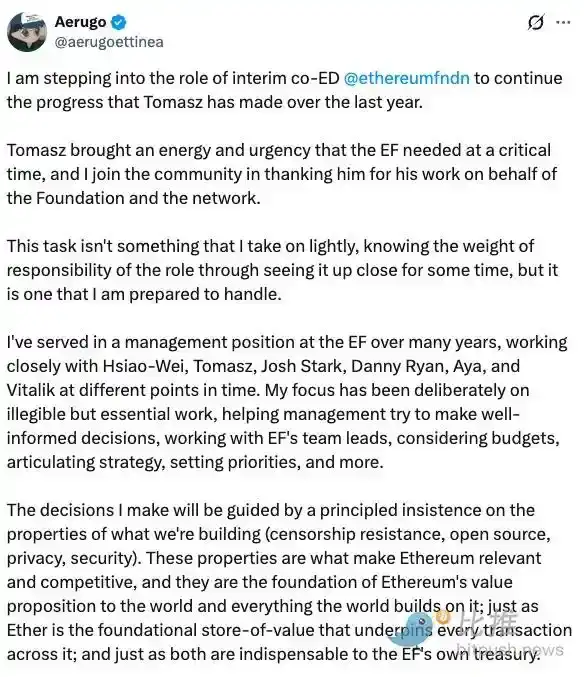
There is extremely little public information. His own description on X is that he was previously responsible for "work that is difficult to quantify but crucial" at the Foundation: assisting management decision-making, communicating with team leaders, budget considerations, strategic梳理 (sorting), priority setting. This low-key style contrasts with Stańczak's distinct entrepreneurial气质 (temperament).

Aue said in his acceptance statement: "My basis for making decisions is a principled insistence on certain properties of what we are building. The mission of the Foundation is to ensure that truly permissionless infrastructure—the core is the cypherpunk spirit—can be built."

This language sounds more like the style of the Miyaguchi era: emphasizing principles, emphasizing spirit, emphasizing coordination rather than leadership.

Does this mean the Foundation will rebalance its direction, dialing back from "aggressive execution" to "principled coordination"? This remains to be seen.

Ethereum's Confusion

Stańczak's departure comes at a time when Ethereum is discussing a series of major proposals. According to him, the Foundation is about to release several key documents, including specific plans for "Lean Ethereum," the future development roadmap, and DeFi coordination mechanisms.

Among them, the "Lean Ethereum" proposal has been jokingly called "Ethereum's weight loss era" by some community members—intending to simplify the protocol, reduce burdens, and make the mainnet run more efficiently.

These directional documents will profoundly影响 (affect) Ethereum's evolution path in the coming years. Changing the core executive负责人 (person in charge) at this moment undoubtedly adds uncertainty to the implementation of these proposals.

The broader context is that Ethereum is facing challenges from multiple fronts: competition from high-performance chains like Solana, the fragmentation issue with Layer 2s, the new narrative window of AI and blockchain integration, and the impact of overall crypto market sentiment fluctuations on ecosystem funding and attention.

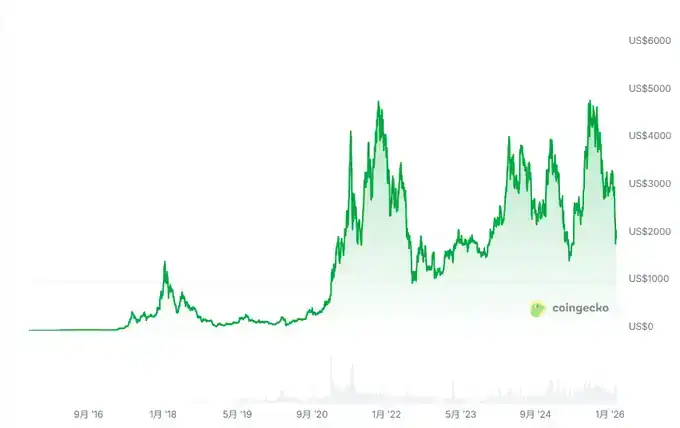
On the same day Stańczak announced his departure, ETH一度跌入 (once fell into) the $1800 range. If it continues to break below this level, an awkward fact will emerge: the comprehensive return on holding ETH may fall below the dollar cash interest rate.

Do the math for a more painful realization: In January 2018, ETH first stood above $1400. That $1400, adjusted for U.S. CPI inflation with compound interest, would be equivalent to approximately $1806 by February 2026.

In other words, if an investor bought ETH in 2018 and held it裸持 (naked, meaning without staking) until now, after eight years, they not only made no money but even underperformed U.S. dollars left in a bank earning interest.

For the "Ethereum Guards" (E 卫兵, loyal supporters) who have believed all along, the real拷问 (questioning) might not be "who won the路线之争 (route dispute)," but rather: how much longer can this last?

The only certainty is: this core organization, which controls one of the most important ecosystems in the crypto world, is still searching for its定位 (positioning) in a rapidly changing industry, and this path is注定 (destined) not to be平静 (calm).

Связанные с этим вопросы

QWho is leaving the Ethereum Foundation (EF) and after how long in the role?

ATomasz Stańczak, the EF's co-executive director, is leaving after just 11 months in the position.

QWhat were some of the key changes implemented during Tomasz Stańczak's tenure?

AKey changes included organizational streamlining with 19 employees laid off, a strategic refocus on Layer 1 scaling over Layer 2, faster upgrade cycles, more proactive public communication, and exploration of new areas like AI integration and quantum resistance.

QWhat reason did Tomasz Stańczak give for his departure from the Ethereum Foundation?

AHe stated he wanted to return to being a hands-on product builder, focusing on AI and Ethereum. He also implied his ability to execute independently within the foundation was diminishing as the leadership team became more self-sufficient.

QWho is replacing Tomasz Stańczak and what is known about his approach?

ABastian Aue is replacing him. Public information is scarce, but his statements suggest a leadership style that emphasizes principle-based decisions and a focus on 'cryptopunk spirit' and coordination, which contrasts with Stańczak's more execution-focused, entrepreneurial approach.

QWhat broader challenge for Ethereum is highlighted by the ETH price comparison from 2018?

AThe article highlights a significant performance challenge: an ETH bought in January 2018 and held without staking would be worth less in real terms (adjusted for inflation) than if the same amount of USD had been kept in a bank account earning interest, raising questions about long-term value retention for passive holders.

Похожее

Has the 'Digital Gold' Narrative for BTC Failed?

**Title: Has the "Digital Gold" Narrative for Bitcoin Failed?** The article argues that Bitcoin's "digital gold" narrative remains valid despite a recent sharp price decline (from a peak near $126k in Oct 2025 to briefly under $61k in Feb 2026). It presents a long-term investment framework based on three core points: **1. Viewing Bitcoin as an Asset:** Bitcoin is presented as a superior potential store of value compared to gold. Key arguments are its absolute scarcity (21 million cap), superior portability, and transparent auditability via its public ledger. While acknowledging its current use in early, volatile stages (~3-4% global adoption), the author draws parallels to the early, disruptive phases of the internet and e-commerce. **2. Understanding the Recent Downturn:** The current ~50% correction is framed as a predictable, consensus-driven cycle following its post-halving peak (the 2024 halving preceded the Oct 2025 high). A crucial factor is a historic "changing of hands": the influx of new institutional buyers via ETFs allowed early, low-cost holders (miners, OG believers) to take profits. The author notes that while severe, Bitcoin's historical drawdowns (e.g., 93% in 2011, 77% in 2021-22) have been progressively smaller, suggesting maturing holder structure and decreasing volatility over time. **3. The Long-Term Perspective:** The long-term thesis hinges on Bitcoin capturing a portion of gold's market value. With Bitcoin's market cap at ~$1.4 trillion (at $70k) versus gold's ~$20 trillion, significant upside potential exists if the "digital gold" narrative is partially realized. However, the author strongly cautions that short-term risks remain, the bottom is unpredictable, and high volatility is inherent. The real risk is not Bitcoin failing but poor personal position management (over-leverage, wrong capital) and a lack of deep understanding, which can force investors out during severe downturns. The conclusion uses Amazon's 95% crash post-2000 dot-com bubble and subsequent 42x recovery as an analogy. The ultimate question is not if Bitcoin's price will rise, but if an investor's strategy and conviction can withstand the volatility to see the long-term play out. The recent divergence (gold up, Bitcoin down) is posed not as a narrative failure, but as potential evidence of this ongoing, painful transition from a speculative asset to a mainstream allocation.

marsbit35 мин. назад

Has the 'Digital Gold' Narrative for BTC Failed?

marsbit35 мин. назад

Has BTC's 'Digital Gold' Narrative Failed?

The article discusses Bitcoin's "digital gold" narrative, its recent price drop, and long-term outlook through the perspective of "Jason". It argues the narrative is not a failure but that Bitcoin represents a superior, new asset class due to its fixed supply (21 million), portability, and auditability. The piece compares its current ~3-4% global adoption rate to early internet/e-commerce, suggesting significant growth potential. Regarding the 2025-2026 price decline (from ~$126k to briefly under $61k), the author views it as a predictable, consensus-driven sell-off within Bitcoin's ~4-year cycle post-halving, exacerbated by a major "handover" from early, low-cost holders to new institutional buyers via ETFs. A key observation is that historical peak-to-trough drawdowns have lessened over time (e.g., 93% in 2011 to ~50% in 2026), indicating maturing volatility as holder structure changes. For the long term, the author uses a simple framework: Bitcoin's total market cap (~$1.4T at $70k) is only about 7% of gold's (~$20T). Even capturing 30-50% of gold's value would imply substantial upside. However, the article strongly cautions against viewing this as investment advice, emphasizing extreme volatility and the critical importance of risk management, position sizing, and deep fundamental understanding to survive severe drawdowns. It concludes by drawing a parallel to Amazon's 95% crash in 2000 and subsequent 42x recovery, stressing that the key is surviving market cycles to realize long-term potential.

链捕手45 мин. назад

Has BTC's 'Digital Gold' Narrative Failed?

链捕手45 мин. назад

From Code to Cognition: A Ten-Thousand-Word Guide to the Evolution of the Robot Brain

"From Code to Cognition: The Evolution of Robot Brains" The journey of robotic intelligence has shifted dramatically from manually coded systems to AI-driven brains. For decades, robots relied on layered software stacks—perception, state estimation, planning, control—each handcrafted. While predictable, they lacked adaptability. The 2010s saw deep learning revolutionize perception (e.g., object detection) and control (via reinforcement learning), but learned skills remained narrow. The arrival of Large Language Models (LLMs) marked a turning point. LLMs acted as high-level planners, interpreting natural language instructions and generating sequences of actions for traditional robotic systems to execute. However, true integration came with Visual-Language-Action (VLA) models, which fused vision, language, and motion prediction into a single network. Pioneered by models like RT-2 and open-source projects like OpenVLA, VLAs enable robots to reason and act directly from visual input and commands. The most advanced humanoid robots now employ a "dual-brain" architecture: a slow-thinking, large VLA (System 2) for reasoning and planning, and a fast-reacting, small network (System 1) for high-frequency motion control, sometimes with an even lower-level System 0 for balance. This split balances cognition with the physics of real-time movement. Computation is split between onboard hardware (e.g., NVIDIA Jetson) for safety-critical control loops and cloud/edge servers for non-critical tasks like learning and interfaces. A crucial driver is the open-source ecosystem—models like GR00T and OpenVLA allow startups to build upon pre-trained brains and fine-tune them with their own data, accelerating development. Despite progress, current systems struggle with recovery from errors, sample inefficiency, and long-horizon tasks. This has spurred the rise of **World Models**—neural networks that predict the consequences of actions. By simulating possible futures before acting (like NVIDIA Cosmos or Meta V-JEPA), robots can plan, recover, and generalize better. This represents the next frontier: shifting intelligence from learned reactions to an internal model of physics and cause-and-effect. The field is rapidly evolving. While not yet at its "ChatGPT moment," the convergence of cheaper hardware, scalable simulation, and world models points toward robots that are increasingly capable, adaptive, and useful. The question is shifting from "what can robots do?" to "what *should* they do?"

marsbit1 ч. назад

From Code to Cognition: A Ten-Thousand-Word Guide to the Evolution of the Robot Brain

marsbit1 ч. назад

AI Bubble Is Bursting

The AI Bubble is Bursting: A Necessary Purge on the Path to Ubiquitous Intelligence Market volatility has reignited debates about an AI bubble, with figures like Ray Dalio pointing to high valuations. However, this parallels the dot-com bubble, which, despite its crash, laid the physical infrastructure for today's internet era. The current AI investment frenzy, with tech giants planning trillions in infrastructure spending far outstripping current AI application revenues, appears similarly imbalanced. This 'bubble' is seen as an inevitable phase for a disruptive technology, paying the "innovation tax." Critically, AI inference costs have plummeted over 99.7% since 2023, making intelligence nearly free at the margin. This hasn't reduced spending but has instead unlocked massive new demand, as seen in enterprise AI cloud expenditure tripling. This follows the Jevons Paradox: efficiency gains lead to greater total consumption. The market is now entering a cleansing phase, weeding out speculative ventures lacking real moats. The deeper shift is a move from capital expenditure (CapEx) on hardware to value creation in operational expenditure (OpEx) through AI applications that solve real industry problems. While infrastructure valuations are high, rapid earnings growth from widespread AI adoption across sectors—from manufacturing and finance to law and healthcare—may digest these valuations over time. Ultimately, this creative destruction will leave behind robust infrastructure and optimized models, cheaply powering an AI-augmented future for all industries, much as the internet became indispensable after its own bubble burst. The core productive potential remains undiminished.

链捕手1 ч. назад

AI Bubble Is Bursting

链捕手1 ч. назад

Торговля

Спот
Фьючерсы

Популярные статьи

Manyu: восходящая мем-звезда на Ethereum, готовая открыть новую эру культуры Shiba

Manyu - это мемтокен на Ethereum, который приносит децентрализованную культурную и развлекательную ценность через вирусное влияние в соцсетях и вовлечённость сообщества.

1.9k просмотров всегоОпубликовано 2025.11.27Обновлено 2025.11.27

Manyu: восходящая мем-звезда на Ethereum, готовая открыть новую эру культуры Shiba

Неделя обучения по популярным токенам 14: Glamsterdam — самое ожидаемое обновление Ethereum в 2026 году

Ordinals/Runes по-прежнему стимулируют доходы от комиссий за блоки и активность разработчиков, рассматриваются как отправная точка «нативной эмиссии активов» в сети.

1.5k просмотров всегоОпубликовано 2026.04.29Обновлено 2026.04.29

Неделя обучения по популярным токенам 14: Glamsterdam — самое ожидаемое обновление Ethereum в 2026 году

Обсуждения

Добро пожаловать в Сообщество HTX. Здесь вы сможете быть в курсе последних новостей о развитии платформы и получить доступ к профессиональной аналитической информации о рынке. Мнения пользователей о цене на ETH (ETH) представлены ниже.

活动图片