Kazakhstan’s Crypto Bet: Central Bank To Begin $350M Digital Assets Investment In Q2

bitcoinistОпубликовано 2026-03-07Обновлено 2026-03-07

Введение

Kazakhstan's central bank (NBK) will invest up to $350 million from its reserves into crypto-related assets starting in Q2 2024. The investment will target shares of high-tech companies, index funds, and instruments linked to digital assets, rather than direct cryptocurrency purchases. Governor Timur Suleimanov emphasized a cautious strategy, focusing on regulated entities like licensed crypto exchanges and infrastructure firms. This initiative is part of a broader plan to create a regulated digital asset market, including potential crypto banks and a national exchange, by enforcing compliance with AML, CTF, and tax regulations.

Kazakhstan’s central bank will soon begin investing up to $350 million from its gold and foreign exchange reserves into cryptocurrency assets and related companies, as part of its broader digital assets strategy.

Central Bank Prepares For $350M Investment Into Crypto-Related Assets

On Friday, Reuters reported that the National Bank of Kazakhstan (NBK) has formed a portfolio of up to $350 million ​from its gold and foreign exchange reserves ‌for investment in digital assets.

As of February 1, Kazakhstan’s central bank held $69.40 billion in gold and foreign exchange reserves, while the assets of the national fund amounted to $65.23 billion, the news media outlet noted.

At a briefing on interest ​rates, the central bank governor, Timur Suleimanov, affirmed that the financial authority is developing a list of instruments to invest in, which will include crypto-related companies.

“These include shares of high-tech ​companies related to cryptocurrencies and digital financial assets, index funds and other instruments that exhibit similar ​dynamics to crypto assets,” Suleimanov explained.

Meanwhile, Central ​Bank Deputy Chair Aliya Moldabekova shared that the investments will begin between April and May. She added that there are no plans to make any large investments directly in digital assets, but in companies that deal with them.

“We are not talking about any large investment in cryptocurrencies. We are currently selecting companies that deal with digital ​assets. For ​example, those ⁠involved in cryptocurrency infrastructure. We are currently in the process ​of selecting such companies,” Moldabekova ​said.

The central bank’s initiative follows Kazakhstan’s plan to establish a national digital asset reserve fund valued between $500 million and $1 billion, primarily comprised of assets seized and repatriated from abroad.

Suleimenov announced the plans last year, emphasizing that the fund would prioritize investments in exchange-traded funds (ETFs) and shares of companies operating within the sector. He stressed that the investment strategy would be cautious, avoiding direct exposure to digital assets.

Kazakhstan Eyes Regulated Landscape

Kazakhstan’s introduction of regulations for digital financial assets could pave the way for a new financial market sector, including tokenized assets and digital assets-fiat payment channels, the central bank governor has stated.

According to local reports, Suleimenov proposed on Friday a licensing system for crypto exchanges rather than strict bans, requiring compliance with anti-money laundering (AML), counter-terrorist financing (CTF), tax, and payment regulations to boost the fintech sector and the country’s economy.

We all know that Bitcoin and other cryptocurrencies are quite actively used in our country, but outside the legal framework. But why fight this with the help of the Criminal Code? It is better to force crypto exchanges to obtain licenses, regulate them, require compliance with AML/CTF regulations, banking legislation, payment legislation, and tax legislation — and let them engage in this activity and do so within the legal framework.

Suleimenov informed that two banks have already begun issuing crypto-fiat cards that enable purchases using stablecoin accounts. During the payment process, the funds are automatically converted into the country’s national currency, the tenge. Additionally, the head of the National Bank mentioned that two more banks are in the process of launching similar products.

“That is, there are quite a few such projects. And I hope that we will gradually begin to transfer them from the ‘sandbox’ mode to the generally established mode as regulations appear. And we will see this as consumers every day,” he added.

The government has reportedly also been exploring the establishment of licensed crypto banks and a national exchange to foster a regulated environment for digital asset trading in Kazakhstan.

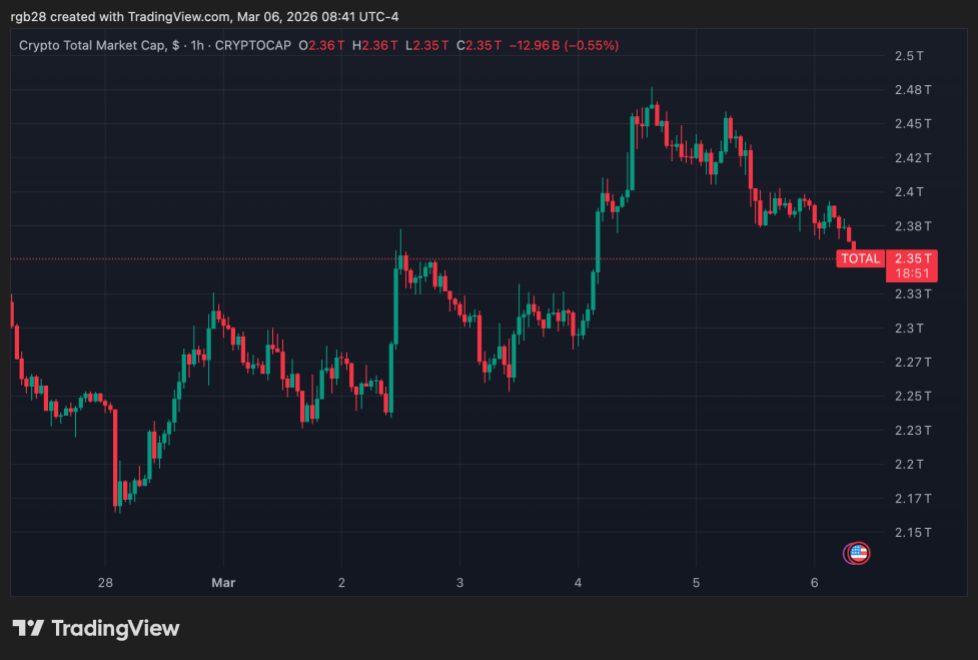
The total crypto market capitalization is at $2.35 trillion in the one-week chart. Source: TOTAL on TradingView

Связанные с этим вопросы

QWhat is the total amount that Kazakhstan's central bank plans to invest in crypto-related assets from its reserves?

AKazakhstan's central bank plans to invest up to $350 million from its gold and foreign exchange reserves into crypto-related assets.

QWhen does the National Bank of Kazakhstan (NBK) plan to begin its investment in digital assets?

AThe investments are scheduled to begin between April and May (Q2).

QAccording to the central bank officials, will the investment be made directly into cryptocurrencies?

ANo, there are no plans for large direct investments in cryptocurrencies. The bank will invest in companies that deal with digital assets, such as those involved in cryptocurrency infrastructure, index funds, and shares of high-tech companies.

QWhat regulatory approach did the central bank governor propose for crypto exchanges in Kazakhstan?

AThe governor proposed a licensing system for crypto exchanges that requires compliance with anti-money laundering (AML), counter-terrorist financing (CTF), tax, and payment regulations, rather than imposing strict bans.

QWhat recent development in the banking sector was mentioned regarding crypto-fiat transactions?

ATwo banks have already begun issuing crypto-fiat cards that allow purchases using stablecoin accounts, with funds automatically converted into the national currency, the tenge. Two more banks are in the process of launching similar products.

Похожее

Anthropic and OpenAI Have Single-Handedly Severed the Logic of Pre-IPO Stock Tokenization

The pre-IPO stock token market is experiencing significant turmoil following strong statements from AI giants Anthropic and OpenAI. Both companies have updated their official policies, declaring that any transfer of their company shares—including sales, transfers, or assignments of share interests—without prior board approval is "invalid" and will not be recognized in their corporate records. This means buyers in such unauthorized transactions would not be recognized as shareholders and would have no shareholder rights. A major point of contention is the use of Special Purpose Vehicles (SPVs), which are legal entities commonly used by pre-IPO token platforms to pool investor funds and indirectly acquire shares from employees or early investors. The companies explicitly state they do not permit SPVs to acquire their shares, and any such transfer violates their restrictions. They warn that third parties selling shares through SPVs, direct sales, forward contracts, or stock tokens are likely engaged in fraud or are offering worthless investments due to these transfer limits. This stance directly threatens the core model of many pre-IPO token platforms, which rely on SPV structures. The announcement revealed additional risks within this model, such as complex "SPV-within-SPV" layering that obscures legal transparency, increases management fees, and creates a chain reaction risk of invalidation. Following the news, tokens like ANTHROPIC and OPENAI on platforms like PreStocks fell sharply (over 20%). The market reaction highlights a divergence: while asset-backed pre-IPO tokens plummeted, purely speculative pre-IPO futures contracts, which are bilateral bets on future IPO prices with no claim to actual shares, remained relatively stable as they are unaffected by the transfer restrictions. The industry is split on the implications. Some believe the fundamental logic of pre-IPO token trading is broken if leading companies reject SPV-held shares, potentially causing a domino effect. Others, like Rivet founder Nick Abouzeid, argue that buyers of such unofficial tokens always knowingly accepted the risk of non-recognition by the company. The statements serve as a stark risk warning and a corrective measure for a market where valuations for some AI-related pre-IPO tokens had soared to irrational levels, far exceeding recent funding round valuations.

marsbit39 мин. назад

Anthropic and OpenAI Have Single-Handedly Severed the Logic of Pre-IPO Stock Tokenization

marsbit39 мин. назад

Anthropic and OpenAI Personally Sever the Logic of Pre-IPO Crypto-Stocks

The pre-IPO token market has been rocked by strong statements from Anthropic and OpenAI. Both AI giants have updated official warnings, declaring that any sale or transfer of their company shares without explicit board approval is "invalid" and will not be recognized on their corporate records. This directly targets Special Purpose Vehicles (SPVs), the common legal structure used by pre-IPO token platforms. These platforms typically use an SPV to acquire shares from employees or early investors, then issue blockchain-based tokens representing a claim on the SPV's economic benefits. Anthropic and OpenAI's position means that if an SPV's share purchase lacked authorization, the underlying asset could be deemed worthless, nullifying the token's value. Anthropic explicitly warned that any third party selling its shares—via direct sales, forwards, or tokens—is likely fraudulent or offering a valueless investment. The crackdown highlights risks in the popular SPV model, including complex multi-layered "Russian doll" SPV structures that obscure legal ownership, add fees, and concentrate risk. If one layer is invalidated, the entire chain could collapse. Following the announcements, tokens like ANTHROPIC and OPENAI on platforms like PreStocks fell sharply (over 20%). In contrast, purely speculative pre-IPO prediction contracts remained stable, as they involve no actual share ownership. The move is seen as a corrective measure amid a market frenzy where some pre-IPO token valuations (e.g., Anthropic's token hitting a $1.4 trillion implied valuation) far exceeded recent official funding rounds. Opinions are split: some believe this undermines the core logic of pre-IPO token trading if top companies reject SPVs, while others argue buyers always assumed this legal risk when accessing unofficial channels. The statements serve as a stark warning and a potential catalyst for market de-leveraging and clearer boundaries.

Odaily星球日报43 мин. назад

Anthropic and OpenAI Personally Sever the Logic of Pre-IPO Crypto-Stocks

Odaily星球日报43 мин. назад

The Waged Worker Driven to Poverty by AI Subscriptions

"AI Membership: The Hidden Cost Pushing Workers Toward 'Poverty'" The widespread corporate push for AI adoption is creating a hidden financial burden for employees. Companies, from giants like Alibaba to small firms, are mandating AI use, often tying token consumption to KPIs, but frequently refuse to cover the costs. Workers are forced to pay for subscriptions out of pocket to stay competitive and avoid being replaced. Front-end developer Long Shen spends up to 2000 RMB monthly on tools like Cursor and ChatGPT Plus, seeing it as a necessary 3% salary investment to handle 90% of his coding tasks. While it boosted his performance and led to promotions, he now faces idle time at work, pretending to be busy. Designer Peng Peng navigates strict company firewalls by using personal devices and accounts for AI image generation tools like Midjourney, spending hundreds monthly without reimbursement, while her boss demands faster, more numerous revisions. The pressure creates workplace anxiety and suspicion. Programmer Li Huahua, after a friend's experience of raised KPIs following AI success, fears being branded a "traitor" for using it yet worries about falling behind if she doesn't. The dynamic allows management to demand results without understanding the tools or covering expenses, treating employees like AI "agents." While some, like entrepreneur Jin Tu, find high value in paid AI, building entire systems and winning competitions, for most, it's a trap. Free tools like Kimi and Doubao are introducing fees, closing off alternatives. The initial efficiency gains individual advantage, but as AI becomes ubiquitous, the personal edge disappears, workloads increase, and a cycle of dependency begins. Workers like Long Shen realize they cannot maintain AI-generated code without AI, making stopping harder than continuing to pay. The tool promising liberation is instead becoming a compulsory, costly chain in the modern workplace.

marsbit1 ч. назад

The Waged Worker Driven to Poverty by AI Subscriptions

marsbit1 ч. назад

SK Hynix's Trillion-Won Empire: The Successors

"SK Hynix's Trillion-Won Empire and Its Heirs" explores the unconventional succession narrative within SK Group, South Korea's second-largest conglomerate, following SK Hynix's dramatic market rise. Unlike traditional chaebol scripts prioritizing the eldest son, ownership, and political marriages, Chairman Choi Tae-won's three children from his first marriage are charting distinct paths. The eldest daughter, Choi Yun-jeong, is considered the most visible candidate. With a background in biology, consulting, and a PhD, she holds executive roles at SK Bioscience and SK Inc.'s growth strategy unit, focusing on biopharma and new businesses. Her marriage is to an AI infrastructure entrepreneur, not a traditional chaebol heir. The second daughter, Choi Min-jeong, took a unique route by voluntarily serving as a South Korean naval officer, including a tour in the Gulf of Aden. She later worked on policy and strategy for SK Hynix in Washington D.C. before co-founding an AI-driven healthcare startup in San Francisco. She married a former U.S. Marine Corps officer, connecting the family to U.S. defense and policy networks. The son, Choi In-geun, who has Type 1 diabetes, followed a more classic preparatory path with a physics degree and a stint at SK E&S but left to join McKinsey's Seoul office. He remains publicly silent and holds no SK shares, defying the traditional "crown prince" archetype. Their paths unfold against the backdrop of their parents' high-profile, contentious divorce and a record-setting asset division lawsuit. The article argues that as SK Hynix becomes a geopolitical asset in the AI era, the conventional rules of chaebol inheritance are changing. The heirs are being groomed not simply to take over, but to navigate a complex global landscape defined by AI, biotech, geopolitics, and policy, forging legitimacy through their own expertise and networks rather than birth order alone.

marsbit1 ч. назад

SK Hynix's Trillion-Won Empire: The Successors

marsbit1 ч. назад

Торговля

Спот
Фьючерсы

Популярные статьи

Как купить S

Добро пожаловать на HTX.com! Мы сделали приобретение Sonic (S) простым и удобным. Следуйте нашему пошаговому руководству и отправляйтесь в свое крипто-путешествие.Шаг 1: Создайте аккаунт на HTXИспользуйте свой адрес электронной почты или номер телефона, чтобы зарегистрироваться и бесплатно создать аккаунт на HTX. Пройдите удобную регистрацию и откройте для себя весь функционал.Создать аккаунтШаг 2: Перейдите в Купить криптовалюту и выберите свой способ оплатыКредитная/Дебетовая Карта: Используйте свою карту Visa или Mastercard для мгновенной покупки Sonic (S).Баланс: Используйте средства с баланса вашего аккаунта HTX для простой торговли.Третьи Лица: Мы добавили популярные способы оплаты, такие как Google Pay и Apple Pay, для повышения удобства.P2P: Торгуйте напрямую с другими пользователями на HTX.Внебиржевая Торговля (OTC): Мы предлагаем индивидуальные услуги и конкурентоспособные обменные курсы для трейдеров.Шаг 3: Хранение Sonic (S)После приобретения вами Sonic (S) храните их в своем аккаунте на HTX. В качестве альтернативы вы можете отправить их куда-либо с помощью перевода в блокчейне или использовать для торговли с другими криптовалютами.Шаг 4: Торговля Sonic (S)С легкостью торгуйте Sonic (S) на спотовом рынке HTX. Просто зайдите в свой аккаунт, выберите торговую пару, совершайте сделки и следите за ними в режиме реального времени. Мы предлагаем удобный интерфейс как для начинающих, так и для опытных трейдеров.

1.3k просмотров всегоОпубликовано 2025.01.15Обновлено 2025.03.21

Как купить S

Sonic: Обновления под руководством Андре Кронье – новая звезда Layer-1 на фоне спада рынка

Он решает проблемы масштабируемости, совместимости между блокчейнами и стимулов для разработчиков с помощью технологических инноваций.

2.2k просмотров всегоОпубликовано 2025.04.09Обновлено 2025.04.09

Sonic: Обновления под руководством Андре Кронье – новая звезда Layer-1 на фоне спада рынка

HTX Learn: Пройдите обучение по "Sonic" и разделите 1000 USDT

HTX Learn — ваш проводник в мир перспективных проектов, и мы запускаем специальное мероприятие "Учитесь и Зарабатывайте", посвящённое этим проектам. Наше новое направление .

1.8k просмотров всегоОпубликовано 2025.04.10Обновлено 2025.04.10

HTX Learn: Пройдите обучение по "Sonic" и разделите 1000 USDT

Обсуждения

Добро пожаловать в Сообщество HTX. Здесь вы сможете быть в курсе последних новостей о развитии платформы и получить доступ к профессиональной аналитической информации о рынке. Мнения пользователей о цене на S (S) представлены ниже.

活动图片