‘Just the beginning’: Paul Atkins signals SEC’s new crypto rule changes

ambcryptoОпубликовано 2026-03-20Обновлено 2026-03-20

Введение

SEC Chair Paul Atkins announced the agency will soon issue formal proposed rules to codify its recent interpretive guidance, which classifies most crypto assets as non-securities and categorizes them into five groups: digital commodities, collectibles, tools, stablecoins, and securities. The SEC also plans to create a regulatory sandbox for experimentation. Atkins noted that while this is a significant step, courts could still deviate from the SEC’s interpretation. He described the move as a "bridge" as Congress progresses on the CLARITY Act. Senator Cynthia Lummis reported that stablecoin yield issues are "99% resolved" in the bill negotiations. Market optimism for the bill has improved slightly despite earlier setbacks.

Paul Atkins, the chairman of the U.S. Securities and Exchange Commission (SEC), has said the agency will soon issue formally proposed rules for the recent crypto asset classification guidance.

In the latest interpretive guidance, the SEC designated most crypto assets as non-securities. Additionally, the framework classified digital assets into five categories, including digital commodities, collectibles, tools, stablecoins, and securities. It also explained how they fit into the current U.S. law.

To codify the framework, Atkins said the agency will formalize it alongside creating a sandbox for experimenting with different crypto products. But he warned the court could still ‘deviate’ from its interpretation.

This is just an interpretation, and the courts can deviate from that if they don’t like our rationale.

He added,

We’ll shortly follow up with a proposed rule to put much more of this framework into effect. And construct a series of exemptions, equivalent of sandbox for people to experiment and develop proof-of-concept for their products.

SEC’s plans and CLARITY Act progress

For Atkins, SEC’s interpretation of crypto laws is ‘just a beginning,’ and the move would be a ‘bridge’ as the Congress works its way through the CLARITY Act. In fact, most of the guidance issued in the past few days and months covers key topics being discussed in the CLARITY Act. For others, the SEC’s proposed rulemaking on key issues would be sufficient for the market, even if the CLARITY Act’s momentum stalls.

That said, the stablecoin yield issue has been the key deal breaker dragging the crypto bill.

Even so, after the recent Senate Republican meeting on the bill, Senator Cynthia Lummis was ‘positive,’ terming it ‘productive,’ and added,

We’re 99% of the way there on stablecoin yield, and negotiations on the digital asset portions of the bill are in a good place.

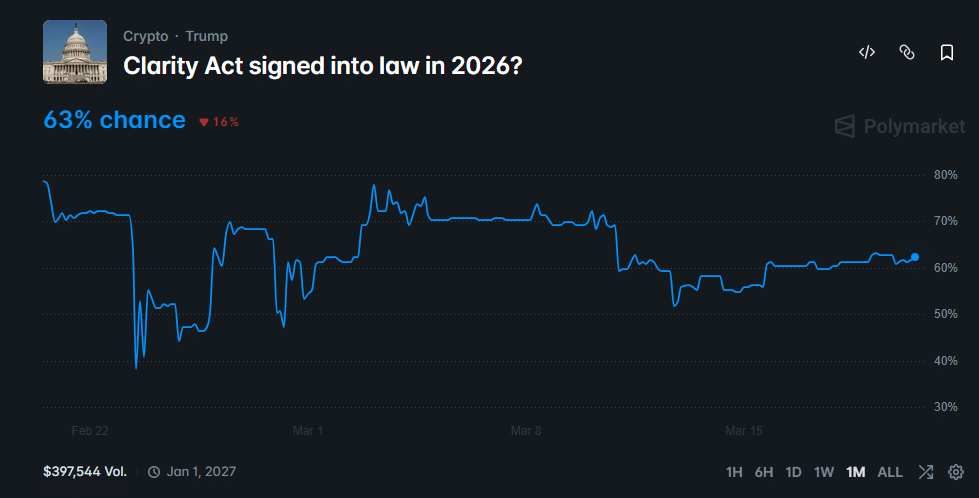
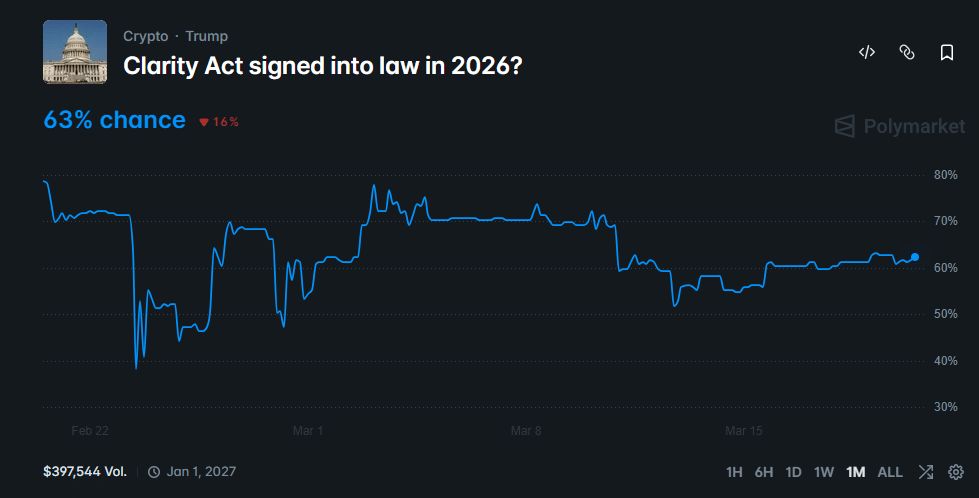
Source: Polymarket

As expected, market optimism on the bill’s passage improved slightly following the recent meetings and updates.

In early March, the chance of the CLARITY Act becoming law dropped to nearly 50% as the White House and the banking industry hit a snag over stablecoin yields.

Whatever the outcome, however, the crypto industry may still be in a better position for clear rules for the road if the SEC continues to issue and codify them.


Final Summary

  • SEC Chair reiterated plans to formalize rulemaking for its recent interpretive guidance on crypto asset classification and how current U.S. law applies to them.
  • According to Senator Lummis, the stablecoin yield issue was ‘99% resolved’ in CLARITY Act talks.

Связанные с этим вопросы

QWhat did SEC Chairman Paul Atkins announce regarding crypto asset classification?

APaul Atkins announced that the SEC will soon issue formally proposed rules to codify its recent interpretive guidance on crypto asset classification, which designates most crypto assets as non-securities and categorizes them into five groups.

QHow did the SEC classify digital assets in its latest guidance?

AThe SEC classified digital assets into five categories: digital commodities, collectibles, tools, stablecoins, and securities, explaining how they fit under current U.S. law.

QWhat did Paul Atkins say about the role of courts in relation to the SEC's interpretation?

AAtkins warned that courts could deviate from the SEC's interpretation if they disagree with the rationale, emphasizing that the guidance is just an interpretation.

QWhat is the CLARITY Act, and how does it relate to the SEC's actions?

AThe CLARITY Act is a congressional bill addressing crypto regulation. The SEC's interpretive guidance covers key topics in the bill and is seen as a 'bridge' while Congress works on the legislation.

QAccording to Senator Cynthia Lummis, what progress has been made on the stablecoin yield issue in the CLARITY Act negotiations?

ASenator Lummis stated that the stablecoin yield issue is '99% resolved' and that negotiations on the digital asset portions of the bill are in a good place.

Похожее

Dialogue with a Macro Analyst: AI Drains All Liquidity from U.S. Stocks, $40K Bitcoin is the True Bottom

In a recent discussion, macro strategist Luke Groman, founder of FFT LC, presented a sobering analysis of current markets. He argues that while the S&P 500 hits new highs, this is largely driven by just seven AI stocks, which are "sucking all the oxygen and liquidity out of the room." Bitcoin, which he calls the "last working smoke alarm for liquidity," is signaling trouble, having entered a difficult period. Groman explains that the AI boom is fueled by accounting practices that front-load revenue, creating an illusion of high profits while cash is being depleted. He warns this cycle could reverse sharply when construction slows. His base case is that stocks will rise in dollar terms but fall significantly when measured in gold or Bitcoin, highlighting that long-term US Treasury futures have already lost 90% of their value against gold over the past decade. He points to major structural risks, including China's dominance in rare earths—a small commodity market underpinning trillions in tech stock value—and the prolonged closure of the Strait of Hormuz, which he calls a "Suez Moment" for the US. This, combined with a shift towards a "no ticky, no washy" proof-of-work system for settling trade (using gold, not trust), signals deeper systemic distrust. Regarding US debt, Groman notes that historically, all 58 countries that reached a 130% debt-to-GDP ratio defaulted, primarily through inflation. The US crossed this threshold in 2020. He also highlights a contradiction in the AI narrative: if it's as transformative as claimed, it must destroy white-collar jobs, threatening half of US tax revenue—a reality at odds with the "no job loss" messaging from tech leaders. On Bitcoin, Groman sold most of his position near the top and hasn't fully re-entered. Citing technical analysis from Northstar Bad Charts, he suggests a potential bottom around $40,000 could materialize in Q3 or Q4. He concludes that while he may be labeled a doomsayer, his view is simply realistic, grounded in historical precedents and current macro pressures.

marsbit7 ч. назад

Dialogue with a Macro Analyst: AI Drains All Liquidity from U.S. Stocks, $40K Bitcoin is the True Bottom

marsbit7 ч. назад

Торговля

Спот
Фьючерсы
活动图片