Jensen Huang Joins Tsinghua, But Did Musk Actually Arrive Ten Years Ago?

marsbitОпубликовано 2026-05-29Обновлено 2026-05-29

Введение

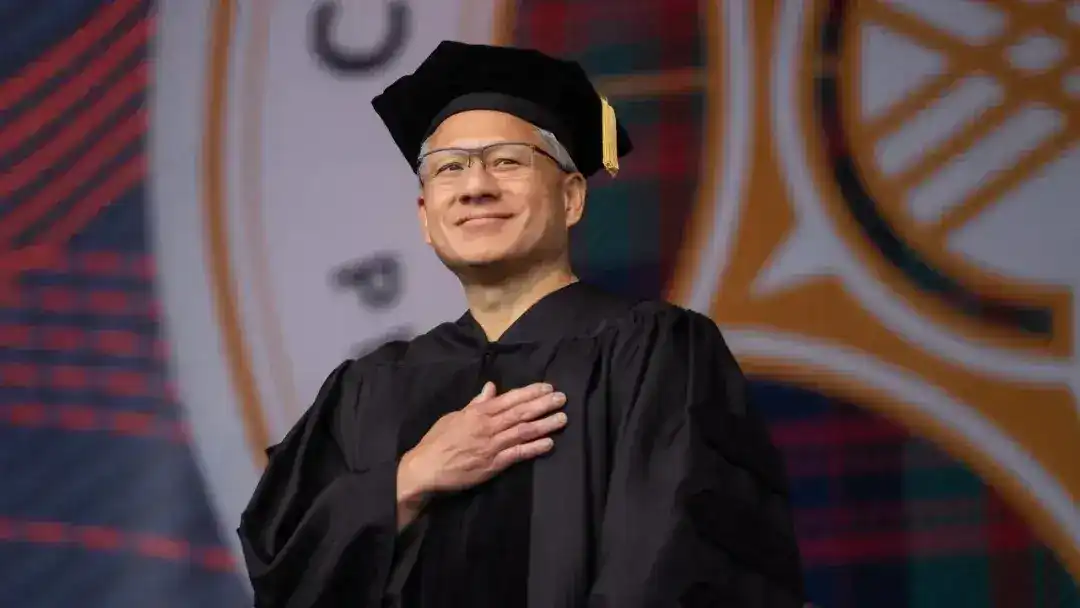
Jensen Huang, founder of NVIDIA, is set to join the Advisory Board of Tsinghua University's School of Economics and Management. This marks his first appointment to an advisory body at a mainland Chinese university, following similar roles at institutions like National Taiwan University, Stanford, and Harvard. The article explores why his entry comes now, a decade after Elon Musk joined the same prestigious committee in 2015. The Tsinghua advisory board, established in 2000, is a high-level strategic body comprising global business elites like Apple's Tim Cook (Chair), Tesla's Elon Musk, Microsoft's Satya Nadella, and Meta's Mark Zuckerberg, alongside financial giants and leading Chinese entrepreneurs. The timing is attributed to a confluence of factors: Huang's current eligibility driven by NVIDIA's dominant role in AI, a recent vacancy on the board, the rising challenge from domestic Chinese chips necessitating stronger local ties, and a recent thaw in U.S.-China relations following high-level diplomatic visits. In contrast, Musk's 2015 entry occurred during a period of warmer bilateral ties, where his disruptive innovation profile aligned well with the board's needs without significant political friction. Huang is noted for his active engagement with academia, holding several honorary doctorates and advisory roles at other universities. His appointment is framed as a reflection of shifting geopolitics, market dynamics, and strategic recalculations over the past decade, u...

Author: Think AI, Aaron

Recently, NVIDIA founder Jensen Huang has been stealing the spotlight. Just after dominating the trending charts for treating a whole night market in Taipei to supper, he is again reported by the Financial Times today:

Jensen Huang will join the Advisory Committee of the School of Economics and Management at Tsinghua University, welcoming a new "teacher" to Tsinghua.

This also marks Huang's first appointment to an advisory body at a mainland Chinese university. Previously, he has served in similar institutions at National Taiwan University, Stanford University, and Harvard University in the US, but entry into mainland China had been delayed until now.

What are the "unspoken difficulties" in between?

It's important to know that this committee currently has 65 members, including major figures from the US financial and tech sectors. Our familiar friend Elon Musk joined as early as ten years ago. Why has Jensen Huang been unable to join until now?

Firstly, of course, is the exceptionally high caliber of Tsinghua's SEM Advisory Committee.

The "Weight" of "Joining"

The Tsinghua SEM Advisory Committee was established in 2000, with then Dean Premier Zhu Rongji actively promoting the formation of this top-tier think tank.

The committee's core mission is to provide high-level guidance on the school's development strategy, international cooperation, faculty building, etc., while also building a dialogue bridge between China and global business elites.

Not only are the members top-tier talents from various industries, but during the annual meetings, state leaders also cordially meet with the attending members. President Xi Jinping has met with them in person twice and delivered a video address once.

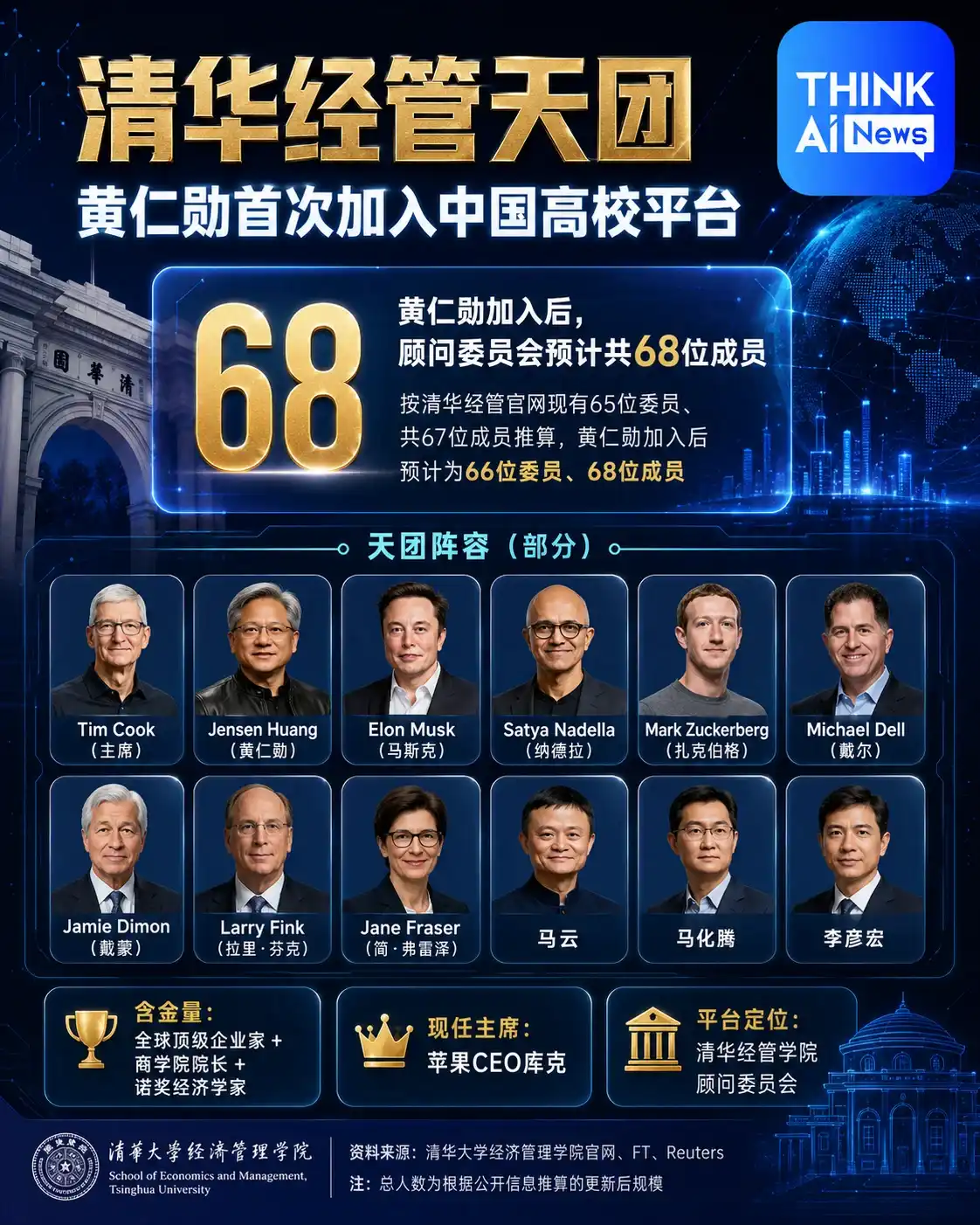
The current committee chairman is former Apple CEO Tim Cook, who currently serves as chairman.

With Huang's addition, the five major US tech giants are now formally assembled. The other three are Tesla's Elon Musk, Microsoft's Satya Nadella, and Meta's Mark Zuckerberg.

The finance sector is represented by Wall Street's top giants: Jamie Dimon of JPMorgan Chase, Stephen Schwarzman of Blackstone, Larry Fink of BlackRock, and Ray Dalio, founder of Bridgewater Associates.

There are also leaders from other globally renowned leading companies, such as BMW, Siemens, Coca-Cola, and so on.

Domestic heavyweights include Jack Ma, Pony Ma (Ma Huateng), Robin Li (Li Yanhong), Terry Gou (Guo Taiming), and others.

As can be seen from the list above, this is not an ordinary academic advisory panel but one of the highest-caliber and most influential circles of global business elites.

Why Now?

Both are tech giant CEOs. Why could Musk join in 2015, while Huang had to wait until now?

There were indeed many twists and turns in between, but now Huang's entry feels like a natural progression.

Looking back to 2015, US-China relations were relatively relaxed, and technological cooperation was in a honeymoon phase. Musk's entry had the right timing, location, and conditions.

At that time, the committee's tech sector already had Cook and Ballmer (former Microsoft CEO), but it lacked leaders in new energy and aerospace. Musk's Tesla and SpaceX正好 filled that gap;

Furthermore, in 2015, Tesla had not yet built a factory in China, but Musk was actively optimistic about the Chinese market, frequently expressing goodwill publicly, with no policy friction;

Coinciding with the committee's 2015-2016 academic year membership renewal, two new seats were added, and Musk became the sole new addition from the tech field;

Musk's "innovative disruptor" persona highly aligned with Tsinghua's goal of cultivating top talent, posing no political risk.

However, NVIDIA's strategic importance was not as pivotal as it is today, and the AI field had not yet demonstrated disruptive potential. In other words, Huang simply did not have the qualifications at that time.

Following 2018, US-China relations gradually became tense. Even as NVIDIA developed rapidly and Huang's wealth surged, it became more difficult to find a good opportunity amidst the climate.

US sanctions against China targeted NVIDIA as a core entity, forcing both Tsinghua and NVIDIA to be swayed by the broader environment.

Additionally, spots on the Tsinghua SEM Committee are highly limited. The tech circle has long been full, with only minor adjustments made annually. A vacancy恰好opened up earlier this year.

Market-wise, even without exporting high-end chips previously, NVIDIA maintained a monopoly position in China's AI chip sector until domestic chips强势崛起 in recent years, prompting Huang to seek new connections and circles to reopen the Chinese market.

Shortly after Trump's recent visit to China, US-China relations saw an easing. Huang accompanied the visit, partially mitigating political risks, allowing him to send more friendly signals towards China.

Huang's "Academic" Moves

It must be said that within the current tech circle, Jensen Huang is one of the tech founders most keen on joining university academic circles, which also makes his committee appointment feel一点也不违和.

It should be noted that while Huang本人已经确认 this news about joining Tsinghua, NVIDIA and Tsinghua have not officially announced it yet. Further official updates can be followed.

Huang himself holds a Master's degree in Electrical Engineering from Stanford University.

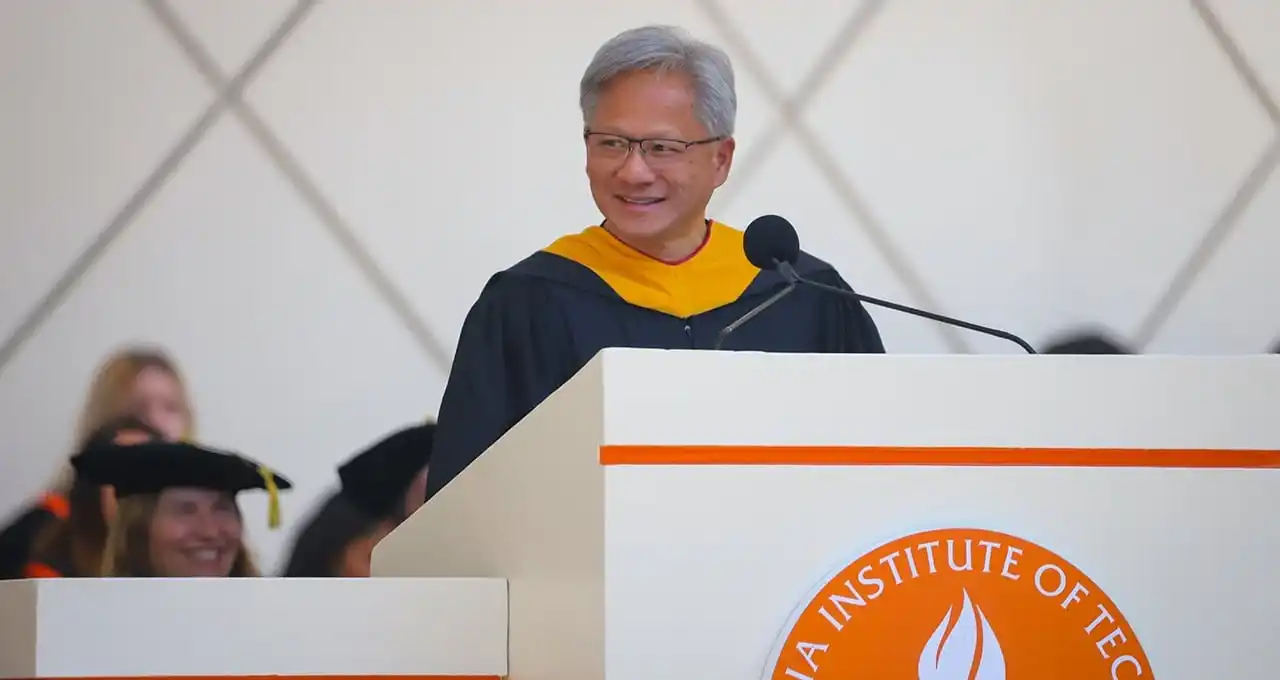
He has also received a total of 7 honorary doctorates to date, from universities across the globe including Taiwan, the US, Hong Kong, and Sweden, awarded in recognition of his industry achievements.

Regarding university advisory roles similar to Tsinghua's SEM Committee, Huang has also joined the Harvard Business School Dean's Advisory Board, the Stanford University Advisory Council, and the National Taiwan University College of Management Advisory Board, among others.

Huang's university speeches in recent years have also been full of quotable lines.

He pointed out, "You are not replaced by AI, but by those who use AI." He also strongly驳斥 the notion that AI leads to job cuts.

He stated, "AI only started to have an impact six months ago, yet they were laying people off because of AI two years ago? How is that possible? It makes no sense."

Overall, Huang's加入委员会 is a microcosm of a decade of geopolitical博弈, market变迁, and利益重构.

The Chinese market remains the重中之重 that Jensen Huang is迫切想要打开.

Связанные с этим вопросы

QWhy has Huang Renxun joined Tsinghua University's School of Economics and Management Advisory Committee now, compared to Elon Musk who joined a decade ago?

AHuang Renxun's recent entry is a result of evolving circumstances. In 2015, when Musk joined, US-China relations were warmer, and his innovative profile in new energy and aerospace filled a gap in the committee. Nvidia's strategic importance in AI was not as dominant then. Post-2018, US-China tensions and US sanctions on Nvidia, a key target, made the timing unfavorable. Recently, a committee seat opened up, US-China relations showed signs of easing after Trump's visit, and with the rise of domestic chips in China, Huang seeks to strengthen his network and access to the Chinese market.

QWhat is the significance and mission of the Tsinghua School of Economics and Management Advisory Committee?

AThe Tsinghua School of Economics and Management Advisory Committee, established in 2000 under then-Dean Premier Zhu Rongji, is a top-tier advisory body. Its core mission is to provide high-level strategic guidance on the school's development, international cooperation, and faculty development. It also serves as a bridge for dialogue between China and global business leaders. The committee is notable for its high-profile members, including top CEOs, and its annual meetings are sometimes attended by Chinese national leaders, including President Xi Jinping.

QWhich other prominent global business leaders are members of this Tsinghua committee alongside Huang Renxun?

AThe committee features a 'who's who' of global business elites. In tech, it includes Apple's Tim Cook (Chair), Tesla's Elon Musk, Microsoft's Satya Nadella, and Meta's Mark Zuckerberg. The finance sector is represented by figures like Jamie Dimon (JPMorgan Chase), Stephen Schwarzman (Blackstone), Larry Fink (BlackRock), and Ray Dalio (Bridgewater). Other members lead major corporations like BMW, Siemens, and Coca-Cola, alongside Chinese leaders such as Jack Ma, Pony Ma, Robin Li, and Terry Gou.

QAccording to the article, what was Huang Renxun's main motivation for seeking to join this committee at this time?

AHuang Renxun's primary motivation is to strengthen his ties and network within the Chinese market. The article states that despite Nvidia's previous dominance in China's AI chip sector, domestic chips have recently seen a strong rise. Therefore, joining this prestigious committee provides Huang with a crucial platform to build new relationships and 'open the Chinese market,' which remains a 'top priority' for him.

QWhat are some of Huang Renxun's views on AI and employment, as mentioned in his university speeches?

AIn his recent university speeches, Huang Renxun emphasized that 'You are not replaced by AI, but by people who use AI.' He also strongly refuted claims that AI leads to job losses, arguing it's illogical: 'AI only started to work six months ago, and they were laying off people because of AI two years ago? How is that possible? That doesn't make any sense at all.'

Похожее

Goldman Sachs Research Report Analysis: Chip Shortage to Persist Until 2028, Maintain Buy Recommendations

Goldman Sachs Research Report Summary: Memory Shortage Until 2028, Maintain Buy Recommendations Goldman Sachs' latest Asia-Pacific equities report, "The 720," forecasts a sustained memory chip upcycle extending into 2028, driven by strong AI server demand visibility, limited supply growth, and binding long-term agreements. The firm believes the market significantly underestimates the cycle's duration, as evidenced by low P/E ratios for memory stocks. Key sector calls include raising 12-month price targets for Samsung Electronics and SK Hynix, and upgrading Kioxia from Hold to Buy, citing higher and more sustainable peak profits over the next 2-3 years. The report also highlights the broader AI hardware supply chain benefiting from hyperscaler capex acceleration. Recommendations include: * MediaTek (Buy) for its data center/ASIC pivot. * Eoptolink (Buy) on 1.6T optical module ramp-up. * Biren (Buy) for its AI chip migration. * Huaqin (Buy, newly covered) for its shift from consumer electronics ODM to AI data centers. * Lenovo (Buy) on the AI PC refresh cycle. Other notable mentions include China property developers (under an optimistic scenario), BYD for its affordable city NOA strategy, and select Japanese semiconductor equipment makers. A macro theme notes the divergence between AI-boom beneficiaries (e.g., Korea, Taiwan) and energy-importing economies facing inflationary pressure. The report concludes with standard disclaimers, noting that price targets are forward-looking estimates and that sell-side research has an inherent bullish bias. The core investment thesis hinges on the longevity of the memory upcycle and the AI-driven capex wave.

marsbit20 мин. назад

Goldman Sachs Research Report Analysis: Chip Shortage to Persist Until 2028, Maintain Buy Recommendations

marsbit20 мин. назад

A Detailed Look at Cathie Wood's Masterful Moves on Circle

Title: A Detailed Look at Cathie Wood's Masterful Moves on Circle ARK Invest's Cathie Wood executed a textbook investment strategy on Circle (CRCL), showcasing how a long-term investor can capitalize on short-term volatility. Key to her success was securing 4.49 million shares at the $31 IPO price before the public offering, leveraging pre-IPO access unavailable to most investors. The stock debuted at $69, fueled by extreme demand against a limited float of only 15% of total shares. Wood then began systematically selling as the price soared, driven by policy optimism like the GENIUS Act, which pushed shares to nearly $299. She sold approximately 1.7 million shares across four transactions at an average price around $210, partly triggered by ARK's internal rule to rebalance when a single stock's weight exceeds 10%. Following a steep decline due to lock-up expirations, increased supply, and interest rate concerns, Circle fell over 80% from its peak. Wood started buying back shares around $82-$86 after a strong Q3 earnings report ironically caused a price drop in November 2025. She continued buying on the way down, eventually rebuilding her position to roughly 4.5 million shares by Q1 2026. The core lessons from Wood's play are: 1) A firm, independent conviction in Circle's long-term narrative as a digital dollar infrastructure player. 2) Executing in phases—selling into strength and buying into weakness—without attempting to time exact tops or bottoms. 3) Strict adherence to position-sizing and rebalancing rules, which forced profit-taking at highs and created capacity to buy at lows. For most investors, chasing the volatile post-IPO "pop" is risky; Wood's success was built on pre-IPO access, deep research, and disciplined execution.

marsbit23 мин. назад

A Detailed Look at Cathie Wood's Masterful Moves on Circle

marsbit23 мин. назад

Morning Post | Michael Saylor Releases Bitcoin Tracker Info; Aave Publishes Kelp rsETH Bridge Attack Post-Incident Investigation; Gravity Bridge Announces Service Suspension Following Attack

ChainCatcher Daily Summary - June 1, 2026 In regulatory news, the U.S. OCC granted preliminary conditional approval for Laser Digital to establish a federally regulated trust bank. In Vietnam, a draft law amendment proposes allowing SMEs to use digital and virtual assets as loan collateral. Hong Kong's SFC chairman reported that trading volume on the city's 12 licensed virtual asset platforms grew nearly 300% YoY in Q1 2026. Notable incidents include the Cosmos ecosystem cross-chain bridge Gravity Bridge pausing services after an attack. Aave published a post-mortem on the April 18th Kelp rsETH bridge attack, attributing it to a third-party bridge infrastructure vulnerability via an RPC poisoning attack, not the Aave protocol itself. In market developments, MicroStrategy's Michael Saylor hinted at a potential upcoming Bitcoin purchase announcement. Fed Governor Waller commented that widespread stablecoin adoption could amplify the impact of U.S. monetary policy. Meanwhile, sentiment analysis from Santiment indicates a record-high Bitcoin long/short ratio of 2.23, potentially signaling a short-term price correction, while Ethereum shows signs of FUD among commentators. In legal matters, the SEC sued the founder of Privvy Investments for an alleged $12.3 million crypto AI trading bot scam. In China, a Qingdao man was sentenced to 10 years and 9 months for stealing 107 BTC by obtaining a victim's wallet seed phrase. Top trending meme tokens on ETH, Solana, and Base networks for the past 24 hours are also listed.

链捕手1 ч. назад

Morning Post | Michael Saylor Releases Bitcoin Tracker Info; Aave Publishes Kelp rsETH Bridge Attack Post-Incident Investigation; Gravity Bridge Announces Service Suspension Following Attack

链捕手1 ч. назад

Торговля

Спот
Фьючерсы

Популярные статьи

Неделя обучения по популярным токенам (2): 2026 может стать годом приложений реального времени, сектор AI продолжает оставаться в тренде

2025 год — год институциональных инвесторов, в будущем он будет доминировать в приложениях реального времени.

1.8k просмотров всегоОпубликовано 2025.12.16Обновлено 2025.12.16

Неделя обучения по популярным токенам (2): 2026 может стать годом приложений реального времени, сектор AI продолжает оставаться в тренде

Обсуждения

Добро пожаловать в Сообщество HTX. Здесь вы сможете быть в курсе последних новостей о развитии платформы и получить доступ к профессиональной аналитической информации о рынке. Мнения пользователей о цене на AI (AI) представлены ниже.

活动图片