Jack Dorsey's Company Is Laying Off 4,000 White-Collar Workers, Replaced by AI

Odaily星球日报Опубликовано 2026-02-27Обновлено 2026-02-27

Введение

Jack Dorsey's fintech company Block has announced a major workforce reduction, cutting nearly 40% of its employees—around 4,000 roles—to streamline operations and transition toward a flatter, AI-centric organizational structure. Despite reporting growing revenue and profitability, and even raising its 2026 profit guidance to $12.2 billion, Block is proactively restructuring to adapt to rapid AI-driven changes in productivity. Dorsey emphasized that AI tools are fundamentally reshaping how companies operate, enabling exponential growth without proportional increases in staff. This move reflects a broader trend among tech firms like Salesforce, Amazon, and ASML, which have also cut jobs during growth phases by leveraging AI for efficiency. Notably, Block’s stock surged 20% following the announcement, adding nearly $6 billion in market value—effectively valuing each eliminated role at about $1.5 million in created enterprise value. The layoffs primarily affect white-collar roles, as AI excels at tasks involving information processing—a core function of many knowledge-economy jobs. Affected employees will receive severance including 20 weeks' base pay, additional compensation per year served, a $5,000 transition bonus, and six months of continued health insurance. The situation underscores how AI is disrupting traditional employment faster than expected, shifting focus toward reskilling and adaptation in the automated economy.

Original | Odaily Planet Daily (@OdailyChina)

Author | Azuma (@azuma_eth)

In the early hours of this morning Beijing time, financial technology company Block, led by Jack Dorsey (also the founder of Twitter), announced a large-scale layoff plan — nearly 4,000 positions will be cut, reducing the total number of employees from over 10,000 to less than 6,000, in order to promote a leaner, flatter, and AI-centric organizational structure.

Jack Dorsey himself is a fervent Bitcoin maximalist, believing that Bitcoin will ultimately become the native currency of the internet. Block's business is also deeply intertwined with Bitcoin. In addition to directly holding Bitcoin on its balance sheet and providing trading, wallet, and mining products and services, Block is also a long-term funder of Bitcoin core developers.

But this is not the focus of this article — the key point this article aims to emphasize is that, unlike other companies forced to lay off employees due to business contraction, Block is proactively choosing to cut nearly 40% of its positions during a period of growth in both business revenue and profit margins. Simultaneously with the layoffs, Block has further raised its 2026 gross profit guidance to $12.2 billion.

Jack Dorsey explained the reason for this decision in the announcement: "Something has changed. We have seen that the intelligent tools we are building and using, combined with smaller, flatter teams, are giving rise to a new way of working — this fundamentally changes the meaning of building and operating a company, and this change is accelerating rapidly... Rather than passively accepting the change and slowly laying off employees over the next few months or years, it is better to proactively adapt now."
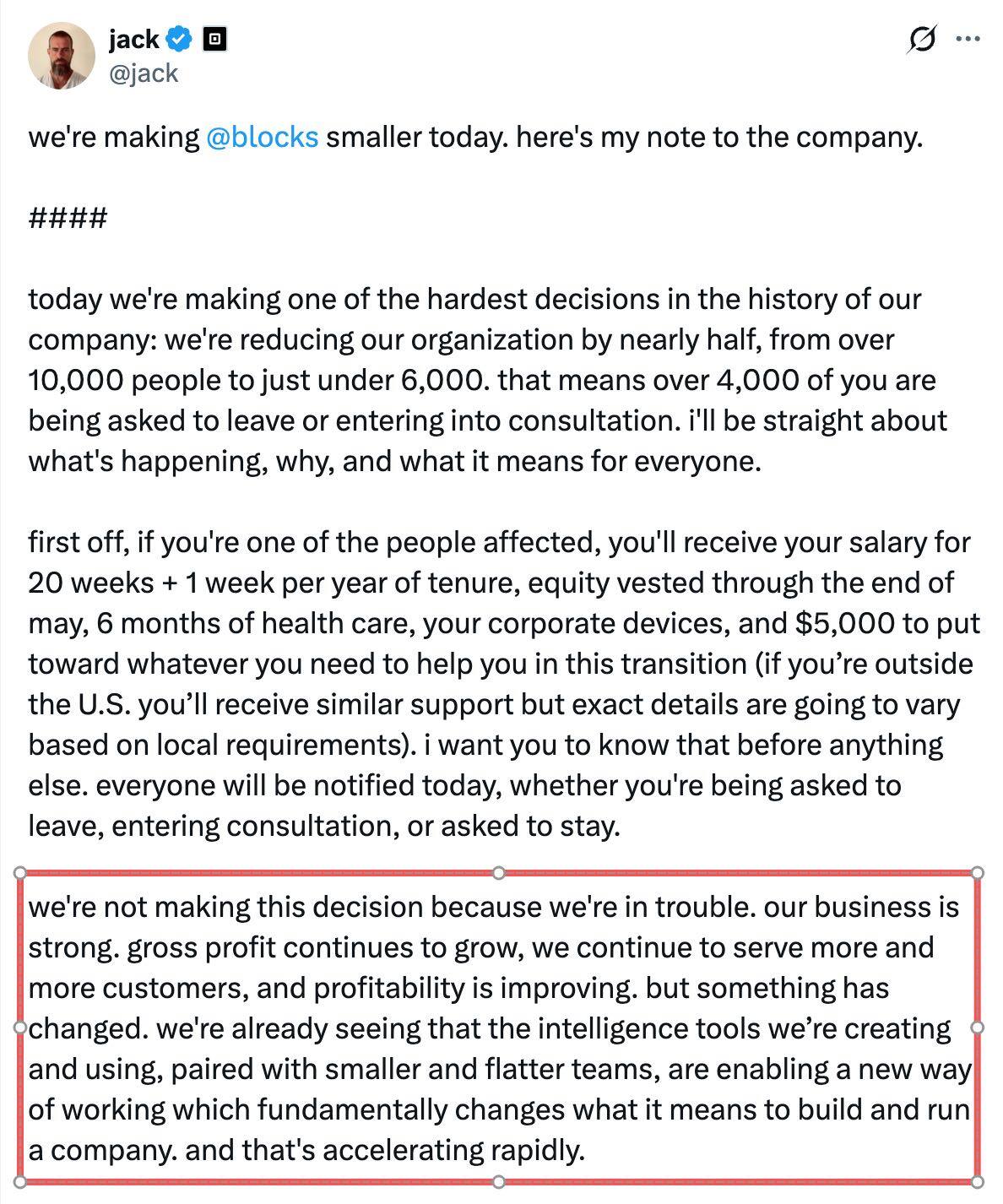
The change mentioned by Jack Dorsey is not new — the rapid development of AI is iterating the traditional paradigm of productivity growth. In the past, enterprises mainly relied on linear growth in employee numbers to increase productivity and expand business scale; but now, with the help of rapidly evolving AI tools, enterprises can achieve exponential growth in productivity while maintaining or even reducing the number of employees.

Overseas influencer and product growth expert Aakash Gupta pointed out that Block is not the first company to make this decision: "Block is not an isolated case. ASML laid off 1,700 people last month while also announcing record order numbers; Salesforce laid off 5,000 people after AI began handling 50% of customer interactions; Amazon laid off 16,000 people in January last year and another 14,000 in October... All these companies were still in a growth trend when they made the decision to lay off employees. Jack Dorsey is just saying out loud what everyone has been tacitly acknowledging, that AI tools combined with smaller team size have completely changed the way a company is operated."

More notably, after Block announced its layoff plan, the capital market quickly gave its response — Block's stock price surged 20%, increasing its market value by nearly $6 billion on the spot. This means that for every position cut, about $1.5 million in enterprise value was created.

It has long been a social consensus that AI will disrupt the job market and eliminate some professions, but many people still underestimate the speed at which this change is arriving. In the past few weeks, we have witnessed the 'dimensionality reduction' impact of Anthropic on multiple industries such as SaaS; seen the 30 million reads of '2028 Global Intelligence Crisis' stirring public sentiment; and now we have Block proactively downsizing without concealing the reason.

Another counterintuitive reality is that while people once believed the threat of AI eliminating jobs would follow a gradual sequence 'from low-end to high-end,' the actual situation is that, due to the immaturity in the field of physical interaction, the first to be eliminated by AI are the white-collar jobs that the market once considered relatively mid-to-high-end. The reason is not complicated: the essence of white-collar work is to perform 'input → processing → output' of information based on specific industry standards, and this is precisely the area where AI large models excel.

In this round of layoffs at Block, affected employees will receive 20 weeks of salary plus an additional week's compensation for each year of service, as well as a $5,000 transition grant. Additionally, Block will continue to provide health insurance for employees for 6 months and allow them to keep their company equipment. The compensation conditions are quite good, but for these laid-off employees and the many positions already threatened by AI, it is time to think about how to avoid being eliminated in the AI era.


Связанные с этим вопросы

QWhat major announcement did Jack Dorsey's company Block make regarding its workforce?

ABlock announced a large-scale layoff plan, cutting nearly 4,000 jobs, which will reduce its total workforce from over 10,000 employees to fewer than 6,000.

QWhat was the stated reason for Block's decision to lay off such a significant portion of its employees despite being in a growth period?

AThe decision was driven by the rapid development of AI tools, which, combined with smaller, flatter teams, are creating a new way of working that fundamentally changes how a company is built and operated. Block chose to proactively adapt to this change rather than react slowly in the future.

QHow did the financial markets react to Block's announcement of the layoffs?

AThe market reacted positively; Block's stock price surged by 20%, increasing its market capitalization by nearly $6 billion, which equates to creating about $1.5 million in enterprise value for each job cut.

QAccording to the article, which sector of the workforce is AI currently impacting most significantly and why?

AAI is currently having the most significant impact on white-collar jobs. This is because the essence of white-collar work involves processing information (input → processing → output) according to specific industry standards, which is precisely the area where AI large language models excel.

QWhat compensation package was offered to the employees who were laid off from Block?

ALaid-off employees will receive 20 weeks of salary plus an additional week for each year of service, a $5,000 transition grant, 6 months of continued health insurance, and they are allowed to keep their company equipment.

Похожее

Goldman Sachs Bows Down, Bitcoin Finally Breaks Through the Gates of Wall Street

Wall Street giants, including Goldman Sachs, Morgan Stanley, Charles Schwab, and the New York Stock Exchange, have reversed their long-standing opposition to Bitcoin and are now actively embracing it. After years of dismissing Bitcoin as a scam, a bubble, or a tool for illicit activities, these institutions are launching Bitcoin ETFs, enabling spot trading, and building dedicated crypto infrastructure. Goldman Sachs, which once called Bitcoin a "fraud tool," is now offering Bitcoin ETFs. Morgan Stanley, which internally banned the term "cryptocurrency," has launched its largest-ever ETF backed by Bitcoin. Charles Schwab has opened spot crypto trading for its retail clients, integrating Bitcoin alongside traditional assets. The NYSE is building robust infrastructure to support digital assets, signaling a long-term commitment. This dramatic shift is driven not by a change in ideology but by economic necessity. As Bitcoin repeatedly survived market crashes and grew into a multi-trillion-dollar asset class, ignoring it became too costly. Wall Street’s business model relies on capturing fees, and Bitcoin’s rise represented a massive wealth transfer occurring outside their ecosystem. The fear of missing out (FOMO) and client demand forced these institutions to capitulate. The article frames this as a historic surrender to Bitcoin’s mathematical inevitability. Unlike the trust-based traditional financial system, Bitcoin operates on decentralized, transparent, and unchangeable rules. Its scarcity and resilience make it a hedge against fiat currency devaluation and systemic risk. The narrative has flipped: not holding Bitcoin is now seen as the greater risk. The author concludes that Bitcoin has not been co-opted by Wall Street; instead, it has co-opted Wall Street, marking a fundamental shift in the global financial architecture.

marsbit1 ч. назад

Goldman Sachs Bows Down, Bitcoin Finally Breaks Through the Gates of Wall Street

marsbit1 ч. назад

Торговля

Спот
Фьючерсы

Популярные статьи

Неделя обучения по популярным токенам (2): 2026 может стать годом приложений реального времени, сектор AI продолжает оставаться в тренде

2025 год — год институциональных инвесторов, в будущем он будет доминировать в приложениях реального времени.

1.8k просмотров всегоОпубликовано 2025.12.16Обновлено 2025.12.16

Неделя обучения по популярным токенам (2): 2026 может стать годом приложений реального времени, сектор AI продолжает оставаться в тренде

Обсуждения

Добро пожаловать в Сообщество HTX. Здесь вы сможете быть в курсе последних новостей о развитии платформы и получить доступ к профессиональной аналитической информации о рынке. Мнения пользователей о цене на AI (AI) представлены ниже.

活动图片