Is DeFi Development Corp’s Solana bet finally paying off?

ambcryptoОпубликовано 2026-04-08Обновлено 2026-04-08

Введение

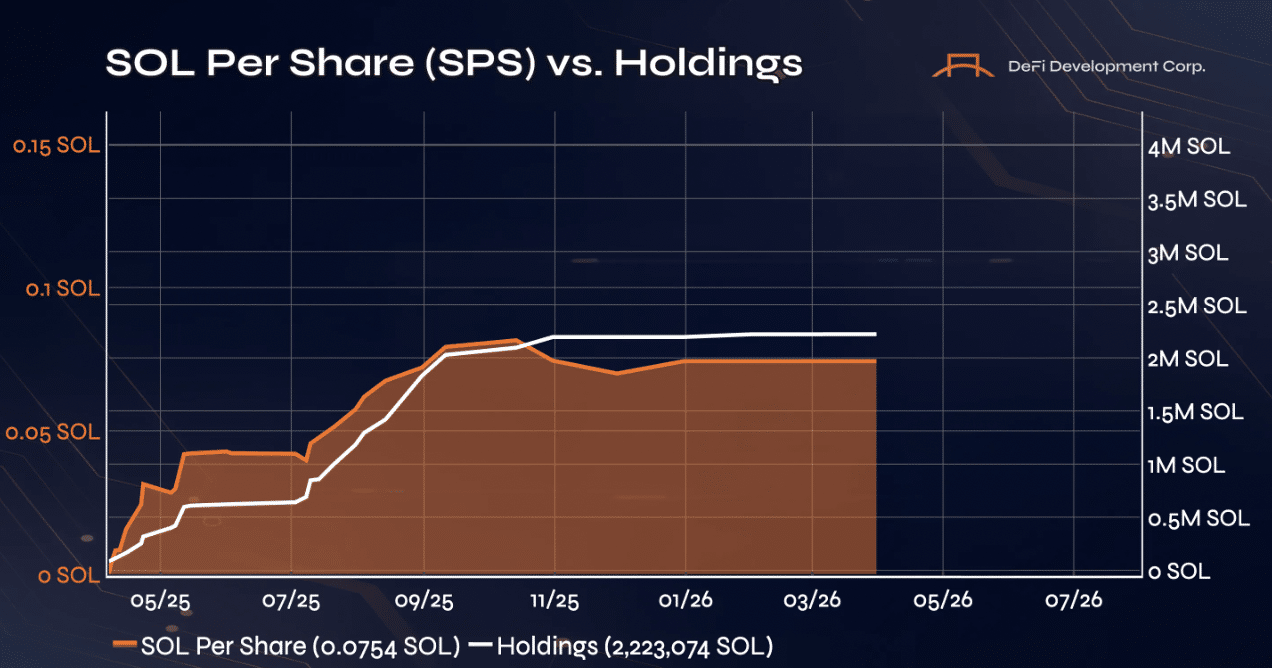
DeFi Development Corp. (DFDV) experienced flat growth in a challenging March 2026 but significantly increased its Solana (SOL) holdings to 2.22 million SOL, valued at $185 million. This resulted in a SOL Per Share (SPS) metric of 0.0754. The firm highlighted Solana's substantial growth in 2025, which now represents nearly 3% of the circulating supply held by Digital Assets Treasuries (DATs). DFDV's 2025 annual results showed an impressive 442% revenue growth. Looking forward, the company explored how autonomous AI agents could generate significant structural demand for SOL, with projections ranging from $27 billion to $112.5 billion. Despite a recent price drop for both DFDV stock and SOL, on-chain data showed that user engagement on the Solana network remained high. However, declining social volume and a large holder realizing substantial losses indicated some market weakness. SOL DATs have demonstrated relative strength compared to their Ethereum counterparts.

March 2026 has been a tough month for the crypto industry, including Digital Assets Treasuries (DTAs). As expected, DeFi Development Corp’s growth was flat too, but it still managed to grab attention. Despite March being a slow month, the firm reportedly pursued avenues to increase its Solana [SOL] balance over time and, in turn, saw a surge in its SOL per Share (SPS).

According to its March 2026 recap report, DeFi Development Corp’s [DFDV] SOL holdings have reached 2,223,074 SOL worth $185 million. Meanwhile, its outstanding shares stood at 29,497,394, translating to 0.0754 SOL Per Share (SPS).

Source: March 2026 report/DeFi Development Corp.

DeFi Development Corp.’s growth in 2025

Additionally, in its shareholder letter, the firm emphasized how Solana’s multifold growth in 2025 now represents nearly 3% of the circulating SOL supply held by DATs.

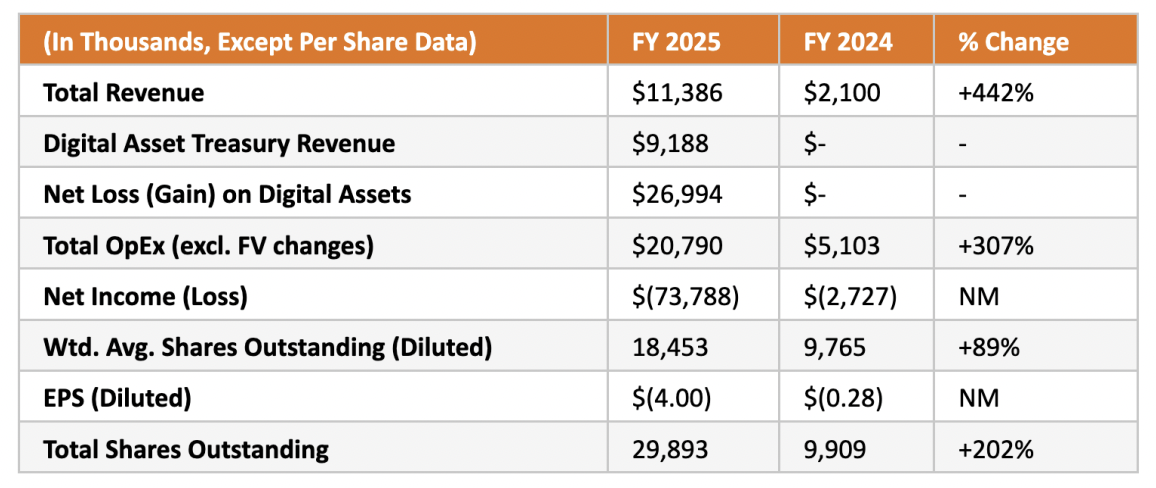
Besides this, the firm also published its annual results for 2025, recording over 442% in revenue growth.

Source: Shareholder letter/DeFi Development Corp.

That being said, in March, DFDV also explored how autonomous AI agents could “create persistent and structural demand for SOL” in the long run.

The report outlined a base-case estimate of $27 billion in structural SOL demand driven solely by agentic AI, alongside a bull-case projection of $112.5 billion.

This, after DFDV’s stock price traded at $3.64 after dropping by 3.84%. On the contrary, Solana was changing hands at $79.12 at press time, falling by 3.88% in the last 24 hours.

Solana’s on-chain metrics paint a confusing picture

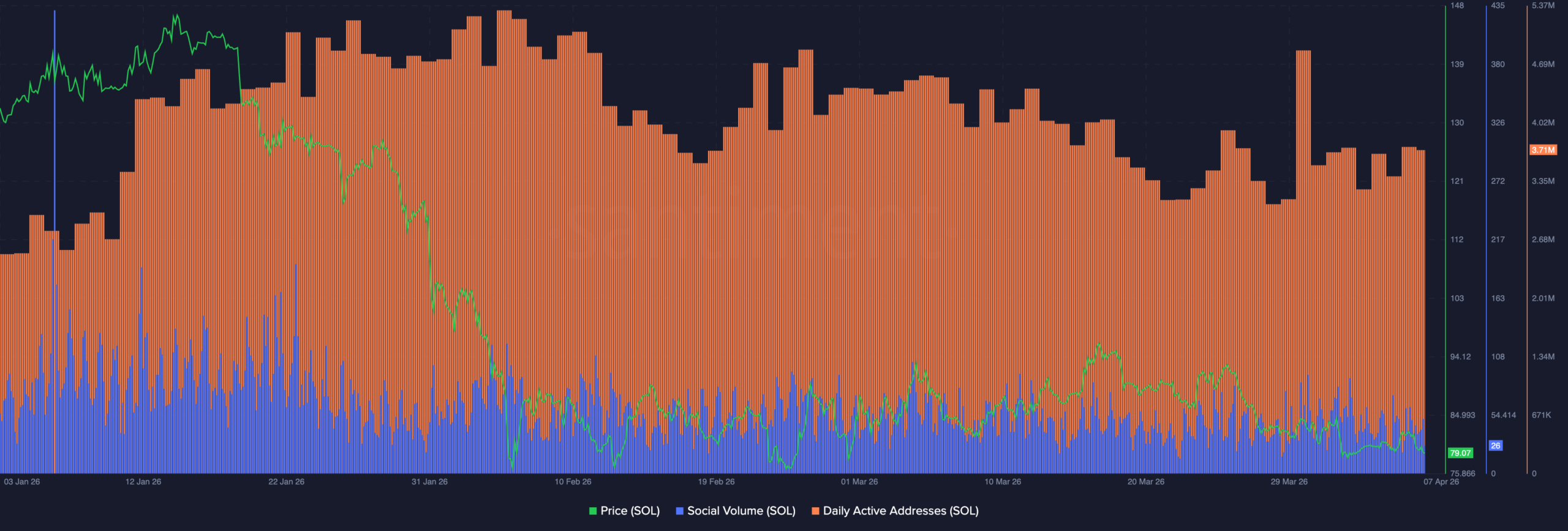
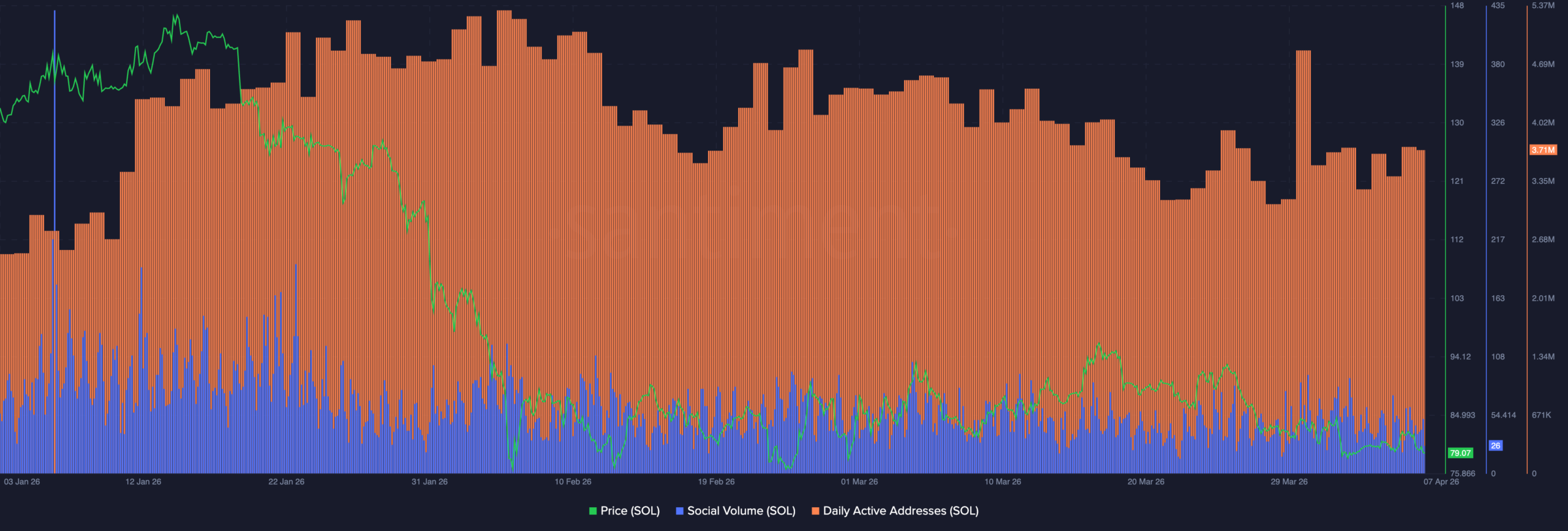
And yet, despite this price weakness, Solana’s high Daily Active Addresses suggested that user engagement has been intact even during bearish price sentiments.

Source: Santiment

However, not all metrics showed signs of strength. Especially since the drop in Social Volume metrics pointed to diminishing hype, compared to previous cycles. This, after a large SOL holder recently realized losses exceeding $4 million after selling 47,401 SOL. This, in turn, resulted in SOL’s price falling by 5.85%.

Additionally, when compared to others, SOL DATs have stood stronger against Ethereum [ETH] DATs. Owing to changing dynamics in and around the market, it remains to be seen what happens to Solana and to SOL DATs.


Final Summary

  • Defi Development Corp. saw over 442% in revenue growth in 2025, thanks to Solana’s performance in comparison to other chains.
  • Solana network activity suggested that user engagement has been high, despite the price drop and low social volume.

Связанные с этим вопросы

QWhat was the value of DeFi Development Corp's SOL holdings as of March 2026, and how many outstanding shares did it have?

AAs of March 2026, DeFi Development Corp's SOL holdings were 2,223,074 SOL, worth $185 million. The company had 29,497,394 outstanding shares.

QWhat significant growth did DeFi Development Corp achieve in 2025, and what was a key factor in this performance?

AIn 2025, DeFi Development Corp recorded over 442% in revenue growth. A key factor in this performance was Solana's multifold growth, which now represents nearly 3% of the circulating SOL supply held by Digital Assets Treasuries (DATs).

QAccording to the report, what long-term potential did DFDV explore for creating demand for SOL, and what were the estimated figures?

ADFDV explored how autonomous AI agents could 'create persistent and structural demand for SOL' in the long run. The report outlined a base-case estimate of $27 billion and a bull-case projection of $112.5 billion in structural SOL demand driven by agentic AI.

QDespite a price drop, what on-chain metric suggested that user engagement on the Solana network remained strong?

ADespite the price weakness, Solana's high Daily Active Addresses suggested that user engagement remained intact.

QWhat was the stock price of DFDV and the price of SOL at the time of the report, and what were their respective 24-hour changes?

AAt the time of the report, DFDV's stock price was $3.64 after dropping by 3.84%. Meanwhile, Solana (SOL) was trading at $79.12, falling by 3.88% in the last 24 hours.

Похожее

Has the 'Digital Gold' Narrative for BTC Failed?

**Title: Has the "Digital Gold" Narrative for Bitcoin Failed?** The article argues that Bitcoin's "digital gold" narrative remains valid despite a recent sharp price decline (from a peak near $126k in Oct 2025 to briefly under $61k in Feb 2026). It presents a long-term investment framework based on three core points: **1. Viewing Bitcoin as an Asset:** Bitcoin is presented as a superior potential store of value compared to gold. Key arguments are its absolute scarcity (21 million cap), superior portability, and transparent auditability via its public ledger. While acknowledging its current use in early, volatile stages (~3-4% global adoption), the author draws parallels to the early, disruptive phases of the internet and e-commerce. **2. Understanding the Recent Downturn:** The current ~50% correction is framed as a predictable, consensus-driven cycle following its post-halving peak (the 2024 halving preceded the Oct 2025 high). A crucial factor is a historic "changing of hands": the influx of new institutional buyers via ETFs allowed early, low-cost holders (miners, OG believers) to take profits. The author notes that while severe, Bitcoin's historical drawdowns (e.g., 93% in 2011, 77% in 2021-22) have been progressively smaller, suggesting maturing holder structure and decreasing volatility over time. **3. The Long-Term Perspective:** The long-term thesis hinges on Bitcoin capturing a portion of gold's market value. With Bitcoin's market cap at ~$1.4 trillion (at $70k) versus gold's ~$20 trillion, significant upside potential exists if the "digital gold" narrative is partially realized. However, the author strongly cautions that short-term risks remain, the bottom is unpredictable, and high volatility is inherent. The real risk is not Bitcoin failing but poor personal position management (over-leverage, wrong capital) and a lack of deep understanding, which can force investors out during severe downturns. The conclusion uses Amazon's 95% crash post-2000 dot-com bubble and subsequent 42x recovery as an analogy. The ultimate question is not if Bitcoin's price will rise, but if an investor's strategy and conviction can withstand the volatility to see the long-term play out. The recent divergence (gold up, Bitcoin down) is posed not as a narrative failure, but as potential evidence of this ongoing, painful transition from a speculative asset to a mainstream allocation.

marsbit6 ч. назад

Has the 'Digital Gold' Narrative for BTC Failed?

marsbit6 ч. назад

Has BTC's 'Digital Gold' Narrative Failed?

The article discusses Bitcoin's "digital gold" narrative, its recent price drop, and long-term outlook through the perspective of "Jason". It argues the narrative is not a failure but that Bitcoin represents a superior, new asset class due to its fixed supply (21 million), portability, and auditability. The piece compares its current ~3-4% global adoption rate to early internet/e-commerce, suggesting significant growth potential. Regarding the 2025-2026 price decline (from ~$126k to briefly under $61k), the author views it as a predictable, consensus-driven sell-off within Bitcoin's ~4-year cycle post-halving, exacerbated by a major "handover" from early, low-cost holders to new institutional buyers via ETFs. A key observation is that historical peak-to-trough drawdowns have lessened over time (e.g., 93% in 2011 to ~50% in 2026), indicating maturing volatility as holder structure changes. For the long term, the author uses a simple framework: Bitcoin's total market cap (~$1.4T at $70k) is only about 7% of gold's (~$20T). Even capturing 30-50% of gold's value would imply substantial upside. However, the article strongly cautions against viewing this as investment advice, emphasizing extreme volatility and the critical importance of risk management, position sizing, and deep fundamental understanding to survive severe drawdowns. It concludes by drawing a parallel to Amazon's 95% crash in 2000 and subsequent 42x recovery, stressing that the key is surviving market cycles to realize long-term potential.

链捕手6 ч. назад

Has BTC's 'Digital Gold' Narrative Failed?

链捕手6 ч. назад

From Code to Cognition: A Ten-Thousand-Word Guide to the Evolution of the Robot Brain

"From Code to Cognition: The Evolution of Robot Brains" The journey of robotic intelligence has shifted dramatically from manually coded systems to AI-driven brains. For decades, robots relied on layered software stacks—perception, state estimation, planning, control—each handcrafted. While predictable, they lacked adaptability. The 2010s saw deep learning revolutionize perception (e.g., object detection) and control (via reinforcement learning), but learned skills remained narrow. The arrival of Large Language Models (LLMs) marked a turning point. LLMs acted as high-level planners, interpreting natural language instructions and generating sequences of actions for traditional robotic systems to execute. However, true integration came with Visual-Language-Action (VLA) models, which fused vision, language, and motion prediction into a single network. Pioneered by models like RT-2 and open-source projects like OpenVLA, VLAs enable robots to reason and act directly from visual input and commands. The most advanced humanoid robots now employ a "dual-brain" architecture: a slow-thinking, large VLA (System 2) for reasoning and planning, and a fast-reacting, small network (System 1) for high-frequency motion control, sometimes with an even lower-level System 0 for balance. This split balances cognition with the physics of real-time movement. Computation is split between onboard hardware (e.g., NVIDIA Jetson) for safety-critical control loops and cloud/edge servers for non-critical tasks like learning and interfaces. A crucial driver is the open-source ecosystem—models like GR00T and OpenVLA allow startups to build upon pre-trained brains and fine-tune them with their own data, accelerating development. Despite progress, current systems struggle with recovery from errors, sample inefficiency, and long-horizon tasks. This has spurred the rise of **World Models**—neural networks that predict the consequences of actions. By simulating possible futures before acting (like NVIDIA Cosmos or Meta V-JEPA), robots can plan, recover, and generalize better. This represents the next frontier: shifting intelligence from learned reactions to an internal model of physics and cause-and-effect. The field is rapidly evolving. While not yet at its "ChatGPT moment," the convergence of cheaper hardware, scalable simulation, and world models points toward robots that are increasingly capable, adaptive, and useful. The question is shifting from "what can robots do?" to "what *should* they do?"

marsbit6 ч. назад

From Code to Cognition: A Ten-Thousand-Word Guide to the Evolution of the Robot Brain

marsbit6 ч. назад

Торговля

Спот
Фьючерсы

Популярные статьи

Как купить S

Добро пожаловать на HTX.com! Мы сделали приобретение Sonic (S) простым и удобным. Следуйте нашему пошаговому руководству и отправляйтесь в свое крипто-путешествие.Шаг 1: Создайте аккаунт на HTXИспользуйте свой адрес электронной почты или номер телефона, чтобы зарегистрироваться и бесплатно создать аккаунт на HTX. Пройдите удобную регистрацию и откройте для себя весь функционал.Создать аккаунтШаг 2: Перейдите в Купить криптовалюту и выберите свой способ оплатыКредитная/Дебетовая Карта: Используйте свою карту Visa или Mastercard для мгновенной покупки Sonic (S).Баланс: Используйте средства с баланса вашего аккаунта HTX для простой торговли.Третьи Лица: Мы добавили популярные способы оплаты, такие как Google Pay и Apple Pay, для повышения удобства.P2P: Торгуйте напрямую с другими пользователями на HTX.Внебиржевая Торговля (OTC): Мы предлагаем индивидуальные услуги и конкурентоспособные обменные курсы для трейдеров.Шаг 3: Хранение Sonic (S)После приобретения вами Sonic (S) храните их в своем аккаунте на HTX. В качестве альтернативы вы можете отправить их куда-либо с помощью перевода в блокчейне или использовать для торговли с другими криптовалютами.Шаг 4: Торговля Sonic (S)С легкостью торгуйте Sonic (S) на спотовом рынке HTX. Просто зайдите в свой аккаунт, выберите торговую пару, совершайте сделки и следите за ними в режиме реального времени. Мы предлагаем удобный интерфейс как для начинающих, так и для опытных трейдеров.

1.4k просмотров всегоОпубликовано 2025.01.15Обновлено 2026.06.02

Как купить S

Sonic: Обновления под руководством Андре Кронье – новая звезда Layer-1 на фоне спада рынка

Он решает проблемы масштабируемости, совместимости между блокчейнами и стимулов для разработчиков с помощью технологических инноваций.

2.3k просмотров всегоОпубликовано 2025.04.09Обновлено 2025.04.09

Sonic: Обновления под руководством Андре Кронье – новая звезда Layer-1 на фоне спада рынка

HTX Learn: Пройдите обучение по "Sonic" и разделите 1000 USDT

HTX Learn — ваш проводник в мир перспективных проектов, и мы запускаем специальное мероприятие "Учитесь и Зарабатывайте", посвящённое этим проектам. Наше новое направление .

1.8k просмотров всегоОпубликовано 2025.04.10Обновлено 2025.04.10

HTX Learn: Пройдите обучение по "Sonic" и разделите 1000 USDT

Обсуждения

Добро пожаловать в Сообщество HTX. Здесь вы сможете быть в курсе последних новостей о развитии платформы и получить доступ к профессиональной аналитической информации о рынке. Мнения пользователей о цене на S (S) представлены ниже.

活动图片