Interop Roadmap "Acceleration": After Fusaka Upgrade, Ethereum Interoperability May Take a Key Leap

深潮Опубликовано 2025-12-11Обновлено 2025-12-11

Введение

The Ethereum Fusaka upgrade, while primarily noted for expanding blob capacity and reducing L2 data costs, introduced the underappreciated EIP-7825—a critical enabler for Ethereum’s ZK and interoperability roadmap. EIP-7825 imposes a per-transaction gas limit (~16.78 million gas), preventing "mega-transactions" from blocking entire blocks. This change makes proof generation parallelizable, transforming it from a logic-bound challenge into a solvable computational problem. As a result, real-time ZK proofs become feasible, even for large blocks, paving the way for near-instant finality. This upgrade supports the development of L1 zkEVM, which can serve as a trust anchor for L2s, enabling secure, instant cross-chain communication without relying on optimistic challenge periods or centralized bridges. Furthermore, the shift from zkEVM to more efficient zkVM architectures is accelerated by EIP-7825, as zkVMs can leverage parallelization for faster, cheaper proof generation. Ultimately, these advancements are key to achieving seamless interoperability—not just for asset transfers, but for generalized cross-chain logic and communication—bringing Ethereum closer to a future where users experience a unified, chain-agnostic interface powered by real-time ZK verification.

Author: imToken

In previous articles of the Interop series, we discussed OIF (Intent Framework) and EIL (Interoperability Layer), which respectively address the standardization of cross-chain intents (making the entire network understand what you want to do) and the execution channel issue (enabling funds to move in a standardized manner).

However, achieving a perfect "single-chain experience" still faces the trade-off between speed and trust. After all, in the current interoperability experience, one must either endure slowness (such as Optimistic Rollup requiring a 7-day challenge period to confirm finality) or sacrifice decentralization (relying on the trust assumptions of multi-signature bridges).

To break this "impossible triangle," it is essential to have a foundational capability that spans the "Acceleration" and finalization (Finalisation) of Ethereum's interoperability roadmap—the "real-time proof" brought by ZK technology (extended reading: "Ethereum Interop Roadmap: How to Unlock the 'Last Mile' of Mass Adoption").

And in the recently activated Fusaka upgrade, the inconspicuous EIP-7825 has cleared the biggest engineering obstacle for this ultimate goal.

I. The Underestimated EIP-7825 Behind the Fusaka Upgrade

On December 4, the Ethereum Fusaka upgrade was officially activated on the mainnet. Unlike the fanfare of the Dencun upgrade, the market spotlight was mostly focused on Blob scaling and PeerDAS, with much discussion about the further reduction of L2 data costs.

But beyond this noise, there was actually an inconspicuous proposal, EIP-7825, which cleared the biggest obstacle for Ethereum to achieve L1 zkEVM and real-time proofs, and can even be said to be quietly paving the way for the ultimate goal of Interop.

In this Fusaka upgrade, the focus was almost entirely on scaling: Blob capacity expanded by 8 times, combined with PeerDAS random sampling verification, making the cost narrative of the DA (Data Availability) track a thing of the past.

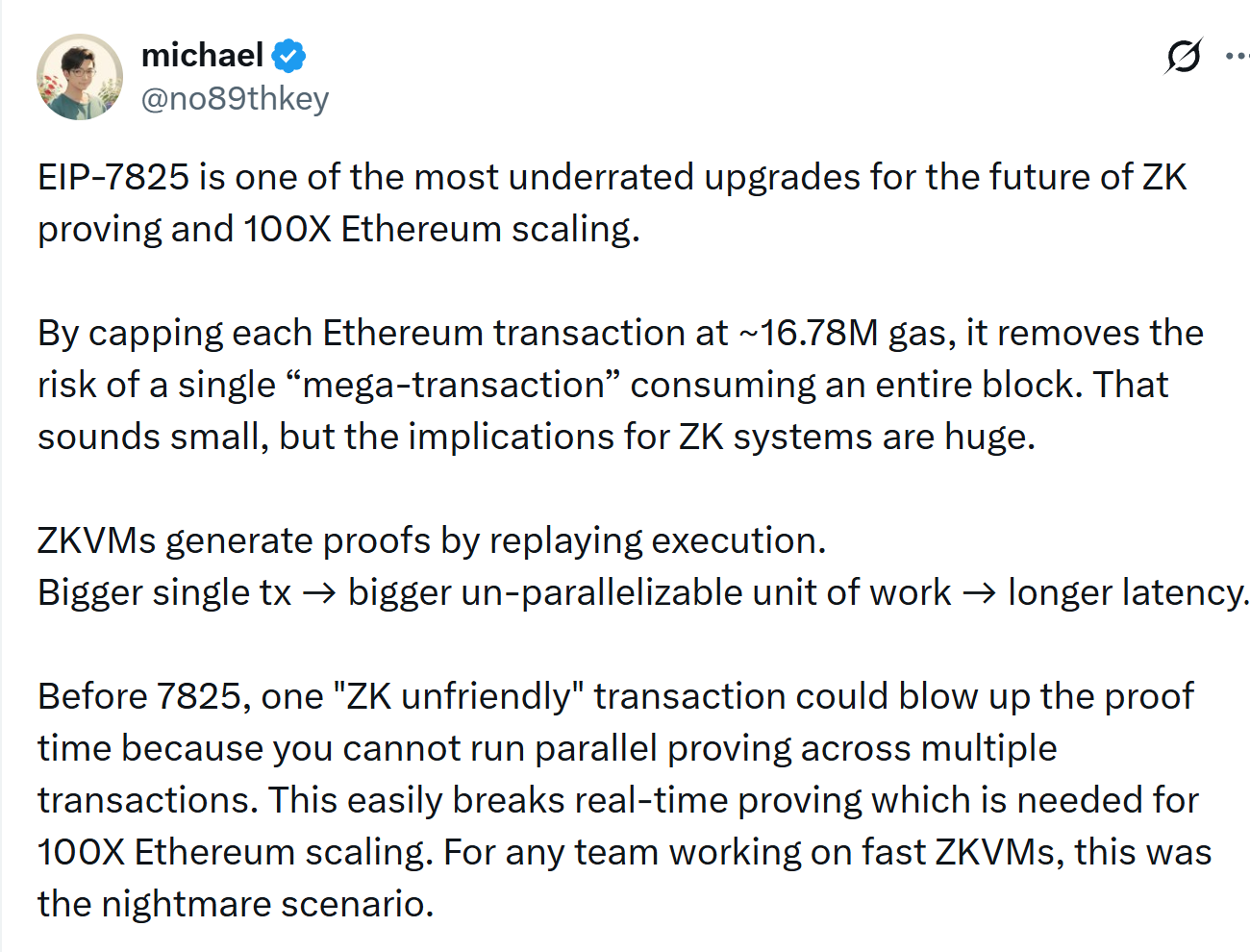
Indeed, cheaper L2s are a good thing, but for Ethereum's long-term ZK roadmap, EIP-7825 is the real game-changer because it sets a Gas limit for a single transaction on Ethereum (about 16.78 million Gas).

As we all know, Ethereum's block Gas Limit has been increased to 60 million this year. But even as the upper limit continues to rise, theoretically, if someone is willing to pay an extremely high Gas Price, they could still send a super-complex "Mega-Transaction" that directly occupies the entire block's 60 million Gas capacity, thereby clogging the entire block.

This was allowed before, but EIP-7825 introduces a new restriction: no single transaction can consume more than 16.78 million Gas, regardless of the block size.

So why limit the size of a single transaction? Actually, this change has no impact on ordinary user transfers, but for ZK Provers (proof generators), it is a matter of life and death, and it is also closely related to how ZK systems generate proofs.

To give a simple example, before EIP-7825, if a block contained a "Mega-Transaction" consuming 60 million Gas, the ZK Prover had to run this extremely complex transaction sequentially—it couldn't be split or parallelized. This is like a single-lane highway where a giant truck is driving extremely slowly in front, and all the cars behind (other transactions) have to wait for it to pass.

This undoubtedly sentenced "real-time proof" to death—because the time to generate the proof becomes completely unpredictable, potentially taking dozens of minutes or even longer.

After EIP-7825, even if the block capacity expands to 100 million Gas in the future, since each transaction is forcibly limited to within 16.78 million Gas, each block is broken down into predictable, bounded, and parallelizable "small task units." This means that Ethereum's proof generation has changed from a tricky "logical puzzle" to a pure "money problem":

As long as enough parallel computing power can be invested, we can process these split small tasks simultaneously in an extremely short time, thereby generating ZK proofs for huge blocks.

As Michael, co-founder and CEO of Brevis, said, EIP-7825 is the most underestimated upgrade on the future path of ZK and Ethereum's 100x scaling. It turns "real-time proof" from "theoretically impossible" to "engineerable," as long as we can solve the computing power problem through parallel computing. Even a 200 million Gas block could achieve second-level proofs. This is not only a breakthrough in ZK technology but also the physical foundation for Ethereum's Interoperability Layer (EIL) to achieve second-level cross-chain settlement.

So this upgrade may not seem like the main event, but it is actually a huge breakthrough for the ZK roadmap and Ethereum's scaling future in 2026.

II. L1 zkEVM: The "Trust Anchor" for Ethereum Interoperability

However, although EIP-7825 paves the physical path (parallelizability) for real-time proofs by limiting the size of single transactions, this is only one side of the coin. The other side is how the Ethereum mainnet itself utilizes this capability?

This involves the most hardcore narrative in Ethereum's roadmap—L1 zkEVM.

For a long time, zkEVM has been regarded as the "holy grail" for scaling Ethereum, not only because it can solve performance bottlenecks but also because it redefines the trust mechanism of blockchain. Its core idea is to enable the Ethereum mainnet to generate and verify ZK proofs.

In other words, in the future, after each Ethereum block is executed, it can output a verifiable mathematical proof, allowing other nodes (especially light nodes and L2s) to confirm the correctness of the result without recalculating—if the ability to generate ZK proofs is directly written into the Ethereum protocol layer (L1), the proposer (Proposer) packs a block and generates a ZK proof, and the verifying nodes no longer need to rerun the transactions; they only need to verify this tiny mathematical proof.

What does this mean for interoperability?

In the context of Interop, the significance of L1 zkEVM far exceeds scaling itself. It can be said to be the "trust anchor" for all L2s. After all, if Ethereum L1 can generate proofs in real time, it means that all L2s can read L1's final state in real time and trustlessly. This will bring about two qualitative changes:

  • Eliminate the challenge period: The confirmation time between chains will be compressed from "7 days (OP mechanism)" to "seconds (ZK mechanism)";

  • Decentralized interconnection: Cross-chain will no longer require trust in third-party multi-signature bridges but will trust the mathematical truth of the Ethereum mainnet;

This is also the physical foundation we mentioned in the previous article for EIL (Interoperability Layer) to truly work—without L1's real-time finality, interoperability between L2s will never escape the shadow of "delay."

The goal is set (L1 zkEVM), and the physical limitations are removed (EIP-7825), but what about the specific implementation tools?

This leads to the subtle evolution happening in the ZK technology stack: from zkEVM to zkVM.

III. Fusaka & EIP-7825: The Interoperability Roadmap is Liberated

If EIP-7825 provides a "parallelizable hardware environment" for ZK by limiting the size of single transactions, then the evolution of the ZK technology stack is to find a "more efficient software architecture." This may sound like a tongue twister, but the difference is significant and represents two stages of ZK development (extended reading: "ZK Route 'Dawn Moment': Is Ethereum's Endgame Roadmap Accelerating Comprehensively?").

The first stage is naturally zkEVM, which can be regarded as the compatibility faction or the reformist faction.

The logic is to strive to imitate every instruction of the Ethereum EVM, allowing developers to deploy Solidity code directly, reducing migration costs and barriers.

In other words, the biggest advantage of zkEVM is its compatibility with existing Ethereum applications, greatly reducing the workload for Ethereum ecosystem developers. They can reuse most of the existing infrastructure and tools (including execution clients, block explorers, debugging tools, etc.).

However, precisely because of this, since the EVM was not designed with ZK-friendliness in mind, for the sake of compatibility, zkEVM's proof efficiency often has a ceiling, and the proof time is much slower, with a heavy historical burden.

zkVM, on the other hand, belongs to the radical revolutionary faction, directly building a virtual machine that is extremely friendly to ZK proofs (such as based on RISC-V or WASM) to speed up proof time and achieve better execution speed and performance.

But it also loses compatibility with many EVM features and the ability to use existing tools (such as low-level debuggers). However, a clear trend is that more and more L2 projects are shedding their burdens, optimizing proof speed and cost to the extreme, and exploring architectures based on zkVM.

So why is the Fusaka upgrade the unlocker?

After all, before EIP-7825, whether it was zkEVM or zkVM, once they encountered a Mega-Transaction on Ethereum, the proof generation time would skyrocket due to the inability to split tasks.

Now, EIP-7825 forcibly breaks down transactions into predictable small units. With a parallelizable environment, an efficient architecture like zkVM can exert its maximum power. Even complex Ethereum blocks, when placed in a zkVM and combined with parallel computing power, can achieve real-time proofs.

What does this mean for interoperability? The proliferation of zkVM combined with EIP-7825 means that the cost of generating proofs will drop significantly. When the cost of generating a cross-chain proof is low enough to be negligible and the speed is as fast as sending an email, traditional "cross-chain bridges" will completely disappear, replaced by underlying universal message protocols.

In Conclusion

As repeatedly mentioned in previous articles of the Interop series, the ultimate goal of Interop is not just asset "cross-chain," nor is it limited to the concept of "asset bridges" anymore. It is a set of system-level capabilities, including cross-chain data communication, cross-chain logic execution, cross-chain user experience, cross-chain security, and consensus.

From this perspective, Interop can be understood as the universal language between future Ethereum ecosystem protocols. Its significance lies not only in transmitting value but also in sharing logic. The role of ZK in this is to guarantee execution correctness and support real-time state verification, making cross-domain calls "dare to do, able to do." It can even be said that without real-time ZK, it is difficult to have truly usable Interop UX.

So when EIP-7825 was quietly activated in the Fusaka upgrade, and as L1 zkEVM gradually becomes a reality, we are getting closer to that endgame: execution, settlement, and proof are completely abstracted in the background, and users are completely unaware of the existence of chains throughout the process.

This is the Interop endgame we all look forward to in the future.

Связанные с этим вопросы

QWhat is the significance of EIP-7825 in the Fusaka upgrade for Ethereum's interoperability?

AEIP-7825 introduces a per-transaction gas limit of approximately 16.78 million gas, which prevents 'mega-transactions' from blocking the entire block. This allows ZK provers to process transactions in parallel, making real-time proof generation for large blocks feasible and paving the way for instant cross-chain settlements in Ethereum's interoperability layer (EIL).

QHow does L1 zkEVM serve as a 'trust anchor' for Ethereum's interoperability?

AL1 zkEVM enables Ethereum mainnet to generate and verify ZK proofs for its own blocks. This allows L2s to read L1's finalized state in real-time without trust assumptions, eliminating challenge periods (e.g., reducing from 7 days to seconds) and enabling decentralized cross-chain interactions without relying on third-party bridges.

QWhat is the key difference between zkEVM and zkVM in the context of ZK technology evolution?

AzkEVM focuses on compatibility with Ethereum's EVM, allowing developers to reuse existing tools and infrastructure but often at the cost of slower proof generation due to EVM's ZK-unfriendly design. zkVM prioritizes proof efficiency and performance by building a ZK-friendly virtual machine (e.g., based on RISC-V or WASM), sacrificing some EVM compatibility for faster execution and lower costs.

QHow does EIP-7825 combined with zkVM architecture improve interoperability?

AEIP-7825 breaks down transactions into small, parallelizable units, while zkVM provides an efficient architecture for proof generation. Together, they drastically reduce the cost and time required to generate cross-chain proofs, making traditional bridges obsolete and enabling seamless, instant cross-chain communication at the protocol level.

QWhat is the ultimate goal of Interop (interoperability) in the Ethereum ecosystem according to the article?

AThe ultimate goal of Interop is not just cross-chain asset transfers but a comprehensive system-level capability that includes cross-chain data communication, logic execution, user experience, security, and consensus. It aims to create a universal language for Ethereum protocols, enabling value transfer and logic sharing with real-time state verification powered by ZK technology, all abstracted away from end-users for a seamless experience.

Похожее

MoneyGram: Why Did We Launch Our Own Stablecoin?

MoneyGram, a global leader in cross-border remittances for over 80 years, has launched its own stablecoin, MGUSD. The initiative aims to evolve from single-transaction services to becoming a more integral part of users' financial lives. By allowing customers to hold a stable US dollar balance within the MoneyGram app, MGUSD enables not only remittances but also everyday spending, currency exchange, cash access, and future financial services. Targeting the billions globally who face challenges like currency volatility or lack of bank accounts, MGUSD leverages Stellar blockchain technology with a self-custody wallet architecture. This gives users control over their assets while providing a secure, compliant experience through a trusted brand. The approach focuses on solving existing customer pain points within MoneyGram's established network, rather than competing for broad crypto market liquidity. A key advantage is MoneyGram's hybrid model, combining digital services with the world's largest physical network for crypto-to-cash conversions. The stablecoin also modernizes the company's internal infrastructure, streamlining treasury management and partner settlements, with annual forex volume via stablecoins already reaching $2 billion. The project was delivered in about a year, driven by a reorganization into agile, cross-functional teams that operate with startup-like speed while leveraging decades of institutional expertise. Partners include Stablecoin (issuance), Crossmint (wallet APIs), Fireblocks (enterprise treasury), m0 (smart contracts), and the Stellar network. MoneyGram emphasizes that enhancing direct consumer offerings strengthens its partner ecosystem. The future direction is clear: to provide users worldwide with stable value storage, better financial tools, and greater control over their funds through a trusted, existing network.

Foresight News25 мин. назад

MoneyGram: Why Did We Launch Our Own Stablecoin?

Foresight News25 мин. назад

BIP-110 Controversy Intensifies: Bitcoin May Face Its Most Divisive Hard Fork Battle in Years

Bitcoin is approaching a critical block height of 961,632, which could activate the controversial BIP-110 proposal. This proposal aims to restrict the amount of non-financial data, such as inscriptions and other large data payloads, within Bitcoin transactions. Supporters, including some node operators and Bitcoin purists, argue that BIP-110 is necessary to preserve Bitcoin's core function as a monetary settlement layer by reducing network congestion and node operational burdens caused by non-essential data. They frame it as a correction to keep the network true to its original purpose. However, critics, including prominent figures like Blockstream's Adam Back and developer Jameson Lopp, warn that the proposal's implementation mechanism is dangerously flawed. They highlight that its low 55% miner signaling threshold, coupled with a contentious enforcement mechanism allowing nodes to unilaterally reject non-compliant blocks, significantly increases the risk of a chain split. Opponents argue this sets a dangerous precedent for transaction censorship, undermines Bitcoin's protocol neutrality, and creates excessive uncertainty for developers and businesses, especially since the rule is proposed as a temporary one-year measure. Market analysts, such as those from Bitfinex, suggest a full-scale network split is unlikely due to a lack of broad economic consensus. Major mining pools remain neutral, and adoption of the new rules is minimal. They view the situation more as a governance stress test. The primary risk is operational disruption: if a minority chain persists, major exchanges and custodians may need to temporarily suspend Bitcoin deposits and withdrawals to manage security and liquidity, potentially unsettling newer institutional investors. While BIP-110 is not expected to succeed in overtaking the main chain, its approach has ignited a significant debate about Bitcoin's governance, core values, and resilience.

Foresight News1 ч. назад

BIP-110 Controversy Intensifies: Bitcoin May Face Its Most Divisive Hard Fork Battle in Years

Foresight News1 ч. назад

NEAR to Airdrop 330,000 Tokens, Betting on TVL Reaching $70 Million

On June 11th, NEAR Protocol launched the Near@3.33 Milestone Incentive Program, targeting users of its Confidential Intents privacy cross-chain execution feature. The program will distribute 333,333 milestone tokens when the Confidential Intents Total Value Locked (TVL) reaches $70 million. Users must have conducted Confidential transactions on near.com and maintain a Confidential balance above $100 in any asset to qualify, with a single wallet capped at 2% of the current airdrop pool. The milestone tokens will be locked upon receipt and cannot be sold or transferred. They can only be converted 1:1 to NEAR tokens once NEAR's Volume Weighted Average Price (VWAP) maintains $3.33 or higher for three consecutive trading days. As of the report, Confidential Intents TVL exceeds $20.69 million, needing roughly a 3x increase to trigger the airdrop. Confidential Intents, launched in February 2026, is NEAR's privacy execution layer designed to prevent MEV, front-running, and strategy leaks by building confidentiality directly into the execution environment. Its TVL has grown from zero to approximately $15 million in about three months. NEAR token price, which surged from around $1 in April to a peak of $3.08, currently trades near $2. The program aims to boost user activity for Confidential Intents, with future incentive rounds planned as community engagement increases.

Foresight News2 ч. назад

NEAR to Airdrop 330,000 Tokens, Betting on TVL Reaching $70 Million

Foresight News2 ч. назад

Crypto Market Makers Are Collectively Seeking Change as Money Becomes Harder to Earn

**Summary: Crypto Market Makers Adapt as Margins Shrink** Leading crypto market maker GSR exemplifies a broader industry shift, moving beyond traditional market-making to become a full-service "Web3 investment bank." Its recent strategic acquisitions—including an SEC-registered broker-dealer, rebranded as GSR Securities—and purchases of token advisory firms aim to create an integrated platform covering token design, fundraising, listing, liquidity provision, and asset management. This includes launching an ETF and investing in tokenization platforms like Libeara, backed by a strategic investment from Standard Chartered's SC Ventures. This transformation is not unique to GSR. Other major players like Keyrock, B2C2, Wintermute, and DWF Labs are also expanding geographically, pursuing regulatory licenses (especially under frameworks like MiCA in the EU), and diversifying into over-the-counter (OTC) trading, asset management, and real-world asset tokenization. The driving force behind this collective pivot is a rapidly changing market. Profits from traditional altcoin market-making are declining due to fewer viable projects, reduced client budgets, increased competition, and smarter, more demanding clients. Simultaneously, regulatory pressures are mounting, making compliance a baseline cost. Extreme market events further expose teams lacking robust risk controls. Consequently, the crypto market-making business model is evolving from one reliant on information asymmetry and volatility to a more institutionalized, regulated, and service-diverse industry. Survival now depends on building systemic capabilities beyond mere liquidity provision.

marsbit2 ч. назад

Crypto Market Makers Are Collectively Seeking Change as Money Becomes Harder to Earn

marsbit2 ч. назад

Торговля

Спот
Фьючерсы

Популярные статьи

Как купить SFP

Добро пожаловать на HTX.com! Мы сделали приобретение SafePal (SFP) простым и удобным. Следуйте нашему пошаговому руководству и отправляйтесь в свое крипто-путешествие.Шаг 1: Создайте аккаунт на HTXИспользуйте свой адрес электронной почты или номер телефона, чтобы зарегистрироваться и бесплатно создать аккаунт на HTX. Пройдите удобную регистрацию и откройте для себя весь функционал.Создать аккаунтШаг 2: Перейдите в Купить криптовалюту и выберите свой способ оплатыКредитная/Дебетовая Карта: Используйте свою карту Visa или Mastercard для мгновенной покупки SafePal (SFP).Баланс: Используйте средства с баланса вашего аккаунта HTX для простой торговли.Третьи Лица: Мы добавили популярные способы оплаты, такие как Google Pay и Apple Pay, для повышения удобства.P2P: Торгуйте напрямую с другими пользователями на HTX.Внебиржевая Торговля (OTC): Мы предлагаем индивидуальные услуги и конкурентоспособные обменные курсы для трейдеров.Шаг 3: Хранение SafePal (SFP)После приобретения вами SafePal (SFP) храните их в своем аккаунте на HTX. В качестве альтернативы вы можете отправить их куда-либо с помощью перевода в блокчейне или использовать для торговли с другими криптовалютами.Шаг 4: Торговля SafePal (SFP)С легкостью торгуйте SafePal (SFP) на спотовом рынке HTX. Просто зайдите в свой аккаунт, выберите торговую пару, совершайте сделки и следите за ними в режиме реального времени. Мы предлагаем удобный интерфейс как для начинающих, так и для опытных трейдеров.

241 просмотров всегоОпубликовано 2026.05.22Обновлено 2026.06.02

Как купить SFP

Как купить CTR

Добро пожаловать на HTX.com! Мы сделали приобретение Citrea (CTR) простым и удобным. Следуйте нашему пошаговому руководству и отправляйтесь в свое крипто-путешествие.Шаг 1: Создайте аккаунт на HTXИспользуйте свой адрес электронной почты или номер телефона, чтобы зарегистрироваться и бесплатно создать аккаунт на HTX. Пройдите удобную регистрацию и откройте для себя весь функционал.Создать аккаунтШаг 2: Перейдите в Купить криптовалюту и выберите свой способ оплатыКредитная/Дебетовая Карта: Используйте свою карту Visa или Mastercard для мгновенной покупки Citrea (CTR).Баланс: Используйте средства с баланса вашего аккаунта HTX для простой торговли.Третьи Лица: Мы добавили популярные способы оплаты, такие как Google Pay и Apple Pay, для повышения удобства.P2P: Торгуйте напрямую с другими пользователями на HTX.Внебиржевая Торговля (OTC): Мы предлагаем индивидуальные услуги и конкурентоспособные обменные курсы для трейдеров.Шаг 3: Хранение Citrea (CTR)После приобретения вами Citrea (CTR) храните их в своем аккаунте на HTX. В качестве альтернативы вы можете отправить их куда-либо с помощью перевода в блокчейне или использовать для торговли с другими криптовалютами.Шаг 4: Торговля Citrea (CTR)С легкостью торгуйте Citrea (CTR) на спотовом рынке HTX. Просто зайдите в свой аккаунт, выберите торговую пару, совершайте сделки и следите за ними в режиме реального времени. Мы предлагаем удобный интерфейс как для начинающих, так и для опытных трейдеров.

235 просмотров всегоОпубликовано 2026.05.25Обновлено 2026.06.02

Как купить CTR

Обсуждения

Добро пожаловать в Сообщество HTX. Здесь вы сможете быть в курсе последних новостей о развитии платформы и получить доступ к профессиональной аналитической информации о рынке. Мнения пользователей о цене на A (A) представлены ниже.

活动图片