Hot Interactions Collection | xStocks Points Event Now Live; Tempo Mainnet Launches (March 25)

Odaily星球日报Опубликовано 2026-03-25Обновлено 2026-03-25

Введение

This article highlights three major interactive opportunities in the crypto space: 1. **xStocks**: A tokenized stock platform backed by Kraken, allowing users to trade tokenized versions of real-world assets. It recently launched an xPoints rewards program where users can earn points by holding tokenized stocks, borrowing/lending, and providing liquidity. Users can connect their wallet, complete daily check-ins, and join the Telegram for bonus points. 2. **Tempo**: A payment-focused Layer 1 blockchain incubated by Stripe and Paradigm. Unlike typical blockchains, it uses stablecoins like USDC/USDT for gas fees. After raising $500M in funding, it has now launched its mainnet. Users can create a wallet using a passkey and bridge USDC to the Tempo network via Stargate. 3. **Forte Protocol**: A blockchain infrastructure project focused on compliance and economic tools, which raised $910M in 2021. It has launched two Galxe quests: one for social media tasks (X account required) and another for Galxe subscribers or users with a high Human Passport score.

Original | Odaily Planet Daily (@OdailyChina)

Author | Asher (@Asher_ 0210)

xStocks: U.S. Stock Tokenization Platform

Project Introduction

Backed Finance is an infrastructure provider responsible for issuing on-chain representations of traditional financial assets, including stocks, ETFs, and bonds. The company was acquired by Kraken in December 2025 and launched xStocks in June of the same year, offering tokenized stock products backed by real stocks held by Swiss custody partners. Currently, xStocks is integrated into multiple centralized platforms, including Kraken, Gate, Bybit, and Bitget, and supports Ethereum, Solana, and Tron.

On March 11, xStocks announced on platform X the launch of the xPoints rewards program. On March 18, it announced that points (xPoints) are now viewable. Users automatically accumulate points by holding tokenized stocks in their wallets, establishing positions in lending markets, and providing liquidity on DEXs.

Interaction Tutorial

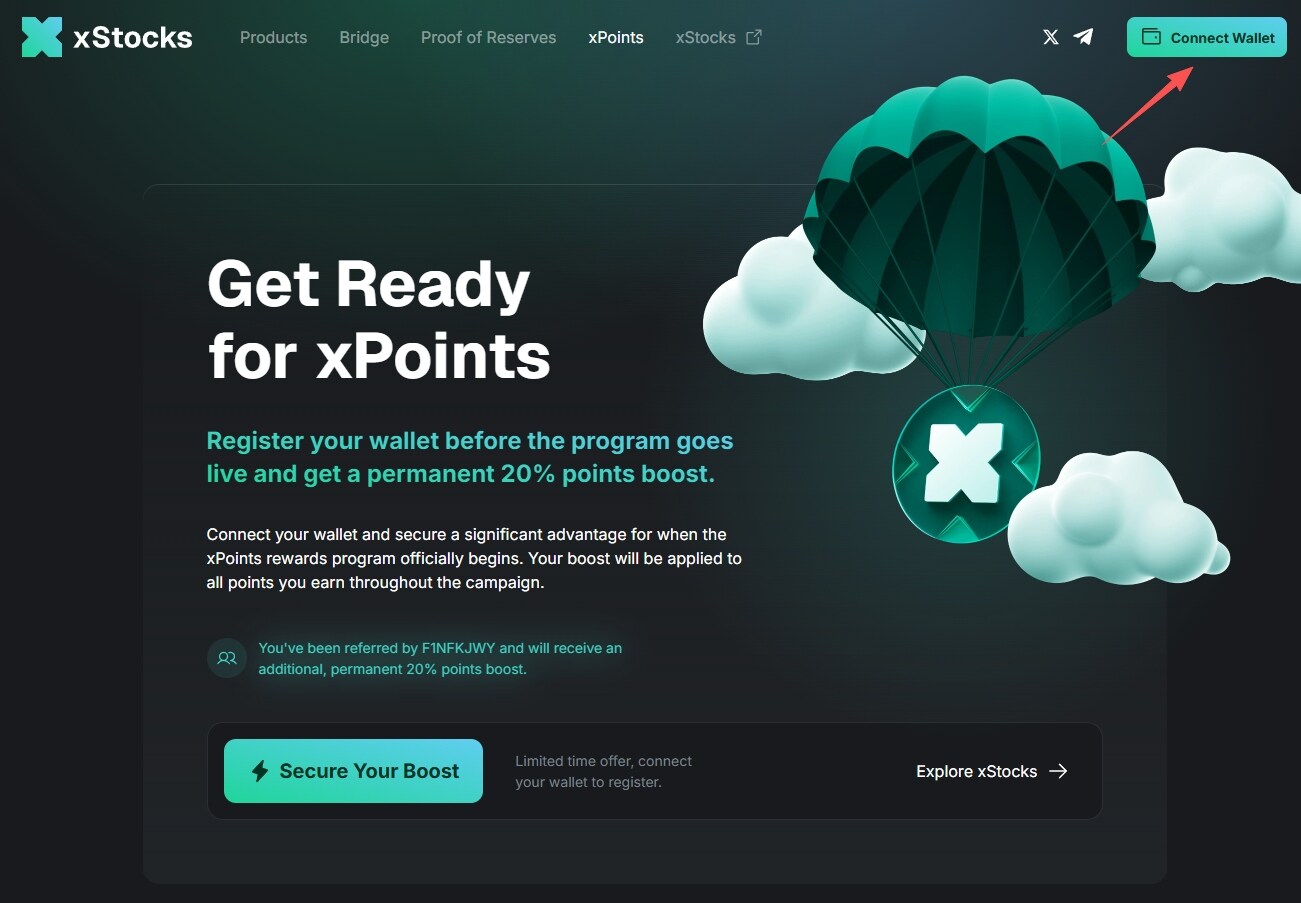
STEP 1. Go to the official website (Link: https://defi.xstocks.fi/points), click "Connect Wallet" to log in.

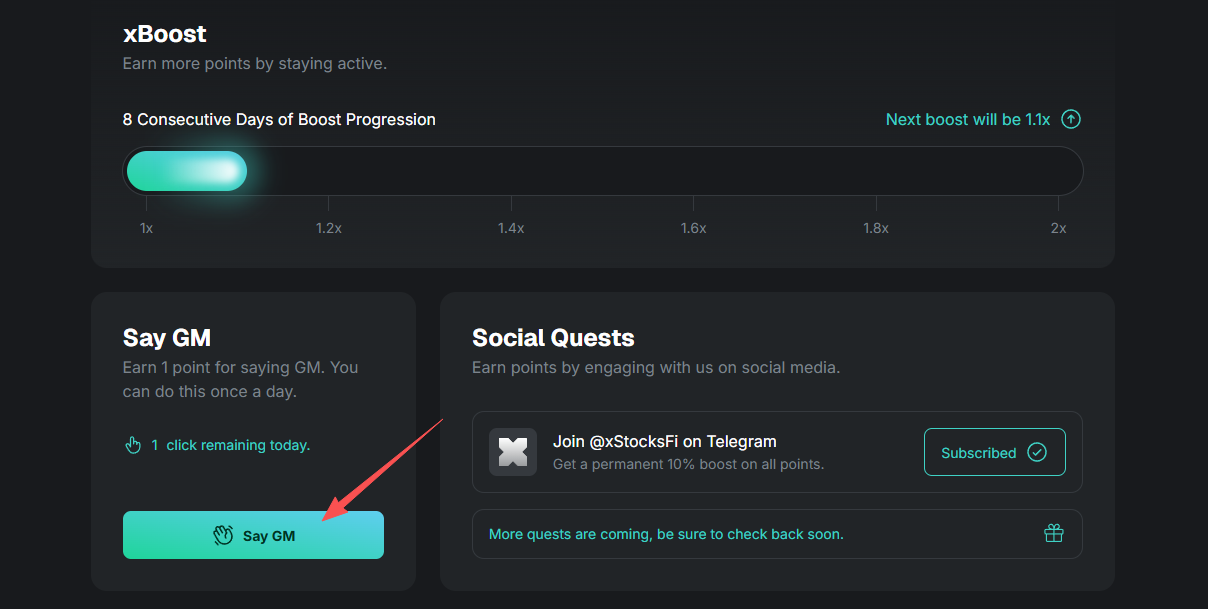
STEP 2. Click GM (daily check-in type task) to earn points. Additionally, joining the official TG and verifying will grant a 10% points bonus.

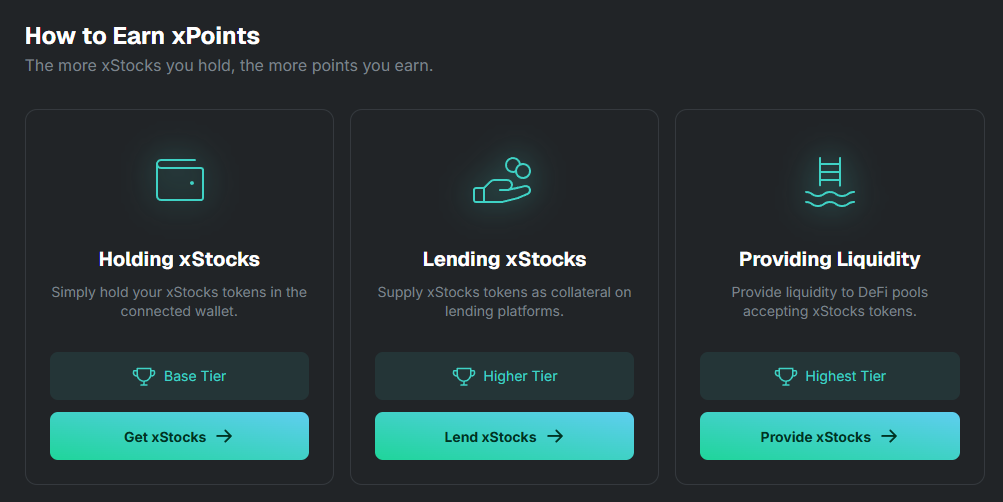
STEP 3. Earn points through three main methods: holding xStocks tokens, borrowing xStocks tokens, and providing liquidity for xStocks tokens, with increasing weight for each method.

Tempo: L1 Project Focused on the Payments Track

Project Introduction

Tempo is an L1 project focused on payments, jointly incubated by Stripe and Paradigm. Its biggest difference from traditional public chains is that it does not issue its own native token but directly accepts mainstream stablecoins like USDC and USDT as Gas.

According to ROOTDATA data, Tempo completed a $500 million Series A funding round on October 8, 2025, led by venture capital giants Greenoaks and Joshua Kushner's Thrive Capital. This round valued Tempo at $5 billion, with participation from Sequoia Capital, Ribbit Capital, and Ron Conway's SV Angel.

On March 18, Tempo announced the launch of its mainnet, marking the official transition of its stablecoin payment system from the testing phase to practical application.

Interaction Tutorial

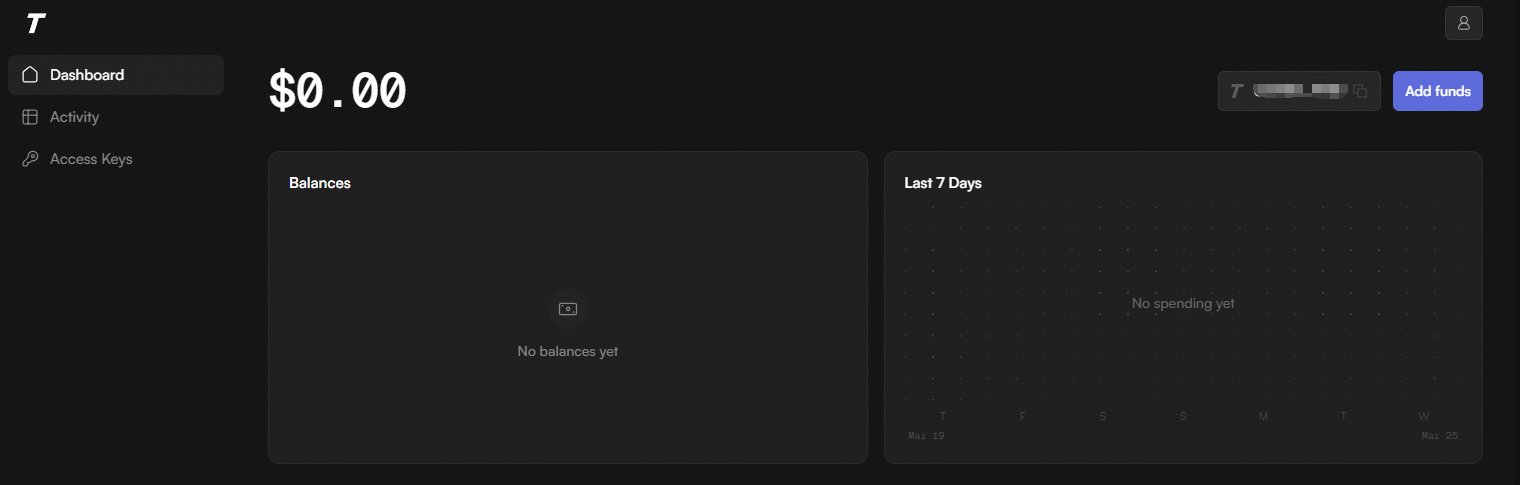
STEP 1. Create a Tempo wallet (Link: https://wallet.tempo.xyz/welcome) by logging in using your computer/phone's Passkey.

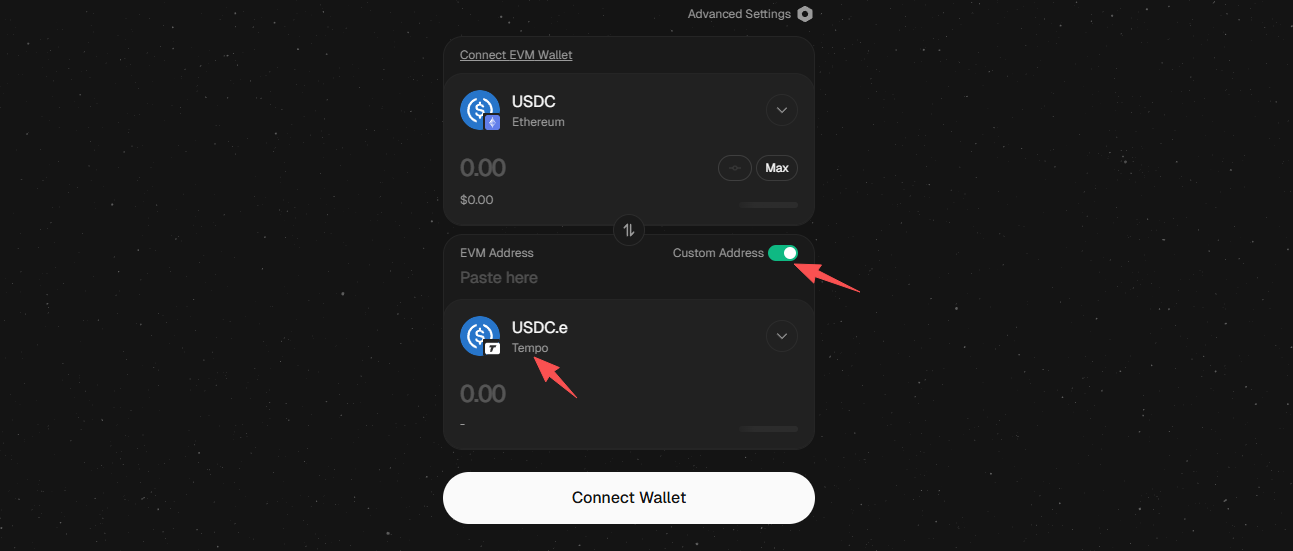
STEP 2. Bridge USDC (Link: https://stargate.finance/). Select USDC, choose the Tempo network as the destination chain, select "Custom address" for the recipient address, paste the newly created Tempo wallet address, and confirm the bridge.

Forte Protocol: Blockchain Infrastructure Focused On-Chain Compliance and Economic Tools

Project Introduction

The Forte Protocol project was established in 2018. It is a set of open-source on-chain compliance and economic rule engines, providing open-source on-chain solutions aimed at creating a secure environment to support healthy and stable digital asset economies. Its trust and privacy protection solutions enable developers to manage compliance risks, promote economic stability, and leverage instant liquidity.

According to ROOTDATA data, Forte Protocol completed two funding rounds as early as 2021, raising a total of $910 million.

Recently, Forte Protocol launched Season 0 tasks on Galxe. Currently, there are 2 tasks available to participate in.

Interaction Tutorial

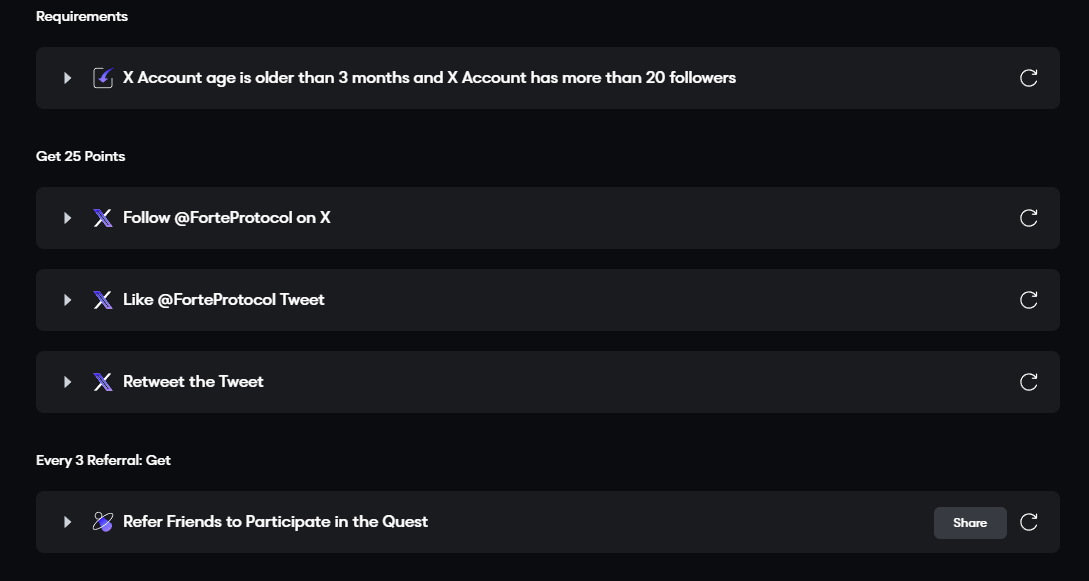
Galxe Task One: Spread the Word (Link: https://app.galxe.com/quest/ForteProtocol/GCHxctYayA?referral_code=GRFr2JLgLym0F_CjZtICIKop6-k3a5AWWjkhuI2Kg5uvmw): X account must be older than 3 months with more than 20 followers, and complete social tasks.

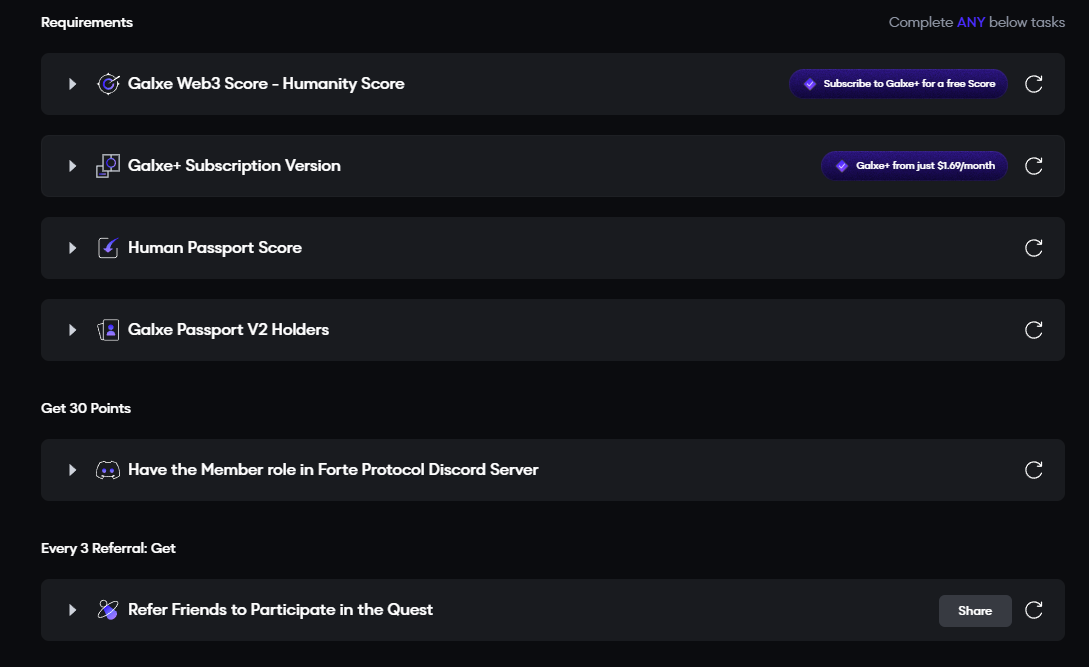
Galxe Task Two: (Link: https://app.galxe.com/quest/ForteProtocol/GCLHFtYfPg?referral_code=GRFr2JPsJmm0Fjrq5tICIKopwKZDR_ow6bG-TQ5tpNQM1dw): Requires a Galxe subscription membership or a Human Passport score that meets the requirements.

Связанные с этим вопросы

QWhat is xStocks and what recent activity did they launch?

AxStocks is a tokenized stock platform that provides on-chain representations of traditional financial assets like stocks, ETFs, and bonds, backed by real stocks held by Swiss custodians. They recently launched an xPoints points program where users can earn points by holding tokenized stocks, establishing positions in lending markets, and providing liquidity on DEXs.

QWhich major exchange acquired Backed Finance, the company behind xStocks?

AKraken acquired Backed Finance in December 2025.

QWhat is Tempo and what makes it different from traditional blockchains?

ATempo is a payment-focused Layer 1 blockchain project incubated by Stripe and Paradigm. Unlike traditional blockchains, it does not have a native token and instead uses mainstream stablecoins like USDC and USDT for gas fees.

QHow much funding did Tempo raise in its Series A round and what was it valued at?

ATempo raised $500 million in its Series A funding round, which valued the company at $5 billion.

QWhat is Forte Protocol and what type of tasks did they recently launch on Galxe?

AForte Protocol is a blockchain infrastructure project focused on on-chain compliance and economic tools. They recently launched 'Season 0' tasks on Galxe, including a 'Spread the Word' social media task and another task requiring a Galxe subscription or a specific Human Passport score.

Похожее

From Banning Doubao to Embracing Honor: Why Did WeChat Suddenly 'Change Its Face'?

The article explores the sudden shift in WeChat's strategy towards AI assistants from mobile phone manufacturers, transitioning from strict opposition to active collaboration. For over a year, WeChat fiercely resisted attempts by phone AI assistants (like ByteDance's Doubao in late 2025) to control its features via GUI automation ("simulated clicking"), citing security and data control concerns. This stance created a significant barrier for system-level AI integration. Now, Tencent has initiated A2A (Agent-to-Agent) partnerships with major phone brands like Honor, Xiaomi, OPPO, and vivo. This model allows a phone's system AI (e.g., Honor's YOYO) to parse a user's voice command and send a structured request directly to WeChat's own internal AI agent via secure APIs. WeChat then executes the action (e.g., sending a message) and returns the result. The article attributes Tencent's "change of face" to strategic pressure. While leading in social app usage, Tencent trails rivals like ByteDance and Alibaba in standalone AI app popularity. WeChat, with its vast mini-program ecosystem, is Tencent's key asset for an AI comeback. The upcoming WeChat AI agent aims to handle tasks like booking and payments within the app. However, phone system assistants remain the primary AI entry point for most users. The A2A collaboration allows Tencent to extend WeChat's AI reach to this crucial system layer while maintaining control over its core functions and data. For phone manufacturers, embracing A2A is a pragmatic move. The GUI route proved unviable due to WeChat's blocks. A2A offers a compliant path to integrate a vital service, enhancing their AI assistants' usefulness. It allows them to focus on developing their own AI ecosystems for other services while cooperating on WeChat access. The collaboration is framed as a mutual, strategic necessity: Tencent gains a distribution channel, and manufacturers gain a key functionality. The partnership relies on a "dual authorization" mechanism for security, requiring both user and app consent for each action. While questions about long-term data privacy practices remain, experts note A2A is more secure and compliant than GUI automation. Ultimately, this cooperation is seen as a tentative, calculated truce. Tencent's long-term goal is to make WeChat an AI-powered "service OS." Phone manufacturers aim to make their system AI the central user interface. Their paths may converge or clash in the future, but for now, the A2A deal represents the opening chapter in the battle for the AI-era user入口, driven by necessity and strategic calculus on both sides.

marsbit53 мин. назад

From Banning Doubao to Embracing Honor: Why Did WeChat Suddenly 'Change Its Face'?

marsbit53 мин. назад

On-Chain Figures on the Eve of Kickoff: 1.6 Billion Traded Before the World Cup Even Begins

"On-Chain Numbers on the Eve of the World Cup: $1.6 Billion Traded Before Kick-off" Analysis of on-chain markets before the 2026 FIFA World Cup reveals significant crypto integration into football. The most striking figure is the approximately **$1.6 billion** in total trading volume on the single "World Cup Winner" contract on the Polymarket prediction market platform, accumulated before a single match was played. This represents explosive growth for a sector whose annual volume surged from ~$16B in 2024 to ~$64B in 2025. The ecosystem is maturing beyond speculation. Key developments include: 1) **Infrastructure upgrades** like Polymarket's migration to native, regulated USDC stablecoin for settlements; 2) **Reliable data oracles**, such as Chainlink, being used to resolve real-world match outcomes on-chain; and 3) **Official recognition**, with FIFA appointing its first-ever "Prediction Markets" partner. Over 100 contracts now cover everything from the outright winner to individual match results and even non-sporting risks like venue relocation. This evolution marks a fundamental shift. While crypto firms are absent from FIFA's top-tier sponsor list, the technology has deeply penetrated the tournament's financial and predictive infrastructure through regulated stablecoin settlements, decentralized oracles, and new official partnership categories. The regulatory landscape remains complex and varies by jurisdiction, but on-chain markets for the World Cup are already a multi-billion-dollar reality.

marsbit1 ч. назад

On-Chain Figures on the Eve of Kickoff: 1.6 Billion Traded Before the World Cup Even Begins

marsbit1 ч. назад

From SpaceX's IPO to the Future of Crypto: Which Crypto Sectors Will Host the Trillion-Dollar Narrative?

From the SpaceX IPO, which targets a $750 billion raise at a $1.77 trillion valuation, we can extrapolate capital flow trends relevant to crypto. The focus shifts from speculative narratives to foundational infrastructure and real-world asset (RWA) integration. Key crypto sectors poised to benefit include: 1. **AI Infrastructure**: The narrative is moving from consumer-facing AI applications to underlying, scarce resources like compute power and decentralized GPU networks (e.g., TAO, RENDER, AKT, IO). These protocols are positioning as the essential "picks and shovels" providers for the AI economy. 2. **Real-World Assets (RWA)**: Beyond tokenized treasury bonds, RWA's future lies in on-chain equity and pre-IPO assets like SpaceX. This could democratize access to high-growth assets and reshape global capital flows, benefiting infrastructure projects like ONDO, LINK, and Plume that facilitate issuance, data, and liquidity. 3. **Core Financial Infrastructure**: Stablecoins, payment networks, and DePIN (Decentralized Physical Infrastructure Networks) are critical for settling the future on-chain economy. Their role expands from internal trading tools to foundational layers for global finance, AI systems, and real-world asset networks, leading to potential value reassessment. In summary, the next cycle may prioritize long-term infrastructure value—AI compute, asset tokenization networks, and settlement layers—over short-lived application hype, mirroring the broader market's shift towards funding the foundational systems of the future.

marsbit2 ч. назад

From SpaceX's IPO to the Future of Crypto: Which Crypto Sectors Will Host the Trillion-Dollar Narrative?

marsbit2 ч. назад

Торговля

Спот
Фьючерсы
活动图片