Hormuz Blockade, Oil Prices Surpass $100, Why Aren't U.S. Stocks Falling?

marsbitОпубликовано 2026-04-14Обновлено 2026-04-14

Введение

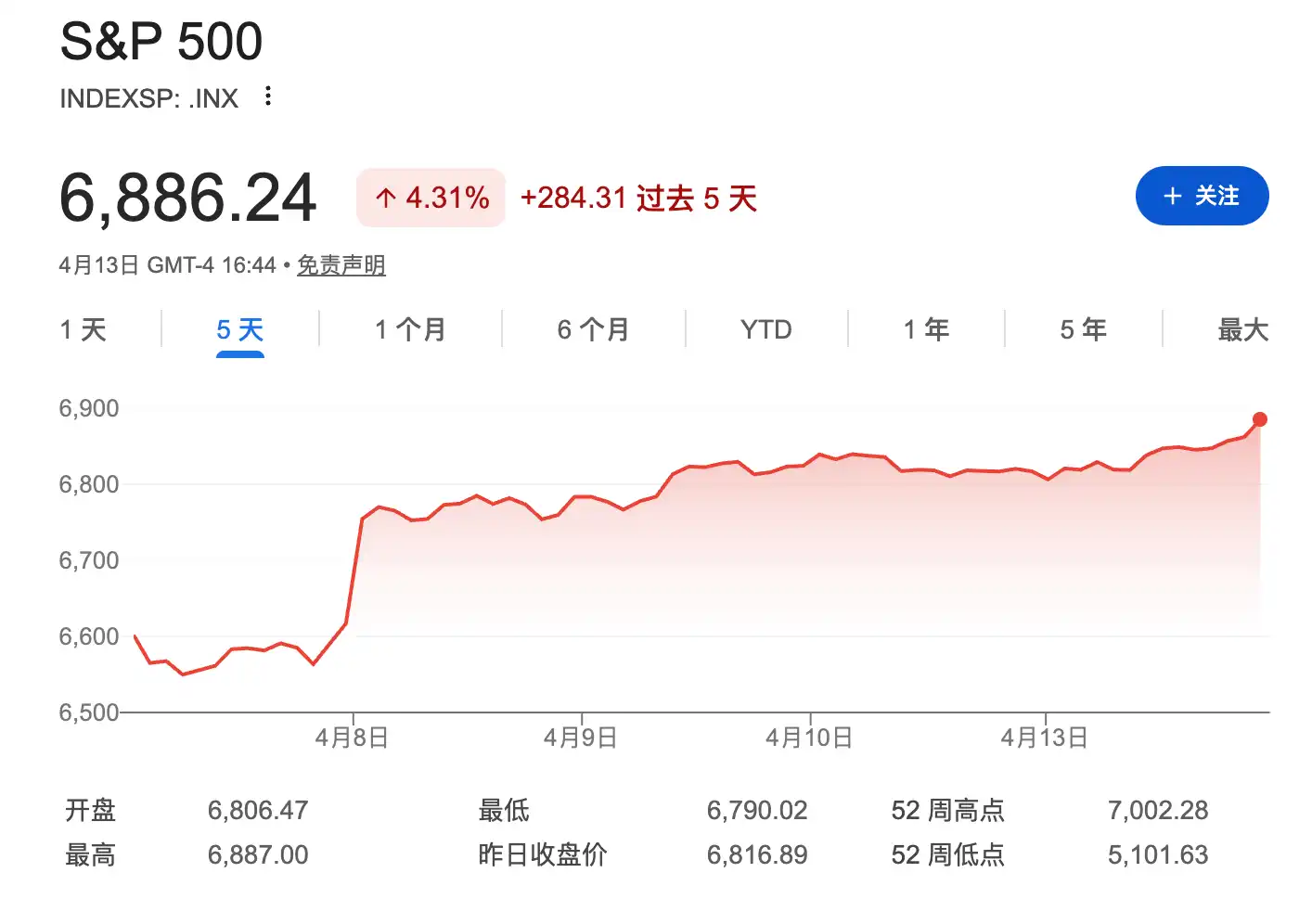
Amidst the U.S.-Iran negotiation breakdown and the subsequent blockade of the Strait of Hormuz, which pushed oil prices above $100 per barrel, the S&P 500 surprisingly rose by 1% on April 13, erasing all losses since the outbreak of the Iran conflict and reaching 6,886 points. Major financial institutions like J.P. Morgan, Morgan Stanley, and BlackRock concurrently expressed bullish outlooks, emphasizing that corporate earnings resilience far outweighs geopolitical shocks. Data from LSEG I/B/E/S showed Q1 2026 earnings growth expectations for the S&P 500 increased to 13.9%, up from 12.7% pre-conflict. The "Magnificent Seven" tech giants saw their valuation premium narrow, making equities more attractive. Historical analysis from UBS and LPL Research indicates that geopolitical shocks typically see markets recover within six weeks. Meanwhile, retail investors on Reddit expressed confusion, questioning why negative news didn’t trigger declines, highlighting a disconnect between headline risks and market pricing. The consensus among institutions is that strong earnings and limited conflict impact justify buying the dip.

Author: Claude, Deep Tide TechFlow

Deep Tide Guide: U.S.-Iran negotiations break down, the Hormuz Strait blockade is initiated, oil prices return above $100, yet the S&P 500 closed up 1% on Monday, completely erasing all losses since the Iran war to reach 6886 points. J.P. Morgan, Morgan Stanley, and BlackRock all expressed bullish views on the same day, with a consistent core logic: corporate profit resilience far outweighs the impact of geopolitical shocks. The investment section of Reddit exploded with activity, with retail investors exclaiming, 'The market simply ignores the news.'

On the first trading day after the breakdown of U.S.-Iran negotiations, U.S. stocks charted a curve that left everyone puzzled.

On April 13 (Monday), the S&P 500 closed up 69 points, a gain of 1%, at 6886 points; the Dow Jones Industrial Average rose 302 points, up 0.6%; the Nasdaq Composite Index increased by 1.2%. On the same day, Trump announced on a social platform that the U.S. Navy would immediately initiate a blockade operation in the Hormuz Strait. Brent crude oil broke through $100 per barrel during the session before pulling back to close around $98.16, while WTI crude closed at $97.82.

The S&P 500 rose to its highest level since the end of February that day, fully recovering all the losses incurred since the outbreak of the Iran war. The simultaneous occurrence of surging oil prices and rising stock markets seems logically contradictory. However, the largest institutions on Wall Street provided a highly consistent explanation: corporate profits remain strong, the persistence of geopolitical shocks is limited, and the current moment presents a window for buying on the dip.

Three Major Institutions Bullish on the Same Day, Core Logic Points to Profit Resilience

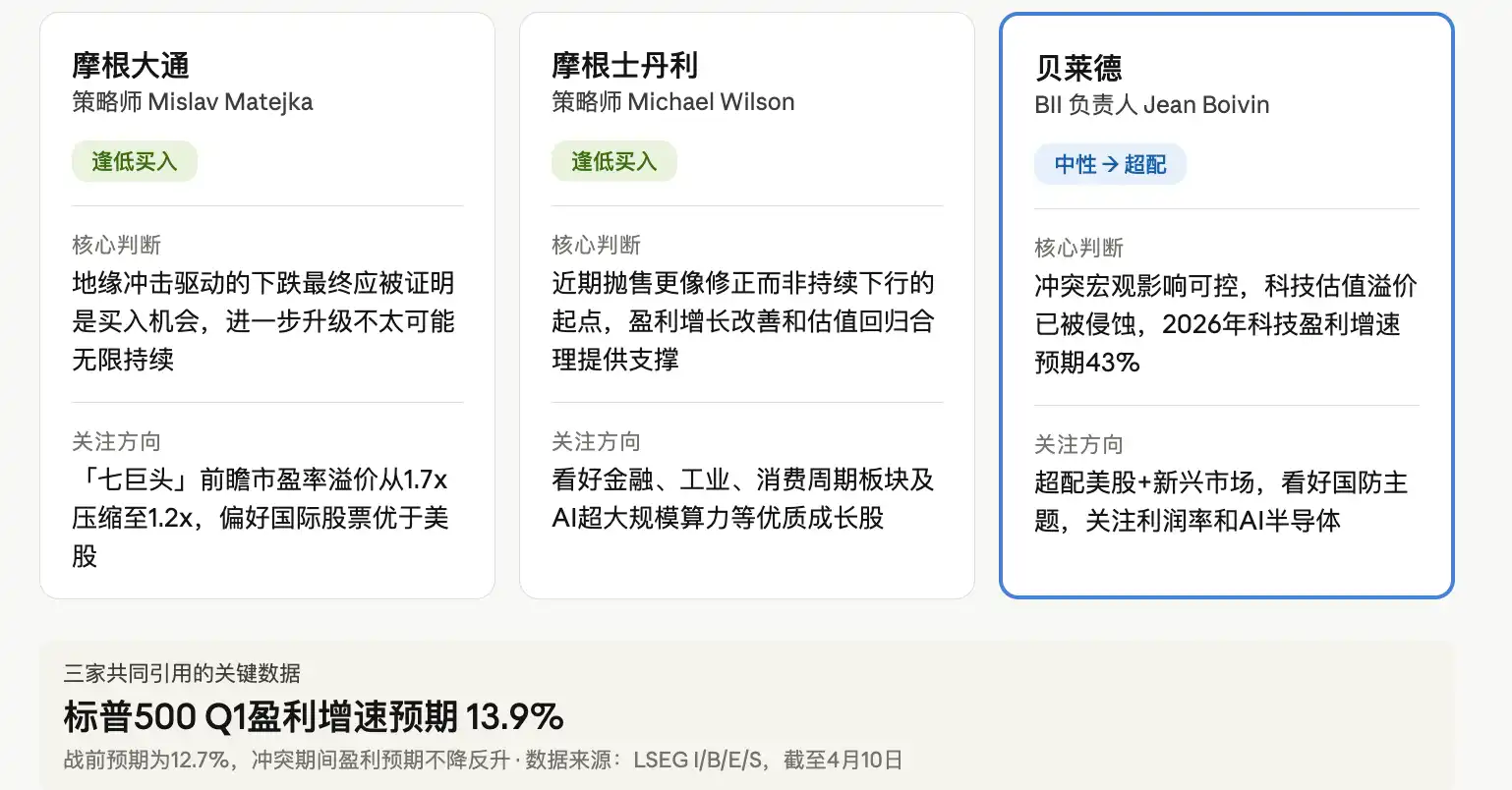
J.P. Morgan, in a research report authored by strategist Mislav Matejka, stated that declines driven by geopolitical shocks should ultimately prove to be buying opportunities.

Morgan Stanley strategist Michael Wilson's team judged that the recent sell-off in the S&P 500 resembled a correction rather than the start of a sustained downturn, with supporting factors coming from improved profit growth and a return to reasonable valuations. Morgan Stanley continues to be bullish on cyclical sectors such as financials, industrials, and consumer discretionary, as well as high-quality growth targets like AI hyperscale computing.

On the same day, the BlackRock Investment Institute upgraded its rating on U.S. stocks from 'neutral' to 'overweight,' making it the most active mover among the three. Jean Boivin, head of the BlackRock Investment Institute, stated that the valuation premium of the technology sector has been eroded, while the sector's expected profit growth rate for 2026 has risen to 43%, higher than last year's 26%.

BlackRock pointed out in its weekly market report that the two signposts triggering its decision to increase exposure have appeared: first, there is tangible evidence showing that navigation through the Hormuz Strait is resuming, and second, the sustained damage of the conflict to the macroeconomy has proven to be manageable.

The three institutions cited the same set of data: according to LSEG I/B/E/S data, as of April 10, the expected Q1 profit growth rate for the S&P 500 is 13.9%, higher than the pre-war 12.7%. In other words, nearly seven weeks after the conflict erupted, analysts have not only failed to lower profit expectations but have instead raised them.

Valuation Contraction of the 'Magnificent Seven' Becomes a Reason to Buy

J.P. Morgan specifically mentioned in its report that the forward P/E premium of the 'Magnificent Seven' (Nvidia, Apple, Microsoft, Meta, Google, Amazon, and Tesla) has narrowed significantly from the previous level of 1.7 times the S&P 500 to 1.2 times.

This data constitutes a key argument for Wall Street bulls: the problem of top-heavy concentration that has suppressed market breadth over the past two years is being alleviated on its own due to valuation regression.

BlackRock pointed out that the valuation premium of the technology sector relative to the other ten sectors has fallen to its lowest level since mid-2020. The company stated that against the backdrop of firm corporate profit expectations and limited damage to global growth, it has decided to increase exposure to U.S. stocks and emerging markets.

Historical Data Backs It Up: Geopolitical Shocks Are Usually Digested Within Six Weeks

The optimism of Wall Street institutions is not without basis. Research from UBS shows that when the S&P 500 falls 5% to 10% within three to four weeks, it historically usually returns to pre-conflict levels within six months.

A review of geopolitical shock events since World War II by LPL Research shows that the average first-day reaction is approximately a 1% decline, the average peak-to-trough decline is about 5%, the average time to bottom is about 19 days, and the average recovery cycle is about 42 days.

UBS stated in a mid-March research report that from the outbreak of the conflict on February 28 to March 13, global stocks fell only about 5%, while crude oil prices rose about 40% during the same period. The stock market's 'insensitivity' to the oil price shock itself validates the above historical pattern.

On April 6, UBS lowered its year-end target price for the S&P 500 from 7700 to 7500 and its mid-term target from 7300 to 7000, but maintained its overall judgment that U.S. stocks are 'attractive,' with the 2026 EPS forecast unchanged at $310.

Reddit Investors' Soul-Searching Question: 'The Market Simply Ignores the News'

While the consensus among institutions can be explained by data, the reaction in retail communities more directly reflects current market sentiment.

In the r/stocks subreddit, a post titled roughly 'Do you believe it now? The market doesn't move because of the news' received 923 upvotes and 159 comments. The poster's core point was: the market moves first, then finds reasons later. This Hormuz blockade is the most typical case he has experienced. A large number of comments expressed confusion about the disconnect between geopolitical risks and market pricing.

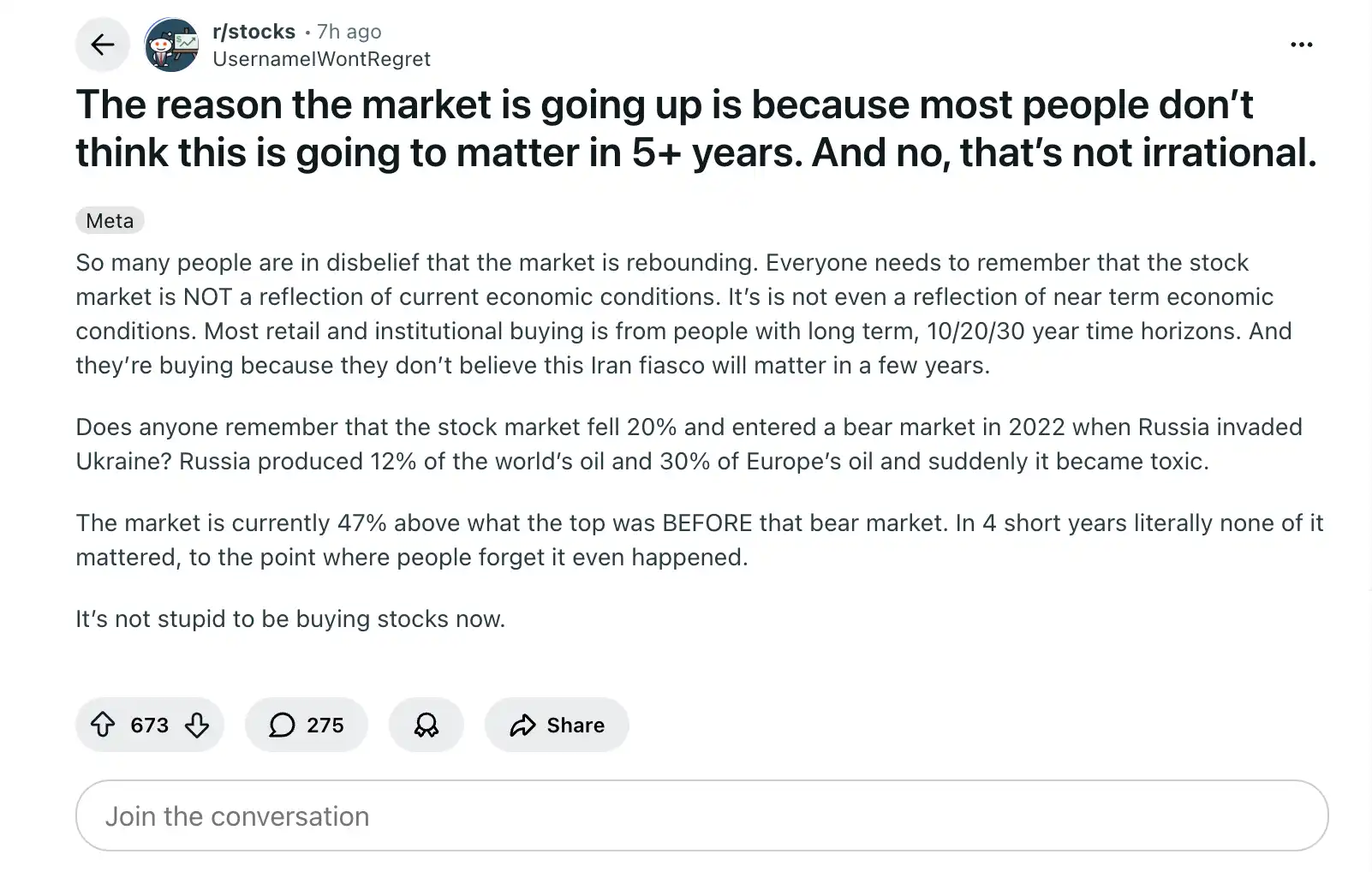
'The market is rising because most people think this won't matter in 5 years; this is not irrational.' This post received 344 upvotes and 199 comments, representing the typical stance of long-term investors.

In the r/wallstreetbets subreddit, a post with 504 upvotes pointed out that the physical oil market is 'screaming supply shock,' but the stock market remains calm, leaving traders不知所措 (at a loss) due to the contradictory signals between the two markets.

The confusion of retail investors and the confidence of institutions form a sharp contrast, but the underlying logic is actually two sides of the same coin: institutions are betting on profit resilience and the limited nature of the conflict, while retail investors are confused about why bad news hasn't translated into declines.

The answer might be simple: the market already completed a round of pricing in March and is currently in a rebound phase where 'bad news is exhausted.'

Связанные с этим вопросы

QWhy did the US stock market rise despite the blockade of the Strait of Hormuz and oil prices above $100?

AMajor financial institutions like JPMorgan, Morgan Stanley, and BlackRock believe that strong corporate earnings resilience far outweighs the impact of geopolitical shocks, making the market a buying opportunity.

QWhat was the core logic provided by Wall Street institutions for being bullish on US stocks?

AThe core logic is that corporate profit growth remains robust, geopolitical shocks are limited in duration, and valuations have become more attractive, particularly in sectors like technology.

QHow did the valuation of the 'Magnificent Seven' tech stocks change, and why was it significant?

AThe forward P/E premium of the 'Magnificent Seven' narrowed from 1.7 times the S&P 500 to 1.2 times, reducing market concentration issues and making valuations more appealing for investors.

QWhat historical data supports the idea that geopolitical shocks are short-lived for the stock market?

AHistorical data from UBS and LPL Research shows that markets typically recover from geopolitical shocks within about six weeks, with an average peak-to-trough decline of around 5% and a recovery period of about 42 days.

QHow did retail investors on platforms like Reddit react to the market's performance amid the geopolitical tension?

ARetail investors expressed confusion and disbelief, with many noting that the market seemed to ignore negative news, highlighting a disconnect between geopolitical risks and market pricing.

Похожее

Three Months, 35 Billion Yuan: Investors Rush to Grab the OpenAI of the Physical World

Investors flock to a physical AI startup as the race for the "OpenAI of the physical world" heats up. Ji Jia Shi Jie (GigaWorld), a company dedicated to developing Artificial General Intelligence (AGI) for the physical world, has raised 3.5 billion RMB (approximately $490 million) in just three months, according to a report from investment media outlet Touzijie. The latest B2 funding round of 1 billion RMB attracted a wide range of top-tier investors, including sovereign wealth funds, industrial capital, and financial institutions. This brings the total funding for the young company, now valued over 10 billion RMB, to 3.5 billion RMB across three recent rounds. The company is led by Huang Guan, a post-90s Tsinghua University PhD with extensive experience in AI, autonomous driving, and entrepreneurship. Its core innovation is a "dual-pyramid" system comprising a five-layer data pyramid (from internet videos to real-world robot data) and a three-layer algorithm pyramid focused on world simulation, action alignment, and reinforcement learning. This system underpins its key models: the "World Action Model" (e.g., GigaBrain series for robot control) and the "World Generation Model" (e.g., GigaWorld series for simulating and understanding the physical world). Its models have reportedly achieved top rankings in global robotics benchmarks. Ji Jia Shi Jie argues that while current digital AGI excels in information processing, the next frontier is physical AGI—systems that can understand and interact with the real world. The company believes the field is approaching its "GPT-3 moment," a key inflection point in capability scaling. To achieve this, the company is pursuing a dual-market strategy. For the consumer (C) market, it launched the "SeeLight" brand and its S1 general-purpose humanoid robot, which has secured initial orders for deployment in real homes. For the business (B) market, it focuses on industrial automation with its Maker series robots, having signed agreements for large-scale deployment in factories, and its DriveDreamer world model for autonomous driving, which is already in use with over 30 automakers and tech companies. The report concludes that by bridging the gap between digital intelligence and physical action, Ji Jia Shi Jie aims to unlock a new wave of productivity, ultimately bringing physical AGI into everyday life.

marsbit21 мин. назад

Three Months, 35 Billion Yuan: Investors Rush to Grab the OpenAI of the Physical World

marsbit21 мин. назад

What's the Connection Between Pinduoduo's Huang Zheng and Blockchain?

This text explores the unexpected connection between Pinduoduo founder Colin Huang and blockchain, as suggested in his article *Turning Capitalism Upside Down*. Huang argues Pinduoduo's core business is about managing "uncertainty." He posits that wealth flows to the rich because they absorb life's uncertainties (e.g., illness, job loss) that devastate the poor, who pay a premium for certainty through insurance or stable prices. Pinduoduo's model attempts a "reverse insurance": by aggregating consumer demand via group-buying and flash sales, it creates a large, predictable order for manufacturers. This certainty allows factories to remove risk premiums, passing savings back as lower prices, thus partially reversing the wealth flow. The key obstacle, Huang notes, is that an individual's buying intent is an unreliable promise. He then asks if blockchain is the natural solution for this "reverse insurance." The text elaborates that blockchain, through smart contracts with binding deposits, could transform casual intent into a costly-to-break, enforceable commitment. This replaces interpersonal trust with coded rules, making promises credible, pricable, and resistant to fraud. Finally, the author draws a parallel to Bitcoin, framing two paths to creating certainty: the "Pinduoduo path" of aggregating decentralized will into scale, and the "Bitcoin path" of locking rules into immutable code. Both sacrifice something—personal freedom or system flexibility—to manufacture trust and predictability.

链捕手1 ч. назад

What's the Connection Between Pinduoduo's Huang Zheng and Blockchain?

链捕手1 ч. назад

The Storage Magnate Who Conquered a Trillion-Dollar Kingdom, Yet Ultimately Could Not Become the Richest

**Summary:** "The Memory Magnate Who Built a Trillion-Dollar Empire, Yet Never Became the Richest" explores the journey of Zhu Yiming, founder of GigaDevice (603986) and co-founder of the soon-to-IPO ChangXin Memory Technologies (CXMT). The article positions GigaDevice, a fabless chip designer now valued at ~¥340 billion, as a prequel to the massive IDM (Integrated Device Manufacturer) venture, CXMT. Starting in 2005 with minimal capital, Zhu strategically "picked up the pieces" by focusing on niche markets like NOR Flash and microcontrollers (MCUs), areas major players were exiting. This allowed GigaDevice to grow into a diversified semiconductor company, maintaining robust profitability even during industry downturns by controlling costs. However, the piece argues that in the highly cyclical and capital-intensive memory chip industry, the fabless model has limits. True resilience and scale require the ability for "counter-cyclical expansion" – investing heavily during downturns – a tactic only possible for IDMs like Samsung or SK Hynix. This insight led Zhu to partner with the Hefei city government in 2016 to establish CXMT, an IDM focused on DRAM. Zhu's symbolic moves, like forfeiting salary and diluting his equity, were crucial in securing the massive state and bank funding needed. CXMT's equipment base is now valued even higher than that of BYD's vast auto manufacturing empire. Despite the potential for CXMT to reach a market cap of ¥1-2 trillion upon its IPO, Zhu's indirect stake in both companies is estimated below 3%, placing his personal wealth far below that of China's top billionaires. The article concludes that his strategic vision built a trillion-yuan memory landscape, but the capital structure necessary to achieve it precluded a personal fortune of similar scale.

marsbit1 ч. назад

The Storage Magnate Who Conquered a Trillion-Dollar Kingdom, Yet Ultimately Could Not Become the Richest

marsbit1 ч. назад

XRP Ledger Daily Fees Drop Below $400 As Network Activity Question Returns

The XRP Ledger is drawing attention as daily network fees have fallen below $400. While low fees align with XRPL's design for affordable transactions and are often seen as a strength, the metric can also serve as an indicator of network demand and paid transaction volume. This data point of around $3,100 in weekly fee burn highlights the stark contrast with higher-fee chains like Ethereum and Bitcoin. The development fuels an ongoing debate. Proponents view low fees as a sign of efficiency and accessibility, while critics may question if the network is generating sufficient high-value activity relative to its market cap and payments-focused narrative. The article cautions against overstating the finding, noting a single low-fee day does not signify network failure. It instead adds context to discussions about XRPL's usage, especially alongside Ripple's broader initiatives in stablecoins (RLUSD), AI payments, and enterprise infrastructure. The report recommends monitoring for a fee rebound, checking transaction counts for a fuller picture, and confirming the trend via native explorers like Bithomp. It frames the story within a larger market shift where on-chain data, protocol updates, and infrastructure developments are becoming crucial alongside price action. The editorial stance is to present the verified data, explain its significance for assessing network activity, and avoid hype, positioning it as part of the daily crypto conversation.

bitcoinist6 ч. назад

XRP Ledger Daily Fees Drop Below $400 As Network Activity Question Returns

bitcoinist6 ч. назад

Торговля

Спот
Фьючерсы
活动图片