Grayscale: Ethereum's Staking Model Needs a Revamp

marsbitОпубликовано 2026-05-13Обновлено 2026-05-13

Введение

The article discusses potential changes to Ethereum's staking reward model, highlighting two structural issues. First, the shift of activity to Layer 2 networks is reducing transaction fees and token burns on the mainnet, leading to an increase in ETH's net issuance. Second, with withdrawals enabled and the rise of liquid staking tokens (LSTs) and exchange-traded products (ETPs), the friction cost for staking has nearly vanished. This could eventually lead to almost all ETH being staked, which may cause unnecessary dilution and centralization risks. To address this, the Ethereum community is considering a model that caps rewards beyond a certain staking threshold, discouraging excessive staking. Grayscale argues this change would be beneficial for ETH's long-term price by controlling inflation, reducing tail risks, and strengthening ETH's narrative as a store of value. It notes that ETH's price volatility has a much greater impact on returns than staking yields, which are currently around 3% annually.

Author: Zach Pandl, Head of Research, Grayscale

Compiled by: Deep Tide TechFlow

Deep Tide Guide: Zach Pandl, Head of Research at Grayscale, writes that Ethereum's current staking reward model faces two structural problems: L2 scaling is reducing token burn and increasing net issuance; staking friction is approaching zero, potentially locking nearly all ETH into staking. The community is discussing implementing a cap on staking rewards, which Grayscale believes would be beneficial for ETH's price in the long term.

The Ethereum community is considering revising the network's staking reward model, with the core idea being to only incentivize staking up to a certain ratio, with no additional rewards beyond that. If implemented, nominal returns for stakers would decrease. However, Grayscale argues this would be positive for ETH's price long-term for two reasons: controlling ETH inflation and strengthening ETH's narrative as a store-of-value asset.

The discussion for this reform is driven by two overlapping issues.

Diminished Token Burn, Rising Net Issuance

ETH's supply depends on the difference between new issuance and token burn. Currently, Ethereum L1 burns all base transaction fees. High fees mean more ETH is burned, suppressing supply growth.

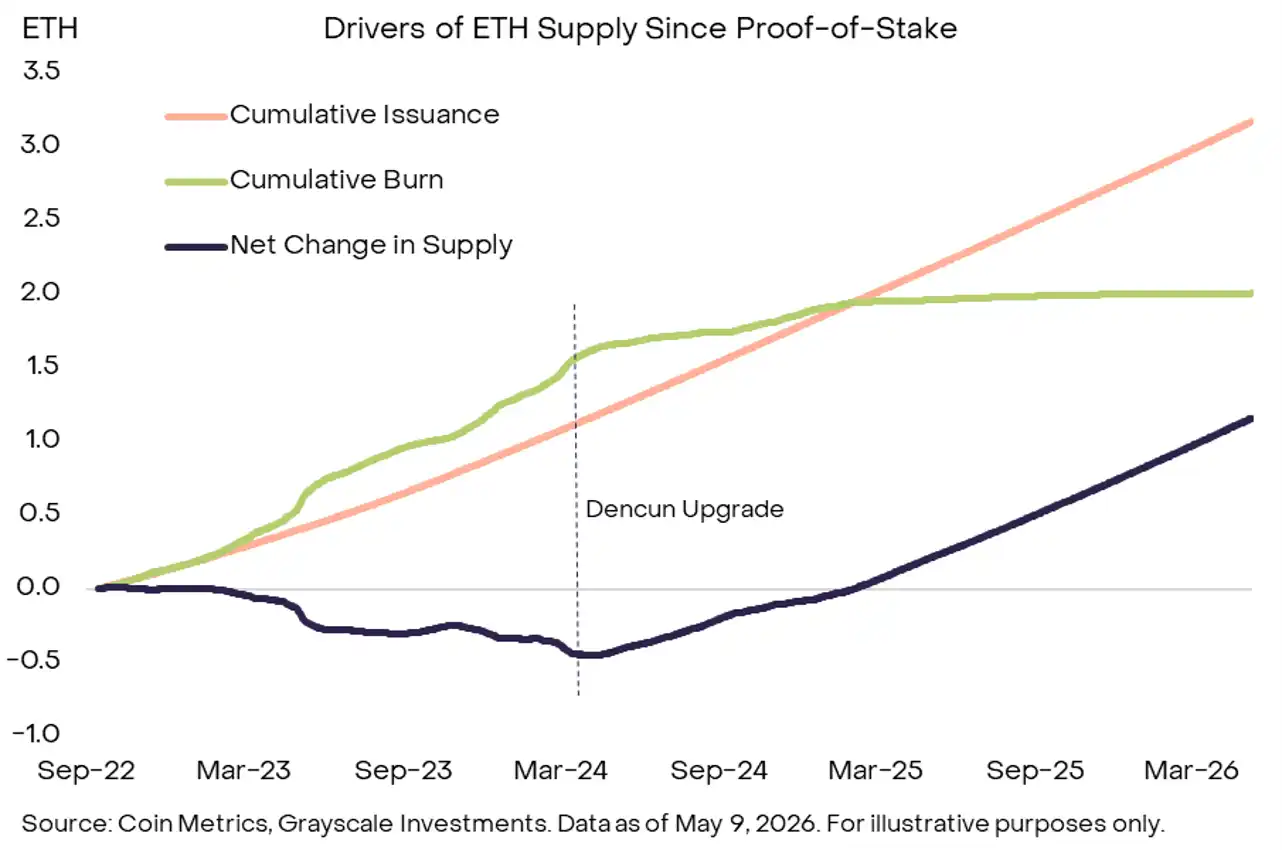
Changes over the past few years have disrupted this balance. As more activity migrates to L2 networks, L1 transaction fees and token burns decrease, leading to a rise in net issuance.

Caption: Exhibit 1 – Drivers of ETH supply changes since PoS. After the Dencun upgrade, cumulative burn (green line) flattened, while cumulative issuance (orange line) continued to rise, causing ETH's net supply change (dark line) to turn positive from negative. Source: Coin Metrics, Grayscale Investments, data as of May 9, 2026

Compounding this issue, Ethereum L1 is now actively choosing to scale to compete with high-throughput chains like Solana. Pandl states directly: L1 transaction fees are likely to remain low for the foreseeable future, token burns will continue to decline, and net supply growth will expand further.

Staking Friction Costs Are Almost Zero

When Ethereum first launched staking, users could not withdraw assets; staked ETH was locked, illiquid, and thus carried a risk premium. Now that withdrawals are enabled, liquidity has greatly improved, and that risk premium has evaporated.

More critically, Liquid Staking Tokens (LSTs), Exchange-Traded Products (ETPs), and corporate ETH treasuries have entered the staking arena. The marginal cost of staking ETH is now close to zero. As long as the network continues to provide marginal rewards to stakers, nearly all ETH could eventually end up staked.

Staking is a necessary condition for the Ethereum protocol to function properly, but an excessively high staking ratio can be counterproductive.

Two risks. First, unnecessary dilution. Rising net issuance without substantially improving network security is like a country overspending on defense with no benefit to national security. Second, the tail risk of centralization where a few institutions dominate staking activity. This possibility exists due to network effects among service providers.

Implementing a Capped Staking Reward Curve

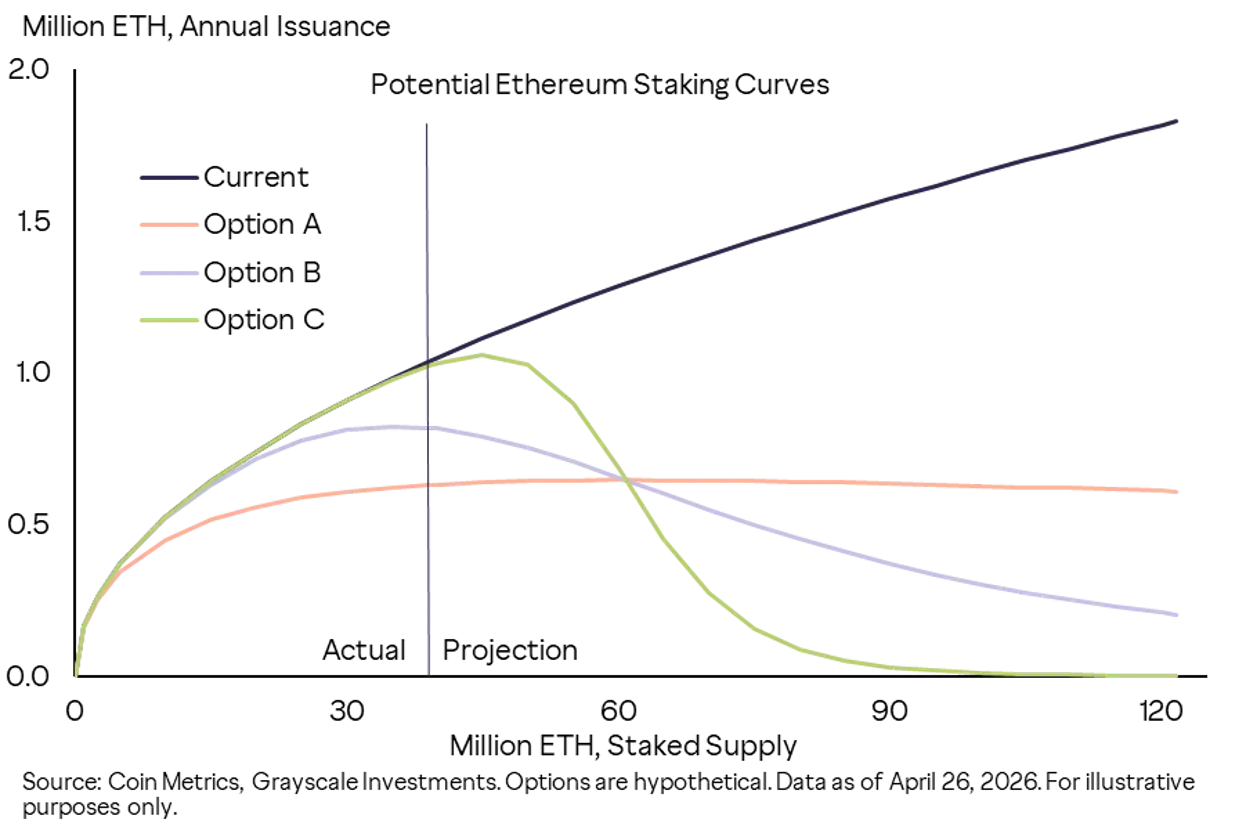
One proposed solution is to transition to a reward model that only incentivizes staking up to a certain level.

Caption: Exhibit 2 – Potential alternative staking reward curves for Ethereum. Under the current model (dark line), annualized issuance grows linearly with stake; Options A/B/C set caps or inflection points at different staking levels, causing issuance to flatten or even decline after the staking ratio exceeds a certain threshold. Source: Coin Metrics, Grayscale Investments, data as of April 26, 2026, options are hypothetical.

Grayscale believes such a change would be favorable for ETH's market value in the long term. ETH is a functionally useful commodity, not a financial claim like stocks or bonds, and should not be priced based solely on cash flows. Updating the staking reward model would reduce supply growth and enhance ETH's scarcity. For commodities, production cuts are price-positive; the same logic applies to ETH.

Reducing network tail risks, controlling long-term inflation, and it could also boost demand for unstaked ETH as a digital store-of-value asset.

There's another easily overlooked perspective: the impact of ETH's price volatility on investment returns far outweighs staking rewards. The current ~3% annualized staking yield is roughly equivalent to ETH's daily price volatility (annualized volatility over the past 360 days is ~60%, implying a daily volatility of ~3%).

Conclusion: Ethereum may revise its staking reward model to control long-term supply growth and reduce specific tail risks. If implemented, Grayscale believes this would be bullish for ETH's price.

Связанные с этим вопросы

QWhat are the two structural issues with Ethereum's current staking reward model mentioned in the Grayscale article?

AThe two structural issues are: 1) The migration of activity to L2 networks has led to lower L1 transaction fees and token burns, resulting in rising net issuance of ETH. 2) The friction cost for staking has dropped to nearly zero, as withdrawals are now enabled and services like LSTs and ETPs have emerged, which could eventually lead to almost all ETH being staked.

QAccording to the article, what solution is the Ethereum community considering to address the high staking ratio and rising net issuance?

AThe Ethereum community is considering modifying the staking reward model to implement a reward curve with an upper limit or inflection point, which would only incentivize staking up to a certain level. Beyond that threshold, additional staking would not earn extra rewards, thereby controlling long-term supply growth.

QHow does Grayscale view the potential impact of changing Ethereum's staking reward model on the price of ETH?

AGrayscale believes that implementing a capped staking reward curve would be a long-term positive for ETH's price. This is because it would reduce supply growth, enhance ETH's scarcity, and reinforce its narrative as a digital store of value, similar to how reduced production benefits commodity prices.

QWhy has the net issuance of ETH been rising post-Dencun upgrade, according to the article?

AFollowing the Dencun upgrade, net issuance has been rising because L1 transaction fees (which are burned) have declined as more activity migrates to L2 networks. This results in lower token burns while staking issuance continues, causing the cumulative net supply change to turn positive.

QWhat are the two risks associated with an extremely high percentage of ETH being staked, as outlined in the article?

AThe two risks are: 1) Unnecessary dilution of the ETH supply, where increased issuance does not meaningfully enhance network security. 2) A tail risk of centralization, where a few large institutional service providers could dominate the staking activity due to network effects.

Похожее

Breaking: OpenAI Undergoes Major Reorganization, President Brockman Assumes Command

OpenAI has announced a major internal reorganization just months before its anticipated IPO. The company is merging its three flagship product lines—ChatGPT, Codex, and the API platform—into a single, unified product organization. The most significant leadership change involves co-founder and President Greg Brockman moving from a background technical role to take full, permanent control over all product strategy. This follows the indefinite medical leave of AGI Deployment CEO Fidji Simo. Additionally, ChatGPT's longtime lead, Nick Turley, has been reassigned to enterprise products, with former Instagram executive Ashley Alexander taking over consumer offerings. The consolidation, internally framed as a strategic move towards an "Agentic Future," aims to break down internal silos and create a cohesive "Super App." This planned desktop application would integrate ChatGPT's conversational abilities, Codex's coding power, and a rumored internal web browser named "Atlas" to autonomously perform complex user tasks. The reorganization occurs amid significant internal and external pressures. OpenAI has recently seen a wave of high-profile departures, including Sora co-lead Bill Peebles and other senior technical leaders, leading to concerns about a thinning executive bench. Externally, rival Anthropic recently secured funding at a staggering $900 billion valuation, surpassing OpenAI's own. Google's upcoming I/O developer conference also poses a competitive threat. Analysts suggest the dramatic restructure is a pre-IPO move to present a clearer, more focused narrative to Wall Street—streamlining operations and demonstrating decisive leadership under Brockman to counter internal turbulence and intense market competition.

marsbit1 ч. назад

Breaking: OpenAI Undergoes Major Reorganization, President Brockman Assumes Command

marsbit1 ч. назад

Two Survival Structures of Market Makers and Arbitrageurs

Market makers and arbitrageurs represent two distinct survival structures in high-frequency trading. Market makers primarily use limit orders (makers) to profit from the bid-ask spread, enjoying high capital efficiency (nominally 100%) but bearing inventory risk. This "inventory risk" arises from passive, fragmented, and discontinuous order fills in the limit order book (LOB). This risk, while a potential cost, can also contribute to excess profit if managed within control boundaries, allowing for mean reversion. Market makers essentially sell "time" (uncertainty over execution timing) to the market for price control and low fees. In contrast, cross-exchange arbitrageurs typically use market orders (takers) to exploit price differences or funding rates, resulting in lower nominal capital efficiency (requiring capital on both exchanges) and higher transaction costs. Their risk exposure stems from asymmetries in exchange rules (e.g., minimum order sizes), execution latency, and infrastructure risks (e.g., ADL, oracle drift). These exposures are active, exogenous gaps that primarily erode profits rather than contribute to them. Arbitrageurs essentially sell "space" (capital sunk across venues) for localized, immediate certainty. Both strategies engage in a trade-off between execution friction and residual risk. Optimal systems allow for temporary, controlled risk exposure rather than enforcing zero exposure at all costs. Their evolution converges towards hybrid models: arbitrageurs may use maker orders to reduce costs, while market makers may use taker orders or hedges for risk management. Ultimately, both use different forms of risk exposure—market makers exposing inventory, arbitrageurs immobilizing capital—to extract marginal, hard-won certainty from the market.

链捕手1 ч. назад

Two Survival Structures of Market Makers and Arbitrageurs

链捕手1 ч. назад

Who Will Define the Rules of the AI Era? Anthropic Discusses the 2028 US-China AI Landscape

This article, based on Anthropic's analysis, outlines the intensifying systemic competition between the U.S./allies and China for AI leadership by 2028. It argues that access to advanced computing power ("compute") is the critical bottleneck, where the U.S. currently holds a significant advantage through chip export controls and allied innovation. However, China's AI labs remain competitive by exploiting policy loopholes—via chip smuggling, overseas data center access, and "model distillation" attacks to copy U.S. model capabilities—keeping them close to the frontier. The piece presents two contrasting scenarios for 2028. In the first, decisive U.S. action to tighten compute controls and curb distillation locks in a 12-24 month AI capability lead, cementing democratic influence over global AI norms, security, and economic infrastructure. In the second, policy inaction allows China to achieve near-parity through continued access to U.S. technology, enabling Beijing to promote its AI stack globally and integrate advanced AI into its military and governance systems, altering the strategic balance. Anthropic contends that maintaining a decisive U.S. lead is essential for shaping safe AI development and governance. The core recommendation is for U.S. policymakers to urgently close compute and model access loopholes while promoting global adoption of the U.S. AI technology stack to secure a lasting strategic advantage.

marsbit3 ч. назад

Who Will Define the Rules of the AI Era? Anthropic Discusses the 2028 US-China AI Landscape

marsbit3 ч. назад

Торговля

Спот
Фьючерсы

Популярные статьи

Как купить S

Добро пожаловать на HTX.com! Мы сделали приобретение Sonic (S) простым и удобным. Следуйте нашему пошаговому руководству и отправляйтесь в свое крипто-путешествие.Шаг 1: Создайте аккаунт на HTXИспользуйте свой адрес электронной почты или номер телефона, чтобы зарегистрироваться и бесплатно создать аккаунт на HTX. Пройдите удобную регистрацию и откройте для себя весь функционал.Создать аккаунтШаг 2: Перейдите в Купить криптовалюту и выберите свой способ оплатыКредитная/Дебетовая Карта: Используйте свою карту Visa или Mastercard для мгновенной покупки Sonic (S).Баланс: Используйте средства с баланса вашего аккаунта HTX для простой торговли.Третьи Лица: Мы добавили популярные способы оплаты, такие как Google Pay и Apple Pay, для повышения удобства.P2P: Торгуйте напрямую с другими пользователями на HTX.Внебиржевая Торговля (OTC): Мы предлагаем индивидуальные услуги и конкурентоспособные обменные курсы для трейдеров.Шаг 3: Хранение Sonic (S)После приобретения вами Sonic (S) храните их в своем аккаунте на HTX. В качестве альтернативы вы можете отправить их куда-либо с помощью перевода в блокчейне или использовать для торговли с другими криптовалютами.Шаг 4: Торговля Sonic (S)С легкостью торгуйте Sonic (S) на спотовом рынке HTX. Просто зайдите в свой аккаунт, выберите торговую пару, совершайте сделки и следите за ними в режиме реального времени. Мы предлагаем удобный интерфейс как для начинающих, так и для опытных трейдеров.

1.3k просмотров всегоОпубликовано 2025.01.15Обновлено 2025.03.21

Как купить S

Sonic: Обновления под руководством Андре Кронье – новая звезда Layer-1 на фоне спада рынка

Он решает проблемы масштабируемости, совместимости между блокчейнами и стимулов для разработчиков с помощью технологических инноваций.

2.2k просмотров всегоОпубликовано 2025.04.09Обновлено 2025.04.09

Sonic: Обновления под руководством Андре Кронье – новая звезда Layer-1 на фоне спада рынка

HTX Learn: Пройдите обучение по "Sonic" и разделите 1000 USDT

HTX Learn — ваш проводник в мир перспективных проектов, и мы запускаем специальное мероприятие "Учитесь и Зарабатывайте", посвящённое этим проектам. Наше новое направление .

1.8k просмотров всегоОпубликовано 2025.04.10Обновлено 2025.04.10

HTX Learn: Пройдите обучение по "Sonic" и разделите 1000 USDT

Обсуждения

Добро пожаловать в Сообщество HTX. Здесь вы сможете быть в курсе последних новостей о развитии платформы и получить доступ к профессиональной аналитической информации о рынке. Мнения пользователей о цене на S (S) представлены ниже.

活动图片