Gold Surpasses $5,000 First, When Will the Crypto Market Reverse?

marsbitОпубликовано 2026-01-26Обновлено 2026-01-26

Введение

The article discusses the outcome of a popular prediction on Polymarket from October last year: "First to $5,000: Gold or ETH?". While Ethereum had once approached $4,800 with high market confidence, gold ultimately surged past $5,100 per ounce on January 26, whereas Ethereum remained stagnant between $2,800 and $3,000. The rise in gold is attributed to macro factors including concerns over U.S. fiscal health, geopolitical tensions, and inflation-driven capital flight toward safe-haven assets. Institutional sentiment has turned strongly bullish, with banks like OCBC and Goldman Sachs raising their gold price targets. Meanwhile, tokenized gold products have seen record investment inflows. In contrast, the crypto market has faced significant outflows, with Bitcoin and Ethereum ETFs recording substantial withdrawals. Bitcoin has fallen 30% from its peak, and Ethereum is down around 40%. Analysts like Peter Brandt have turned bearish, citing completed bear channels. However, the article suggests that crypto’s downturn may be temporary—a phase in capital rotation toward safety. Once gold’s momentum slows or macro risks ease, capital may return to deeply oversold crypto assets. Bitcoin shows classic bottoming signals, including peak realized losses, while Ethereum’s high staking ratio reflects long-term confidence. The potential appointment of a crypto-friendly Fed chair could also boost the market. The piece concludes that gold’s rally may have further to go, and crypt...

Author:zhou, ChainCatcher

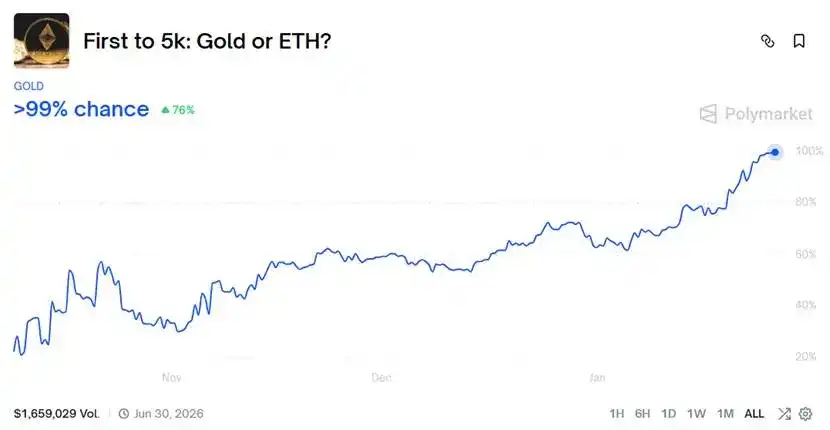
Remember that hot prediction event on Polymarket last October?

"First to $5,000: Gold or ETH?"

At that time, Ethereum's price surged to around $4,800, with the market giving it an 80% probability of breaking through $5,000. Many believed the era of digital gold had arrived.

Three months later, the market has given its answer.

On January 26, spot gold broke through $5,100 per ounce, while Ethereum is still oscillating between $2,800 and $3,000, with the overall crypto market remaining sluggish.

Amid extreme macroeconomic uncertainty, capital has collectively turned to the most traditional safe-haven assets, while cryptocurrencies, as high-volatility risk assets, were sold off first.

Gold Soars, Crypto Market Capital Votes with Its Feet

Gold's upward momentum stems from multiple macro factors.

First, signals of hedging against US dollar credit risk are becoming increasingly evident. The Danish academic pension fund AkademikerPension announced it would liquidate approximately $100 million in US Treasuries by the end of the month,直言 citing serious concerns about the US fiscal situation. Sweden's largest private pension fund, Alecta, also disclosed that since early 2025, it has significantly reduced its holdings of US Treasuries, amounting to approximately $7.7 to $8.8 billion. Institutions cite US policy uncertainty and持续 debt expansion as core reasons.

Second, geopolitical risks are intensifying. Less than a month into 2026, the world has already witnessed several major events, including the US proposing to "force-buy" Greenland, raiding and capturing the Venezuelan president, imposing 25% tariffs on countries trading with Iran, and further chaos within Iran. Coupled with the prolonged stalemate in the Russia-Ukraine conflict, geopolitical issues have not eased in the new year but have shown signs of恶化.

Additionally, inflation and currency depreciation pressures persist. Against the backdrop of massive central bank liquidity injections and fiscal deficit monetization, the purchasing power of fiat currency is constantly being diluted. Gold and silver, as hard assets, naturally become the首选 for capital seeking shelter.

In this context, institutional views on gold are rapidly turning optimistic. OCBC Bank has raised its year-end gold price target for 2026 to $5,600 per ounce; Goldman Sachs has also significantly adjusted its expectations, raising its year-end target from $4,900 to $5,400.

They emphasize that持续 buying by private investors and emerging market central banks is squeezing limited gold supply. Data shows that in 2025, global central banks net purchased over 1,100 tons of gold, and in 2026, it is expected to maintain a pace of over 60 tons per month. Against the backdrop of the Fed potentially restarting rate cuts, gold ETF holdings have also begun to回升.

On the crypto market side, on-chain gold investment enthusiasm has also reached new heights. According to Coingecko data, the total market capitalization of tokenized gold has now exceeded $525 million, and tokenized silver has also hit a historical record. According to Lookonchain monitoring, a whale lost $18.8 million on ETH in a short period and is now doubling down on gold. It spent $36.04 million to buy 7,536 XAUT at an average price of $4,786, with an unrealized profit of $2.3 million.

In contrast, the cryptocurrency market presents a截然不同的 picture. Bitcoin has fallen about 30% from last year's high, and Ethereum has dropped about 40%. Last week, both Bitcoin and Ethereum spot ETFs recorded massive net outflows: Bitcoin ETF net outflows were $1.33 billion (the second-highest weekly规模 in history), and Ethereum ETF net outflows were $611 million.

As of January 20, the performance of the two largest crypto treasury companies varied. Bitcoin treasury company MicroStrategy (MSTR) holds a total of 709,715 BTC with an average cost of $75,979, resulting in a floating profit of $10.813 billion. Ethereum treasury company Bitmine (BMNR) holds a total of 4,203,036 ETH with an average cost of $3,857, resulting in a floating loss of $3.232 billion.

Market sentiment is clearly偏向 bearish. The famous trader and chart analyst Peter Brandt, who successfully predicted Bitcoin's crash in 2018, stated that the Bitcoin bear market channel is complete and issued a sell signal again. He pointed out that Bitcoin's price needs to recover to $93,000 to negate the sell signal. Bloomberg analysts even believe that the possibility of Ethereum falling below $2,000 in the short term is higher than returning to $4,000.

Capital Rotation: The Day Gold Stops Rising is the Day Crypto Reverses?

However, the crypto market's sluggishness is more of a阶段性表现 of capital rotation. During periods of extreme risk aversion, capital flow typically first rushes into zero-credit-risk assets like US Treasuries and gold. Only after the peak of risk passes does it gradually flow back into stocks and crypto markets.

The current collective rise of gold, silver, and some大宗商品 is precisely the most concentrated stage of defensive allocation. Once gold's momentum weakens as it approaches institutional target prices, or a major macro risk shows signs of easing, profit-takers will likely begin searching for the next high-return opportunity. At that time, deeply回调ed crypto assets, with leverage fully washed out, will become the most natural承接 object.

Specifically for Bitcoin and Ethereum, their respective bottoming signals are becoming increasingly clear.

For Bitcoin, massive on-chain realized losses are often a classic bottom特征. CryptoQuant data shows that Bitcoin's realized loss (Realized Loss) has reached $4.5 billion, the highest level in three years. The last time this happened, Bitcoin's price was around $28,000 after about a year of brief adjustment.

On the institutional side, Bitcoin treasury companies continue to increase their BTC holdings through financing plans, especially after MSCI decided not to remove MSTR from its indices for now, prompting passive funds like Vanguard to follow up and buy MSTR stock. Arthur Hayes publicly stated that the core trading strategy this quarter is to go long on MSTR and Metaplanet.

The situation with Ethereum is similar. On one hand, over 36 million ETH has been staked, accounting for nearly 30% of the circulating supply, with the exit queue接近 zero. Validators are expressing long-term confidence in the network with their actions. On the other hand, BitMine recently obtained shareholder approval to increase the上限 of shares the company can issue to enhance future financing flexibility, and it will most likely continue to increase its Ethereum holdings.

It is worth mentioning that on Polymarket currently, the probability of BlackRock executive Rieder succeeding the Fed chair is close to 50%, significantly领先 competitors. Market analysis suggests that if this event materializes, his friendly stance towards RWA and the crypto ecosystem could provide a major boost to the crypto market.

However, history has proven countless times that when precious metal行情 go crazy, they are completely unreasonable.

How high can gold go next? No one knows. What needs to be done now is not to guess where the top is, let alone short it. In an era of inflation cycles and credit revaluation叠加, it is difficult to call a top for gold.

Loyal crypto investors may only need to patiently wait for the rotation signal to appear. Hopefully, that day will come sooner than we imagine.

Click to learn about open positions at ChainCatcher

Связанные с этим вопросы

QWhat was the subject of the popular prediction event on Polymarket mentioned in the article?

AThe prediction event was 'First to $5,000: Gold or ETH?', which asked whether gold or Ethereum would be the first to break the $5,000 price level.

QWhich asset ultimately reached the $5,000 price target first, and what was its price on January 26th?

AGold reached the target first. On January 26th, the spot price of gold broke through $5,100 per ounce.

QWhat are the three main macro factors cited in the article as driving the rise in gold's price?

AThe three main drivers are: 1) Hedging against U.S. dollar credit risk, 2) Escalating geopolitical risks, and 3) Persistent inflation and currency devaluation pressures.

QAccording to the article, what is a potential signal for a reversal in the cryptocurrency market?

AA potential signal for a crypto market reversal is when the momentum in gold's price weakens after it nears institutional target prices, or when a major macro risk shows signs of easing, prompting profit-taking capital to seek higher returns in deeply corrected crypto assets.

QWhat on-chain metric for Bitcoin is mentioned as a classic bottoming feature, and what was its value?

AThe metric is Bitcoin's Realized Loss. The value mentioned is $4.5 billion, which is stated to be the highest level in three years.

Похожее

From Shouting 150 Dollars to Liquidating HYPE in Just Three Days, How Much Credibility Does Arthur Hayes Have Left?

How much of Arthur Hayes's market credibility remains? Recently, the "godfather of crypto perpetual swaps" and BitMEX co-founder has faced public criticism, including accusations from on-chain investigator ZachXBT about creating exit liquidity for his followers. Starting last week, Hayes executed multiple sudden sell-offs. He had repeatedly publicly predicted the HYPE token would reach $150. After a $100,000 bet defending Hyperliquid on June 1st, he announced just three days later that he had completely sold his HYPE and NEAR holdings, successfully exiting near the peak. He also sold ZEC and WLD. His sale of WLD appeared to be a classic "pump and dump" maneuver. On June 3rd, he publicly set a $10 target for WLD, causing its price to surge over 35%. By June 6th, he announced he had sold his WLD, citing "anomalous" SpaceX pre-IPO price action, which triggered a sharp price drop. On June 9th, Hayes published a lengthy article explaining his actions, citing factors like rising energy costs and a potential AI bubble burst. Consequently, his family office, Maelstrom, now holds positions in US energy producers and only core crypto assets BTC and ETH, having sold AI-related stocks and non-core cryptocurrencies. This pattern is not new. In 2025, he similarly touted HYPE before selling it at what turned out to be a cycle peak, only to repurchase it at the next cycle's low. Similar scenarios played out with tokens like ETHFI and ENA. Long-term observers have developed a strategy: ignore Hayes's public statements but closely monitor his on-chain actions—be cautious following his buys, but decisively follow his sells. If he continues these tactics, especially as seen with the WLD case, his market credibility risks being permanently damaged. As Hayes himself admitted in his latest article, "I remain an unapologetic gambler."

marsbit16 мин. назад

From Shouting 150 Dollars to Liquidating HYPE in Just Three Days, How Much Credibility Does Arthur Hayes Have Left?

marsbit16 мин. назад

Fundraising is Like a Strange Dance: The 'Absurd Drama' of Silicon Valley Founders' Capital Raises

The article details a series of absurd and revealing anecdotes shared by Silicon Valley founders about their venture capital fundraising experiences, sparked by Greg Isenberg's story of pitching to a sleeping a16z partner. Founders describe surreal pitch meetings: one faced a barefoot, peanut-eating investor who offered triple the requested amount after 30 seconds; another performed a pitch in a VC's parked car; a founder discovered his audience understood no English beyond "yes." These stories highlight the often irrational and performative nature of fundraising. Beyond the absurdity, darker power imbalances are exposed. Stories include investors suggesting founders fire co-founders for their equity, blatant market misjudgments, disrespectful behavior from LPs, and discriminatory remarks. A debate also emerges around "Sequoia's" practice of splitting a round into two valuations. However, the thread isn't solely critical. Positive counter-narratives celebrate supportive VCs who offered crucial advice during crises, respected founders' timelines, and showed simple gestures of respect—like a partner personally fetching coffee before a major pitch. Ultimately, the collective sharing acts as a pressure release, illustrating that fundraising is a complex dance of power, trust, and sometimes sheer theater. It underscores that beyond capital, mutual respect and integrity remain the most enduring foundations of the founder-investor relationship.

marsbit29 мин. назад

Fundraising is Like a Strange Dance: The 'Absurd Drama' of Silicon Valley Founders' Capital Raises

marsbit29 мин. назад

Vitalik's Vision for the Next Evolution of On-Chain Finance: How to Reconstruct DeFi with an 'Options Mindset'?

Vitalik Buterin recently proposed a conceptual shift for DeFi: replacing traditional Collateralized Debt Positions (CDPs) and forced liquidations with an options-based mechanism. This aims to address key vulnerabilities in current DeFi lending. The traditional CDP model, foundational to protocols like MakerDAO and Aave, allows users to borrow against collateral but relies on real-time oracles and triggers sudden, mandatory liquidations during price volatility. This can cause cascading sell-offs, oracle manipulation risks, and significant MEV extraction, exacerbating market stress. Vitalik's alternative envisions splitting an asset like 1 ETH into two complementary components: one offering stable/index-like exposure and the other absorbing the opposite risk/reward. Instead of a hard liquidation threshold, a user's exposure to the target asset would gradually and smoothly deviate (following a near-quadratic curve) as the collateral price moves. The system would primarily depend on "slow oracles" for periodic settlement rather than instant price feeds. Key potential benefits include: the elimination of abrupt, forced liquidations; drastically reduced reliance on vulnerable real-time oracles; and inherent resistance to certain MEV exploits centered on liquidation auctions. The article posits that for Ethereum DeFi to maintain its relevance amid competition from faster, cheaper chains, it must compete on sophisticated financial engineering and robustness—not just transaction speed or yields. The core value proposition should shift towards offering users clearer, more manageable risk structures, greater autonomy, and resilience in extreme scenarios, moving DeFi from high-risk experimentation towards becoming reliable financial infrastructure.

marsbit1 ч. назад

Vitalik's Vision for the Next Evolution of On-Chain Finance: How to Reconstruct DeFi with an 'Options Mindset'?

marsbit1 ч. назад

Торговля

Спот
Фьючерсы
活动图片