Source: Galaxy Research
Authors:Lucas Tcheyan、Vikram Singh
Original Title: Agentic Payments and Crypto’s Emerging Role in the AI Economy
Compiled and Edited by: BitpushNews
Introduction
Artificial Intelligence Agents (AI Agents) are poised to revolutionize the landscape of the internet. The continuous advancement of AI has enabled intelligent agents to act as programming assistants, shopping advisors, planning tools, and experts in various fields. They represent a powerful new paradigm for human-computer interaction, with their essence being that they significantly reduce the need for humans to directly operate browsers and search engines.
In the Galaxy Research report "Understanding the Intersection of Cryptocurrency and Artificial Intelligence" released in 2024, we identified AI agents as one of the most promising growth directions, noting that they are "ideally suited for cryptocurrency scenarios—users (or the agents themselves) can create wallets to transact with other services, agents, or people." At that time, the agent field was still in its infancy, primarily limited by three aspects: the intelligence level of the underlying AI models, the infrastructure supporting their execution of complex tasks, and the regulatory clarity needed for adoption beyond Web3-native scenarios.
In just over a year, progress in these three areas has been astonishing:
-
AI intelligence has rapidly improved, enabling agents to perform "long-horizon reasoning" and autonomously execute complex tasks with unprecedented reliability.
-
Agent toolchains have achieved leapfrog development, including the release of a series of foundational protocols such as the Model Context Protocol (MCP), Agent-to-Agent (A2A) Protocol, Agent Payments Protocol (AP2), and the x402 standard.
-
The regulatory environment has become increasingly clear, especially regarding stablecoins, which has accelerated the integration of crypto payment channels with traditional systems.
These advancements collectively open the door for the widespread adoption of AI agents utilizing blockchain for payments. One of the most promising developments driving this trend is the emergence of x402 and related payment standards. These standards allow agents to directly pay for services and data using stablecoins or other crypto assets. For simplicity, we will refer to such protocols collectively as Agentic Payment Standards (APS) in this article.
In short, APS open the door to the complete economic landscape of the internet for agents. Through APS, agents can:
-
Become smarter (by accessing external data)
-
Become more powerful (by paying for resource costs)
-
Become more collaborative (by transacting with other agents)
Beyond functional expansion, APS also act as a bridge between on-chain and off-chain economies, enabling any business to sell to the internet's fastest-growing user category—AI agents—and accelerating the adoption of stablecoins in payments.
By refactoring the business model of APIs (Application Programming Interfaces, the standard way software requests data or services), APS also have the potential to improve the capital efficiency of a long-overlooked economic engine. Beyond the economic aspect, APS bring a fundamental change to the programming user experience regarding API key management. These changes make developing new applications easier.
This article focuses on x402, one of the leading emerging on-chain agentic payment standards. We examine x402 within the broader APS landscape, explore its early applications and use cases, and provide a comprehensive analysis of whether blockchain can become the financial backbone of the emerging agentic economy.
The x402 Standard
Background
In May of this year, Coinbase launched the x402 standard, a protocol that utilizes HTTP (the basic language for server-to-server communication) to enable crypto transactions within web interactions. Previously, web transactions relied on traditional payment rails (Visa, Mastercard, etc.), while x402 opened the door for intelligent payments using stablecoins and cryptocurrencies to access digital services.
x402 refers to the status code "HTTP 402 Payment Required," which was included in the original specification of the internet's web protocol. Although HTTP included the 402 status code from the beginning, it remained largely dormant due to a lack of supporting infrastructure. Instead, complementary payment infrastructure was built by companies like PayPal and Stripe, relying on traditional payment rails. While this infrastructure facilitated e-commerce and significantly reduced payment friction, it was detached from the internet's inherent networking capabilities.
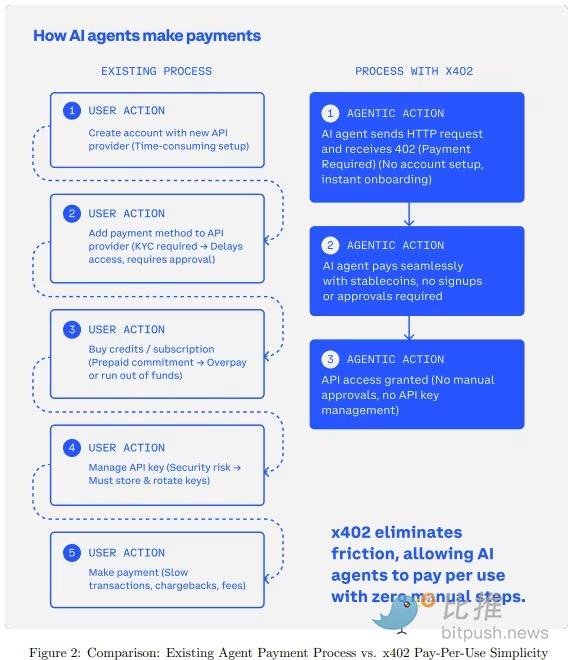
Source: x402 Whitepaper
The key breakthrough brought by x402 is that it becomes much simpler for anyone (human or agent) to pay for online services. According to the development team, the standard aims to "enable value to flow as seamlessly as information on the internet, regardless of whether the actor is an individual, an application, or an agent." This most commonly manifests in simplifying the API request process. As the Coinbase team succinctly stated: "Let's kill API keys."
Payment Flow
The x402 payment flow is easy to understand and consists of four main components:
1. Client: The agent (or user software) initiating the service request.
2. Server: The service provider that returns the 402 request and ultimately delivers the paid resource.
3. Coordinator: Executes and/or verifies the payment.
4. Blockchain: The settlement layer where the actual stablecoin/crypto asset transfer occurs.
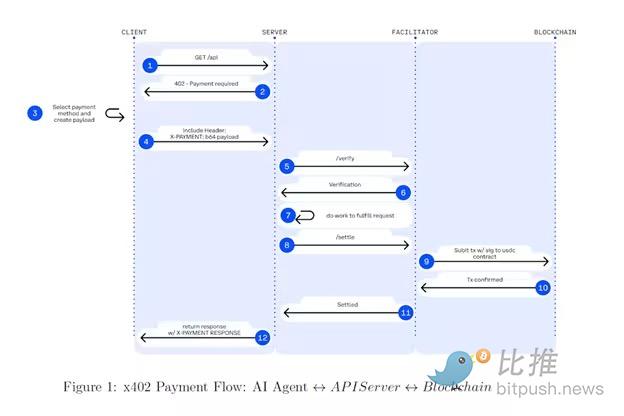
Source: x402 Whitepaper
The agent sends a request to the server for a product or service (e.g., a streaming subscription or an e-book), and the server returns a "Payment Required" request (HTTP 402). This request contains fields such as the required amount, accepted token types, the wallet address to send the payment to, and the blockchain for the payment.
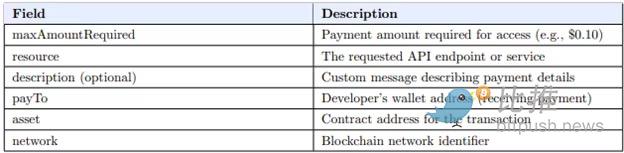
The agent then responds to the payment request, providing all necessary information along with a cryptographic signature authorizing the payment. Finally, the coordinator processes the actual payment for the service on the blockchain and confirms it to the server, which then returns the requested service to the agent.
This is the standard payment flow for x402 adoption, but many variations are possible. For example, if the agent itself controls a wallet and can transact on the blockchain, it could submit the payment and verification directly to the server without relying on a coordinator. However, coordinators have been used so far because they simplify the process by abstracting away the complexities of blockchain interactions like wallet management, gas payments, and network selection. In this regard, coordinators are similar to traditional payment service providers, but the difference is that they never custody funds or control the private keys of the wallets involved in the transaction. Instead, the agent controlling the wallet authorizes the what ("send up to X dollars from payer wallet to payee wallet"), while leaving the how (which chain, how much gas, etc.) to the coordinator to handle.
x402 V2
On December 11th, Coinbase released x402 V2, a significant upgrade based on feedback from the past six months of use. V2 begins the transformation of x402 from a relatively simple but effective specification for intelligent payments into a more modular standard designed to adapt to the evolving blockchain landscape and support a wider range of payment use cases.
At a high level, x402 V2 expands the protocol in three key dimensions. First, it introduces a Unified Payment Interface that supports multiple blockchains and assets through a single format, while also enabling integration with legacy payment rails via coordinators. Second, it adds wallet-based authentication and reusable access sessions, allowing clients to avoid repeated on-chain interactions for subsequent requests—reducing latency and supporting higher-frequency use cases. Third, it enables automatic service discovery, allowing coordinators to index endpoint, pricing, and routing information without manual configuration.
Together, these changes enable x402 to support more complex business models, including subscriptions, prepaid access, usage-based billing, and multi-step agent workflows.
The x402 Intelligent Payment Tech Stack
The x402 technology stack is gradually taking shape. The pace of project and infrastructure releases is exponential, and we have aggregated as many projects as possible in the chart below (likely not exhaustive, this article does not endorse any project, for reference only).
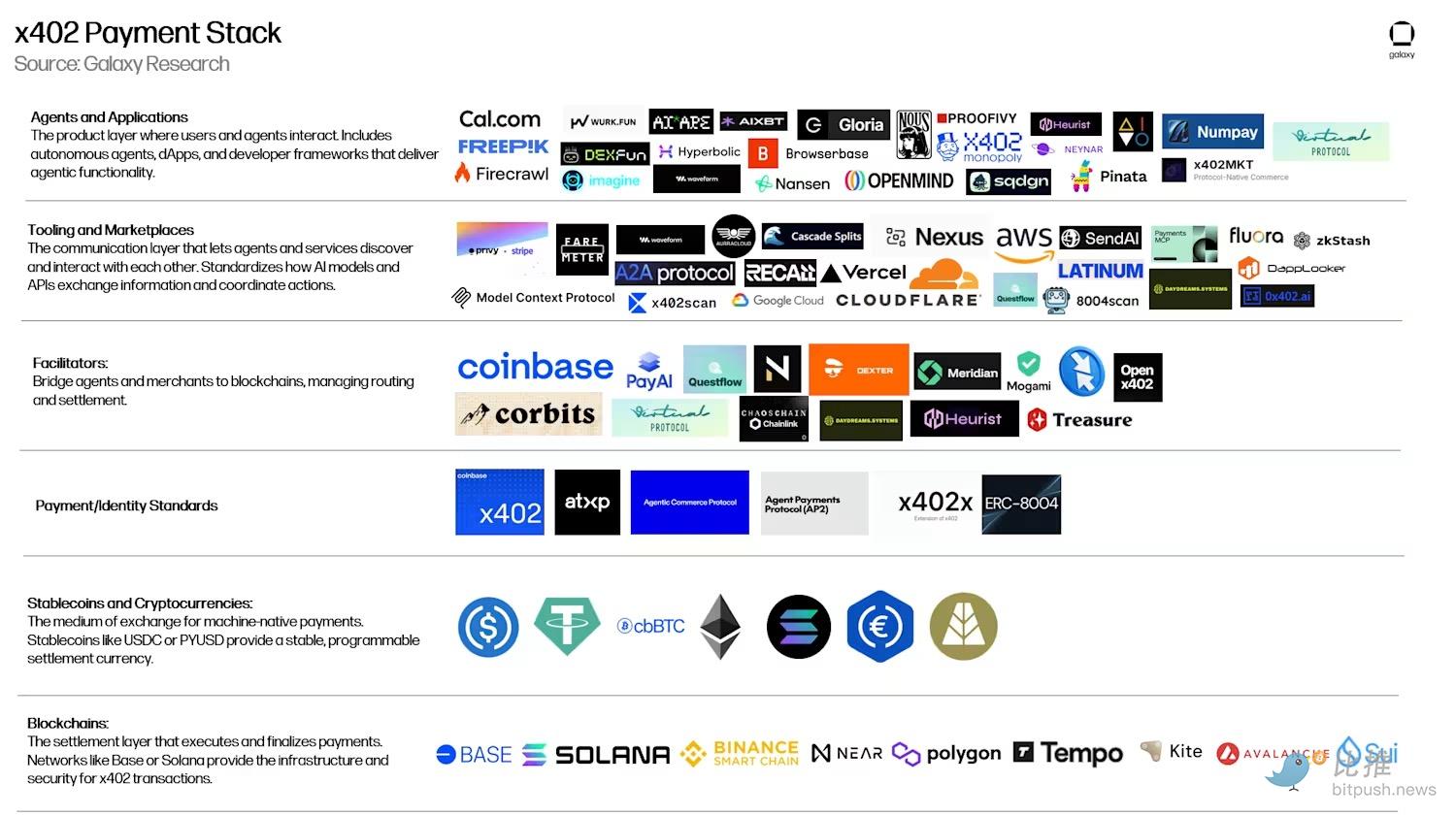
Value flow in the x402 payment tech stack starts at the Agent Layer, moves down through the Coordination Layer, Execution Layer, and Settlement Layer, and then passes back up as fulfilled service access.
First, an agent or application initiates a task requiring access to a paid service, such as querying an API, retrieving proprietary data, or invoking another agent. The agent determines what it needs and under what constraints (including price, latency, preferred chain, or budget).
The Coordination Layer shapes how agents broadcast intent, discover services, exchange context (relevant information needed to complete the task), and coordinate workflows before payment occurs. It embeds additional functionality for agent workflows beyond payment and settlement protocols, including service discovery mechanisms, intent signaling, constraint enforcement (rules or limits, such as budget, time, or permissions), context management, and multi-step or multi-agent coordination.
Once terms are agreed upon, the agent initiates payment through the Coordination Layer. Coordinators (services operated by third-party providers) handle the routing, validation, and execution of the transaction, abstracting away blockchain-specific complexities and interfacing with legacy payment rails when necessary.
The Money Layer defines what is transferred—typically stablecoins—enabling predictable pricing and programmable settlement suitable for high-frequency, machine-native transactions. USDC has been the primary form of payment so far, but theoretically any cryptocurrency could be used.
Finally, the Blockchain Layer executes and finalizes the transaction, providing cryptographic settlement and an auditable record. Confirmation then propagates back up the tech stack, allowing the service provider to deliver the requested resource to the agent.
Emerging Crypto Use Cases
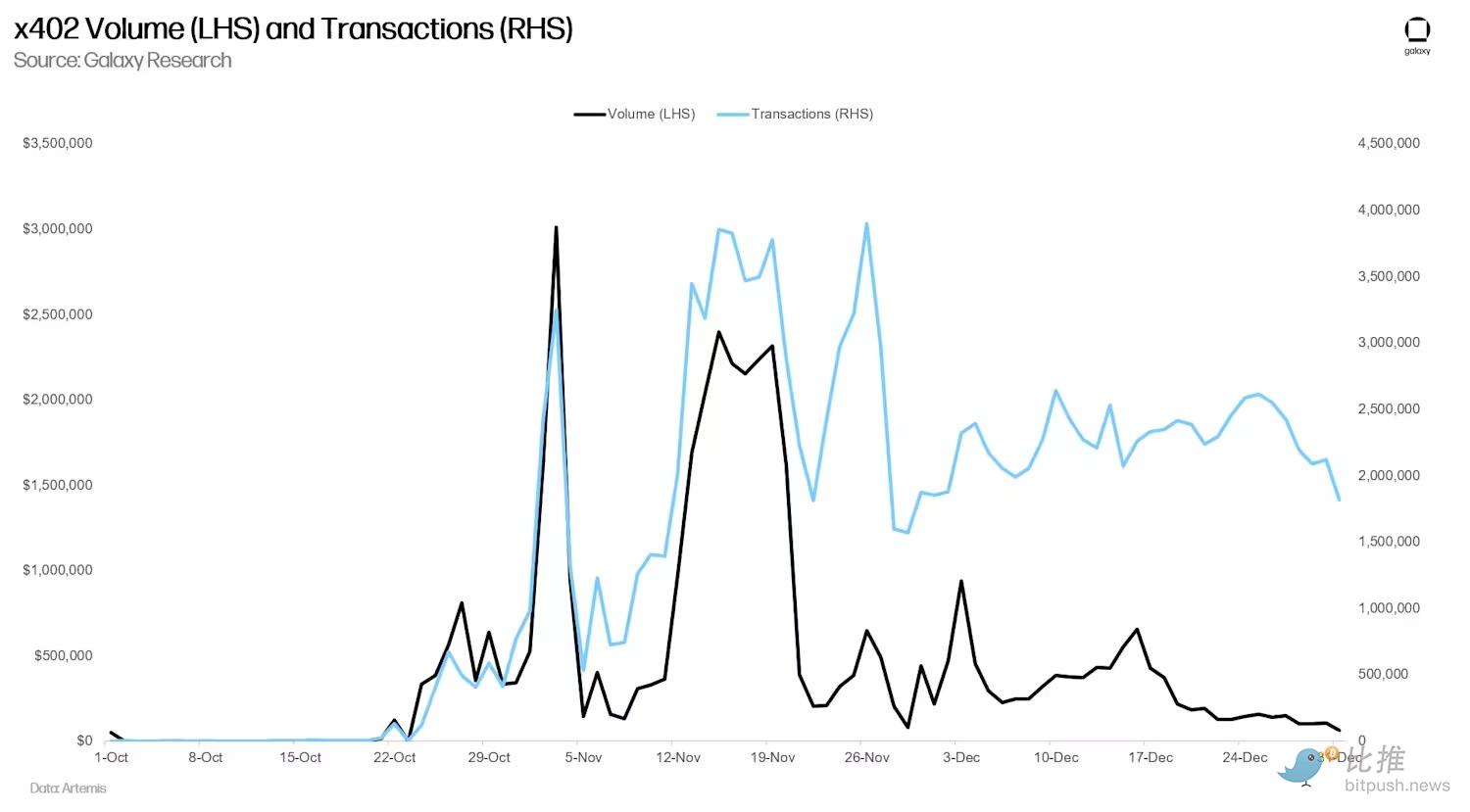
As we mentioned earlier, x402 activity experienced an initial surge in late October and early November, after which activity gradually declined.
Source: Artemis Analytics
As is common when primitives are introduced in the crypto space, initial adoption and interest were primarily driven by speculative activity, with the peak in late October caused by teams using x402 to mint and purchase memecoins. However, since then, transaction volume and count for agent-to-agent services, data-as-a-service, and infrastructure and utilities have begun to capture an increasing share of the market.
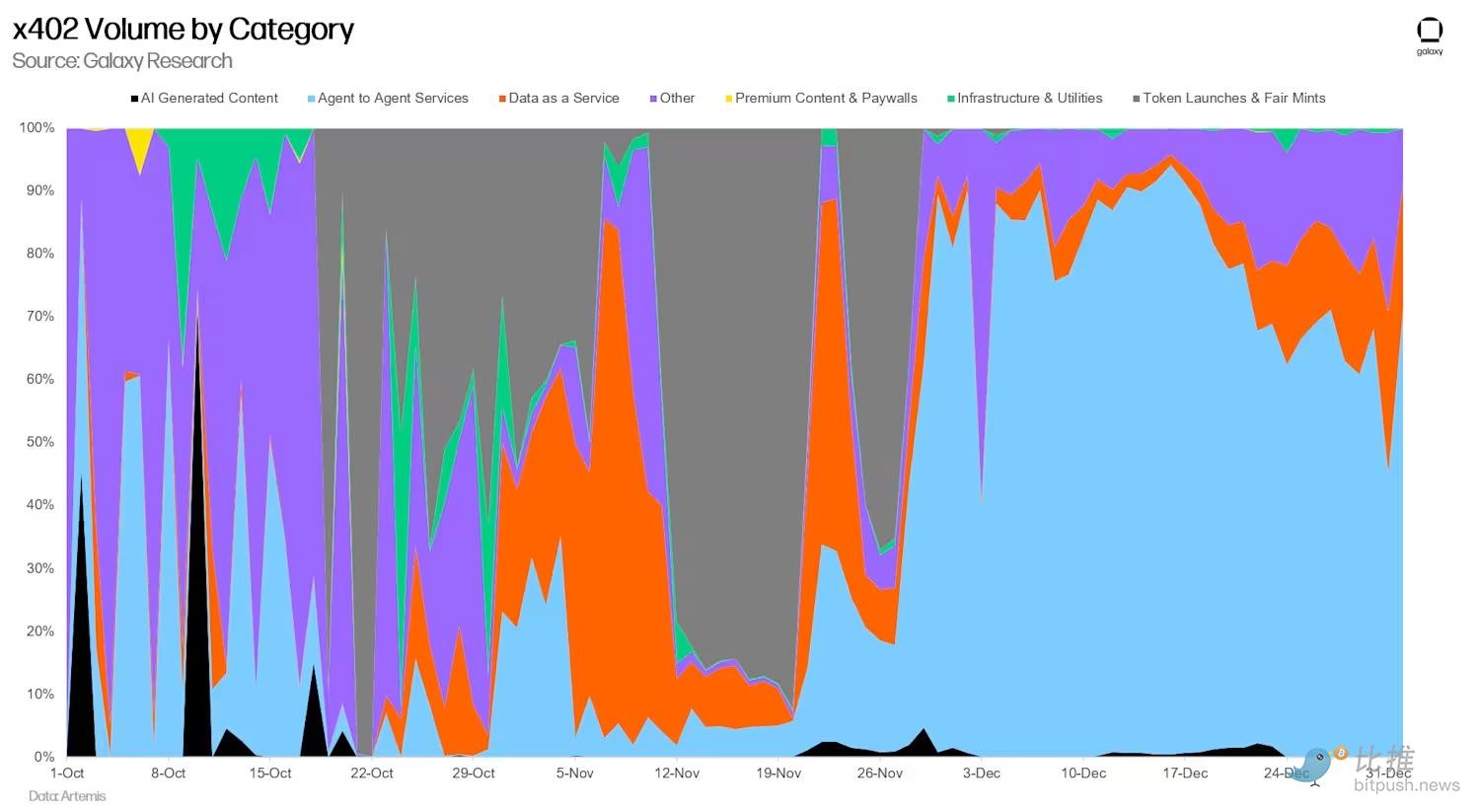
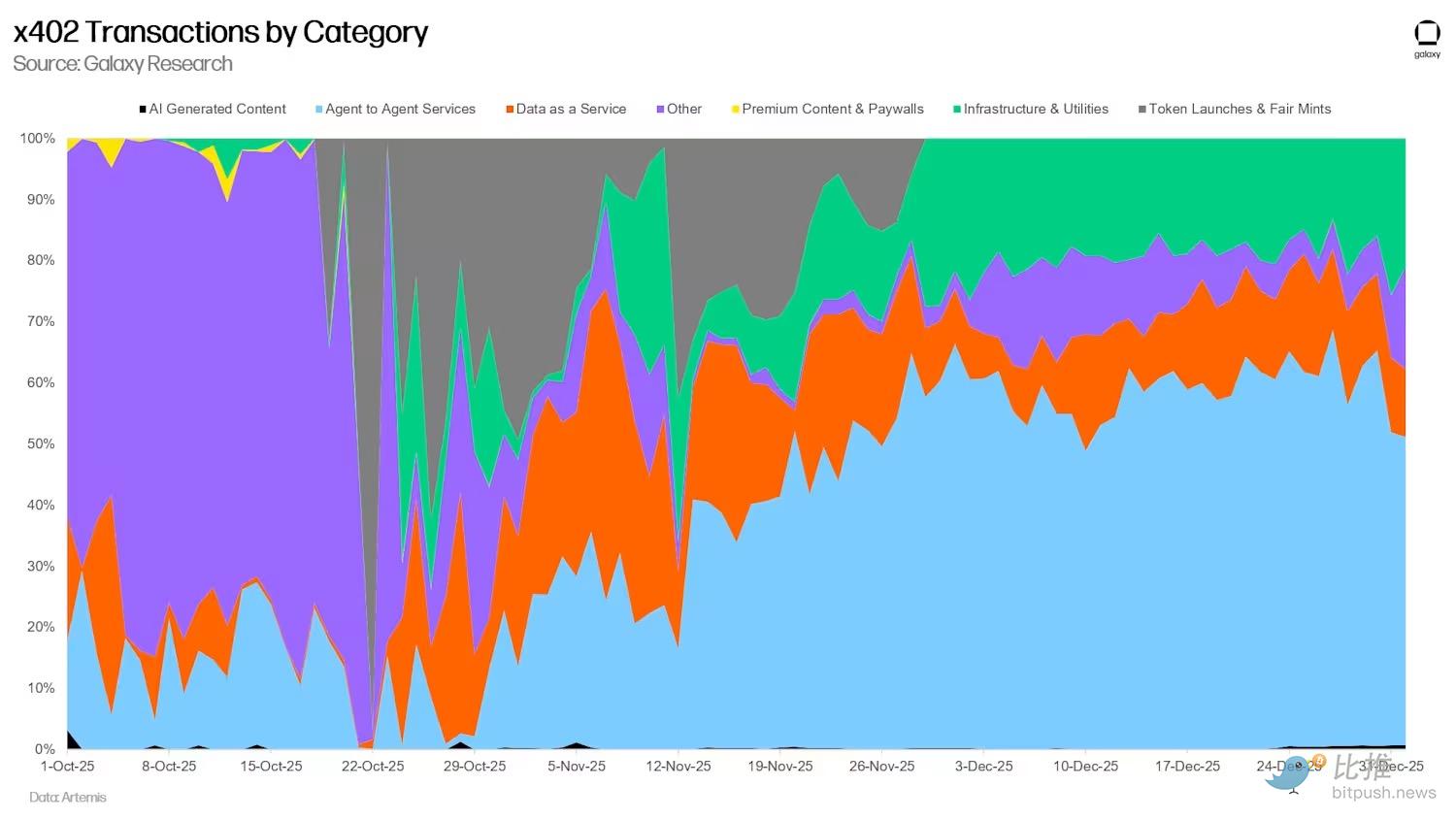
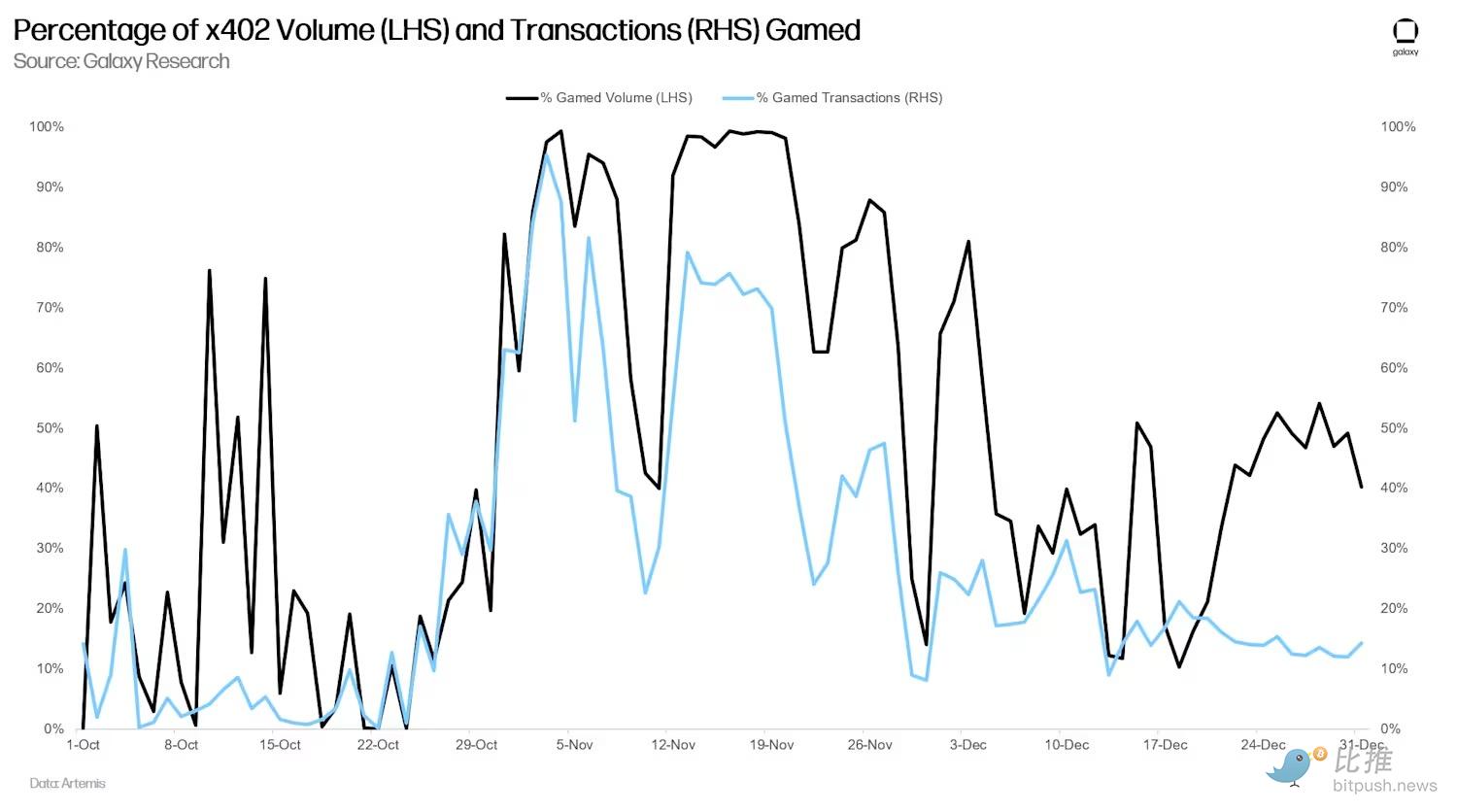
This is the nature of permissionless products in the crypto space. Initial speculative use cases attract users, who then attract developers who begin experimenting with the technology and building applications that go beyond speculative use cases. Indeed, filtering out all gamified transactions (defined by Artemis Analytics as obvious self-trading or wash trading) shows that their share has fallen below 50% since early December.
The most attractive and likely long-lasting use cases are those that leverage x402 to offer differentiated products relative to what is possible with legacy payment rails. This primarily includes services that are cost-prohibitive on traditional rails due to transaction fees, and use cases that require internet-native money because legacy systems are constrained by limited programmability, slow settlement times, and reliance on non-native intermediaries.
Currently, these services are dominated by providers supporting one-off API calls that would otherwise require a subscription. For example, a trading agent could pay-per-call to access the API of a blockchain data provider like Nansen or an AI analyst to supplement its crypto analysis. Beyond data access, x402 also allows agents to pay for infrastructure services (e.g., compute resources) programmatically, which are difficult to price or automate using subscription-based or manually-intermediated payment models. Leading decentralized AI lab Nous Research has enabled x402 payments to access its Hermes 4 model.
Despite the promising prospects, these examples remain largely speculative proofs-of-concept, demonstrating the capability of the infrastructure rather than the growth drivers needed for mass adoption of x402. This is not to disparage any individual project or its potential, but to acknowledge that most on-chain products still primarily target a crypto-native audience and represent only a fraction of potential applications. The next section explores more use cases and the broader conditions needed for intelligent payment standards to scale.
Context and Data Access
One of the most compelling non-crypto-native use cases for intelligent payment standards is paid access to online context and data. As AI agents increasingly rely on external information to perform tasks, the ability to programmatically purchase access to content on a per-request basis becomes crucial.
Cloudflare provides an early example of how this model might emerge. As a major infrastructure provider hosting and protecting a large portion of the internet's content, Cloudflare already mediates interactions between websites and automated traffic. In 2024, it introduced a "Pay-per-Crawl" mechanism, allowing bots and crawlers to pay for access instead of being blocked outright.
Subsequently, Cloudflare indicated plans to integrate this infrastructure with x402 (the company co-founded the x402 Foundation with Coinbase), enabling agents to use internet-native payment rails to pay for access directly. If standardized, this approach could transform bot mitigation from an access control problem into a pricing- and market-based mechanism. In short, an old nuisance now becomes a potential revenue opportunity.
This model extends naturally to paid content and proprietary data. Today, large language models primarily rely on internally trained data and freely available sources (like Wikipedia).
However, high-quality information is often locked behind subscriptions or paywalls—for example, news media, research databases, and analytics platforms. In the current paradigm, accessing this data requires users to leave the agent interface, purchase a subscription (even for one-time use), and manually transfer information, resulting in a suboptimal user experience and inefficient capital allocation.
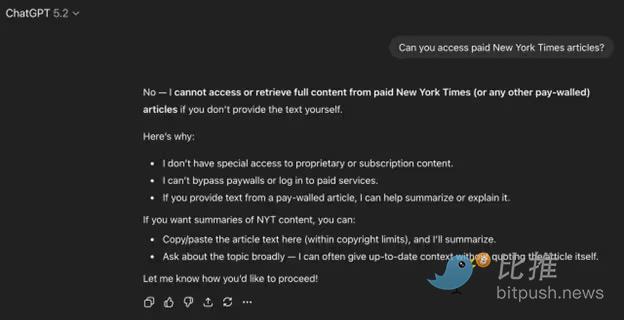
Intelligent payment standards offer an alternative. Users can assign explicit budgets to their agents, allowing them to pay for access to paywalled content on a per-request or per-token basis. For instance, an agent needing access to a single article could submit an x402 request with a micro-payment, retrieve the relevant content, and complete the task without the user purchasing a full subscription. While this model might compress per-user margins for content providers, increased query volume and more granular pricing could offset these effects over time.
In summary, context and data access represent a category where intelligent payments offer a clear improvement over legacy payment systems. It also illustrates how adoption of standards like x402 might originate outside crypto-native environments, embedded within infrastructure that already mediates interactions between agents, content, and the network.
E-commerce
One of the most frequently discussed areas for intelligent payment adoption is e-commerce. Agentic commerce is expected to grow rapidly in the coming decade, with B2C revenue estimates reaching $3-5 trillion by 2030. Consequently, this area has attracted significant attention from existing payment networks and processors, many of whom are now actively developing agent-native payment infrastructure.
However, in e-commerce, x402 adoption faces a more competitive environment than API-native or micropayment-driven use cases. Retail transactions are typically higher value and less sensitive to per-transaction fees, reducing the relative advantage of ultra-low-cost blockchain settlement. More importantly, existing payment providers already control the commercial and regulatory infrastructure on which merchants depend, and they are rapidly extending these capabilities to support autonomous agents without the need for on-chain primitives.
-
Visa's Intelligent Commerce suite (launched early 2025) enables consumers to configure Visa card credentials into AI agents for end-to-end shopping, integrating with platforms like OpenAI and Anthropic.
-
PayPal's Agentic Commerce Services (October 2025) allows PayPal merchants to sell products through agent interfaces like ChatGPT while retaining fraud detection, buyer protection, and merchant workflows.
-
Stripe's Agentic Commerce Protocol (ACP), co-developed with OpenAI and announced mid-2025, defines a standardized way for AI agents to initiate and complete purchases with merchants, requiring minimal changes to Stripe integrations.
-
Mastercard's Agent Pay (April 2025) tokenizes consumer credentials, enabling AI systems like Microsoft Copilot to autonomously execute purchases, with an early focus on subscriptions, loyalty redemptions, and programmable payments.
In some cases, these initiatives could reduce the need for blockchain-based payment protocols by extending traditional payment rails into agent-native flows; in others, they may be complementary. For example, two of the most prominent intelligent payment standards gaining adoption are Google's AP2 and Stripe's ACP. While not the primary implementation method for either, x402 could be integrated to facilitate stablecoin payments through either of them (e.g., via A2A for between agents, or via ACP for merchants).
Below we outline Stripe's push into agentic commerce to better illustrate this model.
Stripe's Push into Agentic Commerce
Stripe's ACP is an open standard that defines how AI agents, merchants, and payment systems communicate during the checkout process. ACP standardizes the checkout conversation—such as item selection, pricing, confirmation, and completion—without dictating how funds are ultimately settled. It acts as a coordination layer for checkout, not a payment rail itself, and is payment processor agnostic, meaning merchants can adopt the protocol without switching payment providers.
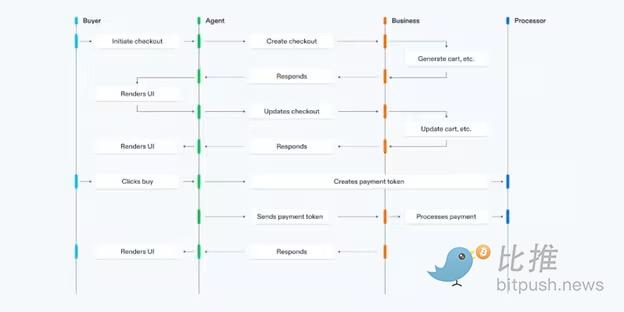
To support secure payment authorization within this framework, Stripe introduced Shared Payment Tokens. Despite using the word "token," SPTs are not crypto assets and do not represent an independent payment rail. Instead, they act as scoped payment authorizations, allowing an agent to authorize a merchant to debit a limited amount using its preferred infrastructure. This means the underlying settlement can be anything, from card payments to bank transfers, to stablecoins.
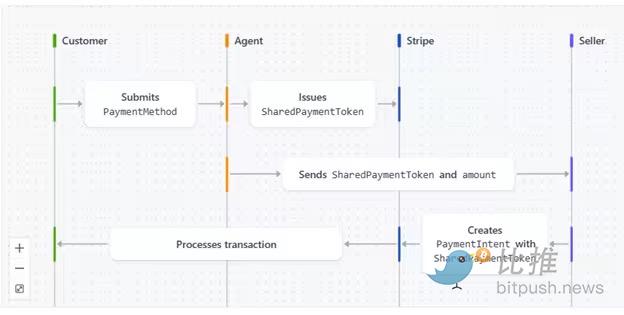
Shared Payment Token Payment Flow
ACP and SPTs together enable agents to participate in e-commerce while preserving the safeguards merchants rely on, including fraud detection, dispute resolution, refunds, regulatory compliance, and customer support. Stripe further packages these components into its Agentic Commerce Suite, offering a one-stop shop for merchants wanting to support agent-driven purchases without redesigning their payment stack.
How x402 and ACP Work Together
The distinction between Stripe's agentic commerce tech stack and x402 lies primarily in scope and transaction context.
-
x402 is built for software paying other software. An agent sees a price, pays automatically, and gains immediate access to the service. This is suitable for APIs, data, and digital tools that agents use within their workflows.
-
ACP and SPTs are built for purchasing physical goods or services. These purchases involve longer processes, hold merchants accountable for fraud and refunds, and often require user approval for payment.
To illustrate how these systems might coexist in practice, consider an AI agent tasked by a user to plan and book a vacation. First, the agent evaluates potential travel dates and destinations. To do this, it queries several specialized data providers, such as a premium weather forecast service and a demand forecasting API that predicts airfare price fluctuations, which have integrated x402. The agent can programmatically discover pricing, pay for access, and retrieve this data on a per-request basis.
These calls are irreversible and require no human intervention. With this data, the agent determines the optimal travel dates and begins selecting flights and hotels. At this point, the transaction shifts to an e-commerce flow. The agent uses ACP to initiate checkout with an airline or travel platform. Payment is authorized via SPTs, allowing the merchant to process the transaction with guarantees for fraud protection, refunds, chargebacks, and compliance. The user reviews and approves the purchase, the booking is completed, and fulfillment follows.
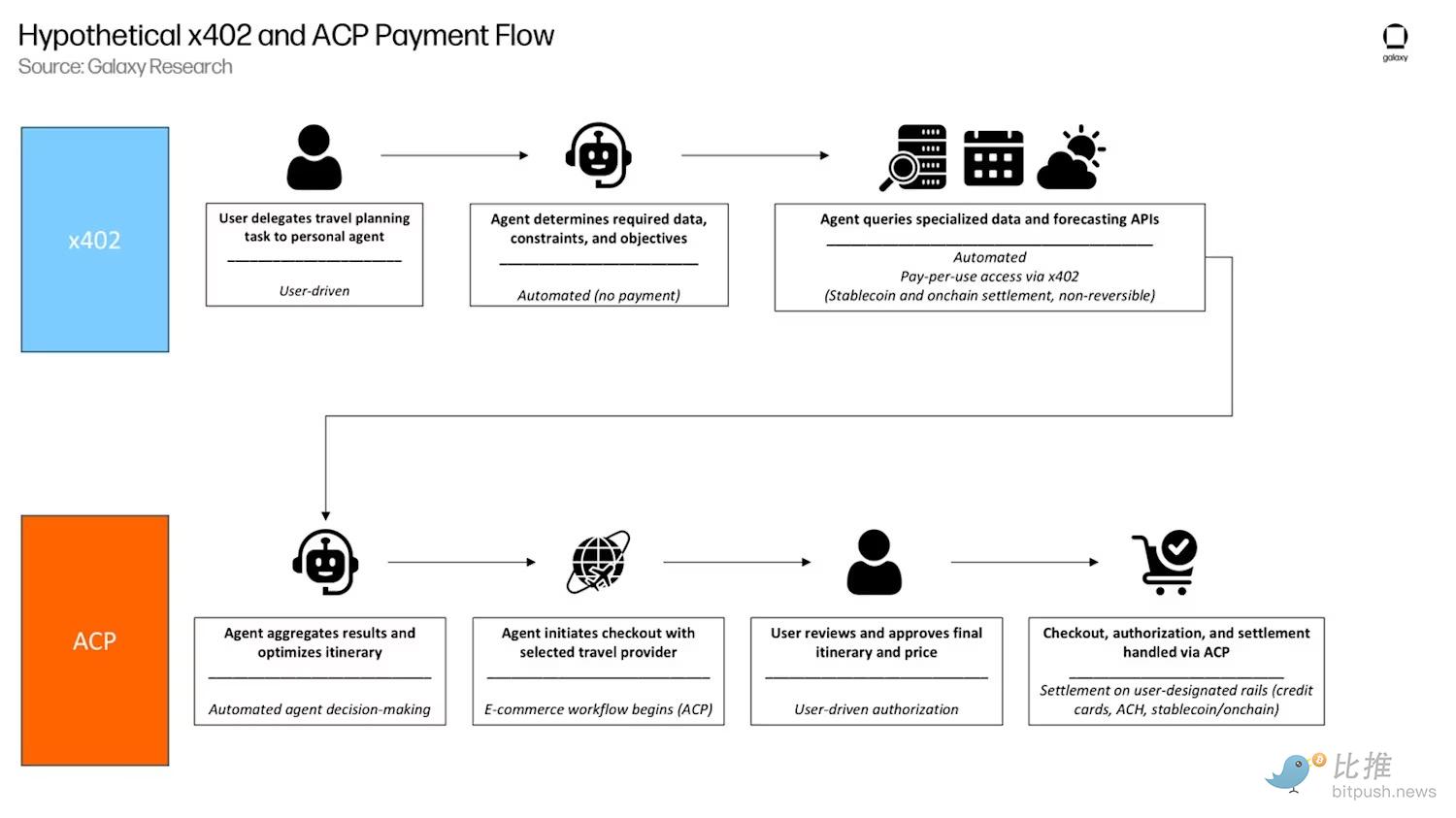
In this workflow, x402 and ACP play different but complementary roles. x402 sits upstream of the checkout process, enabling autonomous payments for resources outside traditional commerce flows.
Meanwhile, ACP handles regulated transactions where merchants require the protections and guarantees of existing payment systems, and users must sign off before payment occurs. A significant breakthrough here is the agent's ability to seamlessly switch between different payment models based on context, selecting the most appropriate mechanism for each step of the task.
Beyond functional differences, there is an important structural distinction. x402 is designed as an open standard settling on public, permissionless blockchains, enabling agents to transact without relying on centralized intermediaries. In contrast, many intelligent payment standards led by existing incumbents are open at the protocol level but operate primarily on permissioned platforms, where execution, compliance, and settlement remain tightly coupled with centralized payment providers. These approaches support different use cases and trust models and are not mutually exclusive. In practice, hybrid architectures are likely to emerge, where agents leverage permissionless rails for machine-native transactions while relying on permissioned systems for regulated commerce and consumer-facing payments.
Conclusion
Rather than immediately driving a wholesale shift to on-chain payments, intelligent payments are more likely to facilitate the adoption of blockchain technology gradually, and largely "quietly," in the future. Stablecoins accelerate this shift by reducing the friction of interfacing with traditional systems, while infrastructure like x402 enables new forms of experimentation that are difficult to support with traditional payment channels.
In the short term, adoption is likely to be uneven. Certain use cases, particularly payments between agents and digital services, may develop rapidly, while consumer-facing e-commerce sees little change. In many cases, blockchain will operate in the background, embedded within agent workflows rather than presented directly to end-users.
The most immediate and underappreciated impact of intelligent payment standards lies not in commercial transactions, but in software production. For many non-production-scale tasks, the capabilities of modern language models have reached a level where human involvement is largely redundant. Today, the main pain point is no longer intelligence or execution, but access: purchasing API subscriptions, managing accounts, handling API keys, and paying for bundled services that are rarely fully utilized. If intelligent payment standards can eliminate this friction—replacing subscription-based access and manual key management with "pay-per-use," machine-native payments—they can substantially lower the cost of experimentation and compress the value of entry-level software engineering work.
From this perspective, the most compelling near-term application of x402 is not abstract agent-to-agent commerce, but micropayments for API and data access. Allowing agents to pay for single API calls or discrete units of context unlocks a more capital-efficient model for both users and suppliers. Instead of overpaying for subscription services, users can allocate explicit budgets (e.g., a fixed monthly allowance) and let their agents autonomously purchase data, analytical services, or contextual information as needed. This model better aligns incentives, improves the user experience, and expands the economic "surface area" available to AI systems.
Over time, the question will shift from "is blockchain being used" to "where and how it is being used." Existing industry giants are already experimenting with stablecoins and blockchain rails in combination with intelligent payment capabilities, suggesting that on-chain settlement will increasingly coexist with traditional payment infrastructure. The open question is whether this activity will concentrate on permissioned chains or consortium chains controlled by centralized entities, or occur on open, permissionless networks like Ethereum or Solana. Likely, both will exist.
More broadly, the emergence of intelligent payment standards reflects a shift in how cryptocurrency adoption might unfold in the future. Blockchain infrastructure is increasingly being absorbed into existing financial and software systems, rather than forming a separate industry. In this model, success is defined not by the growth of a separate "crypto economy," but by the extent to which crypto-native "rails" silently underpin applications that don't identify as "crypto" at all. x402 is a clear example of this dynamic. By embedding payments directly into standard web interactions, it positions blockchain as backend infrastructure—delivering programmability and global settlement capabilities without requiring users or developers to explicitly deal with crypto.
On-chain intelligent payments are unlikely to completely replace the existing payment ecosystem. Instead, they will first complement it in areas where machine-native money offers clear advantages—such as automated access to APIs, data, and digital services—before gradually moving into higher-value commerce processes. In doing so, they are likely to quietly reshape how software is built, priced, and consumed, positioning blockchain as the foundational layer of the emerging agent-driven internet, rather than a visible end-point.
Twitter:https://twitter.com/BitpushNewsCN
Bitpush TG Discussion Group:https://t.me/BitPushCommunity
Bitpush TG Subscription: https://t.me/bitpush