Futu's Fine Turns into a Boon for Hyperliquid?

marsbitОпубликовано 2026-05-25Обновлено 2026-05-25

Введение

The article explores the interconnected narratives of a regulatory crackdown on Chinese fintech brokers and the rise of the decentralized exchange Hyperliquid. It begins with China's May 2026 proposal for severe penalties against brokers like Futu and Tiger for illegal cross-border operations, suggesting this may redirect capital toward platforms like Hyperliquid. This is evidenced by HYPE token's price surge coinciding with the news. The core of the article analyzes Hyperliquid's disruptive potential and the regulatory pressure it faces. Traditional giants like CME and ICE are lobbying the CFTC to crack down on Hyperliquid, citing its lack of KYC, position limits, and market surveillance—particularly for its weekend crude oil contracts, which challenge traditional market hours. Despite this, Hyperliquid demonstrates remarkable efficiency, with a small team generating high revenue, largely funneled into HYPE buybacks. Its innovation lies in synthetic perpetual contracts for pre-IPO companies (e.g., Cerebras, SpaceX), enabling price discovery outside traditional channels. Unlike tokenized equity platforms (PreStocks, Ondo) tied to physical assets or entities, Hyperliquid's "asset-less" synthetic contracts are argued to be more resilient to legal targeting, as they are simply code on a decentralized network. However, the article notes this is not absolute, citing the network's limited validators and past interventions. The piece concludes that Hyperliquid's fundamental advan...

Author: Thejaswini M A

Compiled and Edited: BitpushNews

Bitpush Note:

On May 22, 2026, the China Securities Regulatory Commission (CSRC) dropped a bombshell: it plans to impose severe penalties on the illegal cross-border business activities of institutions such as Tiger Brokers, Futu Securities, and Longbridge Securities. Not only are they facing huge fines, but all illegal gains of related entities both inside and outside China will be confiscated according to law. Furthermore, during a two-year centralized rectification period, all related domestic business will be completely banned, with existing mainland clients only allowed to sell unidirectionally. Upon the news, related US-listed broker stocks plummeted over 40% in pre-market trading.

When compliant cross-border channels are being blocked one by one, where will the capital that still craves global asset allocation, participation in pre-IPO pricing for companies like SpaceX, and the ability to trade any asset anytime, anywhere, flow to?

The answer seems to be faintly emerging: flowing into RWA, flowing into Hyperliquid.

This is not a prophecy. This is happening right now.

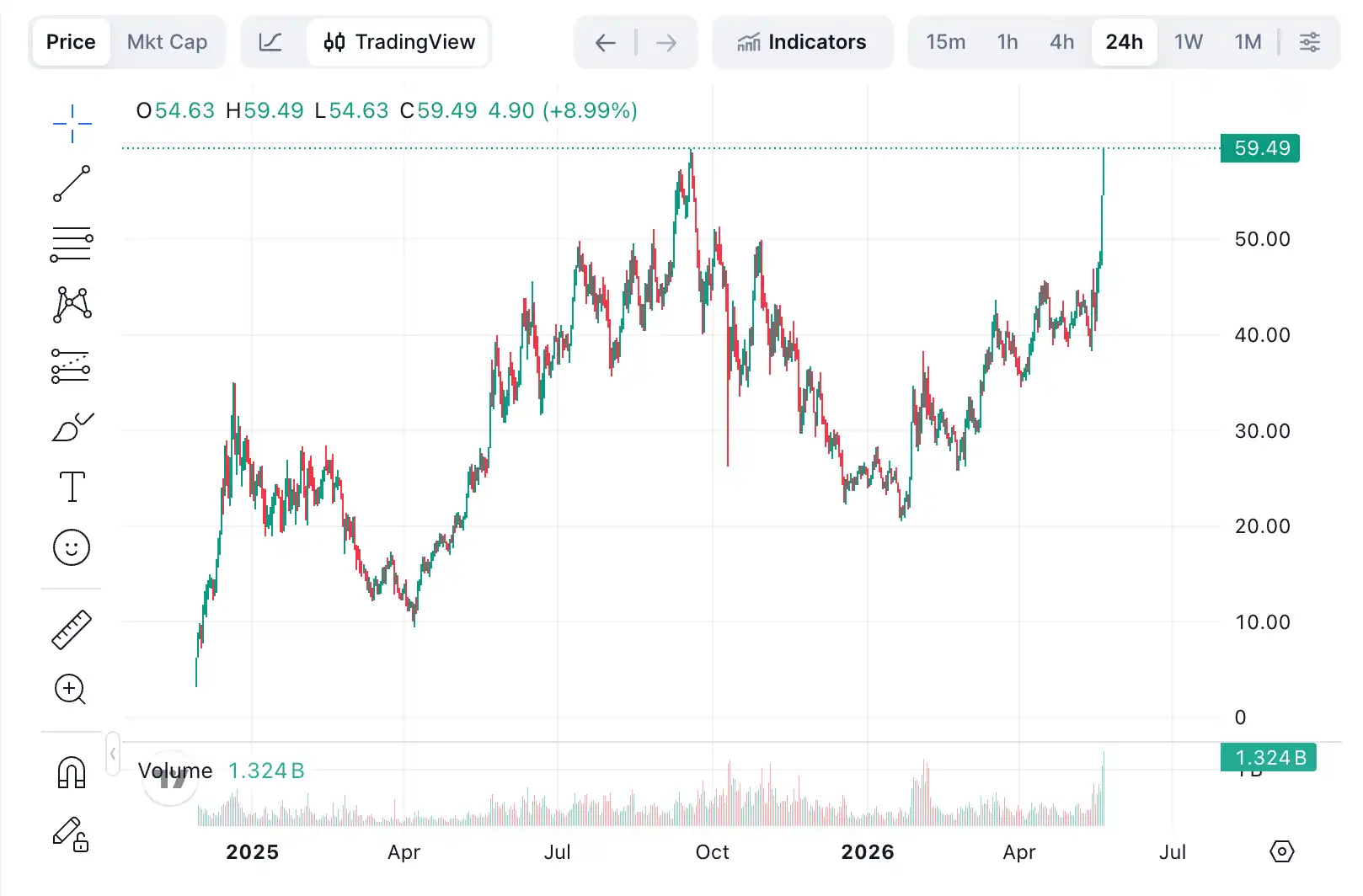
On the very same day the news of the fines broke, HYPE hit a new high.

Coincidence? Perhaps. But capital doesn't believe in coincidences. It only believes in exits.

The following is the main text:

CME Group (Chicago Mercantile Exchange) is the world's largest derivatives exchange. It's where professional traders buy and sell futures on crude oil, gold, interest rates, stock indices, and Bitcoin. It handles trillions of dollars in daily trading volume and has existed since 1898.

Intercontinental Exchange (ICE) owns the New York Stock Exchange and operates multiple derivatives exchanges globally. It's another industry giant.

They are among the most powerful financial market infrastructure companies on Earth. When they point at something and call it "extremely dangerous," regulators find it hard not to listen.

Currently, CME and ICE are pressuring the U.S. Commodity Futures Trading Commission (CFTC) and Capitol Hill to crack down hard on Hyperliquid, warning that this "KYC-free" platform is a breeding ground for market manipulation and sanctions evasion.

  • There is indeed zero KYC. While Hyperliquid uses filters on its main site front-end to block addresses sanctioned by the U.S. Office of Foreign Assets Control (OFAC), its underlying protocol is completely permissionless. If someone bypasses the website and interacts directly with the smart contracts, there is no identity check waiting for them.
  • Additionally, there are no position limits on Hyperliquid. At CME, no single trader can hold a position larger than a specific size in any contract, to guard against manipulation and systemic risk. Hyperliquid has no such restrictions.
  • CME closely monitors manipulative trading behaviors like spoofing, wash trading, and coordinated attacks. Hyperliquid has no surveillance system watching for these.

These are indeed objective facts.

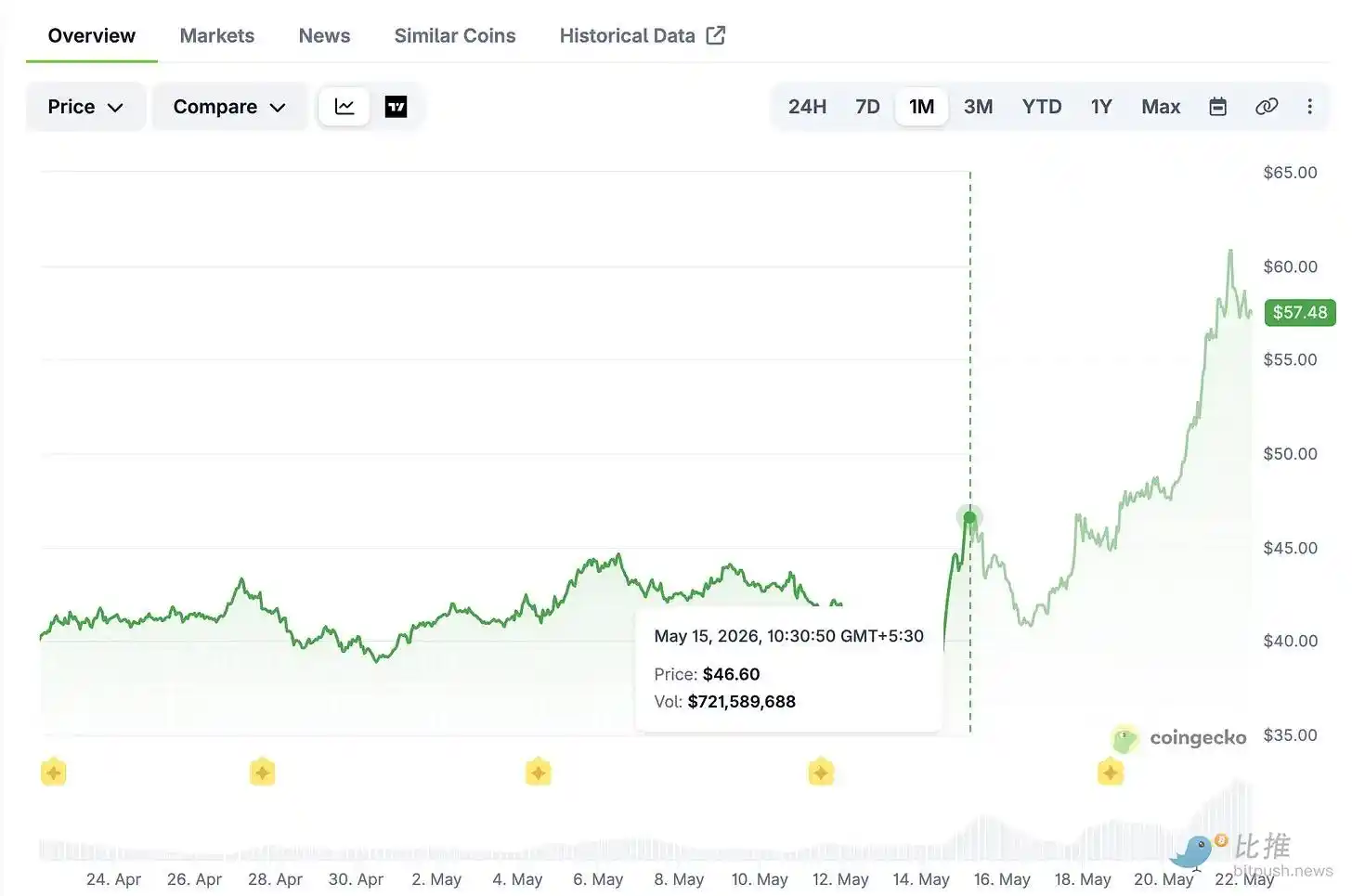
Influenced by this news, the HYPE token dropped 9% on May 15. Subsequently, two market makers withdrew $100 million in liquidity on May 18 in response.

coingecko.com

But, note which specific product they are targeting. It's not the cryptocurrency perpetual contracts that Hyperliquid has been running for years, which regulators never batted an eye at. Their focus is entirely on the crude oil contracts. These are the contracts that generated $720 million in trading volume over weekends when CME's own crude market is closed.

Regarding this regulatory growing pain, CME and ICE's concerns are not entirely without merit, but we also know in our hearts they are anything but neutral observers. Their business models are entirely reliant on a legally protected "trading hours monopoly." They don't mind competing on technology, but when someone competes with them on time, they go absolutely crazy.

By bringing real volume into the crude oil market over weekends, Hyperliquid has essentially broken the space-time continuum of TradFi. And the incumbents are asking the government to force everyone else to also close their eyes while they sleep. If it were me, I'd prefer to apply for a permit to operate on weekends; but clearly, that's just my thinking.

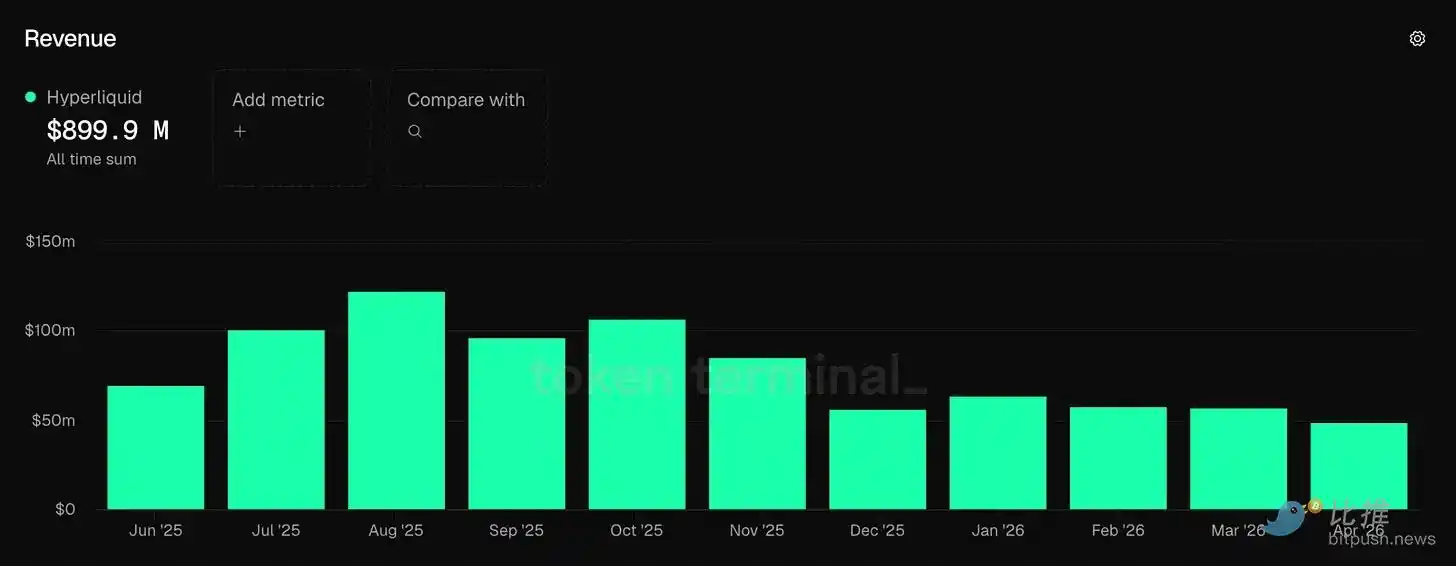
Hyperliquid's office in Singapore has only 11 people. In the 30 days ending May 21, 2026, the protocol generated $51 million in revenue. In March, it processed a staggering $2.6 trillion in nominal derivatives trading volume.

tokenterminal.com

Hyperliquid routes 97% of trading fees through an on-chain fund to buy back HYPE tokens. Generating $51 million in monthly revenue with just 11 people finds no real comparison, whether inside or outside the cryptocurrency industry, in terms of per capita economic efficiency. As of late May, HYPE is up 101% year-to-date.

All of this isn't necessarily because Hyperliquid built a technically superior derivative, strictly speaking. It's simply because it remains open when CME is closed, and therein lies immense value. Recently, some new developments have pushed this logic to an even deeper level.

On May 1, Trade.xyz, a platform built on Hyperliquid, launched a Pre-IPO perpetual futures contract for AI chipmaker Cerebras. The contract ran for two weeks before the IPO. Early in that window, traders had smoothed out a roughly 50% premium relative to the $185 IPO price, implying an opening price around $277. Then market information updated. One hour before Cerebras opened on NASDAQ, the perpetual contract on Trade.xyz was pricing the stock at $340, within less than 3% of the actual opening price. In the end, Cerebras opened at $350 on May 14, a stunning 89% surge from its $185 IPO price. Traditional pre-IPO market platforms like Forge and EquityZen had prediction errors of 35%, while Hyperliquid's error was just 3%.

When genuine uncertainty still existed, $277 was the price the market implied. As information kept flowing in and being priced in, the wisdom of the crowd smoothed out that gap. This is how price discovery is supposed to work.

Then on May 17, a Sunday morning, Trade.xyz launched a SpaceX perpetual futures contract. It opened at a reference price of $150, soared to $216 within hours, and eventually stabilized around $203, implying the crowd valued the company at $2.4 trillion.

Yet at that time, SpaceX had not publicly filed an S-1 registration statement, no Wall Street analyst had given a price target, and an official roadshow was nowhere in sight.

Traders had no idea that SpaceX had actually confidentially submitted a draft filing to the SEC as early as April 1, with a target valuation set between $1.75 trillion and $2 trillion.

Traders settled the contract at $203, implying a $2.4 trillion valuation. Before bankers held their first meeting, without access to the filing documents, the crowd landed smartly at the top end of the company's own target range. Just days later, on May 20, a Wednesday, SpaceX formally filed its actual 277-page S-1 prospectus with the public.

Currently, three products are trying to provide investors with exposure to SpaceX. Each legally bets on a different solution.

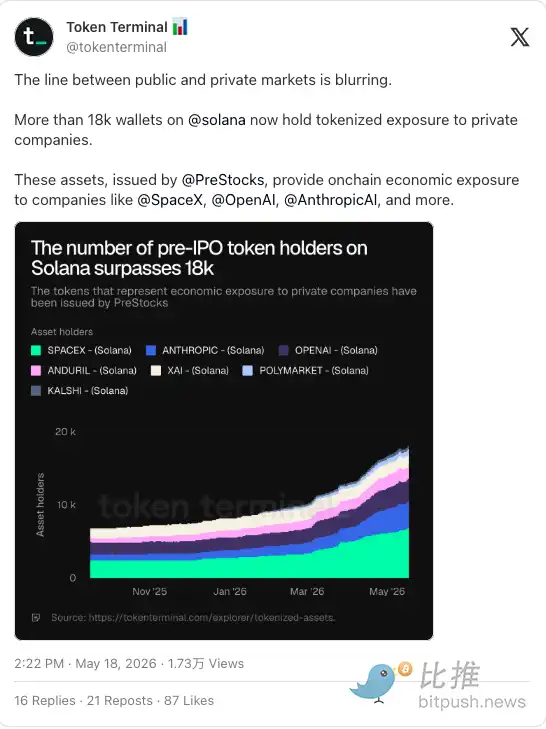
PreStocks tried to be clever. They set up special purpose vehicle (SPV) funds to buy real SpaceX shares, then split and mapped those fund shares into blockchain tokens so retail investors could get a slice. It looked like a clean backdoor into private tech companies.

However, shortly before Hyperliquid launched its SPCX contract, Anthropic and OpenAI publicly distanced themselves from third-party SPV products claiming to track their valuations. Platforms in Hong Kong and the UAE had been selling tokenized exposure to these two companies without board approval. Both companies issued warnings that the equity transfers behind these products were invalid. PreStocks' token promptly plunged 50%. When you try to operate by anchoring to real shares, the company you hold shares in always reserves the right to intervene.

Ondo Global Markets tokenizes shares through a U.S.-registered broker-dealer, with each token backed by underlying securities. Its compliance is very clean; even the Depository Trust & Clearing Corporation (DTCC) is building settlement infrastructure around it.

But Ondo's greatest strength is also its biggest vulnerability. It has a specific physical address. If the SEC decides to shut it down, they know exactly whose door to knock on. If Elon Musk objects, SpaceX's lawyers know exactly which custodian to sue. By choosing to play the game by the rules, Ondo has made itself a perfect target for pinpoint strikes.

Then look at Hyperliquid's SPCX contract — this thing is built entirely on air.

No shares, no registered broker-dealer, no claim on any physical asset. It's a synthetic perpetual contract, a ghost through and through. A pure bet on a price feed, settled entirely in USDC on a decentralized network.

Even if SpaceX wanted to stop people from trading derivatives based on its valuation, it couldn't. There's no corporate entity to serve legal papers to, no central issuer to pressure.

This is really clever. Hyperliquid basically figured out: if you have no face, no one can punch you in the face. By anchoring the product to nothing physical, they've become impossible to target.

I'm not sure this is purely a good thing.

A zero-KYC venue rerouting trillions of dollars around the global banking system — the national security nightmare this poses is hard to argue against. The fact that Hyperliquid co-founder Jeff Yan flew to Washington on May 17 to meet policymakers is proof enough of how real this pressure is.

Speaking of Jeff Yan. He is a real person, shows his face, and went to Harvard. If SpaceX wanted to sue him for trademark infringement or IP violation because his platform lists a contract called "SPCX," they could absolutely serve him the lawsuit.

But suing Jeff wouldn't make the contract disappear.

With PreStocks, if the company deletes the underlying shares, the product ceases to exist. With Ondo, if a judge freezes the bank or custodian, the product stalls. But Hyperliquid's SPCX is an autonomously deployed piece of code. Even if Jeff Yan gets sued into oblivion, those smart contracts are live, the code is immutable, and the global order book would keep running on-chain.

This is the "flawless theory" of decentralization. Reality is more fragile. Hyperliquid only runs on 20 validators, not 900,000. These validators can be identified. And the JELLY incident has already shown: they will intervene if they want to. Validators are not immutable.

Again, time is the only product they can't replicate.

Связанные с этим вопросы

QWhat is Hyperliquid, and how does it differ from traditional derivatives exchanges like CME?

AHyperliquid is a decentralized derivatives exchange that operates 24/7 and without KYC on its underlying protocol, unlike traditional centralized exchanges like CME which have restricted trading hours and strict compliance requirements. It allows users to trade perpetual futures contracts on various assets, including cryptocurrencies and real-world assets (RWAs).

QWhy did the potential fines on Chinese brokerages like Futu and Tiger Securities appear to be a positive catalyst for Hyperliquid's HYPE token?

AThe announcement of severe penalties for illegal cross-border operations by Chinese brokerages signaled a potential crackdown on traditional, compliant channels for accessing global assets. This may have driven capital seeking global asset exposure and 24/7 trading into alternative platforms like Hyperliquid, which offers such access in a decentralized manner, likely contributing to a surge in its HYPE token.

QWhat are the main regulatory concerns raised by traditional exchanges (CME, ICE) against Hyperliquid?

AThe main regulatory concerns raised are: 1) Lack of KYC, which could facilitate market manipulation and sanctions evasion. 2) Absence of position limits to prevent market dominance and systemic risk. 3) No surveillance systems to monitor manipulative trading practices like spoofing or wash trading.

QHow did Hyperliquid's SpaceX (SPCX) perpetual futures contract demonstrate its price discovery capabilities?

AThe SPCX contract started trading before SpaceX's official S-1 filing and without access to confidential documents. It settled at a price implying a $2.4 trillion valuation. Days later, SpaceX's public filing revealed a target valuation range of $1.75-$2 trillion, showing that the Hyperliquid market's 'crowd wisdom' accurately discovered the price at the high end of the company's internal target range.

QWhat is the core strategic advantage of Hyperliquid's synthetic perpetual contracts (like for SpaceX) compared to other tokenized equity platforms?

AThe core advantage is that these contracts are synthetic, not backed by any real underlying asset or equity claim. This makes them legally difficult to target. Unlike platforms that tokenize actual shares (which the issuing company can challenge), Hyperliquid's contracts are pure price bets on decentralized code, offering a form of regulatory and legal resistance by having 'no face to punch.'

Похожее

AI Impact on SaaS Software Stocks: Deconstructing the Bottom-Fishing Logic of Salesforce, ServiceNow, and Snowflake

"AI Nightmare for SaaS Stocks: Unpacking the Bottom-Fishing Logic for Salesforce, ServiceNow, and Snowflake" A deep dive analysis argues that the recent collapse in SaaS software stocks, dubbed the "SaaS Doom," presents a contrarian buying opportunity. The market panic, triggered by fears that AI will disrupt traditional per-user subscription models through "seat compression" and AI agents bypassing software UIs, has led to extreme selling in the software sector. The analysis evaluates three major players under a unified framework: 1. **Salesforce (CRM):** Positioned as a "margin of safety" play. Trading at historically low valuations (13-14x forward P/E), with strong cash flow and a massive buyback, it offers value. Its key challenge is transitioning from a "seat economy" to an AI-driven "task economy" with its Agentforce platform. 2. **ServiceNow (NOW):** The "clearest AI narrative" play. Its "AI Control Tower" strategy aims to become the governance and orchestration layer for enterprise AI agents, benefiting from AI proliferation. Backed by Nvidia's CEO, it trades at a relatively low valuation post-correction. 3. **Snowflake (SNOW):** The "high-risk, high-reward" bet. Its consumption-based model aligns with rising AI workloads, and its RPO growth is strong. However, it faces intense competition (e.g., Databricks), is not yet GAAP profitable, and carries the highest valuation. The conclusion counters the simplified "AI kills software" narrative. AI is eliminating software that sells only functional interfaces but rewarding platforms that provide essential infrastructure, data, and governance. The current sell-off may have created a buying opportunity for resilient software leaders positioned as future AI infrastructure platforms.

marsbit12 мин. назад

AI Impact on SaaS Software Stocks: Deconstructing the Bottom-Fishing Logic of Salesforce, ServiceNow, and Snowflake

marsbit12 мин. назад

Just Now, Ilya Drops Another Mind-Blowing Image ‘The Thinker’: What’s on His Mind in the Ocean of AI Chips?

Shortly after going quiet, Ilya Sutskever, AI's enigmatic spiritual leader, posted a mysterious sketch titled "The Thinker" on Instagram. The drawing depicts Rodin's iconic sculpture perched on a cliff, contemplating a vast, purple microscopic universe made of transistors and digital circuits—a chip die shot—signed "IS 2026." This cryptic image, saying "nothing yet everything," ignited widespread speculation in Silicon Valley. Some see it as a search for sacred meaning in silicon, others as a silent critique of brute-force compute scaling. It echoes Ilya's past influence, like the original OpenAI logo he once doodled on a wall. The post coincided with a triple announcement from OpenAI, intensifying the frenzy. First, an internal reasoning model discovered new geometric constructions, challenging a long-standing conjecture and impressing Fields Medalist Tim Gowers. Second, Codex for Mac introduced "Appshots," allowing it to access application windows—even text outside the view—and gained features like Goal Mode, a built-in browser, and plugin capabilities, evolving from a coding assistant into a persistent "resident engineer." Third, reports surfaced that OpenAI is preparing for a confidential IPO filing with banks like Goldman Sachs and Morgan Stanley, potentially eyeing a fall public listing. Together, these moves signal that AGI (Artificial General Intelligence) is not a distant slogan but an active force reshaping science, software engineering, and capital markets. Ilya's art hints at a paradigm shift where the boundary between human thought and silicon computation blurs. As OpenAI insiders excitedly say, "Feel the AGI," it suggests a tangible breakthrough may be imminent—one our generation is likely to witness.

marsbit31 мин. назад

Just Now, Ilya Drops Another Mind-Blowing Image ‘The Thinker’: What’s on His Mind in the Ocean of AI Chips?

marsbit31 мин. назад

Vitalik on the Future of the Ethereum Foundation: A Smaller, More Distinct, but Longer-Lasting Ship

Vitalik discusses the future direction of the Ethereum Foundation (EF), emphasizing a shift towards a smaller, more focused, and longer-lasting organization. He clarifies this is his personal view and that his own influence within EF is diminishing, which he welcomes. The key driver is aligning EF's actions with its stated values of decentralization, privacy, and being a "sanctuary technology," addressing criticism that its operations haven't fully reflected these ideals. He argues that EF should not be the "center" of Ethereum but one node among many with a specific mandate. With limited resources (holding only ~0.16% of all ETH), EF must focus its remaining efforts on long-term, mission-critical activities that wouldn't happen without its push, particularly those reinforcing Ethereum's core CROPS values (Censorship-Resistance, Resilience, Openness, Privacy, Security). This means making hard choices, potentially spinning out even respected projects to attract external capital, and cultivating a distinct cultural stance. The core technical vision is for Ethereum to be "amazing" not by chasing maximal throughput, but by excelling in the CROPS dimension. Key goals include: a provably bug-free Ethereum via AI-assisted formal verification; high-availability chain consensus combining the best of BFT and Bitcoin-style security; and minimization of intermediaries in transaction sending and user experience. These "unreasonable" ambitions aim to make Ethereum profoundly impressive in its core values, which also support ETH as a robust asset. The future EF will be a smaller, more opinionated ship built for longevity and meaningful impact.

链捕手37 мин. назад

Vitalik on the Future of the Ethereum Foundation: A Smaller, More Distinct, but Longer-Lasting Ship

链捕手37 мин. назад

Leading Players in Large Models Drain the Primary Market

The AI industry is witnessing an unprecedented concentration of capital into a handful of leading players, signaling what insiders call the "eve of a final shakeout." A staggering funding surge exceeding $7 billion hit just three Chinese companies in May alone—Kimi, StepFun (接近完成融资), and DeepSeek—with the latter's valuation reaching $45-$50 billion. Globally, giants like OpenAI, Anthropic, and SpaceX (set to merge with xAI) are preparing for public listings, collectively eyeing valuations over $3 trillion. This capital is no longer fueling a broad "hundred-model war" but is being funneled to "refuel" the final few contenders, following a sector-wide attrition rate exceeding 90%. This frenzy is driven by a fundamental shift in industry logic. The focus has moved from比拼模型智商 (competing on model intelligence) to "token factory economics." The explosion of long-context AI agents has massively increased token consumption per task. With token supply constrained by bottlenecks in HBM memory and power infrastructure—key factors in production costs—dominance now hinges on owning and efficiently operating large-scale compute resources. Major tech firms are investing hundreds of billions annually in this AI "power grid." Consequently, competition pivots to three core areas: 1) **Monetization** as the "AGI premium" cools, forcing a shift from user growth to revenue; 2) **Cost efficiency**, where reducing inference costs becomes the ultimate KPI as model capabilities commoditize; and 3) **Strategic path divergence** between enterprise-focused AI (prioritizing integration and reliability) and consumer-facing applications (betting on scale and user engagement). The message is clear: the final capital injections are determining the endgame lineup. Success will depend not just on technical prowess, but on transforming technology into a sustainable, profitable business model with demonstrable return on massive compute investments.

marsbit46 мин. назад

Leading Players in Large Models Drain the Primary Market

marsbit46 мин. назад

Торговля

Спот
Фьючерсы

Популярные статьи

Как купить S

Добро пожаловать на HTX.com! Мы сделали приобретение Sonic (S) простым и удобным. Следуйте нашему пошаговому руководству и отправляйтесь в свое крипто-путешествие.Шаг 1: Создайте аккаунт на HTXИспользуйте свой адрес электронной почты или номер телефона, чтобы зарегистрироваться и бесплатно создать аккаунт на HTX. Пройдите удобную регистрацию и откройте для себя весь функционал.Создать аккаунтШаг 2: Перейдите в Купить криптовалюту и выберите свой способ оплатыКредитная/Дебетовая Карта: Используйте свою карту Visa или Mastercard для мгновенной покупки Sonic (S).Баланс: Используйте средства с баланса вашего аккаунта HTX для простой торговли.Третьи Лица: Мы добавили популярные способы оплаты, такие как Google Pay и Apple Pay, для повышения удобства.P2P: Торгуйте напрямую с другими пользователями на HTX.Внебиржевая Торговля (OTC): Мы предлагаем индивидуальные услуги и конкурентоспособные обменные курсы для трейдеров.Шаг 3: Хранение Sonic (S)После приобретения вами Sonic (S) храните их в своем аккаунте на HTX. В качестве альтернативы вы можете отправить их куда-либо с помощью перевода в блокчейне или использовать для торговли с другими криптовалютами.Шаг 4: Торговля Sonic (S)С легкостью торгуйте Sonic (S) на спотовом рынке HTX. Просто зайдите в свой аккаунт, выберите торговую пару, совершайте сделки и следите за ними в режиме реального времени. Мы предлагаем удобный интерфейс как для начинающих, так и для опытных трейдеров.

1.3k просмотров всегоОпубликовано 2025.01.15Обновлено 2025.03.21

Как купить S

Sonic: Обновления под руководством Андре Кронье – новая звезда Layer-1 на фоне спада рынка

Он решает проблемы масштабируемости, совместимости между блокчейнами и стимулов для разработчиков с помощью технологических инноваций.

2.3k просмотров всегоОпубликовано 2025.04.09Обновлено 2025.04.09

Sonic: Обновления под руководством Андре Кронье – новая звезда Layer-1 на фоне спада рынка

HTX Learn: Пройдите обучение по "Sonic" и разделите 1000 USDT

HTX Learn — ваш проводник в мир перспективных проектов, и мы запускаем специальное мероприятие "Учитесь и Зарабатывайте", посвящённое этим проектам. Наше новое направление .

1.8k просмотров всегоОпубликовано 2025.04.10Обновлено 2025.04.10

HTX Learn: Пройдите обучение по "Sonic" и разделите 1000 USDT

Обсуждения

Добро пожаловать в Сообщество HTX. Здесь вы сможете быть в курсе последних новостей о развитии платформы и получить доступ к профессиональной аналитической информации о рынке. Мнения пользователей о цене на S (S) представлены ниже.

活动图片