From Robinhood to Polymarket: Is the Era of Integrating All Assets on a Single Platform Coming?

marsbitОпубликовано 2026-04-24Обновлено 2026-04-24

Введение

From Robinhood to Polymarket: The Era of All-in-One Asset Platforms Is Coming Asset classes are rapidly converging. Platforms that once specialized in single categories—such as stocks, cryptocurrencies, or prediction markets—are now moving toward offering all three. Robinhood pioneered this model, starting with equities, adding crypto in 2018, and prediction markets in 2025. This strategy has proven resilient: when crypto revenues fell, other segments like options and stocks filled the gap. Now, prediction market leaders Polymarket and Kalshi are moving in the same direction, both announcing perpetual futures trading on April 21, 2026, pending regulatory approval. These futures will cover assets like Bitcoin, gold, and stocks such as Nvidia. This trend mirrors the consolidation seen in consumer tech, like smartphones replacing dedicated cameras and MP3 players. Younger users, accustomed to interacting with multiple asset types from an early age, will increasingly demand unified platforms. A key competitive advantage in prediction markets is collateral utilization—idle assets locked during betting periods. Polymarket’s move into perpetuals may be a strategy to generate yield from that capital, similar to earlier DeFi integrations like PolyAave. As the regulatory landscape evolves, traditional finance is also likely to incorporate crypto and prediction markets, further accelerating this convergence.

Written by: Tiger Research

Compiled by: AididiaoJP, Foresight News

Key Points

Different asset classes are accelerating their integration: Stocks, cryptocurrencies, and prediction markets were once independent. Today, the trend of integrating all assets on a single platform is accelerating. Robinhood has proven this model with data; Polymarket and Kalshi are moving in the same direction.

In prediction markets, collateral utilization will become a core competitive advantage: In prediction markets, collateral is locked until the outcome is determined. Polymarket's launch of perpetual futures trading is likely an effort to generate returns from idle assets.

Traditional finance is also moving toward the same integration: The new generation of users has grown up accustomed to interacting with multiple asset classes simultaneously. As generations shift, the demand for integrated platforms will only grow, and large financial institutions will gradually incorporate crypto spot trading and prediction markets as the environment opens up to regulation.

On April 21, 2026, the two leading prediction market platforms, @Polymarket and @Kalshi, announced the launch of perpetual futures trading on the same day. The trading targets are expected to include cryptocurrencies like Bitcoin, commodities like gold, and stocks like Nvidia. Both platforms stated that they will officially launch after receiving regulatory approval.

Why Now

This can be understood through the "Robinhood model." The trend of integrating previously independent asset classes into a single platform has long been underway; the announcements from Polymarket and Kalshi are merely a continuation of this trend.

Robinhood started as a stock trading app, added cryptocurrency trading in 2018, and incorporated prediction markets in 2025, pioneering the model of consolidating fragmented trading markets under one platform.
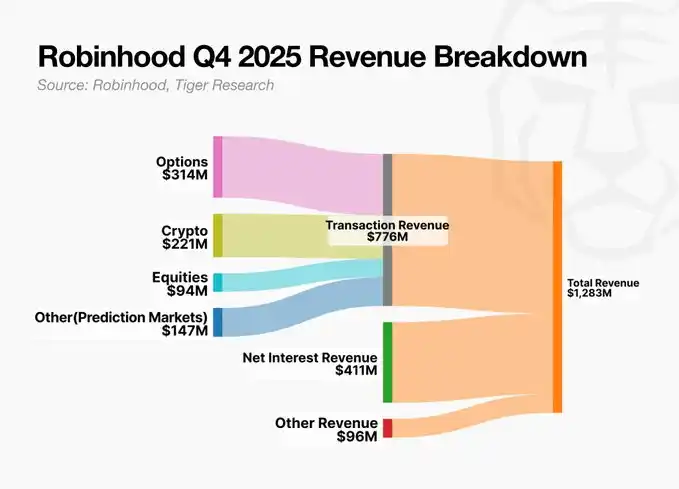
This model has been validated by data. After expanding its crypto business, crypto trading revenue became Robinhood's largest single revenue source in Q4 2024. Although crypto revenue fell 38% year-over-year in Q4 2025, total revenue remained stable, with options, stocks, and prediction markets filling the gap. A structure of resilience through diversification has taken shape.

Polymarket and Kalshi are starting from the opposite direction but heading toward the same endpoint. They originated in prediction markets and are now adding futures trading. The starting points differ, but the destination is the same. As the Robinhood model proves successful, traditional finance is likely exploring the same path.

A Simple Analogy

Smartphones integrated cameras, MP3 players, and navigation into a single device; the era of carrying separate devices for each function is over. The same transformation is happening in finance.

Brokerage accounts, crypto exchanges, and prediction markets are merging into a single platform. Robinhood started as a stock app and gradually added cryptocurrencies and prediction markets; Polymarket started with prediction markets and is now adding crypto perpetual contracts. The starting points differ, but the direction is the same.

The Generalization of the Robinhood Model

As generations shift, this trend will accelerate further. The new generation of users has grown up simultaneously exposed to stocks, cryptocurrencies, and prediction markets. Just as smartphone users would not accept separate devices for a camera, MP3 player, and map, this generation finds the idea of using separate apps for each asset class unfamiliar from the start. The demand for an integrated platform that handles all assets within a familiar interface will grow naturally with each generation.

This is the generalization of the Robinhood model.

Polymarket and Kalshi have a particular advantage in this model. Because collateral in prediction markets is locked until the outcome is determined, how to utilize these idle assets will become a key competitive differentiator.

On December 3, 2025, a developer proposed the concept of PolyAave: depositing Polymarket's outcome tokens into an Aave liquidity pool to earn interest. This was an early attempt to convert prediction market collateral into DeFi yields. Polymarket's launch of perpetual futures is likely an extension of this logic. The strategy of not letting locked capital sit idle is sound.

Polymarket and Kalshi are moving first, but traditional finance faces the same pressure. As the regulatory environment gradually opens up, large financial institutions will directly support crypto spot trading and gradually incorporate new asset classes, including prediction markets.


Связанные с этим вопросы

QWhat is the main trend discussed in the article regarding asset trading platforms?

AThe main trend is the convergence of different asset classes—such as stocks, cryptocurrencies, and prediction markets—into single, integrated platforms, as exemplified by Robinhood, Polymarket, and Kalshi.

QHow did Robinhood validate the integrated platform model according to the article?

ARobinhood validated the model by expanding from stocks to cryptocurrencies in 2018 and prediction markets in 2025, with crypto trading becoming its largest revenue source in Q4 2024. Despite a crypto revenue drop in Q4 2025, total revenue remained stable due to diversification into options, stocks, and prediction markets.

QWhy are Polymarket and Kalshi adding perpetual futures trading?

AThey are adding perpetual futures trading to utilize idle collateral locked in prediction markets, turning it into yield and enhancing their competitive advantage by not letting capital remain idle.

QWhat generational shift is driving the demand for integrated financial platforms?

AYounger generations, who have grown up simultaneously exposed to stocks, cryptocurrencies, and prediction markets, naturally prefer a single platform for all assets, similar to how smartphones integrate multiple devices into one.

QHow might traditional financial institutions respond to this trend?

AAs regulatory environments open up, large financial institutions are likely to gradually adopt crypto spot trading and incorporate new asset classes like prediction markets, following the same convergence path.

Похожее

Xiaohongshu's Second Great Voyage, This Time Sailing Towards AI

Xiaohongshu's Second Voyage: Navigating Towards AI Since ChatGPT's emergence, Xiaohongshu's founder Mao Wenchao has been acutely aware of AI's potential threat, recognizing that the life advice people seek from chatbots overlaps directly with his platform's core business. Founded in 2013 as a PDF shopping guide for Chinese tourists, Xiaohongshu evolved into a massive community where millions share authentic, personal experiences—from product reviews to travel tips. This vast repository of "I've tried this" human judgment became its most valuable asset. However, the rise of AI, which delivers instant answers, challenges the very need for users to sift through numerous personal notes. Fearing its treasure trove of lived experience could become mere training data for others, Xiaohongshu is proactively adapting. In 2026, it established a dedicated AI division (Dots), launched RED Skill to turn user experiences into usable AI tools, and acquired the AI search product "Diandian." Its investments now extend to AI firms like MiniMax and hardware startups, moving upstream to address needs before they even become search queries. The platform's commercialization strategy is also evolving. With a newly acquired payment license and tools like the AIPS model to track consumer decision journeys, Xiaohongshu aims to seamlessly integrate recommendations with transactions, embedding commerce within AI-generated answers. Yet, a critical tension remains. While building smarter machines to organize and leverage its human experiences, Xiaohongshu must prevent AI from drowning out the authentic, flawed, and trustworthy "I've tried this" voices that built its community. Its core challenge is to harness AI's power without letting the map—the machine's perfect, synthesized answer—replace the territory of genuine human experience. This balance between technological advancement and preserving human trust defines its current journey and its future.

marsbit22 мин. назад

Xiaohongshu's Second Great Voyage, This Time Sailing Towards AI

marsbit22 мин. назад

SharpLink CEO: How to Understand Ethereum Developers Just Exceeded 1 Million?

SharpLink CEO reflects on the milestone of Ethereum surpassing 1 million historical developers, emphasizing that this figure represents the largest pool of technical talent ever assembled around an open, permissionless blockchain network. While approximately 232,000 developers remain active, the key question for the crypto industry is not which chain is fastest, but where the best builders choose to build long-term. Ethereum's advantage lies in a decade-long accumulation of infrastructure, standards, tools, liquidity, and a cohesive culture, making it the default operating system for programmable finance. This developer base is tackling complex challenges: the Glamsterdam upgrade aims to enhance scalability while preserving core principles; synchronous composability seeks to unify Rollup ecosystems; and significant efforts are underway for post-quantum security. Ethereum's deeper network effects stem from composability and shared standards (like the EVM and Solidity), creating a flywheel of more developers, tools, and liquidity. Three reinforcing strengths cement Ethereum's lead: credible neutrality (secured by ~900k validators), a modular architecture with interconnected Rollups, and a culture that attracts top researchers. The ecosystem is consolidating as the trusted coordination layer for internet-native finance, favored by large institutions valuing security and liquidity. The future of Ethereum is being built by this global community of founders and architects.

链捕手37 мин. назад

SharpLink CEO: How to Understand Ethereum Developers Just Exceeded 1 Million?

链捕手37 мин. назад

A Clod of Chinese Soil Chokes Two Japanese Giants

"Chinese Soil Chokes Japanese Giants" The production of a key electronic specialty gas, tungsten hexafluoride (WF6), vital for manufacturing AI chips, was halted by two leading Japanese producers—Kanto Denka and Central Glass. Their shutdown was not due to a technological failure but a sudden, critical shortage of a raw material they had long taken for granted: ultra-high-purity (6N-grade) tungsten powder, which is almost entirely sourced from China. Following a quiet Chinese export announcement in January 2026, tungsten powder shipments to Japan dropped to zero for months. Despite frantic efforts, Japanese companies found no viable alternative; imported powder was three times more expensive and lacked the required purity. Their existing stockpiles were exhausted by mid-2026. WF6 is essential for depositing tungsten into the microscopic contact holes of High Bandwidth Memory (HBM) chips, which are crucial for advanced processors like those from Nvidia. While Japanese firms had mastered producing ultra-pure WF6 gas, their entire supply chain relied on China's 6N tungsten powder—a dependency now revealed as a fatal vulnerability. China's dominance in this "soil" results from decades of painstaking R&D by companies like Xiamen Tungsten and China Tungsten & Hightech. They overcame immense technical hurdles, such as separating chemically similar molybdenum from tungsten, to achieve mass production of the world's purest tungsten powder. With their primary suppliers gone, Kanto Denka and Central Glass announced a permanent halt to WF6 production starting July 1, 2026. This immediately created a supply crisis for major semiconductor manufacturers like Samsung and SK Hynix, forcing them to urgently seek and certify new Chinese suppliers for WF6 itself. The reversal marks a dramatic shift: China has moved from exporting low-value raw materials to controlling the high-purity foundation of a critical global tech supply chain, upending a long-established industrial hierarchy.

marsbit1 ч. назад

A Clod of Chinese Soil Chokes Two Japanese Giants

marsbit1 ч. назад

Торговля

Спот
Фьючерсы

Популярные статьи

Как купить ERA

Добро пожаловать на HTX.com! Мы сделали приобретение Caldera (ERA) простым и удобным. Следуйте нашему пошаговому руководству и отправляйтесь в свое крипто-путешествие.Шаг 1: Создайте аккаунт на HTXИспользуйте свой адрес электронной почты или номер телефона, чтобы зарегистрироваться и бесплатно создать аккаунт на HTX. Пройдите удобную регистрацию и откройте для себя весь функционал.Создать аккаунтШаг 2: Перейдите в Купить криптовалюту и выберите свой способ оплатыКредитная/Дебетовая Карта: Используйте свою карту Visa или Mastercard для мгновенной покупки Caldera (ERA).Баланс: Используйте средства с баланса вашего аккаунта HTX для простой торговли.Третьи Лица: Мы добавили популярные способы оплаты, такие как Google Pay и Apple Pay, для повышения удобства.P2P: Торгуйте напрямую с другими пользователями на HTX.Внебиржевая Торговля (OTC): Мы предлагаем индивидуальные услуги и конкурентоспособные обменные курсы для трейдеров.Шаг 3: Хранение Caldera (ERA)После приобретения вами Caldera (ERA) храните их в своем аккаунте на HTX. В качестве альтернативы вы можете отправить их куда-либо с помощью перевода в блокчейне или использовать для торговли с другими криптовалютами.Шаг 4: Торговля Caldera (ERA)С легкостью торгуйте Caldera (ERA) на спотовом рынке HTX. Просто зайдите в свой аккаунт, выберите торговую пару, совершайте сделки и следите за ними в режиме реального времени. Мы предлагаем удобный интерфейс как для начинающих, так и для опытных трейдеров.

742 просмотров всегоОпубликовано 2025.07.17Обновлено 2026.06.02

Как купить ERA

Обсуждения

Добро пожаловать в Сообщество HTX. Здесь вы сможете быть в курсе последних новостей о развитии платформы и получить доступ к профессиональной аналитической информации о рынке. Мнения пользователей о цене на ERA (ERA) представлены ниже.

活动图片