From Outcast to Priceless Target: Mastercard Acquires BVNK for $1.8 Billion

marsbitОпубликовано 2026-03-18Обновлено 2026-03-18

Введение

Mastercard has announced its acquisition of stablecoin infrastructure provider BVNK for up to $1.8 billion, including $300 million in contingent payments. The deal, expected to close by year-end, aims to strengthen Mastercard’s capabilities in digital assets and cross-border value transfers. Founded in 2021, BVNK has built a significant crypto settlement network, processing $25–30 billion in annual stablecoin transactions across 130+ countries. Despite earlier advanced acquisition talks with Coinbase—which ultimately fell through—Mastercard moved decisively to secure the startup. The acquisition is widely seen as a defensive strategy against the growing disruption stablecoins pose to traditional payment networks. With advantages like low cost, speed, and 24/7 operation, stablecoins are increasingly used in B2B and cross-border payments. By integrating BVNK, Mastercard aims to co-opt this technology rather than compete with it. The move is part of a broader trend: traditional financial giants like Visa, Citi, and Stripe are also aggressively investing in or acquiring crypto infrastructure firms. These established players are consolidating fragmented stablecoin liquidity under regulated, centralized frameworks, reinforcing their dominance in the evolving payments landscape.

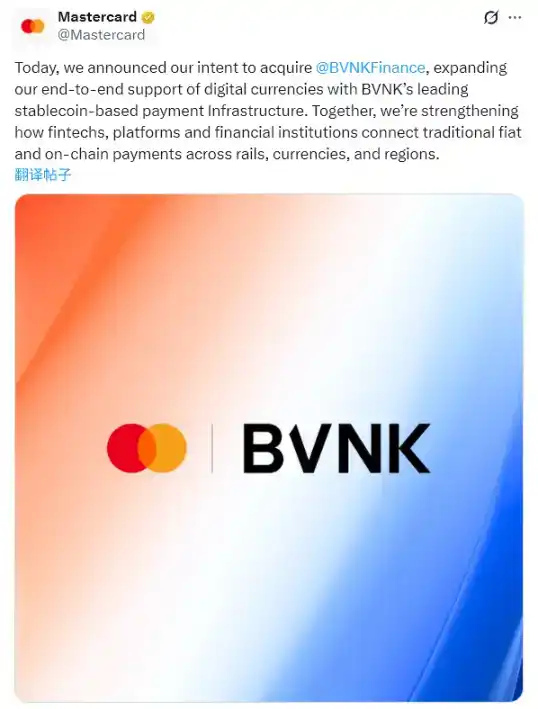
On March 17, global payment giant Mastercard announced the acquisition of stablecoin infrastructure provider BVNK. The deal is valued at up to $1.8 billion, including a $300 million contingent payment clause. Mastercard expects to complete the transaction by the end of this year, thereby expanding its end-to-end support capabilities in the digital assets and cross-currency value transfer fields.
The Value of the Outcast: Coinbase's Hesitation and Mastercard's Decisiveness

BVNK was founded in 2021 and is headquartered in London. In May 2022, BVNK completed a $40 million Series A funding round, reaching a post-money valuation of $340 million. Two years later, in December 2024, it completed a $50 million Series B funding round, raising its valuation to approximately $750 million.

BVNK is led by three South African founders, including CEO Jesse Hemson-Struthers (a serial entrepreneur who previously founded e-commerce and gaming companies acquired by Naspers and Sportradar, respectively), CTO Donald Jackson (a blockchain and enterprise systems expert), and CBO Chris Harmse (a CFA charterholder and former macro/crypto fund partner focused on foreign exchange and cross-border payments).

This startup has quietly built a vast settlement network for crypto assets.

Currently, the platform processes an annual stablecoin payment volume of about $25–30 billion. It provides businesses with a seamless channel connecting fiat currency and stablecoins, supporting payment activities across major blockchain networks in over 130 countries and regions.

But before Mastercard made its move, the real potential buyer for BVNK was actually crypto giant Coinbase.

In November 2025, acquisition talks between Coinbase and BVNK, valued at up to $2 billion, entered the deep due diligence phase, and the two parties even signed an exclusivity agreement at one point.

Coinbase was an investor in its Series B round. Had the deal gone through, it would have been a landmark event for a crypto-native company expanding into the core of global payment infrastructure. However, the two parties ultimately called off the deal that same month without disclosing any substantive reasons for the breakdown.

As Coinbase stepped back, Mastercard swiftly moved in to fill the gap precisely.

For a startup with annual revenue of only about $40 million, the $1.8 billion price tag appears extremely expensive from a financial model perspective. But this sky-high price was never about current profitability; it was about buying a monopoly-level ticket to the next-generation settlement network.

Defensive Counterattack: Buying Out the Possibility of 'Bypassing Card Networks'

Mastercard's move is actually a strategic counterattack with strong defensive overtones.

Stablecoins are visibly eroding the market share of traditional cross-border settlements. With their 24/7 operation, low friction costs, and extremely fast settlement speeds, blockchain-based digital dollars are beginning to show their edge in B2B payments and cross-border remittance scenarios.

In the global financial network, traditional credit card organizations are the payment channels most threatened by the disruption of stablecoins. If multinational corporations and business institutions become accustomed to peer-to-peer on-chain settlements, the centralized fiat routing network that Mastercard relies on for survival faces the risk of being completely marginalized.

If you can't beat them, decisively buy them.

Mastercard's Chief Product Officer, Jorn Lambert, was unequivocal about this. In the acquisition announcement, he stated that he expects most financial institutions and fintech companies to offer digital currency services in the future.

Mastercard's calculation is very clear: it is determined to directly integrate BVNK's ready-made stablecoin rails and compliance engine into its vast global fiat network. Stablecoins are no longer competitors to card networks; instead, they have been forcibly incorporated as a highly complementary business subset of its underlying network.

Traditional giants are building high walls with capital barriers that are difficult to surmount.

Land Grab: Wall Street's Payment Table Has No New Players

This is by no means an isolated action by Mastercard alone; the entire traditional finance sector is frantically scrambling for access to on-chain infrastructure.

Even before this acquisition was finalized, BVNK's backers already included a豪华 (luxury) lineup of Wall Street capital. In May 2025, Mastercard's arch-rival Visa made a strategic investment in BVNK through its venture arm, Visa Ventures.

Then, in October, Citi Ventures, the venture capital department of Citigroup, also invested real money to join the game. Although Citi declined to disclose the specific investment amount and BVNK's valuation, the company stated in an interview that its valuation was higher than the $750 million from the Series B round.

Even just two months before Mastercard announced the acquisition, Visa高调 (high-profile) announced it would integrate BVNK's stablecoin settlement capabilities into its core Visa Direct platform to support cross-border fund disbursement to global digital wallets.

This is both a hard technological integration and a默契 (tacit) capital collusion.

Looking across the entire payments industry, Silicon Valley's current darling, Stripe, had previously acquired stablecoin startup Bridge for $1.1 billion. And before finalizing the BVNK deal, Mastercard was also reported by the market to be in acquisition talks with another crypto infrastructure startup, Zerohash (founded in 2017, headquartered in Chicago), for as much as $1.5 to $2 billion.

Traditional payment giants are using疯狂且密集 (frenzied and密集 intensive) mergers and acquisitions to重新聚拢 (re-aggregate) the originally decentralized, fragmented stablecoin liquidity within the highly familiar business frameworks and regulatory channels they control.

At this highly lucrative table, the ones who ultimately sit down are still the old rulers holding heavy capital.


Связанные с этим вопросы

QWhat is the significance of Mastercard's acquisition of BVNK for the digital asset and cross-border payment industry?

AMastercard's acquisition of BVNK, valued at up to $1.8 billion, is significant as it aims to expand the company's end-to-end support capabilities in digital assets and cross-currency value transfer. It represents a strategic move by a traditional payment giant to integrate stablecoin infrastructure, counter the threat of blockchain-based settlements, and secure a dominant position in the next-generation payment network.

QWhy did Coinbase's potential acquisition of BVNK fall through, and how did Mastercard capitalize on this?

ACoinbase's acquisition talks with BVNK, which reached an advanced stage including due diligence and an exclusivity agreement, were called off in November 2025 without public disclosure of the specific reasons. Mastercard swiftly moved in to acquire BVNK after Coinbase's withdrawal, seizing the opportunity to secure a key player in the stablecoin infrastructure space.

QHow does BVNK's business model and network pose a threat to traditional card networks like Mastercard?

ABVNK's platform, which processes $25-30 billion in annual stablecoin payment volume, provides a seamless channel for businesses to convert between fiat and stablecoins, supporting payments across 130+ countries. Its blockchain-based, peer-to-peer settlement offers 24/7 operation, low friction costs, and fast clearing, threatening to marginalize the centralized fiat routing networks that traditional card organizations like Mastercard rely on.

QWhat defensive strategic motive does Mastercard have for acquiring BVNK?

AMastercard's acquisition is a defensive strategic move to counter the disruptive threat of stablecoins to traditional cross-border settlement. By acquiring BVNK, Mastercard aims to co-opt the technology, integrating its stablecoin轨道 and compliance engine into its global fiat network, thereby turning a potential competitor into a complementary subset of its business and building high capital barriers to maintain its dominance.

QHow are other major traditional financial institutions involved in the stablecoin infrastructure space, as indicated in the article?

AOther major traditional financial institutions are heavily investing in stablecoin infrastructure. Visa's venture arm, Visa Ventures, made a strategic investment in BVNK in May 2025, and Citi Ventures also invested later that year. Furthermore, Visa integrated BVNK's stablecoin settlement capabilities into its Visa Direct platform. Stripe also acquired stablecoin startup Bridge for $1.1 billion, indicating a trend of traditional payment giants consolidating the fragmented stablecoin liquidity within their familiar commercial and regulatory frameworks.

Похожее

Может ли модель генерации обучаться end-to-end? В основе — простой цикл for

В статье представлен новый подход к обучению генеративных моделей под названием Explorative Modeling (XM), который позволяет осуществлять сквозное (end-to-end) обучение. Традиционные генеративные модели, такие как диффузионные или авторегрессионные, страдают от «смешения мод» (mode blurring), когда модель усредняет множество возможных правильных ответов, что приводит к размытым или нереалистичным результатам. Это также вызывает «смещение экспозиции» (exposure bias), когда ошибки накапливаются во время вывода. Ключевая идея XM проста: на каждом шаге обучения модель генерирует K кандидатов, а для обратного распространения градиента выбирает только того кандидата, который наиболее близок к реальным данным. Этот цикл, реализованный в несколько строк кода, повышает «генеративную выразительность» модели, позволяя ей охватывать несколько мод распределения данных, а не усреднять их. Авторы показывают, что «исследование» (exploration) становится третьей осью масштабирования наряду с увеличением параметров и данных. Эксперименты с изображениями, видео и текстом демонстрируют монотонное улучшение качества: при увеличении масштаба данных выгода от исследования возрастает с 7% до 36%, а эффективность использования вычислений (FLOP) повышается в 4.1 раза. В задачах управления роботами сквозная модель XM с одним проходом вперед достигает результатов, сравнимых с диффузионными моделями, требующими сотни проходов. Таким образом, Explorative Modeling предлагает путь к truly end-to-end генеративным моделям, перенося сложность с этапа вывода на этап обучения, что открывает потенциал для более эффективных и мощных систем.

marsbit16 мин. назад

Может ли модель генерации обучаться end-to-end? В основе — простой цикл for

marsbit16 мин. назад

Upbit проводит ребалансировку 864 млрд SHIB при перемещении между внутренними кошельками

Корейская биржа Upbit провела внутреннюю ребалансировку 864 миллиардов токенов SHIB между своими кошельками. Движение активов на сумму около 4 миллионов долларов произошло после роста стоимости SHIB на 36%, что привлекло внимание трейдеров. Однако анализ помеченных адресов показывает, что это была стандартная операция по перераспределению средств между "горячими" и другими внутренними кошельками биржи, а не вывод средств или подготовка к продаже. Общий объем перемещений включал 384 миллиарда SHIB, отправленных с основного горячего кошелька, и 480 миллиардов SHIB, возвращенных обратно. Этот случай подчеркивает важность проверки контекста и меток кошельков при интерпретации крупных ончейн-транзакций, чтобы избежать ошибочных выводов о продаже или давлении на рынок.

bitcoinist16 мин. назад

Upbit проводит ребалансировку 864 млрд SHIB при перемещении между внутренними кошельками

bitcoinist16 мин. назад

Максимум 20 статей на человека? Исследователи DeepMind «просят» снять ограничения ICLR

Новая политика конференции ICLR 2027 ограничивает количество подаваемых одним автором работ до 20. По мнению организаторов, это необходимо для снижения нагрузки на рецензентов, учитывая рекордный рост числа заявок — на 68% за год. В ответ на это исследователь Google DeepMind Дэн Рой иронично запустил «петицию» против лимита, заявив, что он замедлит прогресс в ИИ, особенно в эпоху, когда агенты ИИ могут генерировать множество статей, а рецензии часто пишутся с помощью больших языковых моделей (по некоторым данным, до 21% рецензий на ICLR 2026 могли быть полностью сгенерированы ИИ). Его сатирический пост поднимает серьёзный вопрос о целесообразности простого ограничения количества работ вместо решения системных проблем, связанных с массовым производством статей и автоматизацией рецензирования в современной академической среде.

marsbit21 мин. назад

Максимум 20 статей на человека? Исследователи DeepMind «просят» снять ограничения ICLR

marsbit21 мин. назад

Уязвимость Coldcard привела к краже $89 млн и вызвала самую масштабную миграцию средств в блокчейне после краха FTX

Уязвимость в аппаратном кошельке Coldcard привела к краже 1367,05 BTC (около 89 млн долларов) с 4585 адресов. Инцидент, связанный с ошибкой в генерации сид-фраз в определенной прошивке, вызвал массовую миграцию средств пользователей на новые безопасные адреса. Это привело к аномальному всплеску активности в сети Биткоин, исказив ключевые ончейн-индикаторы, такие как активность долгосрочных держателей и объем мелких транзакций. Активность и рыночные настроения достигли уровня, сравнимого с периодом после краха FTX. Расследование столкнулось с трудностями из-за ограничений коммерческих ИИ-моделей (например, в США), которые блокируют анализ вредоносных данных даже для целей защиты. Следователи были вынуждены использовать открытые модели, такие как китайский GLM 5.2, для отслеживания украденных средств. Этот случай высветил проблему асимметрии: злоумышленники используют неограниченные ИИ-инструменты, в то время как защитники сталкиваются с барьерами коммерческих систем безопасности, что критично в сфере криптовалют, где скорость отслеживания средств крайне важна.

marsbit1 ч. назад

Уязвимость Coldcard привела к краже $89 млн и вызвала самую масштабную миграцию средств в блокчейне после краха FTX

marsbit1 ч. назад

Заработок в миллион на электриках: Meta спешно открывает собственное ПТУ

Новый этап конкуренции в сфере искусственного интеллекта столкнулся с неожиданным препятствием — острой нехваткой квалифицированных технических специалистов, особенно электриков и строителей, для возведения сверхмощных центров обработки данных. В США, согласно прогнозам, к 2030 году для инфраструктуры ИИ потребуется дополнительно 130 000 электриков и 240 000 строителей, однако ежегодно остается незаполненными около 80 000 вакансий электриков. Компании, такие как OpenAI (проект "Stargate" стоимостью $160 млрд), Meta и Microsoft, сталкиваются с огромными убытками из-за задержек строительства. Например, задержка ввода центра мощностью 60 МВт может обернуться потерей $14,2 млн в месяц. Причина спроса — беспрецедентная сложность строительства ИИ-центров. Они потребляют колоссальную энергию (сотни мегаватт), требуют уникальных систем электроснабжения и охлаждения (жидкостное или иммерсионное), что делает работу высококвалифицированных монтажников, сантехников и инженеров незаменимой. Для решения проблемы кадрового голода ИИ-гиганты начали масштабные программы обучения. Meta инвестировала $115 млн в создание собственной школы строителей с бесплатным обучением и стипендией, а OpenAI сотрудничает с профсоюзами. Активная вербовка ведется даже среди старшеклассников. Потребление энергии ИИ-центрами растет экспоненциально, опережая общий рост энергопотребления в 16 раз и увеличивая счета за электричество для потребителей. Однако строительство таких объектов носит проектный характер: для возведения центра "Stargate" требуется 6400 рабочих, а для его обслуживания — всего 100-1000. Это создает риск перенасыщения рынка труда после завершения строительного бума, что может привести к падению зарплат в отрасли.

marsbit2 ч. назад

Заработок в миллион на электриках: Meta спешно открывает собственное ПТУ

marsbit2 ч. назад

Торговля

Спот
活动图片