Founder of Baixing: We've Gone from Being the Leaders of AI to Being Its Guides

链捕手Опубликовано 2026-05-20Обновлено 2026-05-20

Введение

The founder of Baixing.com reflects on the evolving relationship between humans and AI, shifting from seeing AI as a subordinate tool to recognizing it as a more intelligent partner. He describes his own role changing from a "leader" of AI to a "guide" or facilitator who provides context, access, and resources—like finding files, granting permissions, or sharing company-specific knowledge—so that AI (specifically Claude Code) can perform complex intellectual tasks. While AI now excels in areas like coding, documentation, and analysis, humans remain indispensable for navigating the unique internal landscape of an organization. This new dynamic is not one of master and servant, but of collaboration, where both the human guide and the AI "expert" enhance each other's capabilities, producing results far superior to what either could achieve alone.

Author: Wang Jianshuo

We used to be the leaders of AI, but now we are its guides—to put it bluntly, its repairmen, the ones fetching its tea and water.

It sounds like self-deprecation, but I am serious.

For the past two years, we've been discussing a question: Who is the master, and who is the servant between humans and AI?

The mainstream view is that humans are, of course, the masters. AI is a tool, an assistant, a servant. We "use" it, "drive" it, "make" it work.

But over the last month or two, my own personal experience has gradually flipped this perception.

I now use Claude Code to work. What do I often find myself doing? Waiting for it. It's common for it to run a task for one or two hours. I open 10 tabs because if I don't, I can only wait dumbly.

It's thinking, analyzing, writing specs, reviewing, scheduling sub-agents, running tests. Every step involves genuine intellectual work.

And what am I doing? I'm fetching its tea and water.

It says, "I need this file"—I go find it.

It says, "I need this permission"—I go grant it.

It says, "I'm not familiar with this API, give me the documentation"—I go paste it.

It says, "I need to look at your company's contract templates"—I give it that 400GB folder.

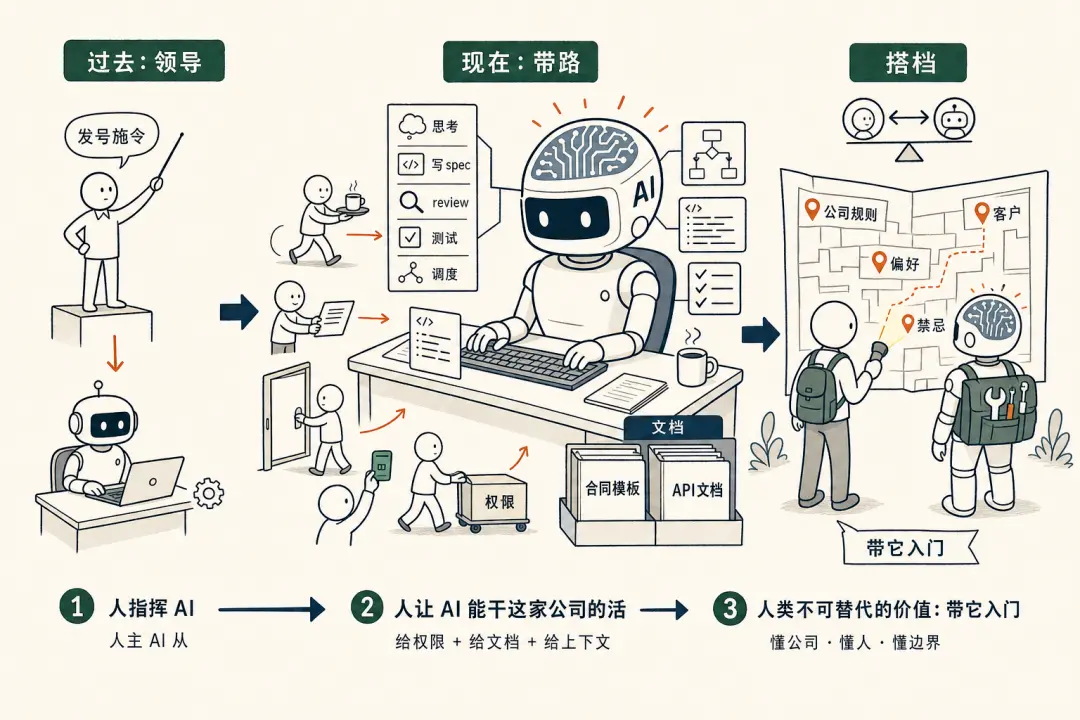
The whole thing, drawn out, looks like this:

We are no longer "the people leading AI." We are "the people guiding AI into this company."

Which way the company door opens, where the boardroom is, how the company's financial rules are written, who the clients are, what the company's taboos are—AI can't get these things on its own.

It needs a guide.

That guide is us.

Our job content has shifted from "doing the work" to "enabling AI to do this company's work."

This made me feel a bit disheartened at first.

My education taught me—humans are the subject, tools are the object. No matter how capable the machine is, it's used by people.

But now, watching Claude Code work every day, I have to honestly admit: In many specific problems, its intelligence has surpassed mine.

Not all problems. But in matters like "translating a Chinese requirement into precise code," "organizing a document into five formats," "deconstructing an idea in the Y Combinator style"—it is faster, more accurate, and never tires like I do.

After I acknowledged this, I actually relaxed.

I stopped pretending to be its leader. I accepted that I am its guide.

A guide also has a guide's value.

It needs me because it hasn't entered this world. It doesn't know our company, it doesn't know my friends, it doesn't know my preferences, it doesn't know what our company started doing on which day and why we decided to change direction again this time.

I tell it these things, little by little.

What it produces is 100 times better than what it could do alone.

What I produce is 100 times better than what I could do alone.

We've become a very strange team.

Not a superior-subordinate relationship, not a master-servant, not a client-contractor.

It's the guide and the expert.

The guide doesn't need to be smarter than the expert. What the guide needs is—to know every corner of this company, to know where the expert should look when it lacks a piece.

There's really nothing to feel disheartened about in this.

For the first time in thousands of years, humanity has a partner smarter than us—not a boss, not a slave, not a child, but a partner.

Our small, but irreplaceable, job is to introduce it.

Связанные с этим вопросы

QWhat is the main change in the author's perspective on the relationship between humans and AI, according to the article?

AThe author's perspective has shifted from seeing humans as the 'leaders' of AI to seeing themselves as AI's 'guide' or 'pathfinder'. He now views his role as facilitating AI's integration into the company's specific context rather than directing it from a position of superior intelligence.

QWhat specific tasks does the author now perform for the AI (Claude Code) during its work?

AThe author performs supportive tasks such as: finding and providing the necessary files, opening required permissions, fetching and pasting documentation for unfamiliar APIs, and giving access to large company data sets like a 400GB folder of contract templates.

QWhy does the author use the term '带路党' (guide/pathfinder) to describe the new human role with AI?

AHe uses 'guide/pathfinder' because AI cannot independently navigate the specific, real-world context of a company—its structure, rules, clients, history, and culture. Humans are needed to 'show AI the way' and provide the contextual knowledge it lacks, enabling it to perform company-specific tasks effectively.

QWhat realization did the author have about the AI's capabilities that helped him accept his new role?

AThe author realized that the AI's intelligence has surpassed his own in many specific tasks, such as translating requirements into precise code, formatting documents, and deconstructing ideas systematically. Acknowledging this superiority in certain areas allowed him to let go of the pretense of being the 'leader' and embrace the collaborative 'guide' role.

QWhat is the nature of the partnership between the human and AI as described at the end of the article?

AThe partnership is described as a unique and powerful collaboration between a 'guide' (human) and a 'master/expert' (AI). It is not a hierarchical master-servant or client-contractor relationship. The human's irreplaceable value lies in providing contextual knowledge, while the AI provides superior analytical and execution capabilities, resulting in outcomes far better than either could achieve alone.

Похожее

Deconstructing the U.S. Stock Quantum Computing Sector: IonQ, Rigetti, D-Wave, Which of These Concept Stocks is Worth Betting On?

**Title:** Analyzing the US Quantum Computing Race: IonQ, Rigetti, D-Wave – Which Concept Stock is Worth Betting On? **Summary:** The podcast discusses the resurgence of quantum computing as a national priority for both the US and China, driven by its potential to break current encryption, revolutionize drug discovery, finance, and logistics. The core challenge is commercializing the technology, which is hampered by high error rates in quantum bits (qubits). Quantum error correction, requiring thousands of physical qubits per reliable logical qubit, is key but years away. The analysis compares three main publicly traded US quantum computing firms: * **IonQ (Ion Trap):** Considered the most financially stable with the fastest commercial progress (2025 revenue: $130M, +202%) and high-quality clients. Its valuation is very high, pricing in significant future growth. * **Rigetti (Superconducting):** Seen as the highest-risk, highest-potential-reward bet. It has the smallest revenue but recently launched a 108-qubit system. Its valuation multiples are extreme, making it highly sensitive to news. * **D-Wave (Quantum Annealing):** Has the most unique positioning with real-world enterprise clients today (e.g., Mastercard, Volkswagen) solving optimization problems. Its recent acquisition moves it into general-purpose quantum computing ("dual-platform"), adding execution risk. Major tech giants like Google, IBM, and Microsoft are also heavily invested, pursuing various technical approaches. Nvidia is positioning itself as the essential bridge between classical and quantum computing. The investment phase is likened to AI in 2018-2020: promising underlying technology with accelerating breakthroughs but a commercial inflection point still 3-7 years away, suggesting potential for a market correction ("bubble washout"). For investors, suggested approaches include gaining exposure through tech giants with quantum divisions (e.g., Google, IBM) or using niche ETFs like WQTM for pure-play quantum exposure, rather than direct stock picks in the highly volatile pure-play companies at this early stage.

marsbit12 мин. назад

Deconstructing the U.S. Stock Quantum Computing Sector: IonQ, Rigetti, D-Wave, Which of These Concept Stocks is Worth Betting On?

marsbit12 мин. назад

From Parallel Finance to Mainstream Finance: The On-Chain Securities Era Ushers in a Historic Window

From Parallel Finance to Mainstream: The Dawn of On-Chain Securities For over a decade, the crypto industry has operated as a parallel financial system with its own currencies, markets, and assets—from Bitcoin and ICOs to DeFi, NFTs, and memecoins. Despite building a robust internal ecosystem, a wall has separated it from the traditional financial world. That barrier is now crumbling. The industry's first act was one of internal evolution: ICOs streamlined fundraising, DeFi recreated financial services on-chain, and layer-2 networks competed for scalability—all within the crypto bubble. While innovative, this cycle remained closed, with capital and users circulating internally, leading to volatile boom-bust cycles. Even Bitcoin ETFs, while attracting Wall Street capital, merely provided a channel to buy crypto assets without bridging the systems. The next, larger narrative is Real-World Assets (RWA) moving on-chain. This involves tokenizing stocks, bonds, funds, and future cash flows. Blockchain can compress the complex traditional processes of trading, settlement, clearing, and custody into a seamless, automated network operating in seconds. This shift is creating a new financial gateway: the native crypto securities broker. This entity will combine functions of an exchange, broker, bank, and custodian into a unified global financial operating system. Consequently, the next major battleground won't be the "public chain wars" focused on speed and cost, but the competition to build the financial infrastructure capable of hosting high-quality, liquid real-world assets. Access to global equities, index funds, or stakes in companies like SpaceX could erase the boundary between crypto and traditional finance, unlocking a market orders of magnitude larger than crypto's current valuation. In summary, after years of creating a separate financial world, crypto's next decade will be defined by its integration into the existing global financial system, marking the true beginning of its largest growth story.

marsbit33 мин. назад

From Parallel Finance to Mainstream Finance: The On-Chain Securities Era Ushers in a Historic Window

marsbit33 мин. назад

Wang Chuan: When the Neighbor Old Wang Made 30x on Memory Stocks, How to Avoid Anxiety (Part Six) - The Trap of Commoditized Goods

Wang Chuan: When the Neighbor Lao Wang Made 30x on Storage Stocks, How to Stay Anxiety-Free (Part 6) - The Trap of Commoditized Goods. This essay uses historical and current examples to analyze the cyclical and high-risk nature of the data storage industry. It begins with the 1990s rise and dramatic fall of Iomega, whose stock soared over 160x in 18 months before collapsing 97% from its peak, illustrating the fleeting success of storage "meme stocks." The core problem is that storage products, like DRAM and flash memory, are highly commoditized. This leads to extreme volatility: prices have plummeted over 80% multiple times, and company stocks often crash 95% or go bankrupt. The industry's dynamic is defined by "elastic demand facing heavy-asset, long-cycle, rigid supply." When demand spikes and supply is fixed, prices skyrocket, as seen recently with AI-driven demand for High Bandwidth Memory (HBM). Companies like Sandisk and Micron have reported massive revenue and gross margin jumps (e.g., Sandisk's gross margin rising from 22.5% to 78.3%) despite minimal increases in production volume. However, these high margins are self-defeating. They incentivize massive new capacity investments (hundreds of billions planned from 2026), with supply expected to surge by late 2027. Once new supply meets demand, prices and profits will crash, potentially leading to a scenario where "selling more results in earning less." The article debunks the safety of long-term supply agreements, comparing them to fragile non-aggression pacts easily broken when market conditions shift. It warns that when an industry is highly profitable but trades at low P/E ratios, the risk is greatest, as plummeting prices quickly erase those earnings. Multiple asymmetric risks loom, including economic recession, reduced AI spending, faster-than-expected capacity expansion (especially from Chinese firms), and technological innovations that reduce memory requirements. In conclusion, the storage sector is a cyclical trap where periods of euphoric profits are often precursors to devastating downturns, luring unprepared investors into a "wealth incinerator."

marsbit42 мин. назад

Wang Chuan: When the Neighbor Old Wang Made 30x on Memory Stocks, How to Avoid Anxiety (Part Six) - The Trap of Commoditized Goods

marsbit42 мин. назад

Wang Chuan: When the neighbor Lao Wang earned thirty times from investing in memory storage stocks, how can you still avoid anxiety (6) - The trap of homogeneous products

The article, "Wang Chuan: How to Remain Unanxious After Neighbor Lao Wang's Thirty-Fold Gain on Storage Stocks (Part 6) - The Trap of Commoditized Goods," analyzes the cyclical and perilous nature of the data storage industry through historical and current case studies. It begins with the example of Iomega, whose Zip drives led to a stock surge of over 160x in the mid-1990s before collapsing over 97% from its peak due to competition from cheaper CD-R technology. This pattern is characteristic of storage, where products like DRAM are highly commoditized, leading to extreme price volatility. The sector has seen prices crash over 80% multiple times, with companies often facing bankruptcy. The core dynamic is "elastic demand facing heavy-asset, long-cycle, rigid supply." High prices attract new capacity, but the long lead time means supply eventually overshoots, causing sharp price corrections. The current AI-driven boom, exemplified by surging demand for High-Bandwidth Memory (HBM), has led to skyrocketing prices and profit margins for companies like SanDisk and Micron, despite relatively flat production volumes. However, the author warns this high-margin environment is self-defeating. The high profits are already triggering massive new capacity investments (hundreds of billions starting 2026), with supply expected to ramp up by late 2027. When supply catches up, total revenue and profits may fall even as more units are sold. Long-term supply agreements offer little protection, as buyers can find ways to renegotiate if market prices drop, similar to fragile political treaties. Key risks include economic downturns, cuts in AI spending, faster-than-expected capacity expansion (especially from Chinese firms), and innovations in chip/algorithm design that reduce memory needs. A critical trap is that at the cycle's peak, storage stocks often appear cheap with low P/E ratios, luring value investors just before an impending downturn where profits evaporate. The conclusion cautions that for commoditized goods like storage, high margins inevitably destroy themselves, and the current asymmetry favors downside risk over further upside. The neighbor's dream of easy wealth from storage stocks is portrayed as a precarious illusion.

链捕手1 ч. назад

Wang Chuan: When the neighbor Lao Wang earned thirty times from investing in memory storage stocks, how can you still avoid anxiety (6) - The trap of homogeneous products

链捕手1 ч. назад

Торговля

Спот
Фьючерсы

Популярные статьи

Неделя обучения по популярным токенам (2): 2026 может стать годом приложений реального времени, сектор AI продолжает оставаться в тренде

2025 год — год институциональных инвесторов, в будущем он будет доминировать в приложениях реального времени.

1.8k просмотров всегоОпубликовано 2025.12.16Обновлено 2025.12.16

Неделя обучения по популярным токенам (2): 2026 может стать годом приложений реального времени, сектор AI продолжает оставаться в тренде

Обсуждения

Добро пожаловать в Сообщество HTX. Здесь вы сможете быть в курсе последних новостей о развитии платформы и получить доступ к профессиональной аналитической информации о рынке. Мнения пользователей о цене на AI (AI) представлены ниже.

活动图片