Farewell to 24-Hour Delays: How to Predict ETF Fund Flows Through Premium Rates

marsbitОпубликовано 2026-02-01Обновлено 2026-02-01

Введение

The article explains how ETF premium/discount rates can predict daily fund flows for Bitcoin and ETH ETFs, bypassing the 24-hour delay of official data. A persistent negative premium (ETF trading below its net asset value) typically signals net outflows, as Authorized Participants (APs) arbitrage by buying cheap ETF shares, redeeming them for the underlying asset, and selling it. Conversely, a positive premium (ETF trading above NAV) predicts inflows, as APs buy the underlying asset to create new ETF shares to sell at the higher price. Statistical analysis from a 146-day period showed this indicator was accurate approximately 81-84% of the time. For instance, a week of sustained premiums below -0.15% in January 2026 preceded a $1.3 billion outflow and a significant price drop. The article cautions that the premium rate is not a standalone tool. Its effectiveness depends on normal market function and should be combined with other indicators for confirmation, such as: - ETF holdings changes - Futures basis and funding rates - Options Put/Call ratios - On-chain large transfers and exchange net flows Key usage tips include focusing on the persistence of the extremity of the premium rate (±1% is significant) and considering the asset's price context (e.g., negative premium at a price high may signal a top). The goal is to use this real-time data to gain an informational edge and validate trends.

Since the approval of spot ETFs for BTC and ETH, daily ETF fund inflows and outflows have become a core metric for many traders to set their positions.

The logic is simple: net inflows indicate institutional buying and bullish sentiment; net outflows indicate institutional selling and bearish sentiment.

But the problem is, the ETF data we see every day is the result of the previous day.

By the time the data is released, the price has often already reflected it.

So, is there any way to predict in advance whether today's ETF will see net inflows or net outflows?

Yes, the answer is the ETF premium rate.

It's not hard to verify this pattern; reviewing the soon-to-end January 2026 is the best sample.

As of January 28th, there were 18 trading days in the U.S. stock market.

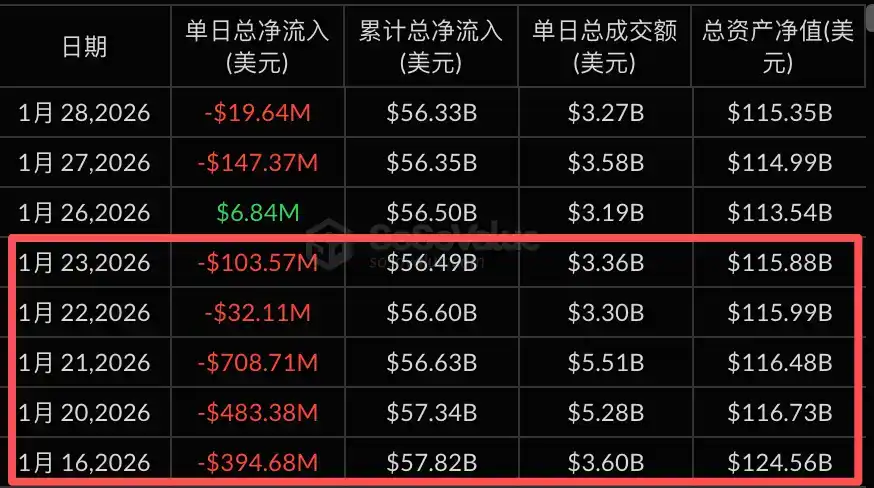
Statistics show that the premium index on Coinbase stayed in positive territory for only two days, while the other 16 days were all in negative premium territory.

Corresponding ETF fund flows show that 11 of these 16 days ultimately recorded net outflows.

Especially from January 16th to 23rd, the negative premium rate continuously fell below -0.15%, corresponding to a weekly net outflow of over $1.3 billion from the ETF market, with BTC's price dropping from a high of $97,000 to around $88,000.
Let's take a longer-term view.

From July 1, 2025, to January 28, 2026, a total of 146 trading days.

· Negative premium rate occurred for 48 days, corresponding to net outflows for 39 days, accuracy rate 81%.

· Positive premium rate occurred for 98 days, corresponding to net inflows for 82 days, accuracy rate 84%.

This is the value of the premium rate: it allows you to see where the money is flowing earlier than most.

What is the Premium Rate

We've been talking about the premium rate, but what exactly is it?

Here's an analogy.

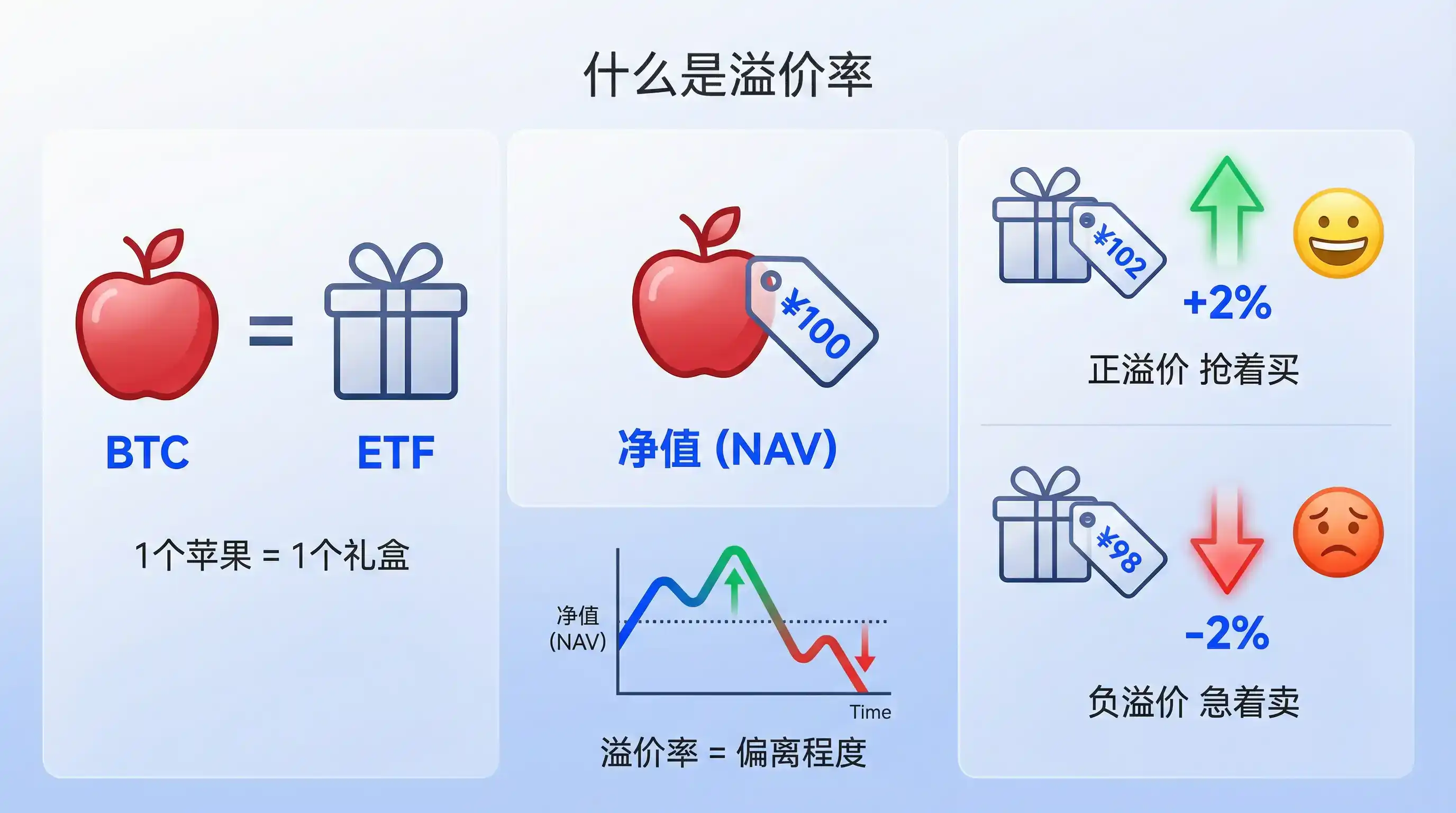
BTC is like loose apples in a grocery market, while a BTC spot ETF is like a packaged apple gift box in a supermarket, each containing one apple.

An apple sells for $100 in the grocery market; this is the Net Asset Value (NAV).

How much the apple gift box sells for in the supermarket depends on supply and demand.

If many people buy it, the box gets bid up to $102; this is a positive premium rate, a premium of +2%.

If many people sell it, the box drops to $98; this is a negative premium rate, a discount of -2%.

The premium rate reflects the degree to which the ETF market price deviates from the true price of BTC.

A positive premium indicates optimistic market sentiment; everyone is rushing to buy.

A negative premium indicates pessimistic market sentiment; everyone is eager to sell.
The Relationship Between Premium Rate Polarity and ETF Inflows/Outflows

The premium rate is not just a market sentiment indicator; it also becomes a key factor driving fund flows.

The key player in this is the AP, or Authorized Participant, which you can think of as a privileged arbitrageur.

The core logic for APs is risk-free arbitrage: they can create and redeem ETF shares in the primary market, and also buy and sell them in the secondary market.

As long as there is a price difference, they will arbitrage it.

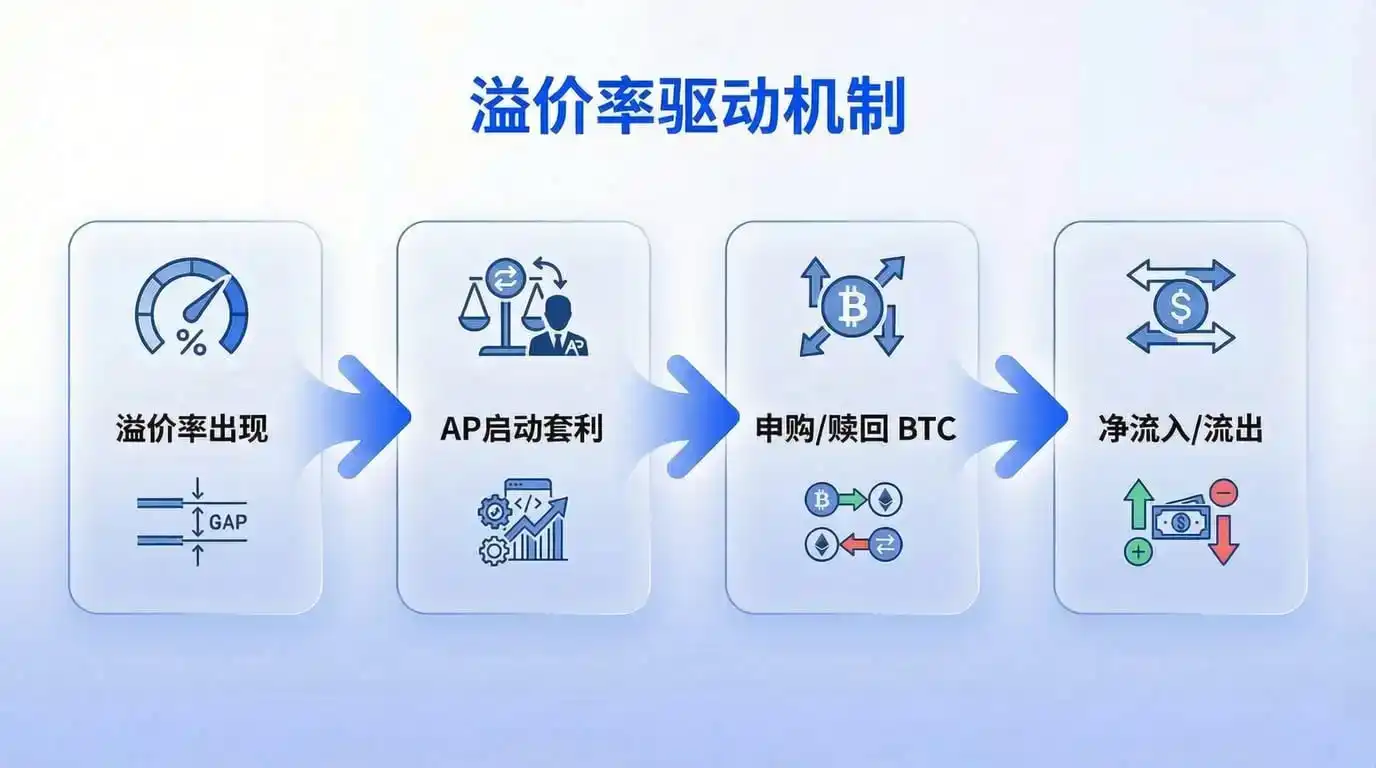
When a positive premium rate occurs, the gift box is more expensive than the apple. APs will go to the primary market to buy BTC, package it into ETF shares, and then sell them in the secondary market to profit from the difference. In this process, BTC is bought, resulting in a net inflow of funds.

Conversely, when a negative premium rate occurs, the gift box is cheaper than the apple. APs will buy ETFs in the secondary market, unbundle them to redeem the underlying BTC, and then sell the BTC to profit from the difference. In this process, BTC is sold, resulting in a net outflow of funds.

So the logical chain is this:

Premium rate appears → APs initiate arbitrage → Creation or redemption occurs → Net inflow or outflow is formed.
And the ETF fund data we see every day is published the next day after settlement.

The premium rate is real-time; the fund data is lagging.

This is why the premium rate can give you a step ahead of the market.

How to Apply the Premium Rate

Now that we understand the principle behind the premium rate and ETF net inflows/outflows, how should we apply it to our individual trading plans?

First, the premium rate is not an indicator to be used in isolation.

It can tell us the direction of funds but not the magnitude or persistence.

Here, I suggest considering it in conjunction with the following dimensions.

1. The Persistence of the Premium Rate is More Important Than a Single Day's Value

A single day of negative premium rate might just be short-term volatility.

But if negative premium rates appear for multiple consecutive days, it likely corresponds to continuous net outflows and is worth being alert about.

Look back at the five consecutive trading days of negative premium rates from January 16th to 23rd this year, which corresponded to five days of net outflows, with BTC falling nearly 10%.

2. Pay Attention to Extreme Values of the Premium Rate

Generally, fluctuations within ±0.5% are normal.

Once it breaks through ±1%, it indicates a clear deviation in market sentiment, AP arbitrage motivation strengthens, and fund flows will accelerate.

3. Judge in Conjunction with Price Levels

Sustained negative premium rates at high prices might be an early signal of capital flight.

Sustained positive premium rates at low prices might be a sign of bottom-fishing capital entering the market.

The premium rate itself does not constitute a buy or sell signal, but it can help you verify the current trend or detect turning points in the trend early.

Final Notes

Finally, a few points to note.

No indicator is a holy grail; the effectiveness of the premium rate is based on the premise of normal AP arbitrage mechanisms.

In extreme market conditions, such as the 10.11 crash, where market liquidity dries up, the arbitrage mechanism may fail, and the correlation between the premium rate and fund flows may decrease.

Furthermore, the premium rate is just one window into observing ETF fund movements.

For mature investors, the premium rate is just one piece of the puzzle.

It is recommended to conduct multi-dimensional cross-verification with the following indicators:

1. Changes in ETF Holdings: Rising holdings indicate institutions are accumulating; falling holdings indicate they are reducing positions. More direct than the premium rate, but data updates are delayed.

2. Futures Basis and Funding Rate: A positive basis and continuously high funding rates indicate overheated long sentiment and possible excessive optimism. Conversely, it indicates bearish dominance.

3. Put/Call Ratio in the Options Market: Puts are put options (bearish), Calls are call options (bullish). A rising ratio indicates rising market risk-off sentiment; a falling ratio indicates dominant optimism.

4. On-chain Large Transfers and Exchange Net Inflows: Large BTC transfers to exchanges often signal impending selling pressure. Large withdrawals from exchanges indicate accumulation.

For example:

When you observe: the premium rate is continuously negative, ETF holdings are decreasing, and exchange net inflows are rising.

Three signals point in the same direction: funds are withdrawing, selling pressure is accumulating.

At this time, you should at least increase vigilance and control your position size, rather than buying the dip.

A single indicator cannot show the full picture; multi-dimensional cross-verification is needed to improve the accuracy of judgment.

In this market, the more dimensions you observe, the smaller the information gap, but the time gap will always exist.

Whoever sees the direction of funds first gains an extra ounce of initiative.

Связанные с этим вопросы

QWhat is the main indicator discussed in the article for predicting ETF fund flows in advance?

AThe ETF premium rate.

QAccording to the data from July 1, 2025, to January 28, 2026, what was the accuracy of positive premium rates in predicting net inflows?

A84%.

QWho are the key players that execute arbitrage based on the ETF premium rate?

AAuthorized Participants (APs).

QWhat does a sustained negative premium rate at a high price level potentially signal?

AIt may be an early signal of capital outflows.

QBesides the premium rate, what other indicators are suggested for multi-dimensional cross-verification?

AETF holdings changes, futures basis and funding rates, Put/Call ratio in the options market, and on-chain large transfers and exchange net inflows.

Похожее

Kicked Out of PayPal, Musk Aims for a Comeback in the Crypto Market

Elon Musk's X (formerly Twitter) has launched its "Smart Cashtags" feature, generating approximately $1 billion in trading volume within days of its April 2026 pilot launch. The feature allows users to click on stock or crypto tickers (or even full Solana token contract addresses) in posts to view real-time price charts and discussions without leaving the app. Initially available to iPhone users in the US and Canada, with a partnership in Canada enabling direct trading via the Wealthsimple app. This move is part of Musk's broader "Everything App" vision, spearheaded by the upcoming X Money platform. Analysts, such as Mizuho's Dan Dolev, see this as a potential disruptor to the US payments market, even prompting a downgrade of PayPal's stock. X Money's beta offers services like 6% APY on deposits, cashback, and P2P transfers, with speculation it may later incorporate crypto trading and stablecoin settlements for faster transactions. However, the ambitious plan faces significant regulatory scrutiny. Senator Elizabeth Warren has questioned the sustainability of the high 6% yield and raised concerns over X's banking partner, Cross River Bank, which has a history of regulatory violations. Additional risks involve the "GENIUS Act," which may create loopholes for stablecoin issuance without full FDIC insurance coverage, potentially leaving users unprotected. The integration of social trading on a platform with over 500 million users could inject new liquidity and retail interest into the crypto market. Yet, it also amplifies risks like herd mentality and the blurring of lines between entertainment and financial speculation. Musk's return to finance, after his ouster from PayPal, hinges on balancing innovation with regulatory compliance.

marsbit1 ч. назад

Kicked Out of PayPal, Musk Aims for a Comeback in the Crypto Market

marsbit1 ч. назад

Торговля

Спот
Фьючерсы

Популярные статьи

Тест по Bitcoin Биткоина

HTX Learn: Изучите Bitcoin halving и Заработаете Токены USDT

3.0k просмотров всегоОпубликовано 2024.04.16Обновлено 2024.04.16

Тест по Bitcoin  Биткоина

Что такое $BITCOIN

ЦИФРОВОЕ ЗОЛОТО ($BITCOIN): Комплексный анализ Введение в ЦИФРОВОЕ ЗОЛОТО ($BITCOIN) ЦИФРОВОЕ ЗОЛОТО ($BITCOIN) — это проект на основе блокчейна, работающий в сети Solana, который стремится объединить характеристики традиционных драгоценных металлов с инновациями децентрализованных технологий. Хотя он носит имя Биткойн, часто называемого “цифровым золотом” из-за его восприятия как средства хранения ценности, ЦИФРОВОЕ ЗОЛОТО является отдельным токеном, предназначенным для создания уникальной экосистемы в ландшафте Web3. Его цель — позиционировать себя как жизнеспособный альтернативный цифровой актив, хотя детали его применения и функциональности все еще развиваются. Что такое ЦИФРОВОЕ ЗОЛОТО ($BITCOIN)? ЦИФРОВОЕ ЗОЛОТО ($BITCOIN) — это токен криптовалюты, специально разработанный для использования в блокчейне Solana. В отличие от Биткойна, который выполняет широко признанную роль хранения ценности, этот токен, похоже, сосредоточен на более широких приложениях и характеристиках. Примечательные аспекты включают: Инфраструктура блокчейна: Токен построен на блокчейне Solana, известном своей способностью обрабатывать высокоскоростные и недорогие транзакции. Динамика предложения: ЦИФРОВОЕ ЗОЛОТО имеет максимальное предложение, ограниченное 100 квадриллионами токенов (100P $BITCOIN), хотя детали о его обращающемся предложении в настоящее время не раскрыты. Утилита: Хотя точные функциональные возможности не описаны, есть указания на то, что токен может быть использован для различных приложений, потенциально связанных с децентрализованными приложениями (dApps) или стратегиями токенизации активов. Кто создатель ЦИФРОВОГО ЗОЛОТА ($BITCOIN)? На данный момент личность создателей и команды разработчиков, стоящих за ЦИФРОВЫМ ЗОЛОТОМ ($BITCOIN), остается неизвестной. Эта ситуация типична для многих инновационных проектов в области блокчейна, особенно тех, которые связаны с децентрализованными финансами и феноменом мем-криптовалют. Хотя такая анонимность может способствовать культуре, ориентированной на сообщество, она усиливает опасения по поводу управления и ответственности. Кто инвесторы ЦИФРОВОГО ЗОЛОТА ($BITCOIN)? Доступная информация указывает на то, что у ЦИФРОВОГО ЗОЛОТА ($BITCOIN) нет известных институциональных спонсоров или значительных венчурных капиталовложений. Проект, похоже, функционирует по модели пирингового взаимодействия, сосредоточенной на поддержке и принятии сообществом, а не на традиционных путях финансирования. Его активность и ликвидность в основном сосредоточены на децентрализованных биржах (DEX), таких как PumpSwap, а не на устоявшихся централизованных торговых платформах, что еще больше подчеркивает его подход, ориентированный на grassroots. Как работает ЦИФРОВОЕ ЗОЛОТО ($BITCOIN) Операционные механизмы ЦИФРОВОГО ЗОЛОТА ($BITCOIN) можно подробно описать на основе его дизайна блокчейна и характеристик сети: Механизм консенсуса: Используя уникальный механизм доказательства истории (PoH) Solana в сочетании с моделью доказательства доли (PoS), проект обеспечивает эффективную валидацию транзакций, что способствует высокой производительности сети. Токеномика: Хотя конкретные дефляционные механизмы не были подробно описаны, большое максимальное предложение токенов подразумевает, что оно может быть предназначено для микротранзакций или нишевых случаев использования, которые еще предстоит определить. Интероперабельность: Существует потенциал для интеграции с более широкой экосистемой Solana, включая различные платформы децентрализованных финансов (DeFi). Однако детали относительно конкретных интеграций остаются неуточненными. Хронология ключевых событий Вот хронология, которая подчеркивает значимые вехи, касающиеся ЦИФРОВОГО ЗОЛОТА ($BITCOIN): 2023: Первоначальное развертывание токена происходит в блокчейне Solana, отмеченное его адресом контракта. 2024: ЦИФРОВОЕ ЗОЛОТО приобретает видимость, когда оно становится доступным для торговли на децентрализованных биржах, таких как PumpSwap, позволяя пользователям обменивать его на SOL. 2025: Проект наблюдает спорадическую торговую активность и потенциальный интерес к инициативам, возглавляемым сообществом, хотя на данный момент не зафиксировано никаких значительных партнерств или технических достижений. Критический анализ Сильные стороны Масштабируемость: Основная инфраструктура Solana поддерживает высокие объемы транзакций, что может повысить полезность $BITCOIN в различных сценариях транзакций. Доступность: Потенциально низкая цена торговли за токен может привлечь розничных инвесторов, способствуя более широкому участию благодаря возможностям дробного владения. Риски Отсутствие прозрачности: Отсутствие публично известных спонсоров, разработчиков или процесса аудита может вызвать скептицизм относительно устойчивости и надежности проекта. Волатильность рынка: Торговая активность сильно зависит от спекулятивного поведения, что может привести к значительной волатильности цен и неопределенности для инвесторов. Заключение ЦИФРОВОЕ ЗОЛОТО ($BITCOIN) является интригующим, но неоднозначным проектом в быстро развивающейся экосистеме Solana. Хотя он пытается использовать нарратив “цифрового золота”, его отход от установленной роли Биткойна как средства хранения ценности подчеркивает необходимость более четкого различения его предполагаемой утилиты и структуры управления. Будущее принятие и усвоение, вероятно, будут зависеть от решения текущей непрозрачности и более четкого определения его операционных и экономических стратегий. Примечание: Этот отчет охватывает синтезированную информацию, доступную на октябрь 2023 года, и с тех пор могут произойти события.

99 просмотров всегоОпубликовано 2025.05.13Обновлено 2025.05.13

Что такое $BITCOIN

Fractal Bitcoin: масштабирование Биткоина с помощью рекурсивной системы

Fractal Bitcoin — масштабное Layer-1-решнение, созданное на базе кода Биткоина, позволяющего достигать бесконечного масштабирования с помощью рекурсивного подхода.

2.2k просмотров всегоОпубликовано 2025.06.30Обновлено 2025.06.30

Fractal Bitcoin: масштабирование Биткоина с помощью рекурсивной системы

Обсуждения

Добро пожаловать в Сообщество HTX. Здесь вы сможете быть в курсе последних новостей о развитии платформы и получить доступ к профессиональной аналитической информации о рынке. Мнения пользователей о цене на BTC (BTC) представлены ниже.

活动图片