Exclusive from Yingke | Tang Wenbin's 'Yuanli Lingji' Merges with Logistics Robotics Company, and Secures Investment from Zhipu, SenseTime, Jieyue, and Others

marsbitОпубликовано 2026-06-05Обновлено 2026-06-05

Введение

Exclusive report: Embodied AI company "Yuanli Lingji" recently completed a new round of financing from major AI model firms including Zhipu AI, Stepfun, and SenseTime, alongside continued investments from industrial backers like Huaqin and SAIC Hengxu. Founded in March 2025 by Tang Wenbin, former co-founder and CTO of Megvii, Yuanli Lingji is a general-purpose embodied AI model company. In a notable move, the company has merged with logistics robotics firm "Atomix" (formerly known as Yuanli Juhe) through a share acquisition. Atomix, which originated from Megvii's logistics robotics business led by Tang in 2016 and was spun off in July 2024, has grown to become the world's second-largest supplier of pallet shuttle robots, with annual revenue nearing 1 billion RMB and over 500 projects globally for clients like Uniqlo and CATL. This merger aims to break the industry's "data deadlock" by combining Atomix's extensive real-world operational data from more than 20 countries with Yuanli Lingji's model training capabilities. The company's embodied AI model "DM0" utilizes a cross-domain training approach, integrating internet semantics, autonomous driving rules, and robotics data to achieve hardware-agnostic, precise manipulation even with a compact 2.4B parameter size. The collective investment from key AI players and the strategic merger signal a shift in the competitive landscape, as major model companies pivot from language tokens to physical actions ("from Token to Action"). T...

Author | Qiu Xiaofen

Editor | Yuan Silai

Exclusive information from Yingke reveals that embodied AI company "Yuanli Lingji" has recently completed a new round of financing. The investors are primarily several major large model companies, including Zhipu, Jieyue Xingchen, and SenseTime. Additionally, industrial investment parties such as Huaqin and SAIC Hengxu have continued to invest.

"Yuanli Lingji" is a general embodied large model company. It was founded in March 2025 by Tang Wenbin, co-founder and CTO of Megvii Technology. The core founding team consists of former members of Megvii Technology.

Interestingly, this financing also marks a rare "meeting" between former rivals SenseTime and Megvii amidst the embodied AI boom.

Furthermore, including Alibaba as the exclusive lead investor in the A+ round, this is a rare gathering of four domestic large model manufacturers in the embodied AI track. Previously, Zhipu had only made small-scale investments in the embodied AI field through its Z Fund, while Jieyue Xingchen had almost never invested in embodied AI.

This collective action also signals a shift: as the main battlefield of large model competition moves from Token to Action, embodied models with the ability to interact with the physical world have become the next high ground targeted by model companies.

Alongside this financing, Tang Wenbin is consolidating forces and beginning to integrate robotics assets.

Yingke exclusively learned that "Yuanli Lingji" has recently completed a merger with the logistics robotics company "Atomix" (Yuanli Juhe) through equity acquisition, aiming for large-scale deployment and global expansion of embodied AI.

The business origins of "Atomix" can be traced back to 2016—at that time, Tang Wenbin led the intelligent logistics and robotics scheduling business (Hetu System) within Megvii Technology, primarily promoting multi-form logistics robotics solutions.

In July 2024, following changes in Megvii's business, Tang Wenbin spun off the logistics robotics business from the Megvii system, establishing "Atomix" as an independent entity.

After several years of exploration, "Atomix" has achieved the second-highest global sales volume of pallet shuttle robots, cumulatively serving over 500 projects. Clients include Uniqlo, Mixue Ice Cream & Tea, CATL, etc., with annual company revenue nearing ten billion yuan.

As the embodied AI hardware supply chain matures, the industry is approaching a wall that must be scaled: the embodied brain. Compared to the clear evolution path of language models, the embodied AI model currently lacks even low-cost, massive, and high-quality data, let alone a convergent training paradigm. It can be said that the entire industry is groping in the dark.

In this situation, the integration of body, brain, and data may become the new norm in the embodied AI track.

Traditionally, the ideal state for the embodied AI industry has been to create a genuine data flywheel. However, the reality is that the industry is in a state of "data deadlock"—models need error data from real-world scenarios to evolve, but without being equipped with a good model, robots cannot enter scenes and thus cannot collect real data.

Therefore, insiders say the merger of the two companies essentially aims to close the loop between the model and the scenario, breaking the data deadlock.

As Tang Wenbin mentioned in a previous interview, Picking is the "atomic task" of the embodied AI era—Picking is to embodied AI what Coding is to large models. "Atomix" is like a continuously operating Picking data engine.

"Yuanli Lingji" Robot Making Breakfast (Source / Company)

It is understood that in the future, the real-world data generated from "Atomix's" operations across over 20 countries and 500+ projects will directly become the fuel for "Yuanli Lingji's" model training; meanwhile, the embodied AI model trained by "Yuanli Lingji" will quickly achieve collaborative operations with "Atomix's" existing robots.

This vision may not be a castle in the air but is built upon a certain technological foundation. Prior to this, "Yuanli Lingji" has already launched the general embodied large model "DM0".

Tang Wenbin mentioned in a previous interview that at the data level, "Yuanli Lingji" has completed the industry's first "integration of three types of data"—conducting mixed training on internet semantics, autonomous driving physical rules, and robotics operation data to enhance data scale and quality.

This cross-domain mixed training approach allows "DM0" to break free from dependence on specific hardware parameters. Like an experienced "veteran driver," it abstracts universal physical laws from massive heterogeneous data and can transfer across various robot body configurations regardless of hardware differences, achieving a universal operational logic.

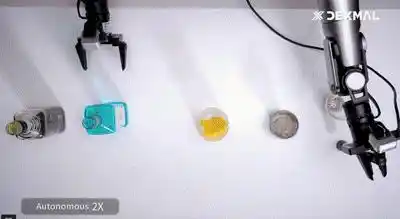
"Yuanli Lingji" Robot Mixing Drinks (Source / Company)

More crucially, "Yuanli Lingji" also attempts to extend the "chain-of-thought reasoning" of large models into physical space—this enables "DM0" to achieve sub-millimeter precision operations with a small parameter scale of just 2.4B, significantly improving success rates in long-horizon continuous tasks.

Through a series of combinations, "DM0" is attempting to break the pain points of traditional embodied models: single-source data, paralysis upon robot change, and bloated parameters.

Following this merger and financing, China's embodied AI industry is welcoming a strong player. More importantly, it also signals that the industry is entering the next phase—finding the scaling law for embodied models.

This is a formidable challenge that cannot be overcome merely by amassing robot bodies.

Just this week, media reports disclosed that ByteDance is heavily recruiting a Head of Embodied AI Technology, targeting core technical talents from leading startups. Meanwhile, overseas embodied AI star company Skild AI just completed the acquisition of Zebra Technologies' robotic automation business.

The moves of giants at home and abroad are strikingly similar—as body manufacturers, data asset holders, model developers, and scenario operators begin to accelerate their convergence, the industry has officially entered deep waters.

Homepage Image Source | Network

Layout | Fan Xinya

Welcome to Connect

Связанные с этим вопросы

QWhat are the major developments in the recent financing round of 'Yuanli Lingji', and who are the main investors?

AThe major developments include a new financing round and a merger with the logistics robotics company 'Atomix'. The main investors are large model companies such as Zhipu, Stepfun, and SenseTime, with continued investment from industry players like Huaqin and SAIC Hengxu.

QWhat is the strategic significance of the merger between 'Yuanli Lingji' and 'Atomix'?

AThe merger aims to integrate assets, enabling 'Yuanli Lingji' to accelerate large-scale implementation and global expansion in embodied AI. It will leverage 'Atomix's real-world logistics operation data from over 500 projects in more than 20 countries to train its models, while its embodied AI models will enhance the capabilities of 'Atomix's existing robots.

QHow does 'Yuanli Lingji' address the 'data deadlock' challenge in the embodied AI industry?

A'Yuanli Lingji' addresses the 'data deadlock' by combining its model development with 'Atomix's real-world robotics operations. This integration provides a continuous source of high-quality, real-world task data (e.g., picking) for model training, thereby creating a closed-loop system where models improve from real errors and, in turn, enable more capable robots for real-world deployment.

QWhat is unique about the training and capabilities of 'Yuanli Lingji's DM0 model?

AThe DM0 model is uniquely trained using a mix of three data types: internet semantics, autonomous driving physical rules, and robotics operational data. This cross-domain training allows it to generalize physical laws, be hardware-agnostic, and transfer skills across different robot types. Despite having only 2.4 billion parameters, it achieves sub-millimeter precision and high success rates in long-horizon tasks.

QWhat broader industry trend is reflected by the merger of 'Yuanli Lingji' and 'Atomix'?

AThis merger reflects a broader industry trend where embodied AI is entering a deep-water phase. Companies are integrating key components—robotics hardware manufacturers, data asset owners, model developers, and scenario operators—to overcome core challenges like finding a 'scaling law' for embodied models and breaking the data deadlock, a pattern also seen with overseas players like Skild AI.

Похожее

Should You Buy SpaceX Stock at $1.7 Trillion? Here's What the Market Is Worried About

SpaceX is preparing for a massive IPO aiming to raise around $75 billion at a valuation of approximately $1.75 trillion. While its achievements in reusable rockets and the profitable Starlink satellite internet service are clear, the market is concerned about the aggressive valuation. Key issues include: the current $1.75 trillion valuation, which is about 94 times 2025 revenue, seems to price in not just existing businesses but also unproven future ventures like AI infrastructure and orbital data centers. Financially, while Starlink is profitable, the AI division, bolstered by the acquisition of xAI, is incurring massive losses and consuming the majority of capital expenditures. This acquisition also introduced complex related-party financing arrangements and debt onto SpaceX's balance sheet. Furthermore, corporate governance poses a challenge. SpaceX's dual-class share structure ensures founder Elon Musk retains absolute control, limiting ordinary shareholders' influence over high-risk, long-term strategic decisions. The future success of ambitious projects like the Starship rocket—critical for lowering costs and enabling new services—remains a significant variable for the valuation. In summary, the market's apprehension (FUD) centers not on doubting SpaceX's past technological triumphs but on questioning how much premium public investors should pay for a future that combines proven profits with highly speculative and capital-intensive new ventures, all under a governance structure that offers limited shareholder oversight.

marsbit56 мин. назад

Should You Buy SpaceX Stock at $1.7 Trillion? Here's What the Market Is Worried About

marsbit56 мин. назад

Breaking the DeFi Cascading Liquidation Curse: Vitalik Proposes a New Solution

Vitalik Buterin has proposed a new DeFi design to eliminate the automatic liquidation mechanism that causes market instability during sharp downturns. The current system, used by protocols like Aave, triggers forced sales when collateral value falls below a threshold, often exacerbating price drops and creating systemic selling pressure. Buterin's alternative model is based on splitting an asset like ETH into two synthetic option-like tokens, P and N, pegged to a price index. Their combined value always equals one ETH. Instead of sudden liquidation, a position's value gradually drifts from its target peg if the market moves. Users must proactively rebalance their holdings to maintain their desired exposure, transferring the management burden from the protocol to the user or automated tools. A key advantage is the reduced reliance on real-time oracles. Pricing decisions are deferred until contract expiry, allowing for more robust, fault-tolerant oracle designs. This removes a clear liquidation threshold that speculators can target for manipulation or MEV extraction. However, significant challenges remain. Frequent rebalancing could incur high slippage and transaction costs, necessitating new liquidity provider models. The design is better suited for hedging instruments than for stablecoins requiring a rigid 1:1 peg. While not an immediate replacement for existing systems, the proposal challenges the foundational assumption that instantaneous forced liquidation is an unavoidable necessity in DeFi, opening the door for fundamentally different risk management architectures.

marsbit1 ч. назад

Breaking the DeFi Cascading Liquidation Curse: Vitalik Proposes a New Solution

marsbit1 ч. назад

The End of Single-Factor Cryptography

The article "The End of Single-Factor Crypto" posits a fundamental shift in the cryptocurrency ecosystem. It argues the era where crypto asset valuations were predominantly driven by, and correlated with, Bitcoin's price is ending. The space is bifurcating into two distinct economies: endogenous and exogenous. The endogenous economy represents traditional crypto, where token and project values are directly tied to crypto market prices. The emerging exogenous economy comprises projects and businesses that may utilize blockchain technology or tokens but derive their fundamental value from external, non-crypto factors like consumer demand, subscription revenue, or real-world utility. Examples include AI inference platforms like Venice, fintech lenders using blockchain for efficiency, and stablecoin/payment infrastructure companies acquired by giants like Mastercard and Stripe. This shift means investment analysis must change. For exogenous assets, evaluating traditional business fundamentals—such as revenue streams, unit economics, and competitive moats—becomes more critical than tracking Bitcoin charts. While endogenous assets like Bitcoin remain relevant, the growth of the exogenous category is driven by measurable demand independent of crypto price cycles, paving the way for a new, more diversified market phase. Consequently, crypto is evolving from a single-factor, reflexive asset class into a multifaceted ecosystem with varied drivers and investment theses.

marsbit1 ч. назад

The End of Single-Factor Cryptography

marsbit1 ч. назад

Morning Post | Bitmine Plans to Raise $300 Million Through Preferred Stock Issuance; Polymarket Accuses Kalshi of Commercial Espionage

ChainCatcher's Daily Crypto Brief: Key developments from the past 24 hours include significant funding moves, regulatory actions, and market predictions. Bitmine announced a $300 million preferred stock fundraising. Polymarket accused rival prediction platform Kalshi of corporate espionage, citing numerous suspicious coincidences in product launches, a claim Kalshi strongly denied. The U.S. Department of Justice, in a joint "Disruption Week" anti-fraud operation with companies like Coinbase and Meta, froze over $3.8 million in cryptocurrency linked to scams. In infrastructure news, Macau completed its integration with the multi-central bank digital currency bridge, mBridge, aiming to build efficient cross-border payment channels. Cosmos Labs acquired the block explorer Mintscan. Market-wise, Geoffrey Kendrick, Standard Chartered's Head of Digital Assets Research, stated Bitcoin is nearing a bottom around $63,000, maintaining a year-end target of $100,000. He noted stability in U.S. spot Bitcoin ETF holdings. Ahead of SpaceX's anticipated IPO, internal insiders at Rocket Lab (RKLB) sold over $18.41 million in stock. In tokenization, Goldman Sachs partnered with Apex and Archax to launch a tokenized real estate fund. The meme token tracker GMGN reported the top trending tokens: on Ethereum, HEX, SHIB, LINK, PEPE, mUSD; on Solana, TROLL, swarms, WORLDCUP, neet, Buttcoin; and on Base, PEPE, toby, ODDS, ELSA, SKI.

链捕手1 ч. назад

Morning Post | Bitmine Plans to Raise $300 Million Through Preferred Stock Issuance; Polymarket Accuses Kalshi of Commercial Espionage

链捕手1 ч. назад

Торговля

Спот
Фьючерсы

Популярные статьи

Как купить S

Добро пожаловать на HTX.com! Мы сделали приобретение Sonic (S) простым и удобным. Следуйте нашему пошаговому руководству и отправляйтесь в свое крипто-путешествие.Шаг 1: Создайте аккаунт на HTXИспользуйте свой адрес электронной почты или номер телефона, чтобы зарегистрироваться и бесплатно создать аккаунт на HTX. Пройдите удобную регистрацию и откройте для себя весь функционал.Создать аккаунтШаг 2: Перейдите в Купить криптовалюту и выберите свой способ оплатыКредитная/Дебетовая Карта: Используйте свою карту Visa или Mastercard для мгновенной покупки Sonic (S).Баланс: Используйте средства с баланса вашего аккаунта HTX для простой торговли.Третьи Лица: Мы добавили популярные способы оплаты, такие как Google Pay и Apple Pay, для повышения удобства.P2P: Торгуйте напрямую с другими пользователями на HTX.Внебиржевая Торговля (OTC): Мы предлагаем индивидуальные услуги и конкурентоспособные обменные курсы для трейдеров.Шаг 3: Хранение Sonic (S)После приобретения вами Sonic (S) храните их в своем аккаунте на HTX. В качестве альтернативы вы можете отправить их куда-либо с помощью перевода в блокчейне или использовать для торговли с другими криптовалютами.Шаг 4: Торговля Sonic (S)С легкостью торгуйте Sonic (S) на спотовом рынке HTX. Просто зайдите в свой аккаунт, выберите торговую пару, совершайте сделки и следите за ними в режиме реального времени. Мы предлагаем удобный интерфейс как для начинающих, так и для опытных трейдеров.

1.4k просмотров всегоОпубликовано 2025.01.15Обновлено 2026.06.02

Как купить S

Sonic: Обновления под руководством Андре Кронье – новая звезда Layer-1 на фоне спада рынка

Он решает проблемы масштабируемости, совместимости между блокчейнами и стимулов для разработчиков с помощью технологических инноваций.

2.3k просмотров всегоОпубликовано 2025.04.09Обновлено 2025.04.09

Sonic: Обновления под руководством Андре Кронье – новая звезда Layer-1 на фоне спада рынка

HTX Learn: Пройдите обучение по "Sonic" и разделите 1000 USDT

HTX Learn — ваш проводник в мир перспективных проектов, и мы запускаем специальное мероприятие "Учитесь и Зарабатывайте", посвящённое этим проектам. Наше новое направление .

1.8k просмотров всегоОпубликовано 2025.04.10Обновлено 2025.04.10

HTX Learn: Пройдите обучение по "Sonic" и разделите 1000 USDT

Обсуждения

Добро пожаловать в Сообщество HTX. Здесь вы сможете быть в курсе последних новостей о развитии платформы и получить доступ к профессиональной аналитической информации о рынке. Мнения пользователей о цене на S (S) представлены ниже.

活动图片