Even Satoshi Nakamoto Would Kowtow to the God of Wealth

深潮Опубликовано 2025-12-25Обновлено 2025-12-25

Введение

On the fifth day of the Lunar New Year, the author visits a temple in Hangzhou and observes a surprising number of cryptocurrency insiders—KOLs, community builders, and tech elites—praying for wealth, abandoning algorithmic consensus for incense and devotion. The piece notes the rising influence of metaphysics in crypto circles, where traditional analysis is increasingly supplanted by astrology, face-reading, and feng shui. A trader’s astrological prediction warns of Bitcoin’s “darkest hour” in 2026, while a VC partner admits that assessing founders’ facial traits is now part of due diligence. Anecdotes illustrate this trend: a listed company CEO’s devotion to feng shui reportedly led to massive Bitcoin gains, while a frog-avatar KOL ignored his advisor’s warning and lost everything trading futures. The author frames this not as mere superstition but as a psychological response to extreme volatility. Just as maritime cultures turned to deities like Mazu for safety in uncertain seas, crypto participants seek spiritual anchors amid market chaos. When tweets from figures like Musk or Trump can swing prices 50% in a day, belief systems—whether in code or cosmology—become a necessary comfort. The question isn’t whether the God of Wealth understands blockchain, but whether faith helps traders sleep at night.

Author: Xiaobing, Deep Tide TechFlow

Every year on the fifth day of the Lunar New Year, Xiaobing wakes up early to visit the Number One Temple of Wealth at Beigao Peak in Hangzhou.

I thought I would be jostling with aunties and uncles, but when I arrived, the scene was filled with familiar faces amidst the swirling incense smoke.

To the left was a well-known爆料KOL, to the right someone involved in community schemes, and a few tech elites who usually preach "decentralization" were devoutly kowtowing with loud thuds. In that moment, algorithmic consensus and Federal Reserve moves were no match for the three sticks of incense in their hands.

Over the past two years, mysticism has become the "mainstream study" in the crypto world. If you’re still looking at K-line charts, you’re a classical rookie; the real OGs are now reading birth charts.

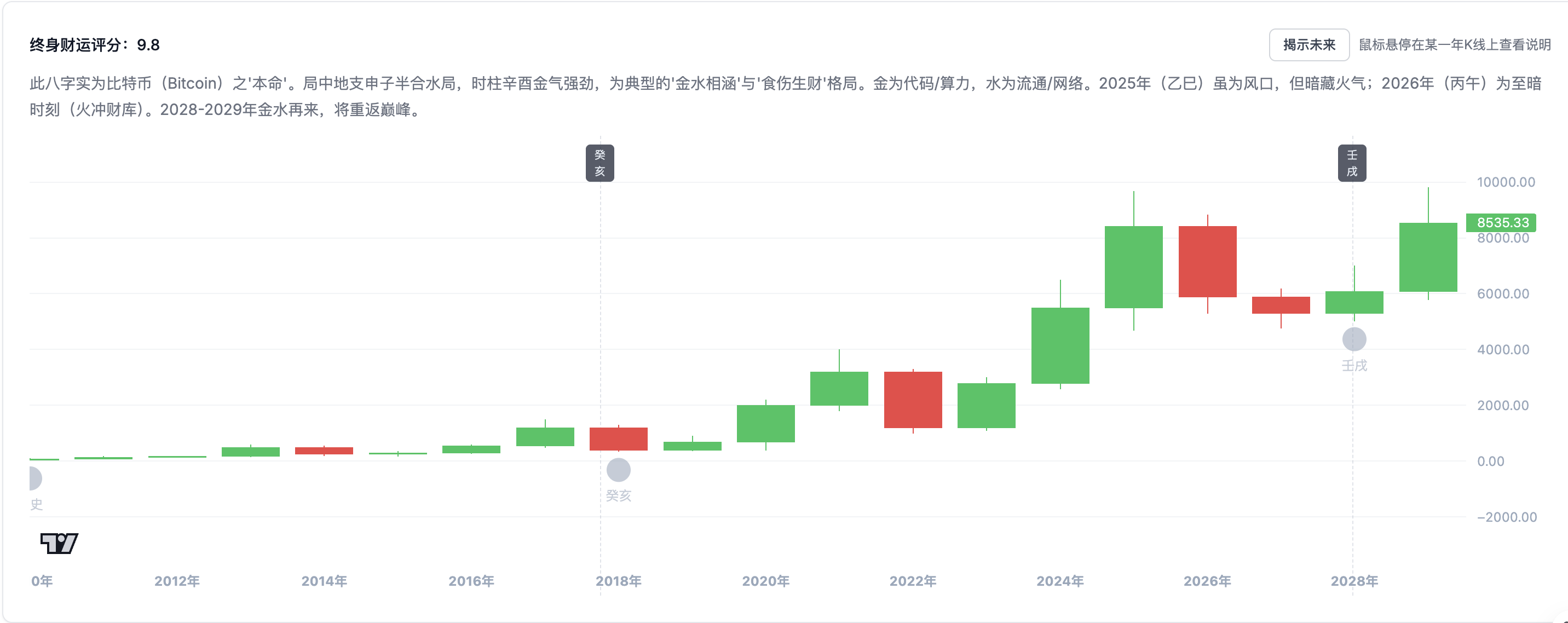
A crypto trader familiar with various macro indicators eventually turned to mysticism, recently calculating Bitcoin’s八字 (Bazi). The result was alarming: Fire clashes with the wealth vault, making 2026 (Bingwu Year) Bitcoin’s darkest hour. I quickly checked my wallet—good thing there were no coins in it anyway.

Remember when Alen, a crypto VC at y2z Ventures, bluntly stated that one of their fund’s core competitive edges was "reading面相" (face reading)? Due diligence (DD) used to involve code audits and business models, but now it’s different. First, check if the founder has a "wealth-draining face," then see if the project’s name clashes with风水 (Feng Shui).

On a recent trip to Shenzhen, I noticed that traders and KOLs’ standard setup isn’t data terminals—they all have a "Feng Shui consultant" backing them.

Don’t laugh; this actually works in the crypto world. Xiaobing knows a listed company boss in Hong Kong who is a devout believer in Feng Shui, donating real money to temples—possibly more than the company’s R&D budget.

And the result? Call it Feng Shui bringing noble help, but starting in 2023, he began buying Bitcoin, made hundreds of millions from hoarding, and later caught the wave of the DAT (Crypto Treasury Reserve) narrative, doubling the company’s stock price... Although everyone knows this is "survivorship bias," you can’t argue with the fact that he really made a fortune.

There are counterexamples too. A frog-avatar爆料KOL also had a Feng Shui consultant who advised him not to trade recently, but he couldn’t resist playing with contracts and ended up getting liquidated.

This isn’t entirely superstition.

Our traditional land-based civilization emphasizes farming—sow one seed in spring, reap ten thousand in autumn—focusing on certainty. But what does maritime civilization face? Storms and unknown waters.

Why do people in the southeastern coastal areas worship Mazu? Not out of ignorance, but because on the vast, unpredictable ocean, besides experience and technology, you need something else.

The crypto world is essentially a modern version of the "Age of Exploration." It faces deep, unfathomable waters and sudden storms. Humans are like this: the greater the randomness and volatility, the more we seek supernatural spiritual anchors.

When K-line charts fail, and a single tweet from Musk, Trump, or CZ can sway the market, Feng Shui becomes the last psychological defense. This isn’t ignorance; it’s an instinctive stress response to massive wealth fluctuations.

After all, when your assets can swing 50% in a day, you have to believe in something to sleep at night. As for whether the God of Wealth understands blockchain—does it really matter?

Связанные с этим вопросы

QWhat is the main theme of the article regarding the crypto community's behavior?

AThe article highlights that mysticism and fortune-seeking practices, like worshipping the God of Wealth and using feng shui, have become prevalent in the crypto community as a psychological anchor amidst extreme market volatility and uncertainty.

QHow does the article describe the crypto space in comparison to historical contexts?

AIt compares the crypto space to the 'Age of Exploration' or maritime civilizations, where people face vast unknowns and storms, leading them to seek supernatural beliefs for stability and mental comfort.

QWhat example does the article give to show the effectiveness of feng shui in crypto success?

AIt mentions a Hong Kong-listed company boss who devoutly donated to temples and followed feng shui, leading to massive profits from Bitcoin investments and a surge in his company's stock price during the DAT narrative wave.

QWhat counterexample is provided about ignoring mystical advice in the crypto world?

AA frog-avatar KOL ignored his feng shui advisor's warning to avoid trading, engaged in contracts, and ended up getting liquidated.

QWhy does the article suggest crypto traders turn to mysticism instead of traditional analysis?

ABecause extreme market randomness, influenced by factors like tweets from figures such as Musk or Trump, makes traditional analysis like K-line charts less reliable, leading traders to seek psychological comfort through superstition.

Похожее

ETFs Are Just the Ticket: The True Institutionalization of Bitcoin Is Happening Where You Can't See It

Beyond the Bitcoin ETF spotlight, a deeper institutionalization is underway, leveraging Bitcoin as a foundational financial primitive. Institutions are using Bitcoin for purposes long reserved for assets like U.S. Treasuries and gold: as collateral for loans, insurance reserves, and the backbone of rated bonds. Examples include a Barbados-based insurer capitalizing with $40M in Bitcoin reserves and Ledn's $188M securitization of Bitcoin-backed loans, which received the first-ever investment-grade rating (BBB-) from S&P for a digital asset-backed security. This structure was stress-tested during a 27% price drop in early 2026, triggering automatic liquidations that functioned as designed but revealed the systemic risk of synchronized selling across leveraged positions. Infrastructure is evolving to support this, with platforms like Anchorage Digital's Atlas network enabling secure, institutional-grade settlement and collateral management. Strategies like basis trades and corporate treasuries (exemplified by companies like MicroStrategy issuing billions in equity and debt to fund Bitcoin acquisitions) further integrate Bitcoin into financial mechanics. While ETFs solved "how to own" Bitcoin, these developments answer "what to do with it," embedding the asset into the working machinery of finance—as collateral upon which loans, derivatives, and structured products are built. The real, enduring institutional shift is happening in these largely invisible plumbing and financing systems.

marsbit7 мин. назад

ETFs Are Just the Ticket: The True Institutionalization of Bitcoin Is Happening Where You Can't See It

marsbit7 мин. назад

ZEC Co-Founder Responds to Orchard Vulnerability: No Signs of Theft, Orchard Pool to Be Sealed

ZEC Co-Founder Addresses Orchard Vulnerability: No Signs of Theft, Plans to Sunset Orchard Pool A security vulnerability was recently discovered in Zcash's Orchard shielded pool, raising key concerns. The primary questions are whether the flaw was exploited, if user funds are safe, whether users can verify the total ZEC supply, and if other similar vulnerabilities exist. Analysis suggests the vulnerability was likely not exploited prior to its discovery. It was found proactively by a researcher using specialized tools, not due to an active breach. The development team and mining pools acted quickly to contain the issue. Typical financially-motivated attacks would likely have left visible on-chain evidence, which has not been observed. User funds in Orchard are considered safe and should be recoverable, assuming no prior exploitation. If the flaw was never used, all legitimate funds can be withdrawn. The article outlines risks associated with moving funds to transparent addresses or other pools, but concludes that leaving assets in place is a reasonable option. Currently, users cannot independently verify that the total ZEC supply hasn't been inflated due to this bug. However, the planned Ironwood network upgrade is designed to resolve this. It will permanently close the Orchard pool to new deposits and internal transfers, allowing only withdrawals. This mechanism will cap total withdrawals at the amount of legitimately deposited funds, enabling anyone to cryptographically verify the supply post-upgrade. Multiple teams, including Shielded Labs, have conducted extensive audits focused on counterfeiting vulnerabilities, assisted by advanced AI tools. No additional flaws of this type have been found so far, increasing confidence that no other similar undisclosed vulnerabilities exist. In summary, evidence indicates the Orchard bug was probably not used, user funds are secure, and no other counterfeiting flaws are currently known. The upcoming Ironwood upgrade will restore users' ability to independently verify the total ZEC supply, closing this chapter.

Foresight News12 мин. назад

ZEC Co-Founder Responds to Orchard Vulnerability: No Signs of Theft, Orchard Pool to Be Sealed

Foresight News12 мин. назад

Microsoft Announces Commercial-Grade Quantum Computer to be Completed in Three Years: Will the Boots Land?

Microsoft announces plans to build a commercially viable quantum computer by 2029, a significant acceleration from the previous industry consensus of a decade. The breakthrough is fueled by their new Majorana 2 quantum chip, which boasts a record-breaking average qubit lifetime of 20 seconds—a 1,000-fold reliability improvement over its predecessor. This leap was achieved by leveraging topological qubits, a theoretically more stable technology using Majorana zero modes, and switching the core superconducting material from aluminum to lead. Crucially, Microsoft's "Discovery" agentic AI platform accelerated the R&D process. AI agents autonomously analyzed vast experimental data, optimized manufacturing parameters (like the lead alloy composition), and solved issues like "ghost noise," dramatically speeding up experimentation. While the 20-second coherence time is a landmark, challenges remain: scaling from 12 qubits to the millions needed for practical applications, managing compilation costs, and verifying quantum results. Skeptics call for peer-reviewed data, and questions persist about whether even 20 seconds is sufficient for complex algorithms like breaking RSA encryption. The race is on with other approaches (superconducting, trapped ions), but Microsoft's confidence in its topological roadmap signals a potential shortcut to a scalable quantum future.

marsbit31 мин. назад

Microsoft Announces Commercial-Grade Quantum Computer to be Completed in Three Years: Will the Boots Land?

marsbit31 мин. назад

Торговля

Спот
Фьючерсы
活动图片