Ethereum Whales Loses Nearly 25% Of Their Holdings Amid Market Shift

bitcoinistОпубликовано 2026-05-09Обновлено 2026-05-09

Введение

Ethereum whales, defined as addresses holding between 1,000 and 10,000 ETH, have sharply reduced their holdings by approximately 21.5% (from 15.95 million to 12.52 million ETH) between October 2025 and May 2026. This sell-off, flagged as a supply overhang by analyst Ali Charts, indicates fading bullish sentiment among major investors and raises questions about short-term market stability. It contrasts with a previous accumulation phase and recent buying sprees, suggesting Ethereum's price may struggle to reach $3,000 without new institutional or retail demand. Concurrently, Ethereum's utility is growing, with tokenized U.S. treasuries on its network surpassing $8 billion, highlighting its role in traditional finance despite current price struggles below $2,300.

With the crypto market turning slightly bearish, the Ethereum price has lost the $2,300 mark, raising questions about the stability of its recent upswing. Amid this sideways price action, a report shows that a fading bullish sentiment among Ethereum whales is evidenced by a significant decline in their holdings.

Large ETH Players’ Portfolio Shrinks Sharply

After examining Ethereum whales‘ holdings, Ali Charts, a seasoned market expert and trader, revealed that these key investors are exhibiting a trend not seen in over a year. While ETH’s price is slowly losing its upside momentum, a major wave of selling has rattled the ETH market.

This heightened selling activity was observed among large investors or whales holding between 1,000 ETH and 10,000 ETH as they dump nearly a quarter of their holdings in the face of uncertainty. Such a trend underscores a major decrease in exposure, which raises questions about confidence and short-term market stability.

Since October 6, 2025, Ethereum holders between 1,000 and 10,000 ETH have undergone a notable regime shift in their market activity. Prior to the shift, the cohort was spotted in a steady accumulation phase. During the period, these investors’ ETH portfolio saw a rise from 12.95 million ETH in April 2025 to a peak of 15.95 million ETH by October 6, 2025. Fast forward to May 2026, and this behavior has flipped again.
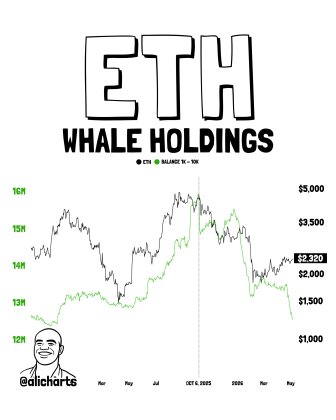
Source: Chart from Ali Charts on X

As seen in the chart shared by Ali Charts, the amount of ETH held by these mid-tier whales has dropped from 15.95 million to about 12.52 million, which represents an approximately 21.5% decrease in their total position. This simply implies a dramatic change in positioning from some of the network’s largest investors.

Ali Charts have flagged this development as a supply overhang. According to the expert, this suggests that the road to the $3,000 may require a fresh wave of demand from institutional or retail investors to offset whale distribution.

It is worth noting that a few days ago, ETH whales went on a buying spree. During the period, over 140,000 ETH, valued at around $322 million, were scooped up by these key players. When high-net-worth holders are buying more, it is a sign that smart money is positioning for a breakout.

Tokenized Treasuries Surges On The ETH Network

Even with the Ethereum price still significantly down from its all-time high, this drop has not hindered institutional adoption, which is currently accelerating. Coin Bureau has reported a surge in tokenized treasuries across the leading network.

The chart shows that the ETH network just surpassed $8 billion in tokenized US treasuries for the first time in its history. The rise in blockchain-based sovereign debt instruments underscores Ethereum’s growing relevance as a foundation for actual financial assets.

In addition, the week experienced the expansion of Stripe’s BRIDGE stablecoins to Celo and plans for Canada’s first regulated stablecoin on Ethereum. Despite the growth, ETH’s price continues to struggle to break key short-term resistance.

ETH trading at $2,279 on the 1D chart | Source: ETHUSDT on Tradingview.com

Связанные с этим вопросы

QAccording to the article, what has happened to the holdings of Ethereum whales in the range of 1,000 to 10,000 ETH?

ATheir holdings have dropped sharply, decreasing by approximately 21.5% from 15.95 million ETH in October 2025 to about 12.52 million ETH by May 2026.

QWhat does market expert Ali Charts suggest is needed for Ethereum's price to reach $3,000?

AAli Charts suggests that reaching $3,000 may require a fresh wave of demand from institutional or retail investors to offset the distribution pressure from whale selling.

QWhat positive development regarding institutional adoption is reported on the Ethereum network despite the price drop?

ATokenized US treasuries on the Ethereum network have surged, surpassing $8 billion for the first time in its history, indicating growing institutional adoption for real financial assets.

QHow did the behavior of the 1,000-10,000 ETH whale cohort change in early October 2025?

ATheir behavior shifted from a steady accumulation phase, where holdings grew from 12.95 million ETH in April to a peak of 15.95 million ETH, to a significant selling phase starting around October 6, 2025.

QWhat was the approximate value and amount of ETH that whales reportedly bought in a recent buying spree mentioned in the article?

ADuring the recent buying spree, whales scooped up over 140,000 ETH, which was valued at around $322 million at the time.

Похожее

The Value Distribution of Stablecoins

**Summary: The Value Distribution of Stablecoins** The article argues that stablecoins are evolving from mere trading tools into broader channels for dollar access. It divides the stablecoin ecosystem into four layers to analyze how value is distributed: 1. **Issuance Layer:** Mints stablecoins, holds reserve assets, and captures the spread between reserve yield and user costs (e.g., Tether, Circle). This layer currently earns the largest profit margin. 2. **Infrastructure Layer:** Connects stablecoins to the traditional financial system, handling fiat on/off-ramps, banking integration, compliance (KYC/AML), and asset management (e.g., Bridge, BVNK). This is the "unglamorous" but critical work, building the essential bridges between crypto and real-world finance. 3. **Acquiring/Distribution Layer:** Integrates stablecoins into merchant systems, manages payment flows, and provides enterprise financial software (e.g., Stripe, Coinbase). They act as the access point for businesses. 4. **Application Layer:** The end-users and businesses that ultimately use stablecoins for payments, settlements, or as a store of value. They benefit from convenience but have little pricing power. The core thesis is that while the issuance layer currently dominates profits, the often-overlooked **infrastructure layer holds significant long-term potential**. The real challenge and barrier to mass adoption is not the on-chain transfer of stablecoins (which is simple), but the complex "last mile" integration into existing business workflows, banking systems, and regulatory frameworks across different countries. Companies in this layer are currently in a "land grab" phase, investing heavily to build networks, secure bank partnerships, and establish compliance pathways. While their position is currently pressured by the profitable issuers above and distribution platforms below, the article suggests that if stablecoins become a default financial rail for businesses, the infrastructure providers who have done the hard work of integration will ultimately gain strong pricing power and become entrenched, essential players.

marsbit5 ч. назад

The Value Distribution of Stablecoins

marsbit5 ч. назад

The Value Distribution of Stablecoins

The Value Distribution of Stablecoins The article argues that stablecoins are evolving from a mere trading tool into a broad "dollar channel." It analyzes the industry's value chain through four layers: 1. **Issuance Layer (e.g., Tether, Circle):** The top layer that mints stablecoins, holds reserve assets, and captures the thickest interest rate spread. 2. **Infrastructure Layer (e.g., Bridge, BVNK):** Connects stablecoins to the traditional financial system, handling critical but complex "dirty work" like fiat on/off-ramps, banking integration, compliance (KYC/AML), and cross-border settlement. 3. **Acquiring/Distribution Layer (e.g., Stripe, Coinbase):** Embeds stablecoins into merchant systems, manages payment flows, and integrates with enterprise software. 4. **Application Layer:** End-users and businesses that ultimately use stablecoins for payments, settlement, or storing value. The author posits that while the issuance layer currently captures the most profit, the most overlooked and potentially critical layer is infrastructure. The core challenge for stablecoin adoption isn't the on-chain transfer (which is simple), but bridging the gap between blockchain and the real-world financial system. This involves solving practical problems for businesses: fiat conversion, reconciliation, tax handling, and user onboarding. Infrastructure companies are currently in a difficult "land-grab" phase—building networks, securing banking relationships, and achieving compliance country-by-country. They face pressure from both the profitable issuance layer above and distribution platforms below. However, the author suggests this layer is building a crucial moat. Once stablecoins become a default business rail, the infrastructure players who have done the hard work of integration may gain significant, durable value and pricing power.

链捕手5 ч. назад

The Value Distribution of Stablecoins

链捕手5 ч. назад

Торговля

Спот
Фьючерсы

Популярные статьи

Manyu: восходящая мем-звезда на Ethereum, готовая открыть новую эру культуры Shiba

Manyu - это мемтокен на Ethereum, который приносит децентрализованную культурную и развлекательную ценность через вирусное влияние в соцсетях и вовлечённость сообщества.

2.0k просмотров всегоОпубликовано 2025.11.27Обновлено 2025.11.27

Manyu: восходящая мем-звезда на Ethereum, готовая открыть новую эру культуры Shiba

Неделя обучения по популярным токенам 14: Glamsterdam — самое ожидаемое обновление Ethereum в 2026 году

Ordinals/Runes по-прежнему стимулируют доходы от комиссий за блоки и активность разработчиков, рассматриваются как отправная точка «нативной эмиссии активов» в сети.

1.5k просмотров всегоОпубликовано 2026.04.29Обновлено 2026.04.29

Неделя обучения по популярным токенам 14: Glamsterdam — самое ожидаемое обновление Ethereum в 2026 году

Обсуждения

Добро пожаловать в Сообщество HTX. Здесь вы сможете быть в курсе последних новостей о развитии платформы и получить доступ к профессиональной аналитической информации о рынке. Мнения пользователей о цене на ETH (ETH) представлены ниже.

活动图片