Ethereum Whales Loses Nearly 25% Of Their Holdings Amid Market Shift

bitcoinistОпубликовано 2026-05-09Обновлено 2026-05-09

Введение

Ethereum whales, defined as addresses holding between 1,000 and 10,000 ETH, have sharply reduced their holdings by approximately 21.5% (from 15.95 million to 12.52 million ETH) between October 2025 and May 2026. This sell-off, flagged as a supply overhang by analyst Ali Charts, indicates fading bullish sentiment among major investors and raises questions about short-term market stability. It contrasts with a previous accumulation phase and recent buying sprees, suggesting Ethereum's price may struggle to reach $3,000 without new institutional or retail demand. Concurrently, Ethereum's utility is growing, with tokenized U.S. treasuries on its network surpassing $8 billion, highlighting its role in traditional finance despite current price struggles below $2,300.

With the crypto market turning slightly bearish, the Ethereum price has lost the $2,300 mark, raising questions about the stability of its recent upswing. Amid this sideways price action, a report shows that a fading bullish sentiment among Ethereum whales is evidenced by a significant decline in their holdings.

Large ETH Players’ Portfolio Shrinks Sharply

After examining Ethereum whales‘ holdings, Ali Charts, a seasoned market expert and trader, revealed that these key investors are exhibiting a trend not seen in over a year. While ETH’s price is slowly losing its upside momentum, a major wave of selling has rattled the ETH market.

This heightened selling activity was observed among large investors or whales holding between 1,000 ETH and 10,000 ETH as they dump nearly a quarter of their holdings in the face of uncertainty. Such a trend underscores a major decrease in exposure, which raises questions about confidence and short-term market stability.

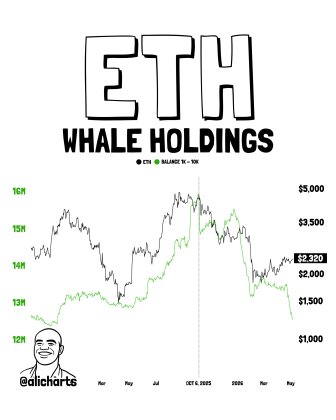
Since October 6, 2025, Ethereum holders between 1,000 and 10,000 ETH have undergone a notable regime shift in their market activity. Prior to the shift, the cohort was spotted in a steady accumulation phase. During the period, these investors’ ETH portfolio saw a rise from 12.95 million ETH in April 2025 to a peak of 15.95 million ETH by October 6, 2025. Fast forward to May 2026, and this behavior has flipped again.

Source: Chart from Ali Charts on X

As seen in the chart shared by Ali Charts, the amount of ETH held by these mid-tier whales has dropped from 15.95 million to about 12.52 million, which represents an approximately 21.5% decrease in their total position. This simply implies a dramatic change in positioning from some of the network’s largest investors.

Ali Charts have flagged this development as a supply overhang. According to the expert, this suggests that the road to the $3,000 may require a fresh wave of demand from institutional or retail investors to offset whale distribution.

It is worth noting that a few days ago, ETH whales went on a buying spree. During the period, over 140,000 ETH, valued at around $322 million, were scooped up by these key players. When high-net-worth holders are buying more, it is a sign that smart money is positioning for a breakout.

Tokenized Treasuries Surges On The ETH Network

Even with the Ethereum price still significantly down from its all-time high, this drop has not hindered institutional adoption, which is currently accelerating. Coin Bureau has reported a surge in tokenized treasuries across the leading network.

The chart shows that the ETH network just surpassed $8 billion in tokenized US treasuries for the first time in its history. The rise in blockchain-based sovereign debt instruments underscores Ethereum’s growing relevance as a foundation for actual financial assets.

In addition, the week experienced the expansion of Stripe’s BRIDGE stablecoins to Celo and plans for Canada’s first regulated stablecoin on Ethereum. Despite the growth, ETH’s price continues to struggle to break key short-term resistance.

ETH trading at $2,279 on the 1D chart | Source: ETHUSDT on Tradingview.com

Связанные с этим вопросы

QAccording to the article, what has happened to the holdings of Ethereum whales in the range of 1,000 to 10,000 ETH?

ATheir holdings have dropped sharply, decreasing by approximately 21.5% from 15.95 million ETH in October 2025 to about 12.52 million ETH by May 2026.

QWhat does market expert Ali Charts suggest is needed for Ethereum's price to reach $3,000?

AAli Charts suggests that reaching $3,000 may require a fresh wave of demand from institutional or retail investors to offset the distribution pressure from whale selling.

QWhat positive development regarding institutional adoption is reported on the Ethereum network despite the price drop?

ATokenized US treasuries on the Ethereum network have surged, surpassing $8 billion for the first time in its history, indicating growing institutional adoption for real financial assets.

QHow did the behavior of the 1,000-10,000 ETH whale cohort change in early October 2025?

ATheir behavior shifted from a steady accumulation phase, where holdings grew from 12.95 million ETH in April to a peak of 15.95 million ETH, to a significant selling phase starting around October 6, 2025.

QWhat was the approximate value and amount of ETH that whales reportedly bought in a recent buying spree mentioned in the article?

ADuring the recent buying spree, whales scooped up over 140,000 ETH, which was valued at around $322 million at the time.

Похожее

A Nation Blocks Chips, a Giant Buys a Nuclear Power Plant: Why It's Time to Seriously Consider DeAI

**Title: Great Powers Blockade Chips, Giants Buy Nuclear Plants: Why It's Time to Seriously Consider DeAI** In May 2026, the US closed loopholes for Chinese firms to acquire advanced NVIDIA chips via overseas subsidiaries. That same month, Kenya halted a $1B geothermal data center project involving Microsoft, fearing its immense energy consumption. Meanwhile, Huawei announced mass production of its Ascend AI chip. These disparate events underscore a new reality: the competition for computing power ("compute") has escalated beyond the tech industry, becoming a geopolitical and infrastructural battleground. A new era of oligopoly is forming, with control over the AI stack—from GPU chips (NVIDIA) and cloud platforms (AWS, Azure, Google Cloud) to foundational models (OpenAI, Anthropic)—concentrating in a few Western "AI Octopus" corporations. This centralization creates systemic risks: pricing power and platform lock-in for users, infrastructure fragility, and a widening "compute divide" that threatens to marginalize nations without independent AI capacity. An "AI Iron Curtain" is deepening through export controls. In response, some nations like Saudi Arabia and the UAE are investing heavily to buy compute power, aiming to transition from oil to AI economies. The EU seeks to triple its compute capacity by 2030 to reduce dependency. However, the spending gap is vast, with four US tech giants alone planning ~$750B in AI capex for 2026. The race is increasingly constrained by energy, with AI tasks consuming up to 1000x more power than web searches, pushing firms to even acquire nuclear plants. This landscape is fueling interest in Decentralized AI (DeAI). It proposes a third way: using open protocols to coordinate a global network of idle GPUs, independent developers, and data centers, creating an AI infrastructure without a single controlling entity. Leveraging blockchain and cryptographic verification, DeAI aims to break market concentration, disperse energy demands, reduce geopolitical dependencies, and enhance transparency. While still nascent in performance and stability, DeAI's core promise is not immediate superiority but providing a crucial alternative architecture to resist monopoly, censorship, and centralized power. As specialized AI hardware costs fall and open-source models flourish, the window to build this foundation is open. The very existence of such competition serves as a vital check against the inevitable abuse of concentrated power.

marsbit37 мин. назад

A Nation Blocks Chips, a Giant Buys a Nuclear Power Plant: Why It's Time to Seriously Consider DeAI

marsbit37 мин. назад

Outpoll Review: A Prediction Market Platform Built for Active Traders

Outpoll Review: A Prediction Market Platform Built for Active Traders In recent years, prediction markets have grown from a niche sector to a mainstream arena, attracting billions in trading volume and institutional capital. However, the user experience and tools for traders have not kept pace. Outpoll, a new global prediction market platform, aims to fill this gap by providing enhanced trading infrastructure for active and professional traders. Built on standard prediction market principles, Outpoll allows users to trade on the outcome of specific events. It uses fully collateralized contracts with USDC settlement, charges a competitive 0.1% fee per trade, and provides clear settlement rules upfront to minimize disputes. A key focus for Outpoll is its professional-grade trading tools. The platform supports limit and market orders, as well as take-profit and stop-loss orders for open positions—features uncommon in prediction markets. For automated trading, Outpoll offers comprehensive REST and WebSocket APIs, enabling portfolio management, price arbitrage, and integration with existing tools. The platform also features a creator-led market model, where approved experts and community leaders can create and manage markets for niche topics under platform supervision. Its integrated interface combines news feeds directly with trading functions, allowing users to monitor events and manage positions seamlessly. Outpoll launched with a native Android app (available on Google Play) and plans an iOS version later this year. In summary, Outpoll distinguishes itself with trader-focused tools, practical APIs, transparent and collateralized markets, integrated news, and an expanding creator program. For active traders, its advanced order types and API access alone make it a platform worth watching. Outpoll is now globally accessible via outpoll.com and Google Play.

marsbit45 мин. назад

Outpoll Review: A Prediction Market Platform Built for Active Traders

marsbit45 мин. назад

Bitwise: Crypto Becomes a Contrarian Investment, Three Logics to Understand the Current Market

**Summary** Matt Hougan, Bitwise's CIO, analyzes the current crypto market through three key lenses, arguing it has shifted from a momentum-driven to a contrarian investment. **1) Crypto Becomes a Contrarian Play:** The market is weak, with major assets like Bitcoin and Ethereum down significantly. Capital has moved to hot sectors like AI, leaving crypto as an "unloved" asset class. This transforms crypto investing from trend-following to a test of patience and fundamental analysis. Investors now favor projects with solid fundamentals (e.g., Hyperliquid) over speculative ones. **2) Regulatory Overhang:** The uncertain fate of the U.S. CLARITY Act, a major crypto regulatory framework, is a key headwind. With its passage in 2024 seen as far from guaranteed (estimates range from 30-55%), institutional capital remains on the sidelines, choosing less risky alternatives like AI stocks. The market needs clarity—whether the bill passes or fails—more than any specific outcome to move decisively. **3) Capital Rotates to New Fundamentals:** This cycle differs from past bear markets where money fled to Bitcoin. Now, capital seeks smaller assets with strong use cases. While major cryptos fell in May 2024, tokens like Hyperliquid (+72%), Zcash (+50%), and XLM (+44%) rallied on their specific fundamentals. This rotation confirms the new contrarian, fundamentals-driven logic and signals the bear market may be in its later stages. **Conclusion:** Short-term pressure persists due to regulatory uncertainty and competition from AI narratives. Investing in crypto now requires a contrarian mindset—acting against the crowd and focusing on fundamental value. Patience and targeting high-quality projects based on their merits are essential for capturing long-term gains.

marsbit1 ч. назад

Bitwise: Crypto Becomes a Contrarian Investment, Three Logics to Understand the Current Market

marsbit1 ч. назад

ChatGPT Might Be Disappearing Soon

OpenAI announced at its "Intelligence at Work" event that its coding assistant, Codex, will be fully integrated into the ChatGPT app within weeks. This move marks a strategic shift from a conversational AI (Chat) towards a unified "agentic" platform capable of execution. Codex, originally launched to compete with Anthropic's Claude Code, has grown rapidly to 5 million weekly active users, with 20% being non-developers like analysts and designers. Its enterprise revenue now constitutes 40% of OpenAI's total. The integration is the first step in creating a super-app combining ChatGPT (interface), Codex (execution engine), and the Atlas browser (web access). OpenAI also unveiled new Codex features: specialized Agent plugins for six professional roles, an "Annotations" tool for direct document editing, and a "Sites" function to turn work into shareable web apps. Internally, this reflects a power shift; the Codex team now leads core product strategy. While the ChatGPT brand remains for its vast user base, the platform's future is focused on autonomous agents that perform tasks, not just chat. The article notes that competition with Claude Code pushed OpenAI's development, with Codex competing on cost-effectiveness and accessibility rather than raw coding quality. It concludes that the essence of "ChatGPT" is evolving from a chatbot into an AI agent platform, with the name potentially becoming a legacy symbol of its original function.

marsbit1 ч. назад

ChatGPT Might Be Disappearing Soon

marsbit1 ч. назад

Торговля

Спот
Фьючерсы

Популярные статьи

Manyu: восходящая мем-звезда на Ethereum, готовая открыть новую эру культуры Shiba

Manyu - это мемтокен на Ethereum, который приносит децентрализованную культурную и развлекательную ценность через вирусное влияние в соцсетях и вовлечённость сообщества.

1.9k просмотров всегоОпубликовано 2025.11.27Обновлено 2025.11.27

Manyu: восходящая мем-звезда на Ethereum, готовая открыть новую эру культуры Shiba

Неделя обучения по популярным токенам 14: Glamsterdam — самое ожидаемое обновление Ethereum в 2026 году

Ordinals/Runes по-прежнему стимулируют доходы от комиссий за блоки и активность разработчиков, рассматриваются как отправная точка «нативной эмиссии активов» в сети.

1.5k просмотров всегоОпубликовано 2026.04.29Обновлено 2026.04.29

Неделя обучения по популярным токенам 14: Glamsterdam — самое ожидаемое обновление Ethereum в 2026 году

Обсуждения

Добро пожаловать в Сообщество HTX. Здесь вы сможете быть в курсе последних новостей о развитии платформы и получить доступ к профессиональной аналитической информации о рынке. Мнения пользователей о цене на ETH (ETH) представлены ниже.

活动图片