Ethereum Supply Becomes More Concentrated In Large Wallets, Here Are The Numbers

bitcoinistОпубликовано 2026-06-01Обновлено 2026-06-01

Введение

Recent on-chain data indicates a significant increase in Ethereum concentration among large wallet holders. Whale addresses holding at least 100,000 ETH now control 22.03% of the total supply, the highest level in ten weeks, representing approximately $35 billion in value. This trend points to aggressive accumulation by institutional players and whales, continuing despite recent market volatility and price declines. Supporting this shift, exchange reserves have been consistently declining, suggesting assets are being moved to cold storage for long-term holding. Market activity shows a surge in buy orders from these large holders, effectively absorbing selling pressure from retail investors. Notably, one whale recently opened a highly leveraged $25.6 million long position, signaling strong confidence albeit with substantial risk.

The concentration of Ethereum (ETH) among large wallet holders is increasing as whales and institutional players continue to buy the second-largest cryptocurrency at an aggressive pace. Fresh on-chain data has also revealed a striking shift in the asset’s supply distribution. Currently, almost a quarter of Ethereum’s supply is now controlled by these large players, suggesting that accumulation by whales has continued despite recent price declines and market volatility.

Over 22% Of Ethereum Supply Now Controlled By Whales

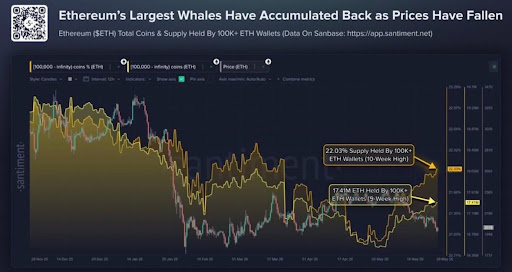
On May 28, on-chain analytics platform Santiment posted fresh data on Ethereum’s supply distribution and whale concentration on X. According to the report, whale wallets with at least 100,000 ETH now collectively hold a staggering 17.4 million tokens, indicating a renewed accumulation trend among major investors.

Santiment noted that this represents the highest number of ETH held by this group of whales in the past nine weeks, suggesting that large players and institutions are aggressively increasing their buying activity as prices continue to decline. Notably, the total value of each ETH whale wallet has surged to approximately $35 billion based on recent market prices.

Source: Santiment

Moreover, the share of Ethereum’s supply held by these whales has reached a whopping 22.03%, marking a supply distribution high not seen in as long as 10 weeks. This data highlights a growing dominance of a small group of large holders over Ethereum’s circulating supply, in contrast to the smaller holdings of retail investors.

Interestingly, Ethereum whale activity has been increasing since 2025, with investors taking advantage of lower prices and market swings to bolster their positions. However, sometime in 2026, Ethereum experienced a major distribution phase, as these same whales began selling off their cryptocurrencies. However, recent reports indicate this trend has since changed.

Not only are whales accumulating Ethereum directly, but according to CryptoQuant, exchange reserves have continued to decline into Q2 2026. This consistent outflow has contributed significantly to ETH’s reduced circulating supply, suggesting that whales are buying ETH and moving it to cold wallets for long-term holding.

ETH Buy Orders Surge As Whales Go Long

Currently, buy orders for Ethereum are still rising, as on-chain data shows strong confidence and renewed interest among large holders. Crypto analyst CW shared this latest development on X, noting that there have been virtually no sell orders from whales in recent days. He also said that the buy orders are effectively absorbing the selling volume from retail investors in the ETH market.

Source: Santiment

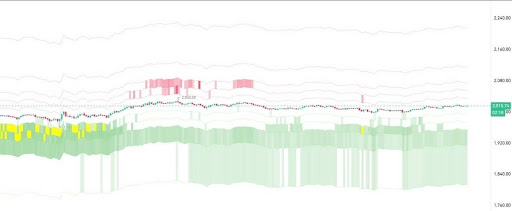
As this unfolds, whales appear to be going long on Ethereum, betting that it could increase soon. A recent market report by Crypto Rover shows that a large holder opened a staggering $25.6 million ETH long position with 25x leverage. Crypto Rover described this as an “insane gamble,” highlighting both massive confidence and extreme risk involved. The analyst noted that if Ethereum’s price drops by just $20, the whale’s entire position could be wiped out.

ETH bull push for recovery | Source: ETHUSDT on Tradingview.com

Связанные с этим вопросы

QAccording to the article, what percentage of Ethereum's supply is now controlled by large wallet holders (whales)?

AAccording to the on-chain data from Santiment, large wallet holders (whales) now control 22.03% of Ethereum's supply.

QWhat is the minimum amount of ETH that defines a 'whale wallet' in the data presented by Santiment?

AIn the Santiment data, a 'whale wallet' is defined as a wallet holding at least 100,000 ETH.

QWhat recent trend does the decline in exchange reserves into Q2 2026 suggest about whale behavior?

AThe consistent decline in exchange reserves into Q2 2026 suggests that whales are buying ETH and moving it to cold wallets for long-term holding, rather than keeping it on exchanges for trading.

QWhat did analyst CW note about sell orders from whales in recent days?

AAnalyst CW noted that there have been virtually no sell orders from whales in recent days, with buy orders effectively absorbing the selling volume from retail investors.

QWhat significant risk did Crypto Rover highlight about the large $25.6 million ETH long position with 25x leverage?

ACrypto Rover highlighted that if Ethereum's price drops by just $20, the whale's entire $25.6 million leveraged long position could be wiped out.

Похожее

STRC Breaks Below $95: Why Does It Continue to Depeg? Is There Default Risk?

"STRC Falls Below $95: Why the Persistent Depegging and Is There Default Risk?" The article discusses the recent decline in the price of STRC, a perpetual preferred stock issued by Strategy (MSTR) designed to trade around a $100 par value. As of publication, STRC traded at $94.65, raising market concerns. STRC is described as a high-yield cash flow product, offering an 11.50% annual dividend paid monthly. Its "preferred" status grants it priority over common stock for dividends and in liquidation. Key reasons cited for the price depegging include: 1. **Bitcoin's Price Drop:** MSTR's assets are heavily tied to Bitcoin (BTC), which fell over 21% from its recent high, pressuring all Strategy-related products. 2. **Competitive Pressure:** Rival Strive Asset Management's similar product, SATA, offers daily dividends and has maintained its $100 par value with a ~13% yield. In response, Strategy has proposed changing STRC's dividend frequency from monthly to bi-weekly, pending shareholder vote. 3. **Technical Selling:** A break below $100 may have triggered algorithmic selling and stop-losses, exacerbating the decline. Regarding default risk, the analysis suggests it is currently low. Strategy founder Michael Saylor confirmed the June 2026 dividend rate remains at 11.50% with no cuts or suspensions. The company's massive reserve of 843,706 BTC provides a significant backstop for its obligations. Industry opinions are mixed. Some analysts view the BTC holdings as reliable support for dividends, while critics like Peter Schiff warn of potential dividend cuts leading to price crashes and lawsuits. Others highlight inflation risk and the company's ability to reduce dividends without a formal default. In summary, STRC's drop is attributed to BTC volatility, competition, and technical factors. While immediate default risk appears contained, the product faces challenges from market conditions and competitive dynamics.

marsbit30 мин. назад

STRC Breaks Below $95: Why Does It Continue to Depeg? Is There Default Risk?

marsbit30 мин. назад

AI Trading Cools, South Korean Stocks Plunge 1.8%, Spot Gold Rises 1%, Bitcoin Dives

A sell-off in AI-related stocks, triggered by Broadcom's disappointing earnings forecast, sent shockwaves through global markets. South Korea's KOSPI led Asia's decline, plunging 1.8% as the risks from concentrated chip stock gains and surging leveraged investments came to the fore. The tech-heavy Nasdaq 100 futures fell 0.5% following Broadcom's 14% after-hours plunge, which signaled a slower-than-expected transition to AI clients. This pullback extended Wall Street's weakness, halting the S&P 500's nine-day rally amid hawkish Fed signals and renewed Middle East tensions. South Korean authorities convened an emergency meeting, pledging "immediate measures" against market volatility and warning of record-high stock margin debt. The adjustment rippled across assets: Bitcoin fell to around $64,000, its lowest since February, while safe-haven gold rose 1% on bargain hunting. Oil prices dipped on Middle East ceasefire news. Market analysts noted the sell-off was driven by profit-taking after massive gains, particularly in chip stocks like Samsung and SK Hynix, which now dominate the KOSPI. Wall Street banks are divided on Korea's outlook, with Goldman Sachs raising its target while Citigroup and others warn of overvaluation and a potential bubble. Bridgewater's Ray Dalio noted that great technological shifts often create bubbles. Meanwhile, Fed officials' hints at potential future rate hikes added to the cautious mood ahead of key U.S. jobs data.

华尔街日报56 мин. назад

AI Trading Cools, South Korean Stocks Plunge 1.8%, Spot Gold Rises 1%, Bitcoin Dives

华尔街日报56 мин. назад

Seeking Alpha's Hot Article: Why Might the U.S. Stock Market Crash in June?

In a recent Seeking Alpha article, financial professor and analyst Damir Tokic argues that the US stock market may be poised for a significant crash in June 2026. The core thesis centers on a "mega-bubble" in equities, particularly within the technology sector, which has driven the S&P 500 to near-record valuations, with a Shiller P/E ratio exceeding 40—a level comparable to the 2000 dot-com bubble. Tokic identifies two primary catalysts for a potential collapse. First, he points to unsustainable market exuberance fueled by what he terms the "Trump Stimulus"—massive AI capital expenditure by tech giants, which he believes is politically driven and cannot last. Second, and more urgently, he highlights the escalating Iran war as a critical threat. The ongoing closure of the Strait of Hormuz has created a severe global energy supply crunch. Strategic petroleum reserves are projected to hit critically low operational levels by June, potentially causing oil prices to spike above $200 per barrel and triggering a severe, supply-driven inflationary shock. This scenario, Tokic warns, would force the Federal Reserve's hand. Despite currently maintaining a dovish bias, the Fed would likely be compelled to officially pivot to a hawkish stance at its June FOMC meeting to combat soaring inflation and bond yields. He contends that such a shift—or even a failure to act, which would destroy Fed credibility—could be the trigger that punctures the market bubble. The resulting downturn, he concludes, could rival the bear markets of 2000 and 2008, advising investors to prepare for a major correction.

marsbit1 ч. назад

Seeking Alpha's Hot Article: Why Might the U.S. Stock Market Crash in June?

marsbit1 ч. назад

Торговля

Спот
Фьючерсы

Популярные статьи

Manyu: восходящая мем-звезда на Ethereum, готовая открыть новую эру культуры Shiba

Manyu - это мемтокен на Ethereum, который приносит децентрализованную культурную и развлекательную ценность через вирусное влияние в соцсетях и вовлечённость сообщества.

1.9k просмотров всегоОпубликовано 2025.11.27Обновлено 2025.11.27

Manyu: восходящая мем-звезда на Ethereum, готовая открыть новую эру культуры Shiba

Неделя обучения по популярным токенам 14: Glamsterdam — самое ожидаемое обновление Ethereum в 2026 году

Ordinals/Runes по-прежнему стимулируют доходы от комиссий за блоки и активность разработчиков, рассматриваются как отправная точка «нативной эмиссии активов» в сети.

1.5k просмотров всегоОпубликовано 2026.04.29Обновлено 2026.04.29

Неделя обучения по популярным токенам 14: Glamsterdam — самое ожидаемое обновление Ethereum в 2026 году

Обсуждения

Добро пожаловать в Сообщество HTX. Здесь вы сможете быть в курсе последних новостей о развитии платформы и получить доступ к профессиональной аналитической информации о рынке. Мнения пользователей о цене на ETH (ETH) представлены ниже.

活动图片