Ethereum Retail Participation Vanishes: Hits One-Year Low In Network Activity

bitcoinistОпубликовано 2025-12-19Обновлено 2025-12-19

Введение

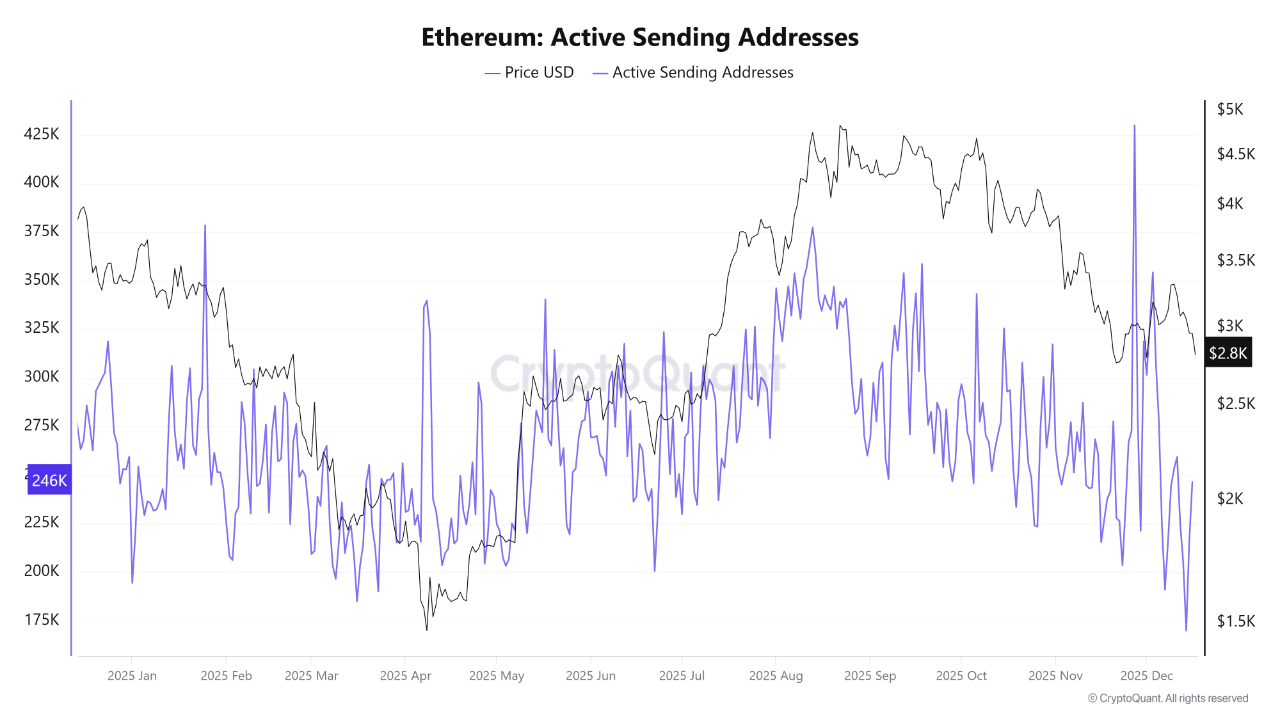
Ethereum's network activity has hit a one-year low, with active sending addresses falling to around 170,000, signaling a significant decline in retail participation. This drop reflects deteriorating market conditions and fading investor confidence amid prolonged volatility and bearish sentiment. On-chain data suggests a phase of seller exhaustion rather than capitulation, where selling pressure is easing but new demand remains weak. Without retail momentum, Ethereum's recovery attempts have been shallow and short-lived. However, such low activity periods have often attracted long-term institutional accumulation. A sustainable rebound would require both price stabilization and a recovery in network activity, indicating returning demand. Continued stagnation risks deeper consolidation or a demand-destruction phase.

Ethereum is struggling to maintain a convincing bullish narrative as market conditions continue to deteriorate and a growing number of analysts begin to call for a broader bear market. After months of heightened volatility and repeated corrective phases, price action alone has failed to restore confidence, leaving participants increasingly cautious.

This hesitation is now being reflected clearly in on-chain data, reinforcing the idea that the current weakness is not purely technical, but structural.

According to a recent CryptoQuant report, Ethereum’s network activity has dropped to levels that strongly suggest a withdrawal of retail participation. Active sending addresses have fallen toward the 170,000 mark, a threshold historically associated with reduced engagement from smaller investors. In past cycles, retail activity typically expands during bullish phases as new participants enter the market, then contracts sharply once confidence fades and price momentum weakens.

Prolonged volatility and corrective price action have likely eroded Ethereum’s short-term conviction, pushing retail participants either to the sidelines or out of the market entirely. This absence matters. Retail flow often plays a critical role in sustaining momentum during recoveries, and without it, upside moves tend to stall quickly.

On-Chain Signals Point to Exhaustion, Not Capitulation

According to CryptoOnchain’s analysis, Ethereum’s sharply depressed on-chain activity aligns with a classic phase of seller exhaustion rather than active capitulation. In this regime, selling pressure gradually diminishes as participants willing to exit have largely done so, yet fresh demand has not meaningfully returned. The result is a fragile equilibrium where price may stabilize, but upside remains limited in the absence of new buyers.

Ethereum Active Sending Addresses | Source: CryptoQuant

The lack of retail participation plays a central role in this dynamic. Retail flow typically provides the initial momentum during early rebounds, amplifying price moves once confidence begins to recover. With active sending addresses at one-year lows, that catalyst is currently missing, which helps explain why upside attempts have been shallow and short-lived.

However, this same environment has historically attracted larger, long-term participants. Institutional and high-conviction holders often accumulate during periods of low activity, when liquidity is thin, and sentiment is decisively negative.

Importantly, a credible recovery signal would not emerge from price action alone. CryptoOnchain emphasizes that a sustainable shift would require a gradual rebound in active sending addresses alongside price stabilization.

That combination would point to returning demand and improving network utilization. Conversely, continued stagnation or further declines in address activity would increase the risk of Ethereum entering a deeper consolidation or even a demand-destruction phase.

While current conditions highlight clear short-term weakness and retail disengagement, similar on-chain setups have historically formed near structural bottoms, creating the potential for medium-term trend shifts if activity begins to recover.

Связанные с этим вопросы

QWhat has happened to Ethereum's network activity according to the CryptoQuant report?

AEthereum's network activity has dropped to a one-year low, with active sending addresses falling toward the 170,000 mark, indicating a significant decline in retail participation.

QWhat role does retail flow typically play in Ethereum's price movements?

ARetail flow often provides the initial momentum during early rebounds and helps sustain recovery momentum by amplifying price moves when confidence begins to recover.

QWhat does the current on-chain data suggest about selling pressure?

AThe on-chain data indicates a phase of seller exhaustion rather than active capitulation, meaning selling pressure is gradually diminishing as most willing sellers have exited, but fresh demand has not yet returned.

QWhat type of participants are often attracted to Ethereum during periods of low activity?

AInstitutional and high-conviction holders often accumulate during periods of low activity, when liquidity is thin and sentiment is decisively negative.

QWhat would be required for a sustainable recovery in Ethereum according to the analysis?

AA sustainable recovery would require a gradual rebound in active sending addresses alongside price stabilization, indicating returning demand and improved network utilization.

Похожее

OpenAI's Largest Internal Wealth Creation: 600 People Cash Out a Total of $6.6 Billion, 75 Take Home the Maximum $30 Million Each

A Wall Street Journal report reveals OpenAI's unprecedented pre-IPO wealth creation. In a single employee stock sale last October, over 600 current and former employees sold shares, collectively cashing out approximately $6.6 billion. Due to high investor demand, the company tripled the individual sale cap to $30 million, with about 75 employees selling the maximum amount. This event represents the largest such transaction in tech industry history for a private company. OpenAI's valuation was $500 billion for this tender offer. Employees with over two years of tenure were eligible, allowing many post-ChatGPT hires their first liquidity event. The company's stock has reportedly grown over 100-fold in seven years. Following a restructuring, employees collectively hold about 26% of OpenAI. The scale of executive wealth is also staggering. In court testimony related to Elon Musk's lawsuit, President and co-founder Greg Brockman confirmed his OpenAI stake is worth around $30 billion. Analysis indicates about 165 current and former employees hold a combined ~$164.9 billion in equity, averaging nearly $1 billion per person in paper wealth. OpenAI's per-employee stock-based compensation is estimated to be 34 times the average of major tech firms before their IPOs. OpenAI continues its rapid ascent, closing a $122 billion funding round at an $852 billion valuation in March. With monthly revenue hitting $2 billion, over 900 million weekly ChatGPT users, and plans for a potential trillion-dollar IPO in late 2026, this wealth-creation engine shows no signs of stopping.

链捕手18 мин. назад

OpenAI's Largest Internal Wealth Creation: 600 People Cash Out a Total of $6.6 Billion, 75 Take Home the Maximum $30 Million Each

链捕手18 мин. назад

Understanding CPO (Co-Packaged Optics) in One Article: Why Nvidia Is Willing to Spend $3.2 Billion on a Fiber?

NVIDIA and Corning announced a multi-year strategic partnership on May 6, 2026, with NVIDIA committing up to $3.2 billion to support Corning's U.S. expansion. This investment will triple Corning's manufacturing plants and significantly boost its optical fiber and communications production capacity. The core driver behind this massive investment is the fundamental shift from copper to optical interconnect technology within AI data centers. As GPU clusters scale, copper wires face critical limitations: severe signal attenuation over distance, high energy consumption for signal integrity, and excessive heat generation. Optical fiber, transmitting light instead of electrical signals, solves these issues with minimal loss, near-light speed, and lower power needs. The article outlines a three-stage evolution of data center interconnect: 1. **Traditional Copper Interconnects:** The mainstream solution of the 2010s, now being phased out due to scaling bottlenecks. 2. **Pluggable Optical Modules:** The current mainstream, where modules convert electrical signals to light externally. This process still introduces energy loss and latency. 3. **CPO (Co-Packaged Optics):** The next-generation technology where the optical engine is integrated directly with the GPU chip package. This drastically reduces the electrical signal travel distance to mere millimeters, slashing power consumption and latency while boosting data density. NVIDIA CEO Jensen Huang has identified CPO as an essential core technology for AI infrastructure. NVIDIA's investment signifies a strategic shift from being a buyer to actively controlling its supply chain for critical components. With demand for specialized optical fiber far outstripping supply—evidenced by soaring prices—securing long-term manufacturing capacity has become a competitive necessity. While Corning's expansion may pressure some suppliers, a projected global fiber supply gap of 5-15% over the next few years creates a significant opportunity window, particularly for Chinese manufacturers competitive in optical preforms, chips, and modules. Ultimately, NVIDIA's move is not about chasing a trend but an engineering imperative. The transition to light-based interconnects like CPO is driven by the physical limits of copper, marking a definitive step in the ongoing AI computing revolution.

marsbit43 мин. назад

Understanding CPO (Co-Packaged Optics) in One Article: Why Nvidia Is Willing to Spend $3.2 Billion on a Fiber?

marsbit43 мин. назад

KOL's Perspective: Why Is SOL Set to Rise from This Point?

**Summary: Why SOL is Positioned for Growth at This Level** The article argues that SOL is poised for an upward move from its current price point, citing several key factors. Primarily, SOL has just broken out of a 4-month consolidation phase. This breakout signals a return of risk appetite to the broader crypto market, as SOL is seen as a key indicator of overall crypto health. The token's ownership has reportedly shifted from short-term traders and tourists to long-term accumulators, leading to low volume. Any meaningful increase in trading activity could thus trigger significant upward momentum. Fundamental strengths include strong institutional adoption, integration with DeFi and RWAs (Real-World Assets), and the potential benefits from the Clarity Act. Despite its high volatility—having dropped 70% from its all-time high but still up 12x from its bear market low—SOL is highlighted as one of the few tokens from the last cycle to reach new highs. It boasts a robust ecosystem of applications, users, and protocols. Future catalysts include the expected influx of AI developers following the Miami Accelerate conference, which focused on AI on Solana. Furthermore, Solana is positioned as the premier chain for memecoin activity, a trend expected to continue and drive network usage and fees. The article concludes that recent price action reflects a healthy transfer to long-term holders, setting the stage for growth.

marsbit1 ч. назад

KOL's Perspective: Why Is SOL Set to Rise from This Point?

marsbit1 ч. назад

Торговля

Спот
Фьючерсы

Популярные статьи

Manyu: восходящая мем-звезда на Ethereum, готовая открыть новую эру культуры Shiba

Manyu - это мемтокен на Ethereum, который приносит децентрализованную культурную и развлекательную ценность через вирусное влияние в соцсетях и вовлечённость сообщества.

1.9k просмотров всегоОпубликовано 2025.11.27Обновлено 2025.11.27

Manyu: восходящая мем-звезда на Ethereum, готовая открыть новую эру культуры Shiba

Неделя обучения по популярным токенам 14: Glamsterdam — самое ожидаемое обновление Ethereum в 2026 году

Ordinals/Runes по-прежнему стимулируют доходы от комиссий за блоки и активность разработчиков, рассматриваются как отправная точка «нативной эмиссии активов» в сети.

1.3k просмотров всегоОпубликовано 2026.04.29Обновлено 2026.04.29

Неделя обучения по популярным токенам 14: Glamsterdam — самое ожидаемое обновление Ethereum в 2026 году

Обсуждения

Добро пожаловать в Сообщество HTX. Здесь вы сможете быть в курсе последних новостей о развитии платформы и получить доступ к профессиональной аналитической информации о рынке. Мнения пользователей о цене на ETH (ETH) представлены ниже.

活动图片