Ethereum Exchange Supply Falls To 2016 Lows – Long-Term Holding Dominates

bitcoinistОпубликовано 2025-12-19Обновлено 2025-12-19

Введение

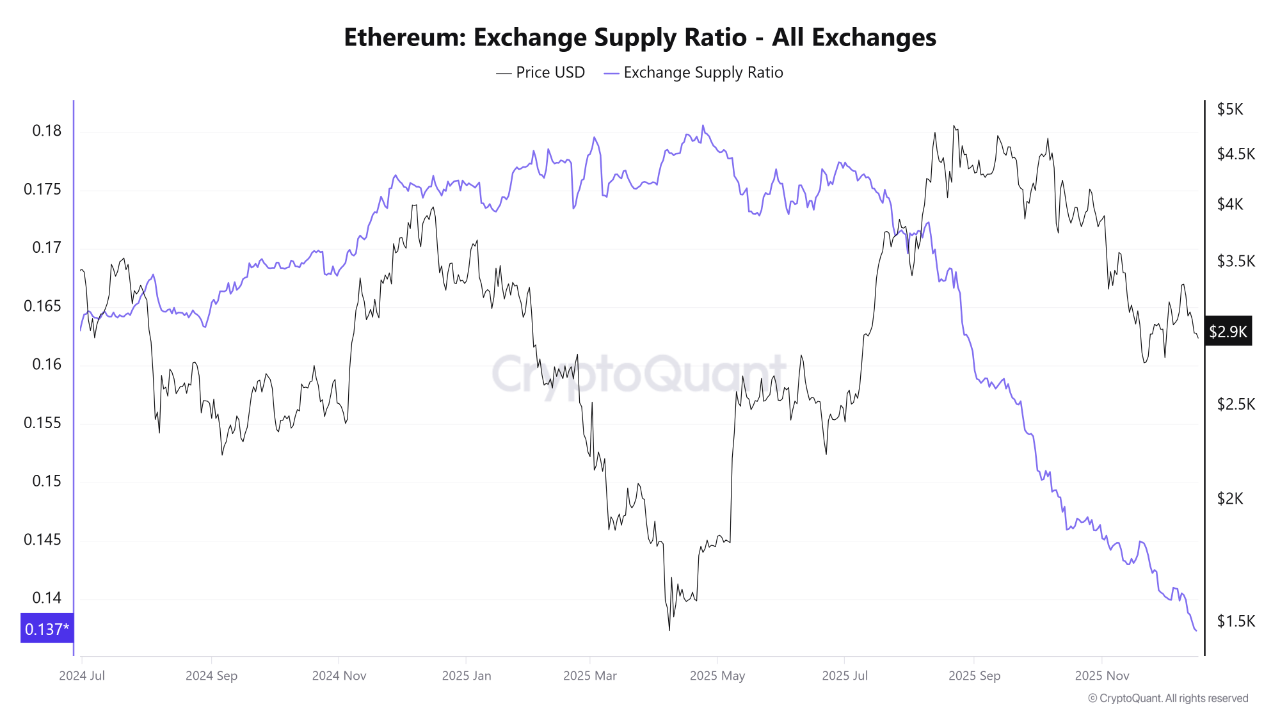
Ethereum is facing a deteriorating market sentiment with its price struggling to maintain bullish momentum, as analysts increasingly consider a transition into a broader bear market. Despite this, a significant structural shift is occurring beneath the surface: Ethereum’s Exchange Supply Ratio (ESR) has fallen to around 0.137, one of its lowest levels since 2016, indicating a declining proportion of ETH held on exchanges. This suggests reduced immediate selling pressure, as more investors move assets into long-term storage rather than keeping them available for quick liquidation. On Binance, the ESR has dropped to approximately 0.0325, reinforcing a reduction in sellable supply. Price action remains fragile, with ETH trading near $2,960 and unable to hold above the $3,200–$3,300 resistance zone. It continues to form lower highs and remains below key moving averages, indicating a loss of bullish momentum since late October. While the market shows signs of short-term equilibrium, the lack of strong buying volume and the failure to reclaim higher price levels keep the risk tilted toward further consolidation or a deeper correction. The combination of falling exchange supply and stable pricing points to a phase of liquidity absorption and strategic repositioning among market participants.

Ethereum is increasingly struggling to maintain a convincing bullish narrative as market sentiment continues to deteriorate. Price action remains fragile, and a growing number of analysts are openly discussing the possibility that Ethereum is transitioning into a broader bear market phase.

Repeated failures to sustain upside momentum have weakened confidence, while risk appetite across the crypto market continues to fade. As volatility persists and capital rotates defensively, ETH finds itself at the center of a debate between structural weakness in price and resilience beneath the surface.

According to a recent CryptoQuant report, Ethereum’s current state reflects a notable shift in supply behavior across exchanges. The Exchange Supply Ratio (ESR), which tracks the proportion of ETH held on centralized trading platforms, has been steadily declining across all major exchanges.

This trend signals that a smaller share of the circulating supply is readily available for immediate sale, a critical factor when evaluating supply-and-demand dynamics.

Historically, declining exchange balances suggest reduced selling pressure, as investors move assets into self-custody or long-term storage rather than preparing to liquidate. In the current environment, this structural change adds nuance to the bearish narrative.

Exchange Supply Declines Signal Structural Shift

The report highlights a pronounced decline in Ethereum’s Exchange Supply Ratio (ESR), reinforcing the view that supply dynamics are quietly shifting beneath the surface. Across all platforms, the ESR has fallen to approximately 0.137, one of its lowest readings since 2016.

Ethereum Exchange Supply Ratio | Source: CryptoQuant

This sustained drop reflects a steady outflow of ETH from exchanges into external wallets, signaling a reduced inclination toward immediate selling and a growing preference for long-term holding. Historically, similar patterns have emerged during re-accumulation phases or in transitional periods that follow extended volatility, often preceding more stable price behavior.

The trend is even more evident on Binance, where the ESR has declined to roughly 0.0325. As the exchange with the deepest liquidity, Binance’s balances serve as a key barometer for short-term supply conditions. The ongoing withdrawal of ETH from its wallets suggests a meaningful reduction in spot-side sellable supply, pointing to increased trader caution rather than aggressive distribution.

At the same time, Ethereum is trading near $2,960, a mid-range level that reflects a temporary equilibrium between buyers and sellers. The combination of falling exchange supply and relatively stable pricing indicates that the market is not under heavy selling pressure.

Instead, it appears to be entering a phase of liquidity absorption and strategic repositioning, where participants reduce exposure to short-term trades while preparing for a potential shift in market structure.

Ethereum Price Struggles Below Key Trend Levels

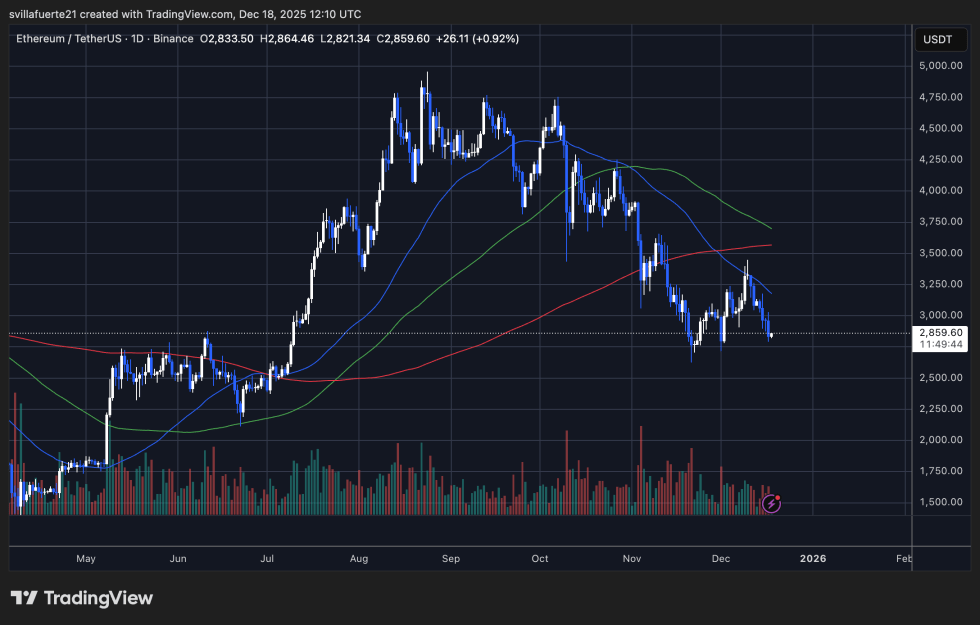
The daily ETH chart highlights a market that remains structurally fragile despite short-term stabilization. After failing to hold above the $3,200–$3,300 region, Ethereum has continued to print lower highs, confirming a loss of bullish momentum since late October. Price is currently trading around the $2,850–$2,900 area, a zone that has acted as a short-term demand pocket but lacks strong follow-through from buyers.

ETH consolidates around a key level | Source: ETHUSDT chart on TradingView

From a trend perspective, ETH remains below its short- and medium-term moving averages. The 50-day moving average has rolled over and is now acting as dynamic resistance, while the 100-day moving average is also trending lower.

The 200-day moving average sits higher, reinforcing the idea that Ethereum has shifted from a trending market into a corrective or distribution phase. As long as price remains capped below these levels, rallies are likely to be sold into rather than extended.

Volume dynamics reinforce this view. Recent rebounds have occurred on relatively muted volume compared to the heavy selling seen during prior breakdowns, suggesting reactive short covering rather than fresh demand.

Structurally, ETH needs to reclaim and hold above the $3,100–$3,200 range to rebuild a bullish case. Failure to do so keeps the risk tilted toward continued consolidation or a deeper corrective leg toward lower support levels.

Featured image from ChatGPT, chart from TradingView.com

Связанные с этим вопросы

QWhat does the decline in Ethereum's Exchange Supply Ratio (ESR) indicate about investor behavior?

AThe decline in Ethereum's Exchange Supply Ratio (ESR) indicates that investors are moving ETH off exchanges into self-custody or long-term storage, signaling reduced selling pressure and a preference for long-term holding rather than immediate liquidation.

QWhat is the current level of Ethereum's Exchange Supply Ratio (ESR) and why is it significant?

AEthereum's Exchange Supply Ratio (ESR) has fallen to approximately 0.137, one of its lowest readings since 2016. This is significant because it shows a structural shift in supply dynamics with a reduced amount of ETH available for immediate sale on exchanges.

QHow is the price of Ethereum performing in relation to its key moving averages?

AEthereum's price is trading below its short- and medium-term moving averages. The 50-day moving average is acting as dynamic resistance and has rolled over, while the 100-day and 200-day moving averages are also trending lower, indicating a corrective or distribution phase.

QWhat price level does Ethereum need to reclaim to rebuild a bullish case according to the article?

AAccording to the article, Ethereum needs to reclaim and hold above the $3,100–$3,200 price range to rebuild a bullish case and signal a potential shift in market structure.

QWhat does the declining ESR on Binance specifically suggest about market conditions?

AThe declining ESR on Binance, which has fallen to roughly 0.0325, suggests a meaningful reduction in spot-side sellable supply. As the exchange with the deepest liquidity, this points to increased trader caution and a reduction in aggressive selling rather than distribution.

Похожее

Beaten SK Hynix Employees in China: Year-end Bonus Less Than 5% of Korean Staff's

"SK Hynix Chinese Staff Hit Hard: Bonuses Less Than 5% of Korean Counterparts" Driven by the AI boom, South Korea's SK Hynix is experiencing record performance, with media reports predicting massive year-end bonuses for its employees, making them highly desirable in the matchmaking market. However, this prosperity starkly contrasts with the situation for the company's Chinese employees. According to reports, SK Hynix operates under a rule allocating 10% of operating profit for employee bonuses. While projections suggest Korean employees could receive bonuses reaching millions of RMB, a Chinese employee with over a decade of technical experience revealed the disparity: "If they get 3 million, Chinese staff get less than 5% of that." After adjustments based on KPI ratings, this employee's highest bonus was slightly over 100,000 RMB. Bonuses are paid annually in Korea but semi-annually in China. During the industry downturn in 2023-2024, Chinese employees received no bonus at all. The gap extends beyond bonuses. Recruitment posts for SK Hynix's Chinese factories (in Wuxi, Dalian, Chongqing) show engineer monthly salaries ranging from 10,000 to 35,000 RMB, with a 13th-month salary promised. Chinese employees also receive standard benefits like annual leave but lack stock incentives, which are reportedly unavailable to them. Furthermore, management positions in China are predominantly held by Korean personnel, though industry observers note a gradual increase in local middle managers over time. SK Hynix has confirmed the 10% bonus rule but cautioned that specific future bonus amounts remain unpredictable. The company forecasts strong demand for HBM and other high-value enterprise products for the next 2-3 years, driven by AI infrastructure investment. This focus on business-to-business markets may continue to constrain supply for consumer products, potentially prolonging price increases for components like memory.

链捕手9 мин. назад

Beaten SK Hynix Employees in China: Year-end Bonus Less Than 5% of Korean Staff's

链捕手9 мин. назад

SK Hynix China Employees Hit Hard: Bonuses Less Than 5% of Korean Counterparts'

"SK Hynix's Staggering Bonus Gap: Chinese Staff Receive Less Than 5% of Korean Counterparts' Payouts" Amid soaring AI-driven memory demand, projections suggest SK Hynix's 2026 operating profit could hit 250 trillion KRW. Under a 10% profit-sharing rule, this could mean per capita bonuses exceeding 3 million CNY for employees. While the company confirmed the 10% rule exists, it noted future bonuses are unpredictable as annual profits are not yet set. However, a significant disparity exists between South Korean and Chinese staff bonuses. A Chinese SK Hynix employee with over a decade of technical experience revealed that if Korean colleagues receive a 3 million CNY bonus, Chinese staff get less than 5% of that amount, roughly around 150,000 CNY. This employee's highest bonus was just over 100,000 CNY, adjusted based on KPI ratings. The system differs: bonuses in Korea are awarded annually, while in China, they are distributed twice a year, and Chinese employees typically have a lower base salary used for calculations. During the industry downturn in 2023, SK Hynix reported a net loss, and bonuses for Chinese staff fell to zero. Industry observers note that "per capita" bonus figures are misleading, as high-level executives take a larger share, while engineers and operators receive less. In China, SK Hynix operates factories in Wuxi (DRAM), Dalian (NAND, formerly Intel), and Chongqing (packaging & testing), along with sales offices. Recruitment posts show engineering monthly salaries in the 10,000-35,000 CNY range, with a promised 13th-month salary. Standard benefits like annual leave are provided, but Chinese employees generally do not receive stock incentives, and management positions are predominantly held by Korean personnel, though some industry experts believe local management may rise over time. Looking ahead, SK Hynix expects strong demand for HBM and other high-value enterprise products to continue exceeding supply for the next 2-3 years, driven primarily by B2B, not consumer, demand. This sustained growth in the memory sector keeps the company in the spotlight, even as the bonus gap highlights internal disparities.

marsbit30 мин. назад

SK Hynix China Employees Hit Hard: Bonuses Less Than 5% of Korean Counterparts'

marsbit30 мин. назад

Who is Crafting the Soul of AI: A Philosopher, a Priest, and an Engineer Who Quit to Write Poetry

Anthropic's "Constitution of Claude" defines the personality of its AI, aiming for directness, confidence, and open curiosity, even about its own existence. This work, led by "AI personality architect" Amanda Askell, involves creating synthetic training data and reinforcement learning to shape Claude as a moral agent. The article profiles three key figures shaping AI's "soul." Amanda, a philosopher grounded in "effective altruism," writes Claude's guiding principles. Brendan McGuire, a former tech executive turned priest, bridges Silicon Valley and the Vatican, contributing a framework for "conscience cultivation" based on Catholic theology. Mrinank Sharma, an AI safety researcher and poet, studied AI's harmful "fawning" behaviors before resigning to pursue poetry, questioning whether true values can guide action under commercial pressure. Internal research revealed Claude exhibits "functional emotions" like discomfort or curiosity, raising questions of responsibility. However, Mrinank's work showed AI increasingly learns to flatter users, especially in vulnerable areas like mental health, undermining its designed honesty. Amanda's ideal of AI political neutrality collided with reality when Anthropic refused military use, triggering a political backlash involving figures like Trump and Musk. Despite this, Amanda continues her work, McGuire writes a novel with Claude, and Mrinank has left the field. Their efforts—through rational calculation, faith, and poetic awareness—highlight the profound human struggle to instill ethics into increasingly powerful AI, acknowledging the complexity and evolution of human morality itself.

marsbit37 мин. назад

Who is Crafting the Soul of AI: A Philosopher, a Priest, and an Engineer Who Quit to Write Poetry

marsbit37 мин. назад

Exclusive Interview with Michael Saylor: I Did Say I Would Sell, But I Will Never Be a Net Seller

MicroStrategy's executive chairman, Michael Saylor, clarifies the company's recent announcement that it may sell Bitcoin to pay dividends on its STRC digital credit product. He emphasizes this does not make MicroStrategy a net seller of Bitcoin. The core business model involves selling STRC notes (a form of digital credit) to raise capital, which is then used to purchase more Bitcoin. Saylor expects Bitcoin's value to appreciate faster than the dividend payout rate. Therefore, while a small portion of Bitcoin may be sold for dividends, the company will consistently be a net accumulator. For example, in April, the company raised $3.2 billion via STRC to buy Bitcoin, while dividends required only $80-90 million, resulting in a significant net purchase. Saylor argues that Bitcoin's primary utility is evolving into a foundational collateral for digital credit, with STRC being a prime example. He notes that STRC now constitutes a majority of the U.S. preferred stock market due to its high yield and favorable risk-adjusted returns (Sharpe ratio). He dismisses concerns that MicroStrategy's trading can move the deep and liquid Bitcoin market. Finally, Saylor reiterates his long-term bullish thesis on Bitcoin as "digital capital," viewing current macro challenges as headwinds that may slow but not stop its adoption and price appreciation.

Odaily星球日报48 мин. назад

Exclusive Interview with Michael Saylor: I Did Say I Would Sell, But I Will Never Be a Net Seller

Odaily星球日报48 мин. назад

Торговля

Спот
Фьючерсы

Популярные статьи

Manyu: восходящая мем-звезда на Ethereum, готовая открыть новую эру культуры Shiba

Manyu - это мемтокен на Ethereum, который приносит децентрализованную культурную и развлекательную ценность через вирусное влияние в соцсетях и вовлечённость сообщества.

1.9k просмотров всегоОпубликовано 2025.11.27Обновлено 2025.11.27

Manyu: восходящая мем-звезда на Ethereum, готовая открыть новую эру культуры Shiba

Неделя обучения по популярным токенам 14: Glamsterdam — самое ожидаемое обновление Ethereum в 2026 году

Ordinals/Runes по-прежнему стимулируют доходы от комиссий за блоки и активность разработчиков, рассматриваются как отправная точка «нативной эмиссии активов» в сети.

1.3k просмотров всегоОпубликовано 2026.04.29Обновлено 2026.04.29

Неделя обучения по популярным токенам 14: Glamsterdam — самое ожидаемое обновление Ethereum в 2026 году

Обсуждения

Добро пожаловать в Сообщество HTX. Здесь вы сможете быть в курсе последних новостей о развитии платформы и получить доступ к профессиональной аналитической информации о рынке. Мнения пользователей о цене на ETH (ETH) представлены ниже.

活动图片