Ethereum Drops After Vitalik Buterin Sells Again: Is History Repeating?

bitcoinistОпубликовано 2026-02-23Обновлено 2026-02-23

Введение

Ethereum's price declined over 5% in two days, dropping from $1,988 to $1,875, as on-chain trackers identified renewed selling activity from wallets associated with co-founder Vitalik Buterin. According to Lookonchain, Buterin sold 1,869 ETH (worth approximately $3.67 million) during this period. This has drawn comparisons to a previous instance where his reported sale of 6,958 ETH was followed by a significant market drop. The activity appears intentional, with ETH being withdrawn from Aave before being sold, suggesting active distribution rather than simple wallet management. While causation isn't proven, such founder-linked selling often impacts trader sentiment and market flows. At the time of reporting, Ethereum was trading at $1,884.

Ethereum slipped over the past two days as on-chain trackers flagged another burst of selling tied to Vitalik Buterin’s wallets, reviving a familiar narrative for traders: founder-linked distribution showing up alongside spot weakness.

Ethereum Pullback Coincides With Fresh Vitalik Sales

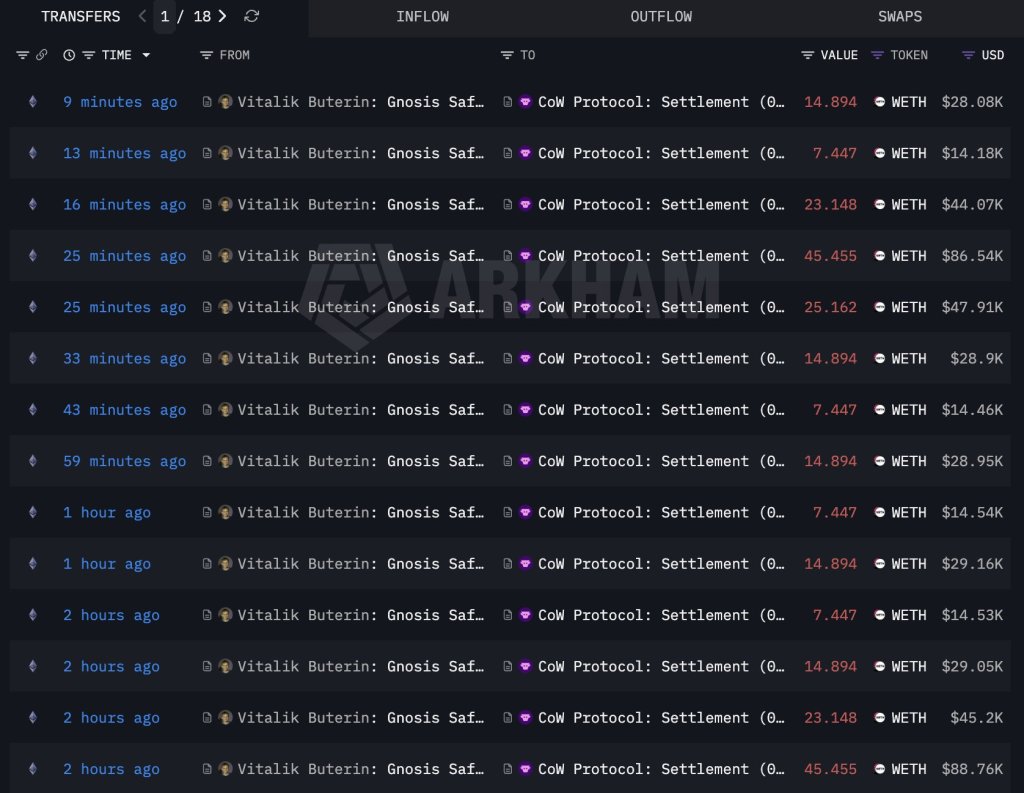
Lookonchain said Buterin has sold 1,869 ETH (about $3.67 million) over the past two days, a window in which ETH fell from $1,988 to $1,875, a 5.7% drawdown based on the figures cited in the post. The account framed the move as an acceleration: “vitalik.eth(@VitalikButerin) is selling ETH faster again. In the past 2 days, he has sold 1,869 ETH($3.67M). During that time, ETH fell from $1,988 to $1,875, down 5.7%.”

Vitalik Buterin on Arkham | Source: X @lookonchain

The sharper edge of the thread was the historical comparison. Lookonchain pointed to a previous episode when it said Buterin sold 6,958 ETH (about $14.78 million) and ETH subsequently fell from $2,360 to $1,825, a 22.7% decline. “Last time he sold 6,958 ETH($14.78M), $ETH dropped from $2,360 to $1,825 — a 22.7% fall,” the post added, linking to an Arkham entity page attributed to Buterin.

The comparison does not prove causation, but it’s exactly the kind of pattern-matching that can matter at the margin in a market primed to trade flows. Founder wallets are heavily monitored, and any hint of renewed supply can become a focal point for positioning—especially when price is already drifting lower.

Lookonchain’s earlier post dated Feb. 22 described the sequence as a return to activity after a pause. “After a two-week break, vitalik.eth(@VitalikButerin) is selling ETH again! 8 hours ago, he withdrew 3,500 ETH($6.95M) from Aave to sell. So far, he has already sold 571 ETH($1.13M),” the account wrote.

That detail matters because it frames the selling as an intentional unwind rather than passive movement between wallets. Pulling ETH from Aave, then selling portions, is the sort of breadcrumb traders look for when trying to distinguish “wallet housekeeping” from outright distribution.

The Feb. 22 posts also land on top of another Lookonchain note from Feb. 5, which described sustained selling over multiple days. “vitalik.eth(@VitalikButerin) is dumping ETH fast!” it said, adding: “Over the past 3 days, Vitalik has sold 2,961.5 $ETH($6.6M) at an average price of $2,228 — and the selling is still ongoing.”

For markets, the immediate question is whether this remains a contained, trackable flow or whether it becomes the kind of recurring headline that pulls liquidity and sentiment lower simply by staying in the tape. If additional wallet-linked sales surface, traders will likely keep stress-testing the “history repeating” narrative against price, rather than assuming the selling is the sole driver.

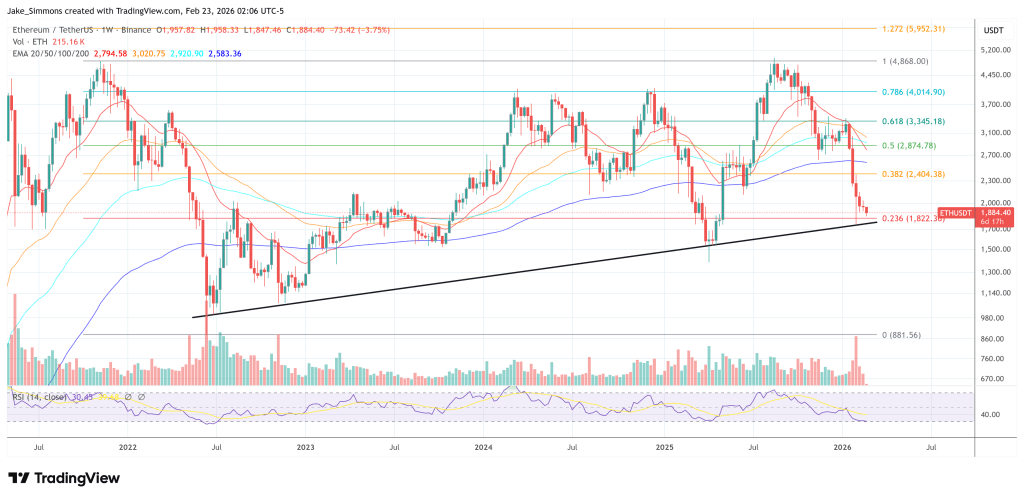
At press time, Ethereum traded at $1,884.

Ethereum continues to fall towards the black trendline, 1-week chart | Source: ETHUSDT on TradingView.com

Связанные с этим вопросы

QWhat is the main reason for Ethereum's recent price drop according to the article?

AThe article attributes Ethereum's recent price drop to on-chain trackers flagging another burst of selling activity from wallets linked to its co-founder, Vitalik Buterin.

QHow much ETH did Vitalik Buterin sell in the past two days, and what was its approximate USD value?

AVitalik Buterin sold 1,869 ETH, which was valued at approximately $3.67 million.

QWhat historical event does Lookonchain compare the current selling activity to?

ALookonchain compares it to a previous episode where Buterin sold 6,958 ETH (worth ~$14.78M), after which the price fell from $2,360 to $1,825, a decline of 22.7%.

QWhy does the article state that pulling ETH from Aave to sell is a notable detail?

AIt frames the selling as an intentional unwind or distribution rather than simple 'wallet housekeeping' or passive movement between wallets, which traders see as a more significant signal.

QWhat is the price of Ethereum at the time the article was published?

AAt press time, Ethereum traded at $1,884.

Похожее

Google and Amazon Simultaneously Invest Heavily in a Competitor: The Most Absurd Business Logic of the AI Era Is Becoming Reality

In a span of four days, Amazon announced an additional $25 billion investment, and Google pledged up to $40 billion—both direct competitors pouring over $65 billion into the same AI startup, Anthropic. Rather than a typical venture capital move, this signals the latest escalation in the cloud wars. The core of the deal is not equity but compute pre-orders: Anthropic must spend the majority of these funds on AWS and Google Cloud services and chips, effectively locking in massive future compute consumption. This reflects a shift in cloud market dynamics—enterprises now choose cloud providers based on which hosts the best AI models, not just price or stability. With OpenAI deeply tied to Microsoft, Anthropic’s Claude has become the only viable strategic asset for Google and Amazon to remain competitive. Anthropic’s annualized revenue has surged to $30 billion, and it is expanding into verticals like biotech, positioning itself as a cross-industry AI infrastructure layer. However, this funding comes with constraints: Anthropic’s independence is challenged as it balances two rival investors, its safety-first narrative faces pressure from regulatory scrutiny, and its path to IPO introduces new financial pressures. Globally, this accelerates a "tri-polar" closed-loop structure in AI infrastructure, with Microsoft-OpenAI, Google-Anthropic, and Amazon-Anthropic forming exclusive model-cloud alliances. In contrast, China’s landscape differs—investments like Alibaba and Tencent backing open-source model firm DeepSeek reflect a more decoupled approach, though closed-source models from major cloud providers still dominate. The $65 billion bet is ultimately about securing a seat at the table in an AI-defined future—where missing the model layer means losing the cloud war.

marsbit17 мин. назад

Google and Amazon Simultaneously Invest Heavily in a Competitor: The Most Absurd Business Logic of the AI Era Is Becoming Reality

marsbit17 мин. назад

Computing Power Constrained, Why Did DeepSeek-V4 Open Source?

DeepSeek-V4 has been released as a preview open-source model, featuring 1 million tokens of context length as a baseline capability—previously a premium feature locked behind enterprise paywalls by major overseas AI firms. The official announcement, however, openly acknowledges computational constraints, particularly limited service throughput for the high-end DeepSeek-V4-Pro version due to restricted high-end computing power. Rather than competing on pure scale, DeepSeek adopts a pragmatic approach that balances algorithmic innovation with hardware realities in China’s AI ecosystem. The V4-Pro model uses a highly sparse architecture with 1.6T total parameters but only activates 49B during inference. It performs strongly in agentic coding, knowledge-intensive tasks, and STEM reasoning, competing closely with top-tier closed models like Gemini Pro 3.1 and Claude Opus 4.6 in certain scenarios. A key strategic product is the Flash edition, with 284B total parameters but only 13B activated—making it cost-effective and accessible for mid- and low-tier hardware, including domestic AI chips from Huawei (Ascend), Cambricon, and Hygon. This design supports broader adoption across developers and SMEs while stimulating China's domestic semiconductor ecosystem. Despite facing talent outflow and intense competition in user traffic—with rivals like Doubao and Qianwen leading in monthly active users—DeepSeek has maintained technical momentum. The release also comes amid reports of a new funding round targeting a valuation exceeding $10 billion, potentially setting a new record in China’s LLM sector. Ultimately, DeepSeek-V4 represents a shift toward open yet realistic infrastructure development in the constrained compute landscape of Chinese AI, emphasizing engineering efficiency and domestic hardware compatibility over pure model scale.

marsbit54 мин. назад

Computing Power Constrained, Why Did DeepSeek-V4 Open Source?

marsbit54 мин. назад

Торговля

Спот
Фьючерсы

Популярные статьи

Manyu: восходящая мем-звезда на Ethereum, готовая открыть новую эру культуры Shiba

Manyu - это мемтокен на Ethereum, который приносит децентрализованную культурную и развлекательную ценность через вирусное влияние в соцсетях и вовлечённость сообщества.

1.9k просмотров всегоОпубликовано 2025.11.27Обновлено 2025.11.27

Manyu: восходящая мем-звезда на Ethereum, готовая открыть новую эру культуры Shiba

Обсуждения

Добро пожаловать в Сообщество HTX. Здесь вы сможете быть в курсе последних новостей о развитии платформы и получить доступ к профессиональной аналитической информации о рынке. Мнения пользователей о цене на ETH (ETH) представлены ниже.

活动图片