Ethereum down 42% from all-time high: Where will ETH price bottom?

cointelegraphОпубликовано 2025-12-18Обновлено 2025-12-18

Введение

Ether (ETH) has declined 42% from its all-time high of $4,950, falling below $3,000. Analysts warn that if the $2,800 support level fails, ETH could drop toward $2,100—a key level where 2.1 million ETH were previously acquired. Traders note Ethereum's significant underperformance compared to Bitcoin and other assets this cycle. Market sentiment remains bearish, with Polymarket bettors pricing an 83% chance of ETH revisiting $2,500 and a 59% chance of falling to $2,000 by 2026. Institutional demand has weakened, as U.S. spot Ethereum ETFs saw five consecutive days of outflows totaling $533.1 million, reducing assets under management to $17.34 billion. Additionally, daily treasury buying of ETH has dropped sharply from its August high. Despite the current 42% drawdown being relatively shallow compared to historical bear cycles (which saw 80-90% declines), on-chain and technical indicators suggest further downside risk.

Ether (ETH) has retraced 42% from its all-time high of $4,950 with traders wondering where the altcoin was likely to bottom out next.


Key takeaways:

  • Ethereum traders see ETH price dropping to $2,100 if support at $2,800 fails.

  • Persistent Ether ETF outlaws and less treasury buying introduce more risks for bulls.

Analysis: 25% ETH price drop possible

Data from Cointelegraph Markets Pro and TradingView showed that the ETH/USD pair has dropped back below $3,000.

Commenting on the latest price action, analyst and trader Daan Crypto Trades said that although this cycle has not been what ETH investors anticipated, Ether’s “market structure and the Ethereum ecosystem have matured during this time,” adding:

“I can’t defend the price action this cycle, it has underperformed $BTC and many others massively.”

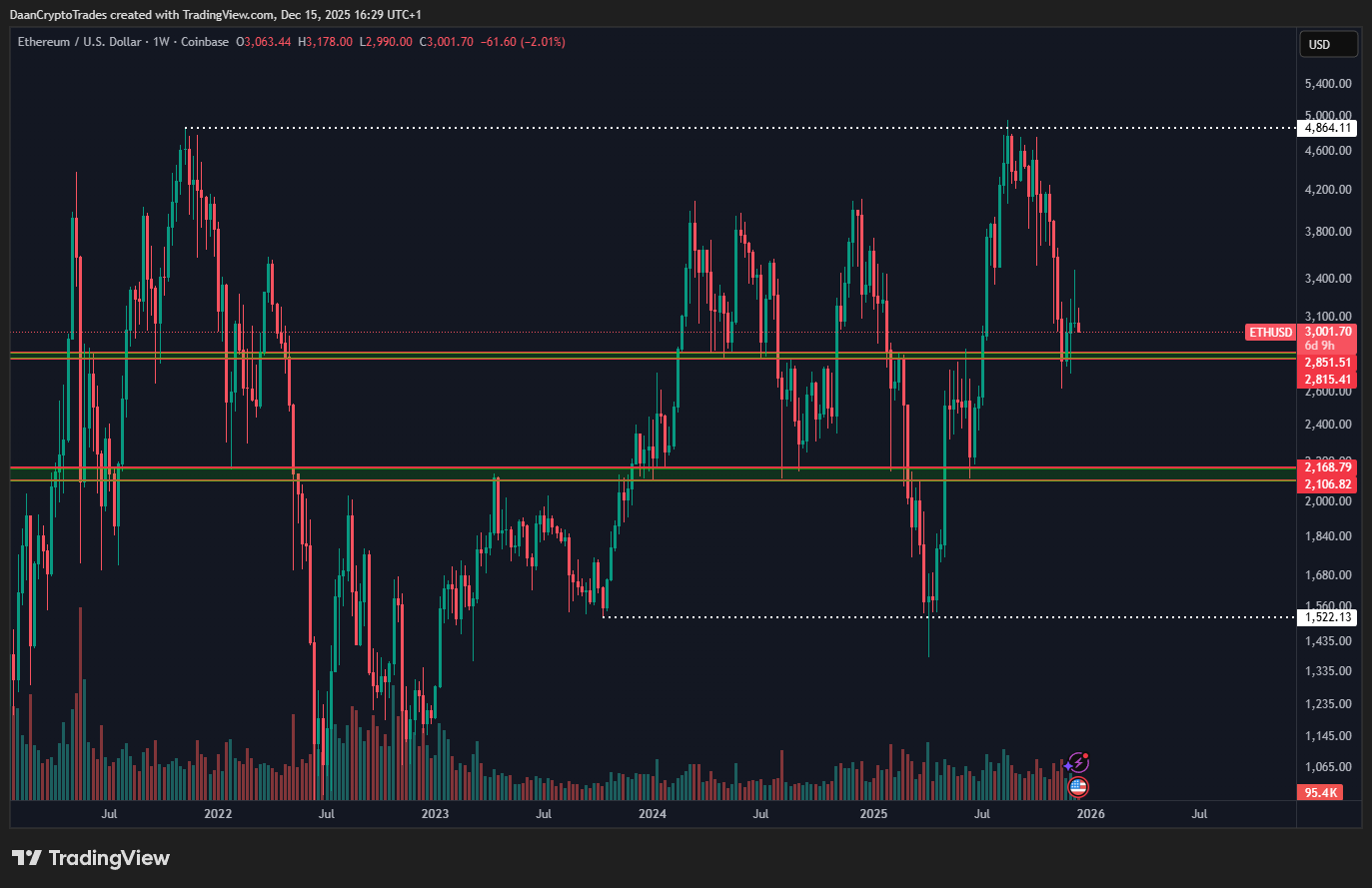
An accompanying chart suggested that if ETH lost its $2,800 support, it would likely drop toward the next major support level around $2,100.

ETH/USD weekly chart. Source: Daan Crypto Trades

Data from Glassnode showed that the next significant support below $2,800 sits at around $2,100, where approximately 2.1 million ETH were previously acquired.

Related: Ethereum could get faster in January with gas limit rise to 80M

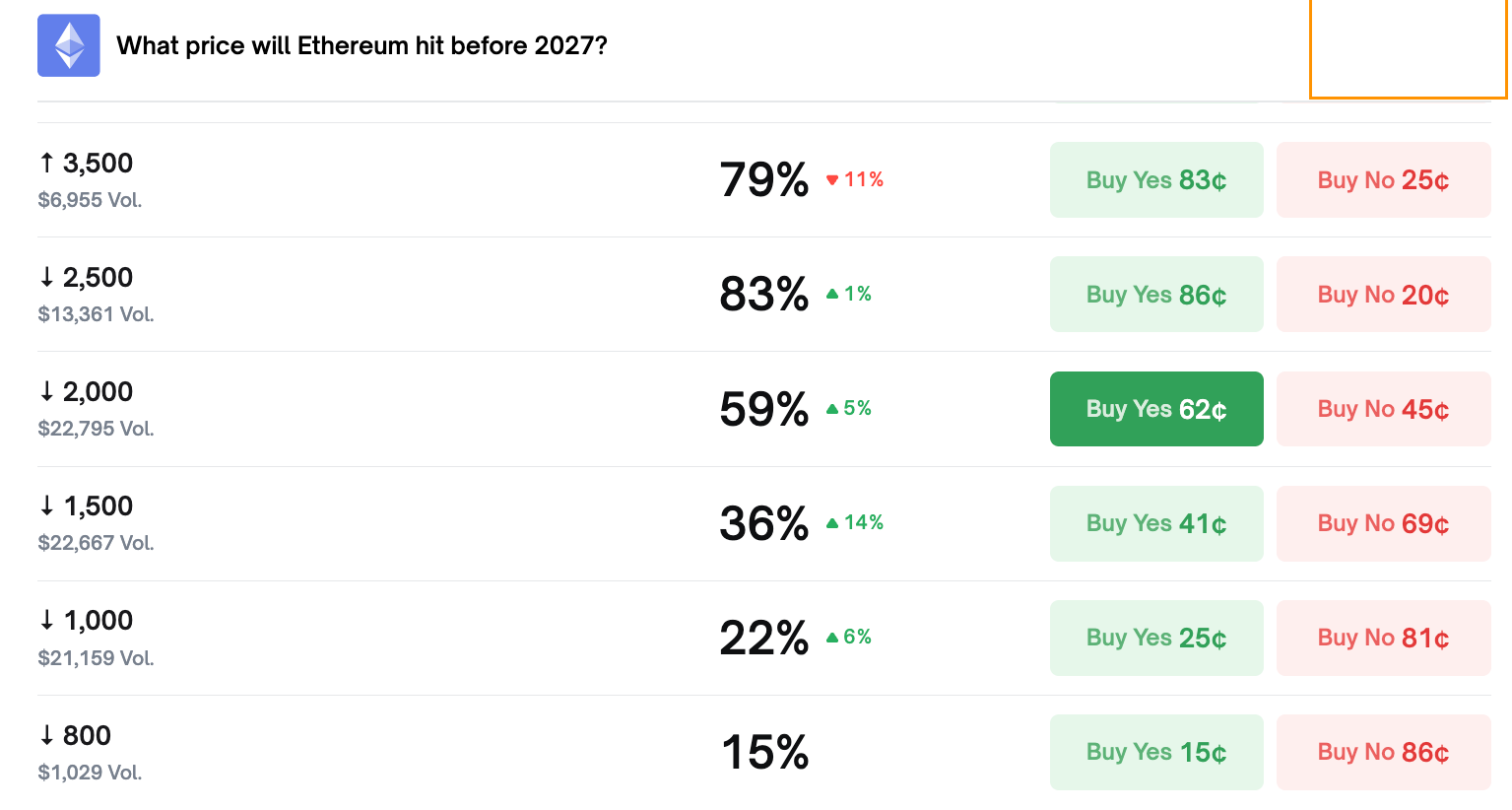
Although Polymarket bettors are pricing in only about an 11% chance of ETH dropping to $2,000-$2,200 before the end of 2025, they see an 83% chance of Ether’s price revisiting $2,500 and a 59% chance of it falling to $2,000 in 2026.

Ether’s price targets before Dec. 31, 2026. Source: Polymarket

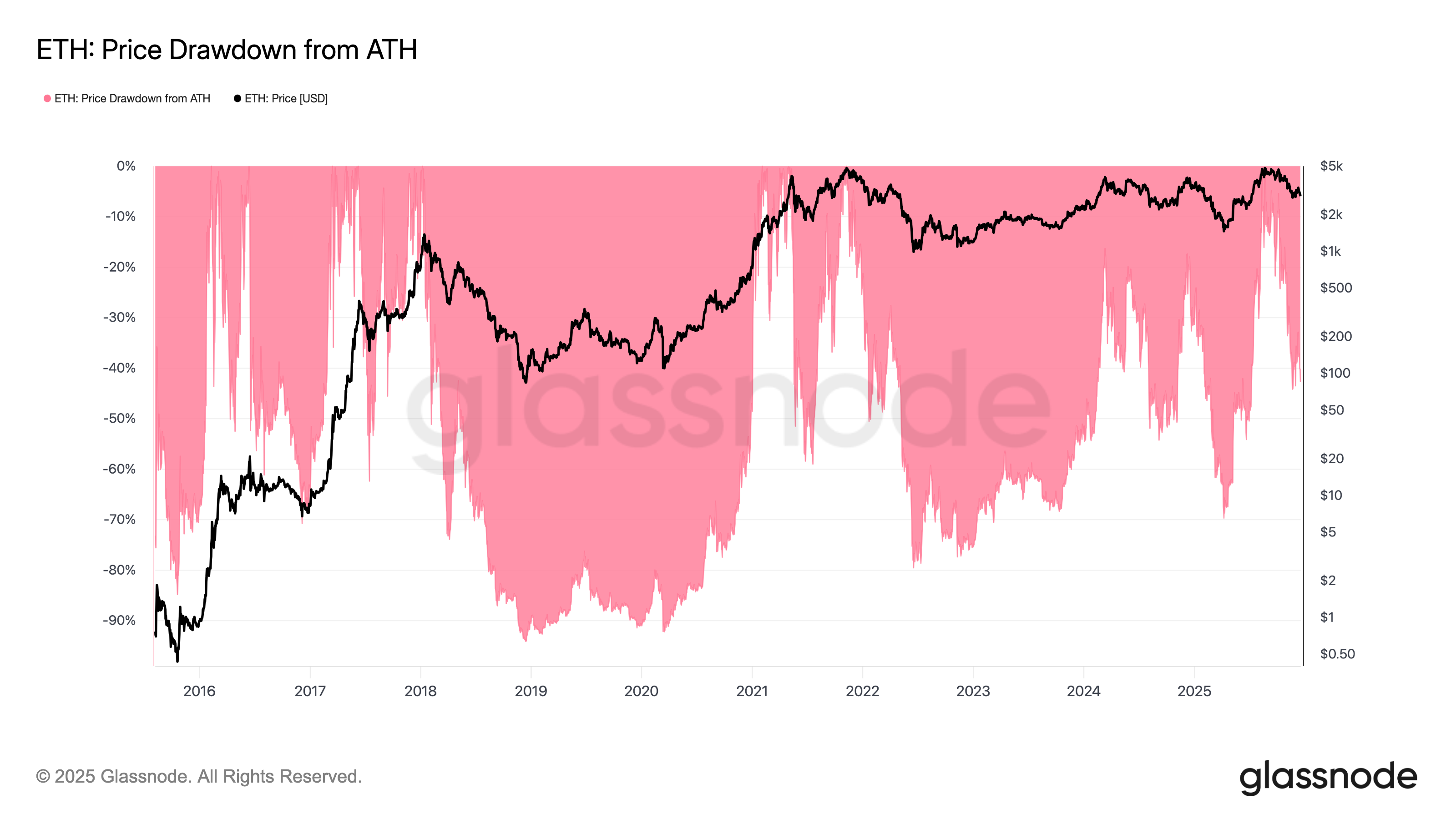
Ether’s low for 2025 is $1,380, reached in April, and the last time the ETH/USD pair traded at $2,100 was on May 9. The current 42% drawdown from all-time highs, however, is relatively shallow. Previous bear cycles bottomed after the price declined by around 80-90%.

ETH price drawdown from all-time high. Source: Glassnode

Investors de-risk from Ethereum ETFs

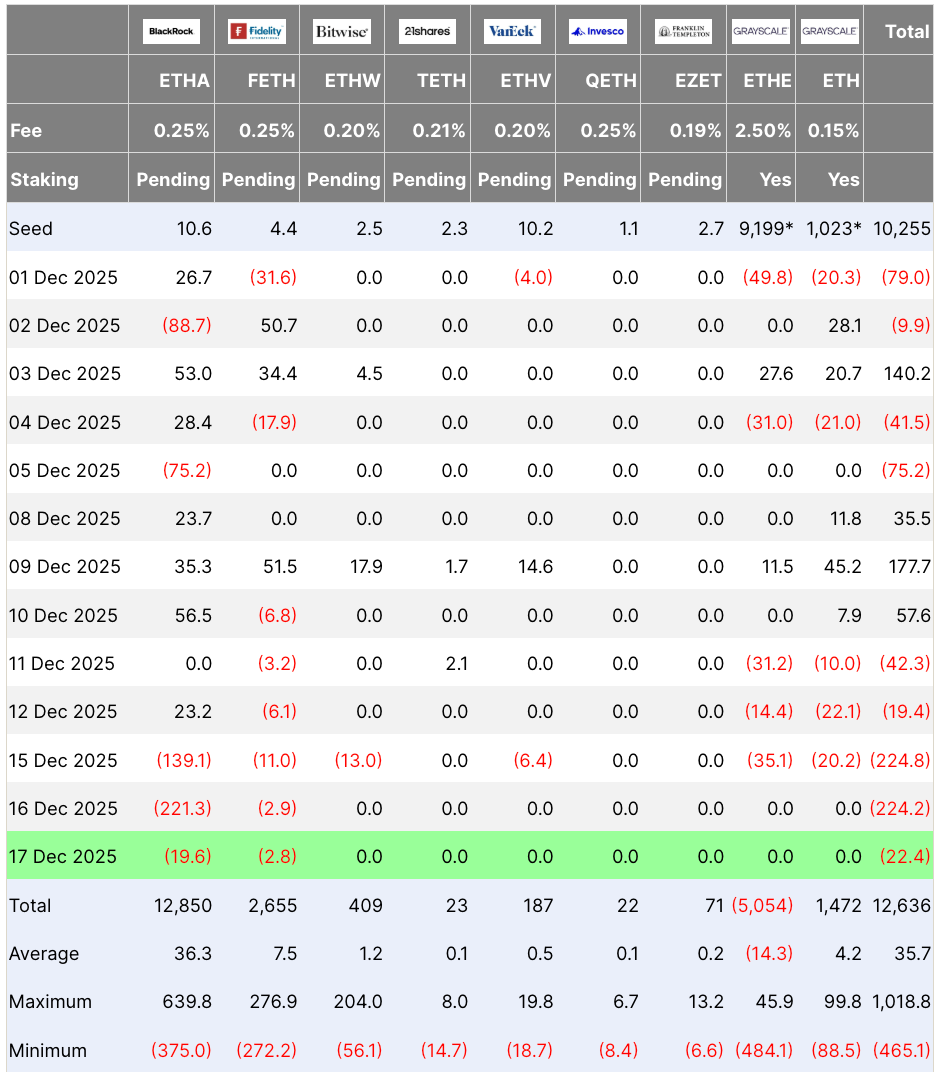
Institutional demand for US-based spot Ethereum exchange-traded funds (ETFs) has declined, according to data from Farside Investors.

These investment products posted outflows for five consecutive days, totaling $533.1 million, and reducing the assets under management to $17.34 billion.

“US-based Ethereum ETFs continue to see capital outflows,” CryptoQuant analyst IT Tech said in his latest post on X, adding:

“Investors are de-risking or quietly rotating away from ETH, suggesting no immediate comeback for Ether.”
Spot Ether ETFs flows table. Source: Farside Investors

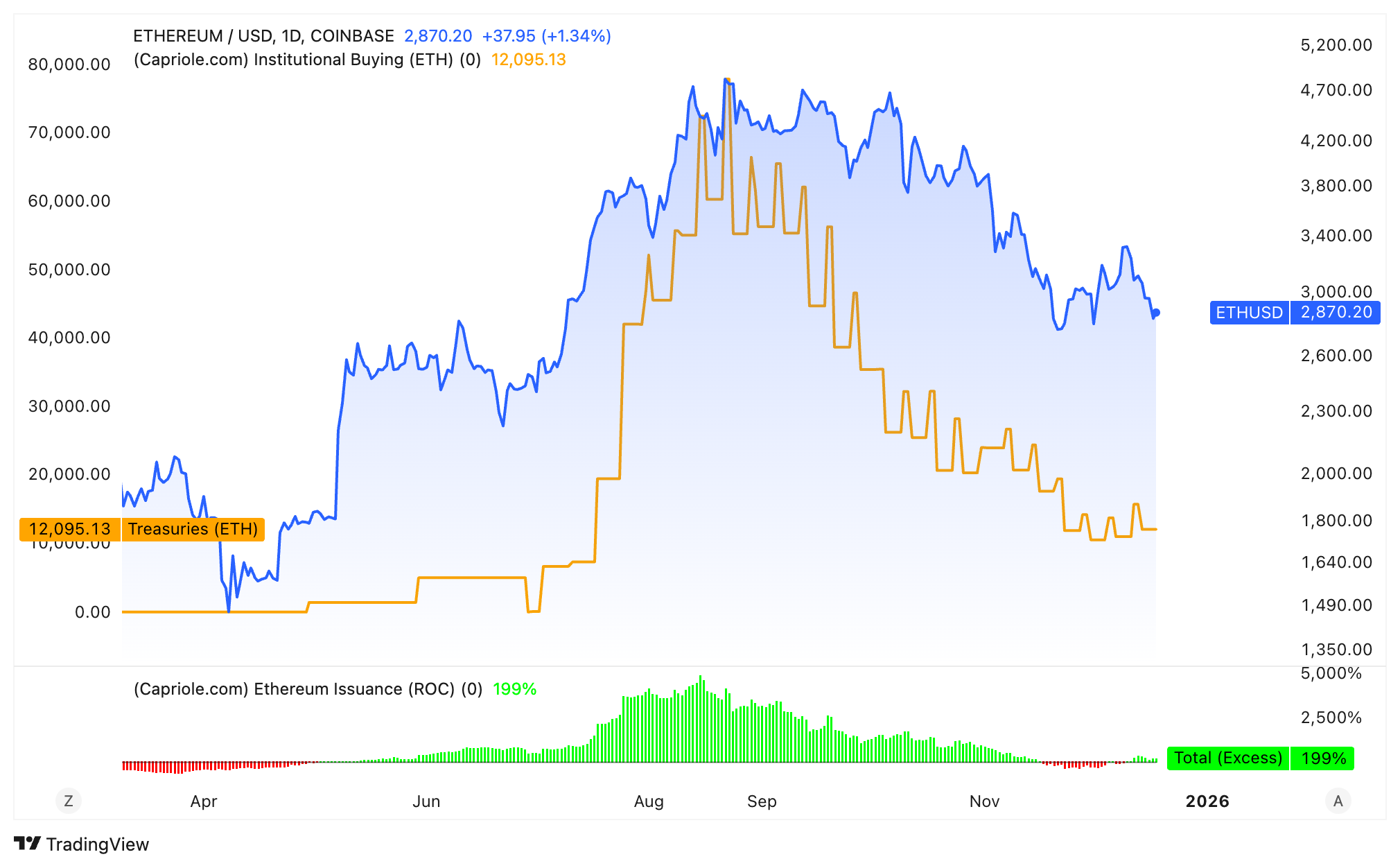
Additional data from Capriole Investments reveals that daily purchases by Ethereum treasury companies have dropped from a peak of 78,010 ETH on Aug. 23 to 12,095 ETH per day.

Ethereum: Daily rate of treasury buying. Source: Capriole Investments

Even though BitMine is accelerating its Ether buying, multiple onchain and technical indicators around the ETH have turned bearish, suggesting more pain ahead.

This article does not contain investment advice or recommendations. Every investment and trading move involves risk, and readers should conduct their own research when making a decision. While we strive to provide accurate and timely information, Cointelegraph does not guarantee the accuracy, completeness, or reliability of any information in this article. This article may contain forward-looking statements that are subject to risks and uncertainties. Cointelegraph will not be liable for any loss or damage arising from your reliance on this information.


Связанные с этим вопросы

QHow much has Ether (ETH) retraced from its all-time high, and what is the current price level mentioned?

AEther has retraced 42% from its all-time high of $4,950, and the ETH/USD pair has dropped back below $3,000.

QAccording to analyst Daan Crypto Trades, what is the potential downside target for ETH if it loses the $2,800 support?

AIf ETH loses its $2,800 support, it would likely drop toward the next major support level around $2,100.

QWhat does the data from Glassnode indicate about the support level below $2,800?

AData from Glassnode showed that the next significant support below $2,800 sits at around $2,100, where approximately 2.1 million ETH were previously acquired.

QWhat is the trend in institutional demand for US-based spot Ethereum ETFs, according to Farside Investors?

AInstitutional demand has declined, with these investment products posting outflows for five consecutive days, totaling $533.1 million, and reducing the assets under management to $17.34 billion.

QHow have daily purchases by Ethereum treasury companies changed, as revealed by Capriole Investments?

ADaily purchases by Ethereum treasury companies have dropped significantly from a peak of 78,010 ETH on Aug. 23 to 12,095 ETH per day.

Похожее

Only a 50% Chance of Passing This Year, Can the CLARITY Bill Succeed Before the Midterm Elections?

The CLARITY Act, which passed the House in July 2025 with strong bipartisan support (294-134), faces a critical juncture in the Senate. The Senate Banking Committee is expected to hold a markup soon, but key issues remain unresolved, including stablecoin yield provisions, DeFi regulations, and securing full Republican committee support. Other contentious points involve the Blockchain Regulatory Certainty Act (BRCA), ethics amendments for government officials, and SEC-related matters. The legislative calendar is tight, with limited time before the midterm elections. If the committee markup is delayed beyond mid-May, the chances of passage in 2026 drop significantly. Senator Cynthia Lummis has warned that failure this year could delay comprehensive crypto market structure legislation until 2030 or later. Galaxy estimates the probability of the CLARITY Act becoming law in 2026 is only about 50%. The bill provides crucial regulatory clarity by defining jurisdictional boundaries between the SEC and CFTC, establishing a path for decentralization, and bringing digital commodity intermediaries under federal regulation. Its passage is seen as vital before potential power shifts in the next Congress, which could bring less favorable leadership to key committees. The timeline is compressed, and the bill must compete for floor time with other priorities like Iran authorization and DHS appropriations. Key hurdles include finalizing the stablecoin yield compromise text, addressing law enforcement concerns about BRCA, and navigating political dynamics around SEC nominations. The outcome of the Banking Committee markup and the level of bipartisan support will be critical indicators of its future success.

marsbit19 мин. назад

Only a 50% Chance of Passing This Year, Can the CLARITY Bill Succeed Before the Midterm Elections?

marsbit19 мин. назад

Dialogue with Xinhuo Chief Economist Fu Peng: Macro Bear Market Expected to End This Year, Prioritize Allocation to Value Assets

Fu Peng, Chief Economist at New Huo Group, discusses the integration of crypto assets into traditional finance, marking a shift from a speculative phase to institutionalization. He highlights the current era as the second major fusion of finance and technology, driven by AI, data, and computing power, with crypto assets becoming part of the FICC+C (Fixed Income, Currencies, Commodities + Crypto) framework. Regulatory clarity in the U.S., such as the GENIUS and Clarity Acts, has paved the way for institutional adoption by defining digital assets as financial instruments. Fu views RWA (Real World Assets) as a tool for asset tokenization rather than a standalone asset class, noting that financial innovation differs between Eastern and Western markets due to cultural approaches to risk and regulation. He emphasizes that stablecoins are essential for future finance, but Asian markets, including Hong Kong, will adopt them cautiously. Macro liquidity now significantly influences crypto markets, as institutional participation increases correlation with traditional assets. Fu suggests the macro-driven bear market may end by year-end, reducing the relevance of Bitcoin’s four-year cycle. For asset allocation, he recommends value-oriented AI stocks for stability, Bitcoin for moderate certainty, and Ethereum for higher volatility.

marsbit27 мин. назад

Dialogue with Xinhuo Chief Economist Fu Peng: Macro Bear Market Expected to End This Year, Prioritize Allocation to Value Assets

marsbit27 мин. назад

Only a 50% Chance of Passing This Year, Can the CLARITY Bill Succeed Before the Midterm Elections?

The CLARITY Act, which passed the U.S. House in July 2025 with strong bipartisan support (294-134), faces a critical juncture in the Senate. The Senate Banking Committee is expected to hold a markup soon, but key issues remain unresolved, including stablecoin yield provisions, DeFi regulations, and securing full Republican committee support. Additional challenges involve the Blockchain Regulatory Certainty Act (BRCA), ethics amendments for government officials, and SEC-related concerns. Galaxy estimates only a 50% chance of the bill becoming law in 2026. The tight legislative calendar, competing priorities like Iran military authorization and DHS appropriations, and the impending midterm elections create significant time pressure. If the bill is not passed before the new Congress convenes in 2027, comprehensive crypto market structure legislation could be delayed until 2030 or later, especially if leadership changes result in less favorable committee chairs. The act provides crucial regulatory clarity by defining the jurisdictional boundaries between the SEC and CFTC, establishing a path for decentralized networks to be classified as non-securities, and bringing digital commodity intermediaries under federal regulation. The outcome of ongoing Senate negotiations, particularly the release of revised text on stablecoin yields, will be a key indicator of its future prospects.

Odaily星球日报29 мин. назад

Only a 50% Chance of Passing This Year, Can the CLARITY Bill Succeed Before the Midterm Elections?

Odaily星球日报29 мин. назад

Four-Dimensional Resonance: Hong Kong Web3 Carnival Sub-Forum Co-Creates Blueprint for Global Financial New Infrastructure

The "Four-Dimensional Resonance: 2026 Global Financial New Infrastructure" forum, a core event of the Hong Kong Web3 Festival, was successfully held at the Hong Kong Convention and Exhibition Centre. Co-hosted by Web3Labs and DeShang Singularity Tech, with joint support from Bitroot, Injective, Microsoft, and Z Oracle, the event gathered policymakers, industry leaders, and investors to explore the integration and innovation of global financial infrastructure, focusing on RWA, AI, DeFi, and compliant payments. Policy speakers, including Hong Kong Legislative Council Member Mr. Wu Jiezhuang, South Korean National Assembly Member Mr. Min Byung-duk, and ACED Chairman Mr. Yun Seok-hun, emphasized the importance of cross-border regulatory collaboration and an open policy environment for fintech innovation. Web3Labs CEO Caspar and DeShang Singularity Tech CEO Chang Shuai highlighted Hong Kong’s role as a financial innovation center and the approaching "singularity moment" for global financial infrastructure. Technical insights were shared by MagnetX, Bitroot, Microsoft, and Injective on topics including AI Agent economies, the evolution of public blockchains, and AI’s transformative role in finance. Key partnerships and initiatives were launched: - GWDC 2026 Korea collaboration between Hong Kong and South Korea. - A strategic agreement between Web3Labs and Microsoft. - The launch of a public anti-fraud alliance by Z Oracle and partners. - The "Injective Rising Star" program to support AI and Web3 projects. Panel discussions delved into AI-driven smart payments, compliant cross-border transactions, and the fusion of RWA and DeFi. Participants agreed that integrating RWA with DeFi is crucial for the next stage of financial infrastructure, enabling a shift from physical to digital finance. The forum underscored Hong Kong’s pivotal role in advancing a globalized and sustainable Asian fintech ecosystem.

marsbit38 мин. назад

Four-Dimensional Resonance: Hong Kong Web3 Carnival Sub-Forum Co-Creates Blueprint for Global Financial New Infrastructure

marsbit38 мин. назад

Торговля

Спот
Фьючерсы

Популярные статьи

Manyu: восходящая мем-звезда на Ethereum, готовая открыть новую эру культуры Shiba

Manyu - это мемтокен на Ethereum, который приносит децентрализованную культурную и развлекательную ценность через вирусное влияние в соцсетях и вовлечённость сообщества.

1.9k просмотров всегоОпубликовано 2025.11.27Обновлено 2025.11.27

Manyu: восходящая мем-звезда на Ethereum, готовая открыть новую эру культуры Shiba

Обсуждения

Добро пожаловать в Сообщество HTX. Здесь вы сможете быть в курсе последних новостей о развитии платформы и получить доступ к профессиональной аналитической информации о рынке. Мнения пользователей о цене на ETH (ETH) представлены ниже.

活动图片