Ethereum Approaching Major Capitulation Zone — On-Chain Metrics Hint At Impending Shift

bitcoinistОпубликовано 2026-03-15Обновлено 2026-03-15

Введение

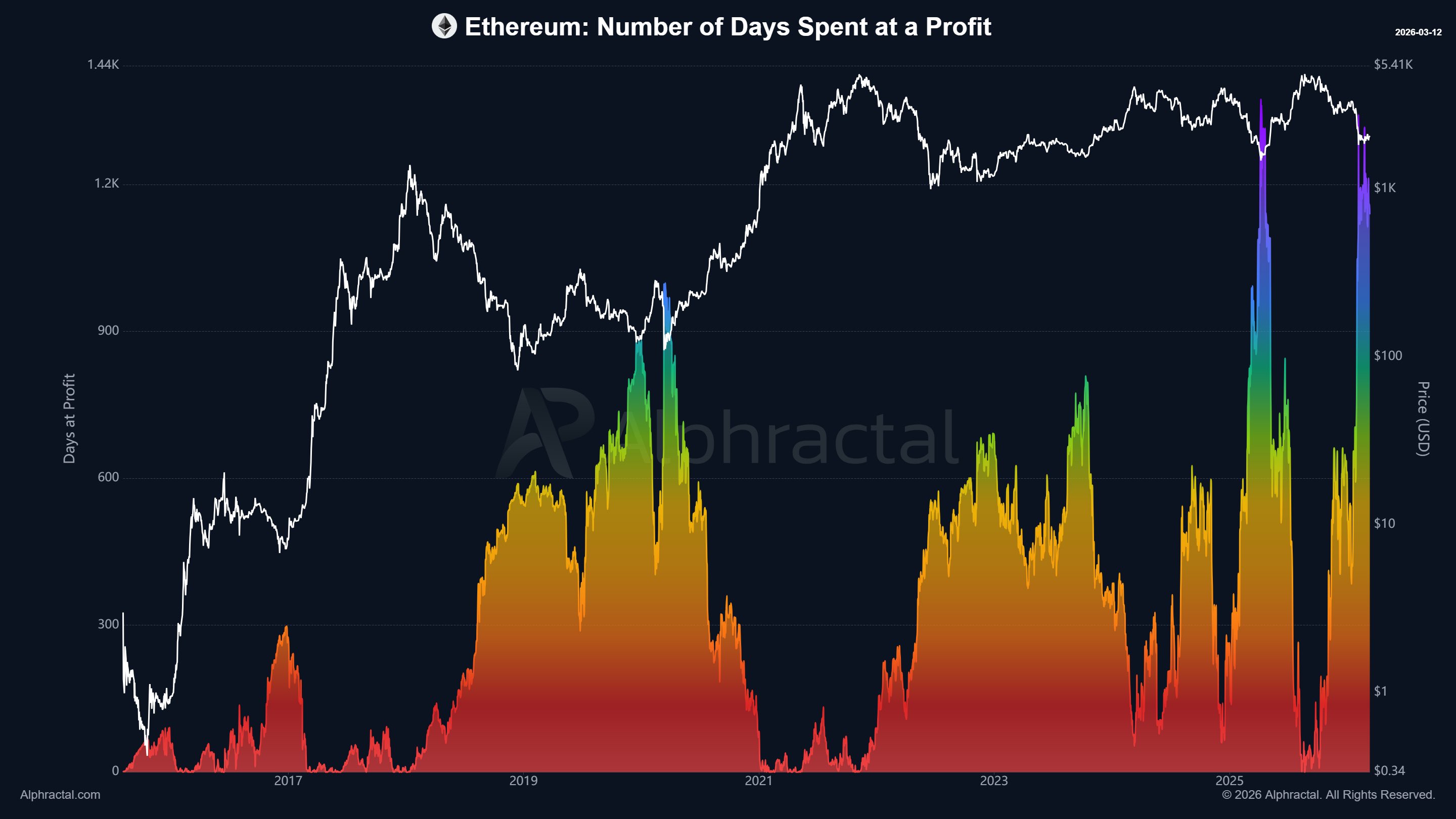
Following a period of underperformance, Ethereum has found some stability around the $2,000 level. However, on-chain analyst Boris warns that multiple metrics suggest the market is under significant stress and may be approaching a major capitulation phase. Key indicators signaling potential trouble include the Net Unrealized Profit/Loss (NUPL) metric, which is negative, indicating investors are holding unrealized losses. Furthermore, Ethereum's price is currently trading below its realized price of $2,200, meaning the average investor is at a loss. The network has also recently ended a 1,340-day streak during which most ETH tokens were in profit—a signal that often coincides with the end of a market cycle and bear market bottoms. For a market bottom to form, Boris notes the NUPL would need to move deeper into the capitulation zone. If another sell-off occurs, it could force investors to surrender their positions, creating a potential opportunity for long-term holders. At the time of writing, Ethereum's price is approximately $2,092, down over 1% in the past day.

Following a disappointing performance in February, the Ethereum price has seen some semblance of relief over the past two weeks. With the steadying market condition, the “king of altcoins” has managed to hold its own around the psychological $2,000 level.

This, expectedly, has been enough to rouse hopes in silent investors on the Ether token’s future; however, a market analyst has revealed reasons to believe that Ethereum buyers might want to sit on their hands — at least in the meantime.

Multiple Indicators Align To Reflect High Market Stress

In a recent post on the social media platform X, on-chain analyst Boris highlighted data from three metrics, showing that the Ethereum market is starting to see a surge in pressure. According to the analyst, if the present conditions persist, a capitulation phase might be on the horizon for the second-largest cryptocurrency.

The market pundit started their analysis with the Net Unrealized Profit/Loss (NUPL) metric, which measures the overall profit or loss of investors by comparing the current market value of ETH to the price at which coins last moved on-chain. Boris shared in his post that the NUPL currently sits on a negative level, suggesting that Ethereum’s investors may be holding through unrealized losses.

Another major metric cited was the Realized Price metric, which represents the average price at which all coins in circulation were last moved on-chain. Boris pointed out in his tweet that the altcoin is currently trading beneath its realized price of $2,200.

When the market falls below this level, it indicates that the average Ethereum investor is holding through losses. Hence, this on-chain signal translates as a level of pressure being felt by Ethereum’s investors, as the market price continues to fluctuate below the realized price.

Source: @Fundingvest on X

Furthermore, Boris mentioned the Number of Days Spent at a Profit metric in his analysis, saying that the Ethereum network recently ended an impressive 1,340-day streak, during which the majority of circulating Ether tokens remained profitable.

The analyst explained that this is often a signal that a market cycle has ended — a conjecture that is consistent with historical events and tends to appear close to the bottoms of bear markets.

Despite the present conditions, Boris warned that NUPL still has to move deeper towards the capitulation zone between –0.5 and –1 for a bottom to be formed. If the Ethereum price were to experience another sell-off round, the metric could enter the capitulation zone, where several investors might be forced to forfeit their positions — an event that would most likely be exploited by long-term traders (the diamond hands).

Ethereum Price At A Glance

As of this writing, the price of Ethereum stands at around about $2,092, reflecting an over 1% drop since the past day.

The price of ETH on the daily timeframe | Source: ETHUSDT chart on TradingView

Связанные с этим вопросы

QWhat are the three key on-chain metrics that analyst Boris highlighted to suggest Ethereum is approaching a capitulation zone?

AThe three key on-chain metrics are: 1) Net Unrealized Profit/Loss (NUPL), which is negative, indicating investors are holding unrealized losses. 2) The price trading below the Realized Price of $2,200, showing the average investor is at a loss. 3) The end of a 1,340-day streak where the majority of ETH tokens were profitable, a signal that a market cycle has ended.

QAccording to the analyst, what does it mean that Ethereum's NUPL is currently negative?

AA negative NUPL means that Ethereum investors, on average, are holding their coins at an unrealized loss, as the current market value is lower than the price at which those coins were last moved on-chain.

QWhat is the significance of the Ethereum price trading below its Realized Price?

AWhen the market price trades below the Realized Price, it indicates that the average investor in the market is holding their coins at a loss, which reflects significant market pressure and stress.

QWhat event did the 'Number of Days Spent at a Profit' metric recently signal, and what is its historical significance?

AThe metric recently ended a 1,340-day streak of profitability for the majority of circulating ETH. Historically, this is a signal that a market cycle has ended and often appears close to the bottoms of bear markets.

QWhat condition must the NUPL meet for a market bottom to be formed, according to the analyst's warning?

AThe analyst warned that the NUPL must move deeper into the capitulation zone, specifically between -0.5 and -1, for a market bottom to be formed. This would likely be triggered by another sell-off, forcing weaker investors to forfeit their positions.

Похожее

South Korean Stocks Plunge, Global Funds Liquidate: Has the Semiconductor Fundamentals Really Changed?

South Korean stocks experienced their sharpest decline of the year, with the KOSPI index plunging nearly 9% on Monday, triggering a market circuit breaker. Leading semiconductor firms Samsung Electronics and SK Hynix were heavily sold off, raising questions about whether the AI-driven bull market has reached an inflection point. This sell-off was largely triggered by a significant drop in the U.S. semiconductor sector late last week. Concurrently, NVIDIA CEO Jensen Huang visited Seoul over the weekend, meeting with top executives from SK Group, Samsung, LG, and NAVER. He announced a new multi-year partnership with SK Hynix to co-develop next-generation memory products for AI data centers. Huang emphasized that AI infrastructure build-out remains in its early stages, creating a stark contrast between market panic and ongoing, strengthened industry collaboration. The article argues that South Korea has become one of the most sensitive markets for global AI-related capital flows, functioning like a large AI memory ETF due to the heavy weighting of its chipmakers. The current market turmoil reflects a shift in investor focus: from simply betting on overall AI growth to scrutinizing which companies will actually capture the profits from that growth. This "profit pool reassessment" phase is causing high volatility based on supply chain news and earnings guidance. Ultimately, the direction of the Korean market will be determined by external factors—NVIDIA's orders, HBM supply-demand dynamics, and capital expenditures from cloud service providers—rather than domestic conditions. The disconnect between sharp price corrections and continued strong signals from the industry core leaves the market at a crossroads, awaiting clearer data on the durability of AI infrastructure demand.

marsbit31 мин. назад

South Korean Stocks Plunge, Global Funds Liquidate: Has the Semiconductor Fundamentals Really Changed?

marsbit31 мин. назад

Trump in Talks with AI Companies Over Profit Sharing, A Narrative Pressure of Industrial Revolution Scale Begins

In recent AI market discussions, a new dimension beyond growth and profits has emerged: the question of how the immense wealth potentially generated by AI should be shared with the wider public. Triggered by reports of White House officials discussing "voluntary equity transfers" with top AI firms, similar to models like Alaska's Permanent Fund, the conversation focuses on public wealth funds. OpenAI's own whitepaper proposes such funds, allowing households without direct tech stock ownership to benefit from AI gains. More radical proposals, like Bernie Sanders' call for high public equity stakes and board seats, represent an extreme end of the spectrum. Currently, these are early-stage policy probes, not enacted laws. OpenAI's initiative is seen as an attempt to secure "social license" for its future expansion, mitigating risks of public backlash, stricter regulation, or anti-trust actions as AI's economic impact grows. The core market implication is the introduction of a "policy discount" to AI valuations, particularly for private model companies like OpenAI, Anthropic, and xAI. Investors must now consider not just future earnings but also what portion might be allocated to public mechanisms. The impact varies greatly based on the mechanism. A small, voluntary transfer of non-voting economic rights (e.g., 5%) acts as a quantifiable long-term cost. Government acquisition of economic rights via warrants tied to support differs from direct equity with governance power. The most disruptive scenario would be forced high-percentage public ownership affecting control and innovation incentives. Key signals to watch include whether other AI companies follow suit, if the White House formalizes proposals, related disclosures in future IPO documents, and any market price reactions. For now, this represents a shift from pricing pure AI growth to pricing its potential distribution. A manageable, voluntary economic share is akin to an insurance cost for societal acceptance, while a forced shift toward control and governance would fundamentally alter valuation logic.

marsbit35 мин. назад

Trump in Talks with AI Companies Over Profit Sharing, A Narrative Pressure of Industrial Revolution Scale Begins

marsbit35 мин. назад

From Record Highs to a Two-Week Low: Why Did AI Concept Stocks Suddenly Pull Back?

From Record Highs to Two-Week Lows: Why Did AI Stocks Suddenly Pull Back? U.S. stock indices, led by the tech-heavy Nasdaq 100, fell sharply to two-week lows. This marked a reversal from earlier in the week when AI infrastructure and semiconductor stocks had propelled major indices to record highs. Investors are rotating out of these previously high-flying tech sectors into other areas. The sell-off was driven by profit-taking and concerns that the AI rally had become overextended, exacerbated by chipmaker Broadcom's sales outlook falling short of lofty market expectations. The decline accelerated following a stronger-than-expected U.S. May nonfarm payrolls report, which showed 172,000 jobs added versus an estimated 88,000. This data sparked a jump in bond yields, with the 10-year Treasury yield rising to 4.553%, as it reinforced market speculation that the Federal Reserve's next move could be a rate hike rather than a cut. Globally, equities also declined, with European and Asian markets falling. Within the U.S. market, chip and AI-related stocks like Super Micro Computer and Arm Holdings led the losses, dropping over 7%. Cryptocurrency-linked stocks and mining shares also fell sharply amid drops in Bitcoin and commodity prices. While the overall Q1 earnings season remained solid, with 83% of S&P 500 companies beating estimates, the weakness was concentrated in tech. Excluding the tech sector, Q1 earnings growth was around 3%, the weakest in two years.

marsbit36 мин. назад

From Record Highs to a Two-Week Low: Why Did AI Concept Stocks Suddenly Pull Back?

marsbit36 мин. назад

JP Morgan Mid-Year Research Report Analysis: The AI Supercycle is Not Over, Reduce Cash Holdings + Allocate to Real Assets

JP Morgan's 2026 Mid-Year Outlook argues the AI supercycle is far from over, despite market pessimism. The report advises clients to reduce cash holdings, increase allocations to real assets as an inflation hedge, and focus on emerging markets. Key conclusions include: 1. **AI Supercycle Intact**: Hyperscalers' 2026 capex forecasts exceed $650B, with AI contributing to GDP growth. However, their financial profile is shifting toward heavy investment, compressing free cash flow. 2. **SaaS Disruption**: Traditional software companies are being negatively impacted by AI, with significant stock declines and pressure in credit markets. 3. **Persistent Inflation**: Core inflation is structurally higher post-pandemic. Holding excess cash and bonds leads to real wealth erosion. Recommendations include commodities, infrastructure, real estate, and gold. 4. **Geopolitical Shocks & Opportunities**: The Hormuz Strait blockade caused a major oil shock, but JP Morgan views the subsequent equity market pullback as a buying opportunity. "Fragmentation" is creating pockets of value, notably in resource-rich Latin America, AI-supply-chain-linked East Asia, and deeply discounted Chinese equities, where a policy shift could trigger a re-rating. 5. **Regional Views**: The firm is cautious on Europe due to high energy costs and lower innovation investment, preferring US and select EM exposures. In short, JP Morgan sees market volatility as an entry point but recommends a portfolio pivot: favor AI infrastructure, real assets, and EM, while avoiding excess cash, vulnerable software firms, and traditional 60/40 stock-bond allocations.

marsbit1 ч. назад

JP Morgan Mid-Year Research Report Analysis: The AI Supercycle is Not Over, Reduce Cash Holdings + Allocate to Real Assets

marsbit1 ч. назад

Торговля

Спот
Фьючерсы

Популярные статьи

Manyu: восходящая мем-звезда на Ethereum, готовая открыть новую эру культуры Shiba

Manyu - это мемтокен на Ethereum, который приносит децентрализованную культурную и развлекательную ценность через вирусное влияние в соцсетях и вовлечённость сообщества.

1.9k просмотров всегоОпубликовано 2025.11.27Обновлено 2025.11.27

Manyu: восходящая мем-звезда на Ethereum, готовая открыть новую эру культуры Shiba

Неделя обучения по популярным токенам 14: Glamsterdam — самое ожидаемое обновление Ethereum в 2026 году

Ordinals/Runes по-прежнему стимулируют доходы от комиссий за блоки и активность разработчиков, рассматриваются как отправная точка «нативной эмиссии активов» в сети.

1.5k просмотров всегоОпубликовано 2026.04.29Обновлено 2026.04.29

Неделя обучения по популярным токенам 14: Glamsterdam — самое ожидаемое обновление Ethereum в 2026 году

Обсуждения

Добро пожаловать в Сообщество HTX. Здесь вы сможете быть в курсе последних новостей о развитии платформы и получить доступ к профессиональной аналитической информации о рынке. Мнения пользователей о цене на ETH (ETH) представлены ниже.

活动图片