ETC Olympia Development Part 1: Implementing ECIP-1111 and ECIP-1112

金色财经Опубликовано 2025-12-12Обновлено 2025-12-12

Введение

ETC Olympia Development Series Part 1: Implementing ECIP-1111 and ECIP-1112 This article introduces the first part of the Ethereum Classic Olympia development series, focusing on the implementation of ECIP-1111 and ECIP-1112. These two proposals are the only components within the broader Olympia framework that modify consensus behavior. ECIP-1111 modernizes the fee market by introducing an EIP-1559-style mechanism with a base fee and optional priority tip (miner tip). A key difference from Ethereum is that the base fee is not burned but is instead redirected to a treasury address defined by ECIP-1112. It also adds support for Type-2 transactions and the BASEFEE opcode (0x48), ensuring compatibility with modern EVM tooling and wallets. Crucially, it does not change miner rewards, monetary policy, or existing transaction types. ECIP-1112 defines an immutable, deterministic treasury smart contract that will receive the redirected base fees. This vault is designed to be receive-only upon activation, meaning it can accumulate value but cannot distribute funds until a separate, subsequent governance layer (defined in other ECIPs) is deployed and activated on the contract layer. The article emphasizes the modular architecture of Olympia. While the suite includes five ECIPs (1111-1115), only these two affect consensus. This separation ensures that the core protocol remains minimal and auditable, while future governance and funding mechanisms can evolve independently at the contra...

Ethereum Classic Core Developers - Olympia Development Series (Part 1)

Implementing ECIP-1111 and ECIP-1112: Base Fee Redirection and the Immutable Treasury

1. Introduction - From Concept to Code

This section provides an overview of the overall architecture of Olympia: its purpose, development history, and how ECIPs 1111-1115 fit into the modular, multi-layer upgrade path. This article will delve into the current engineering practices for two ECIPs, which together define the consensus boundaries of Olympia:

  • ECIP-1111 — EVM and Protocol Upgrades

  • ECIP-1112 — Immutable Treasury Contract

These two proposals are the only components in Olympia that modify consensus behavior. Other parts of the framework—governance (ECIP-1113), funding proposals (ECIP-1114), and the optional smoothing mechanism (ECIP-1115)—all operate at the contract layer and do not affect block validity or fork choice. On November 11, 2025, Ethereum Classic core developers initiated the implementation phase, preparing consensus logic and reference client infrastructure for a potential Mordor testnet deployment.

This article outlines:

  • What ECIP-1111 introduces

  • How ECIP-1112 defines the treasury target address

  • How these components work together

  • What is currently being prototyped in reference client development

This article only describes design proposals and implementation work and does not indicate that they will necessarily be activated or adopted in the future through the ECIP-1000 process. Before deploying the consensus layer changes of ECIP-1111 or ECIP-1112 to Mordor or the mainnet, ETC clients must first verify their stability and compatibility under baseline conditions.

2. ECIP-1111 — Modernizing the Fee Mechanism, Minimizing Network Disruption

ECIP-1111 integrates two widely adopted EVM improvements:

  • EIP-1559-style fee mechanism (Base Fee + optional tip) This mechanism introduces:

  • A dynamically adjusting base fee (BASEFEE),

  • An optional high-priority fee (tip) still paid directly to miners

  • And a more predictable fee market for modern tools.

2. Support for Type-2 (1559-style) transactions: This functionality has become standard for most wallets and infrastructure.

3. BASEFEE opcode (0x48): This exposes the current block's BASEFEE to contract logic (gas estimators, DEX routers, toolchains, etc.).

What changes for Ethereum Classic (ETC)?

Only one behavior differs from the Ethereum mainnet:

  • Ethereum Foundation (ETH): BASEFEE is burned.

  • Ethereum Classic (ETC): BASEFEE is redirected to the treasury defined by ECIP-1112. All other EIP-1559 semantics remain unchanged.

What remains the same?

  • Miner tips remain unchanged.

  • Block rewards remain unchanged.

  • Monetary policy (ECIP-1017) remains unchanged.

  • Traditional transaction types (Type-0 and Type-1) remain fully valid.

  • Existing contracts will not break; existing applications require no modifications.

  • No additional trust assumptions or permission mechanisms are introduced.

ECIP-1111 is additive, minimal, and strictly limited to modernizing the fee mechanism and enabling the BASEFEE redirection function.

3. ECIP-1112 — The Immutable Deterministic Treasury

ECIP-1112 defines the receiving address for the redirected base fees: a minimal, immutable smart contract deployed at a deterministic address. These definitions remain theoretical until client software demonstrates consistent behavior in a multi-client environment, a milestone requiring comprehensive testing to safely assess the Olympia components.

Core Features

  • Immutability: No upgrade key, no admin, no proxy pattern.

  • Deterministic address (e.g., via CREATE2): All clients agree on the same treasury destination.

  • Receive-only upon activation: The treasury can accumulate value but cannot release funds until subsequent governance is activated.

  • No internal governance logic: Purely a custody layer, not a decision-making layer.

Upon activation (testnet or mainnet):

  • The treasury can only receive funds.

  • No withdrawal mechanism is enabled until ECIP-1113 and ECIP-1114 are deployed, audited, and intentionally activated. This separation ensures predictability for consensus upgrades and makes them independent of the implementation of any governance scheme.

4. Clear Consensus Boundaries

Although Olympia comprises five ECIP proposals, only ECIP-1111 and ECIP-1112 change consensus behavior.

Consensus Boundary Summary

  • ECIP-1111 — Protocol layer. Introduces consensus changes: new base fee mechanism, Type-2 transactions, and the BASEFEE opcode.

  • ECIP-1112 — Protocol/Contract layer. Introduces consensus changes: defines the deterministic treasury receiving address for redirected base fees.

  • ECIP-1113 — Contract/Application layer. No consensus changes.
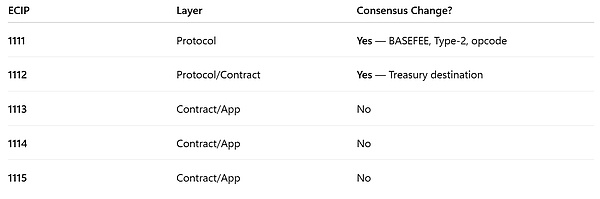
  • ECIP-1114 — Contract/Application layer. No consensus changes.

  • ECIP-1115 — Contract/Application layer. No consensus changes.

This modular structure ensures:

  • Consensus-critical logic remains lean and auditable,

  • Governance and funding mechanisms can evolve at the contract layer,

  • Improvements to ECIP-1113 to 1115 require no additional consensus changes.

If adopted, clients implementing ECIP-1111 and ECIP-1112 will maintain consensus compatibility, unaffected by subsequent governance layer deployments. Reference implementations can begin prototyping consensus logic during the draft stage, but these changes must undergo comprehensive testing (including baseline client validation such as the Gorgoroth verification described in Part II) before being merged into production clients.

5. Why Governance Activation is Delayed

If ECIP-1111 and ECIP-1112 are activated, base fees will begin flowing into the treasury—but treasury spending will remain disabled.

This phased deployment enables:

  • Independent testing of base fees

  • Comprehensive auditing of ECIP-1113 and ECIP-1114

  • Precise coordination among client implementers and infrastructure providers

  • Predictable behavior for node operators

If governance contracts are subsequently deployed and activated, the treasury will connect with authorized executors entirely at the contract layer (not the consensus layer).

6. Type-2 Transactions and Long-term EVM Interoperability

Type-2 transaction support is crucial for Ethereum Classic to maintain compatibility with:

  • Modern wallets

  • Exchanges and custody services

  • RPC infrastructure

  • Tooling frameworks (Hardhat, Foundry, etc.)

  • Block explorers

  • Cross-chain interoperability

Type-2 transactions do not alter user requirements or introduce permission mechanisms. Traditional transaction types will remain fully supported.

Type-2, as an incremental feature, ensures ETC maintains interoperability with the mainstream transaction format of the EVM ecosystem.

7. The Broader Context — Maintaining a Programmable Proof-of-Work Base Layer

Together, ECIP-1111 and ECIP-1112 constitute a foundational step for Ethereum Classic towards a sustainably funded, operational model for programmable proof-of-work—provided the community chooses to adopt these proposals.

These proposals achieve their goals without:

  • Modifying miner incentives

  • Introducing inflation

  • Changing monetary policy

  • Adding a governance layer to consensus

  • Altering Ethereum Classic's security assumptions

Their purpose is limited to:

  • Modernizing the fee market

  • Establishing a transparent protocol-level value accrual mechanism

If adopted, these changes will pave the way for the contract-layer governance and funding systems in subsequent Olympia proposals, without requiring new consensus rules.

8. Conclusion — Minimal, Secure, and Forward-Compatible

ECIP-1111 and ECIP-1112 define the consensus layer components proposed within the Olympia framework. They:

  • Add Type-2 and base fee mechanisms

  • Redirect the base fee to a deterministic treasury

  • Keep all existing user and miner behavior unchanged

  • Prepare ETC for future contract-layer components

These proposals do not introduce governance logic into the consensus mechanism, nor do they add trust assumptions on top of the existing EIP-1559/EIP-3198 semantics. Their aim is to preserve the conservatism of ETC's core protocol and EVM ecosystem compatibility, while enabling sustainable value flows at the contract layer.

9. ECIP Process Clarity

The Olympia ECIP specifications (1111–1115) are currently in the draft stage and under active discussion. Reference clients have initiated early implementation work on ECIP-1111 and ECIP-1112, which is fully consistent with the provisions of the ECIP-1000 draft stage. Reference implementations will only be considered for mainnet activation after testing on the Mordor testnet is completed. After testnet results are qualified, ECIP proposers may submit specification update proposals. Any decision to advance to "Accepted" status or schedule mainnet activation must undergo community review and the full ECIP-1000 evaluation process. This article outlines the design and implementation work being advanced during the draft stage.

10. What's Next in the Series

With the consensus design framework established, the next installment will focus on the client layer—the Fukuii alpha testing plan is about to launch, aiming to validate ETC client interoperability before Olympia integrations.

Disclaimer: The content of this article does not constitute any investment or financial advice. The content is reproduced from EthereumClassic and is for industry information reference only. If you have questions or copyright issues, please contact us for removal.


Связанные с этим вопросы

QWhat are the two ECIPs that modify consensus behavior in the Olympia upgrade series?

AECIP-1111 (EVM and Protocol Upgrades) and ECIP-1112 (Immutable Vault Contract) are the two proposals that modify consensus behavior.

QHow does the handling of the BASEFEE differ between Ethereum (ETH) and Ethereum Classic (ETC) under ECIP-1111?

AOn Ethereum (ETH), the BASEFEE is burned. On Ethereum Classic (ETC), the BASEFEE is redirected to the treasury defined by ECIP-1112.

QWhat is the core purpose of the vault defined in ECIP-1112 at the time of its initial activation?

AAt activation, the vault is receive-only; it can accumulate value but has no mechanism to withdraw or release funds until governance proposals (ECIP-1113 and ECIP-1114) are deployed, audited, and intentionally activated.

QWhich components of the Olympia series operate purely at the contract/application layer without changing consensus rules?

AECIP-1113 (Governance), ECIP-1114 (Funding Proposals), and ECIP-1115 (Optional Smoothing Mechanism) operate at the contract/application layer and do not change consensus behavior.

QWhat is the stated goal of implementing Type-2 (EIP-1559-style) transactions on Ethereum Classic?

AThe goal is to ensure interoperability with the broader EVM ecosystem, including modern wallets, exchanges, RPC infrastructure, development frameworks, and block explorers, by supporting a mainstream transaction format.

Похожее

Humanity Loses $31 Million, a Private Key Causes Token Price to Plunge 90%

On June 9th, the digital identity project Humanity Protocol suffered a major security breach resulting in over $31 million stolen from hundreds of wallets holding its H token. The attack was caused by the compromise of a private key belonging to a foundation member, leading the team to advise users against interacting with its bridge or liquidity pools. Following the incident, the price of the H token plummeted by over 90%, from around $0.70 to a low of $0.052, wiping out a significant portion of its market capitalization. The attacker allegedly minted 100 million new H tokens and began selling them for BNB. Humanity Protocol, founded in 2024, aimed to verify human users through palm-print biometrics and zero-knowledge proofs on Polygon CDK. Despite raising $50 million across two funding rounds and achieving a unicorn valuation, the project faced prior controversies. Shortly after its June 2025 token launch, reports emerged that only about 1 million of its 9 million registered IDs had completed biometric verification, suggesting 88% might be bots. Furthermore, allegations surfaced that the project might be a rebranded "shell" of a Chinese access control company, raising concerns about data privacy and authenticity. The project's founder, Terence Kwok, has a controversial business history. His previous venture, Tink Labs, burned through $170 million in funding before collapsing in 2020. The breach highlights the persistent critical risk of private key management in crypto. With no user compensation plan detailed in the initial response, the incident deals a severe blow to trust in a project already struggling with credibility issues.

Foresight News15 мин. назад

Humanity Loses $31 Million, a Private Key Causes Token Price to Plunge 90%

Foresight News15 мин. назад

How to Conduct Deep Research Using Claude's Dynamic Workflows

The article "How to Use Claude's Dynamic Workflows for Deep Research" discusses overcoming the pitfalls of technical research, where both humans and AI can get overwhelmed by information, leading to vague conclusions. It introduces Claude Code's new "Dynamic Workflows" feature, which automatically designs and executes task-specific workflows before starting a task, unlike simpler "planning modes." This approach incorporates validation, result convergence, and adversarial verification from the outset. The core of Dynamic Workflows is six predefined scheduling patterns that address how to decompose tasks and synthesize results: 1. **Classify-and-Act (Routing):** An agent classifies the task and routes it to the most suitable specialist agent for execution. It's precise and efficient but struggles with ambiguous tasks. 2. **Fan-out & Merge:** The task is split into parallel, independent subtasks whose results are later merged. It's fast and isolates contexts but is more expensive and challenging to synthesize. 3. **Adversarial Verification:** Multiple "challenger" agents critique a worker agent's conclusion, requiring majority approval. This counters confirmation bias and self-assessment errors but relies on verifiable facts. 4. **Generate & Filter:** Multiple agents generate many candidate solutions, which are then filtered against a rubric to output only the best. It fosters diversity but depends heavily on the filter's quality. 5. **Tournament:** Multiple agents compete on the same task, with pairwise comparisons eliminating contestants over rounds to select the best. This offers stable relative judgment but is complex. 6. **Loop:** An agent iteratively attempts a task, learning from errors and adjusting until a stop condition is met. It handles tasks with unknown scope but risks infinite loops without proper design. The author compares their own custom deep-research system, which involved multi-agent analysis and deduplication but lacked goal-oriented convergence, to Claude's built-in workflow. The official workflow adds critical layers: initial problem decomposition, credibility assessment of sources, cross-agent voting to delete weak conclusions (not just averaging), and output tightly focused on the user's original goals and actionable recommendations. This structurally addresses common AI issues like goal drift, premature stopping, context pollution, and output bias. In summary, Dynamic Workflows represent a shift from smarter single conversations to a structured research process, compressing what used to require many dialogues into 3-4 interactions, albeit at higher token cost. The author notes remaining challenges for their specific domain (blockchain research): the need for fact-based verification over official documentation, depth in truly novel interdisciplinary thinking, the practical validation of proposed solutions, and tailoring information density to the audience.

marsbit25 мин. назад

How to Conduct Deep Research Using Claude's Dynamic Workflows

marsbit25 мин. назад

When LPs Teach Me Investment with Doubao: A Self-Narrative of a Private Equity GP Switching Careers

When LPs Use Doubao to Teach Investing: A Transition Story of a Private Equity GP AI is making life increasingly difficult for small private equity fund managers, as a former GP of an offshore dollar fund reveals. The fund, managing tens of millions in US stocks, outperformed the Nasdaq but struggled with fundraising. Its traditional Cayman SPC/BVI structure failed to attract major Asian LPs, who now prefer Hong Kong LPF or Singapore VCC frameworks. The rise of AI-powered quantitative strategies has further squeezed the space for funds like his, which relied on subjective, discretionary investing. AI tools have leveled the information playing field, empowering LPs—often high-net-worth individuals, entrepreneurs, or family offices—to analyze investments themselves using chatbots like Doubao. This has eroded trust in GPs' expertise, leading to more frequent challenges over investment decisions and even withdrawals, especially during market rallies when retail investors sometimes outperform funds. Friction arises not necessarily from AI's capabilities but from how LPs use it. Many rely on conversational AI for validation rather than rigorous analysis, sometimes receiving misleading or hallucinated advice. While AI democratizes research, effective investing still requires discerning real insight from plausible-sounding output. Ultimately, AI is unlikely to fully replace GPs. Asset management remains a trust-based service. However, the industry must adapt. The future may see "human私募" (private equity) learning from AI and focusing more on providing value beyond pure analysis—perhaps by mastering the emotional intelligence and trust-building that machines cannot replicate.

Odaily星球日报53 мин. назад

When LPs Teach Me Investment with Doubao: A Self-Narrative of a Private Equity GP Switching Careers

Odaily星球日报53 мин. назад

Wang Chuan: After Investing in Storage Stocks and Seeing a Thirty-Fold Return, How to Remain Unanxious (Part 7) - A Quarter-Century Cycle

Wang Chuan: Reflections on Investment Anxiety and Market Cycles After Observing a 30x Gain in a Storage Stock (Part 7) – A Quarter-Century Cycle This article examines the cyclical nature and inherent risks in technology hardware investments, using the storage and semiconductor sectors as examples. It criticizes the misleading practice of "annualized" Net Dollar Retention (NDR) rates, where short-term growth is extrapolated unrealistically. A key concept explored is "reflexivity" – demand driven by panic, exploration, and liquidity during market booms, which can vanish just as quickly when conditions reverse. This reflexivity exists both in product demand and among speculative stock buyers, creating powerful feedback loops that inflate prices during upturns and exacerbate crashes during downturns. The author highlights a major risk for hardware sectors: unlike assets with defined cycles (e.g., Bitcoin's halving), there's no guarantee of a swift recovery post-crash. Companies like Micron, Intel, and Cisco took roughly a quarter-century to surpass their 2000 highs, enduring drawdowns exceeding 80%. This is attributed to the "bullwhip effect" in supply chains, where demand collapses instantly but过剩产能 persists, and a migration of narrative-driven capital. High-valuation stories吸引 speculative funds during growth phases, but these funds quickly depart for the next hot narrative once growth slows, leaving behind stronger companies with much lower valuations. The piece warns of dangerous mental models formed during bull markets: 1) equating current strong demand with perpetual high growth, and 2) believing that making fast, large profits is easy. Citing巴菲特, the author notes that easy money undermines rationality, likening speculators to Cinderella at a ball with a clock that has no hands. The current phase presents an asymmetric risk-reward scenario: potential for further gains exists, but the downside risk is an 80%+ drawdown and a multi-decade wait for breakeven, which reflexive speculators cannot tolerate. The hypothetical investor "老王" (Lao Wang), who achieved a 30x return, is used to illustrate potential pitfalls. Leverage could lead to a wipeout during a sharp correction. Even without leverage, ingrained beliefs in easy money would likely lead him to double down after losses, expecting a quick rebound. Instead, he might face a protracted decline, depleting his resources through frantic trading as the high-growth narrative fades. The conclusion references Schopenhauer, comparing those who have seen multiple market cycles to an audience seeing the same magic trick repeatedly—once the illusion is understood, its power is gone.

marsbit1 ч. назад

Wang Chuan: After Investing in Storage Stocks and Seeing a Thirty-Fold Return, How to Remain Unanxious (Part 7) - A Quarter-Century Cycle

marsbit1 ч. назад

Торговля

Спот
Фьючерсы

Популярные статьи

Как купить ETC

Добро пожаловать на HTX.com! Мы сделали приобретение Ethereum Classic (ETC) простым и удобным. Следуйте нашему пошаговому руководству и отправляйтесь в свое крипто-путешествие.Шаг 1: Создайте аккаунт на HTXИспользуйте свой адрес электронной почты или номер телефона, чтобы зарегистрироваться и бесплатно создать аккаунт на HTX. Пройдите удобную регистрацию и откройте для себя весь функционал.Создать аккаунтШаг 2: Перейдите в Купить криптовалюту и выберите свой способ оплатыКредитная/Дебетовая Карта: Используйте свою карту Visa или Mastercard для мгновенной покупки Ethereum Classic (ETC).Баланс: Используйте средства с баланса вашего аккаунта HTX для простой торговли.Третьи Лица: Мы добавили популярные способы оплаты, такие как Google Pay и Apple Pay, для повышения удобства.P2P: Торгуйте напрямую с другими пользователями на HTX.Внебиржевая Торговля (OTC): Мы предлагаем индивидуальные услуги и конкурентоспособные обменные курсы для трейдеров.Шаг 3: Хранение Ethereum Classic (ETC)После приобретения вами Ethereum Classic (ETC) храните их в своем аккаунте на HTX. В качестве альтернативы вы можете отправить их куда-либо с помощью перевода в блокчейне или использовать для торговли с другими криптовалютами.Шаг 4: Торговля Ethereum Classic (ETC)С легкостью торгуйте Ethereum Classic (ETC) на спотовом рынке HTX. Просто зайдите в свой аккаунт, выберите торговую пару, совершайте сделки и следите за ними в режиме реального времени. Мы предлагаем удобный интерфейс как для начинающих, так и для опытных трейдеров.

550 просмотров всегоОпубликовано 2024.03.29Обновлено 2026.06.02

Как купить ETC

Обсуждения

Добро пожаловать в Сообщество HTX. Здесь вы сможете быть в курсе последних новостей о развитии платформы и получить доступ к профессиональной аналитической информации о рынке. Мнения пользователей о цене на ETC (ETC) представлены ниже.

活动图片