ERC-8004 Launch: Issuing ID Cards for AI, Ethereum's New Business?

marsbitОпубликовано 2026-01-28Обновлено 2026-01-28

Введение

Ethereum is set to launch ERC-8004, a new standard referred to as "Trustless Agents," which aims to provide on-chain digital identities for AI Agents. The initiative, backed by the Ethereum Foundation and supported by companies like Google, Coinbase, and MetaMask, introduces three core registries: an identity registry (using ERC-721 NFTs to verify AI Agents), a reputation registry (tracking historical performance), and a verification registry (for third-party audits). The goal is to establish trust between AI Agents operating on-chain, enabling them to securely interact, execute transactions, and manage assets without human intervention. This move is seen as Ethereum’s strategic response to its declining dominance in the AI Agent space, where platforms like Solana and Base currently lead in adoption due to lower fees and higher throughput. However, the immediate practical need for such a standard is questioned, as most current AI Agents operate within trusted platforms and lack the cross-protocol autonomy that ERC-8004 targets. The standard is viewed as a forward-looking effort to position Ethereum as the trust layer for future AI economies, though its broader impact remains uncertain.

Author: Deep Tide TechFlow

On January 28, Ethereum officially announced that the ERC-8004 protocol is about to launch on the mainnet.

We mentioned this standard in our article last October. If you are completely unfamiliar with it, you can refer here: "x402 Gradually Becoming Inward-Looking, Exploring New Asset Opportunities in ERC-8004 in Advance"

Actually, it has a formal name: "Trustless Agents." In plain language, it roughly means:

Issuing on-chain ID cards for AI Agents.

The Ethereum Foundation rarely promotes an ERC standard so vigorously. They specifically formed a team called dAI, included ERC-8004 in the 2026 strategic roadmap, collaborated with Google, Coinbase, and MetaMask to draft the proposal, and even hosted a Trustless Agents Day at DevConnect in November to build momentum.
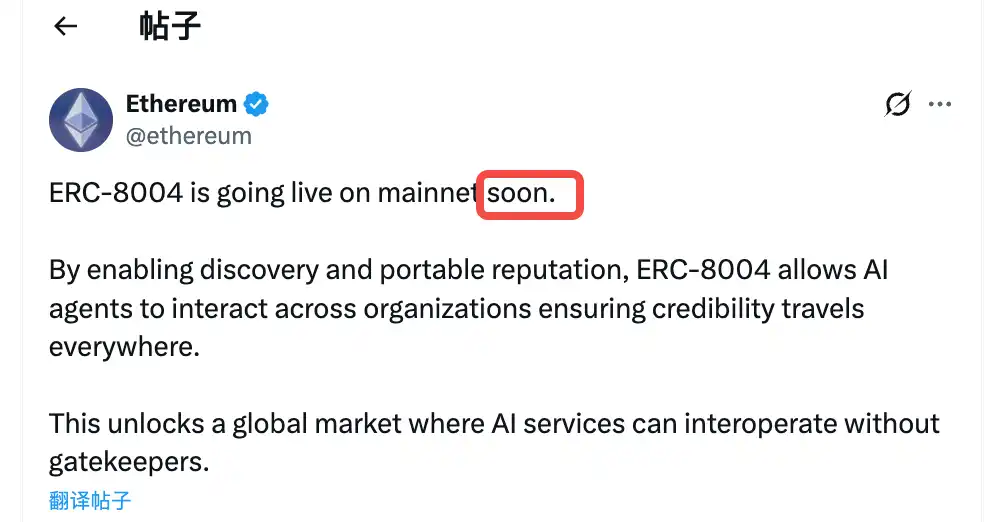
The last time Ethereum was this serious about promoting a standard was with ERC-20 and ERC-721.

One defined tokens, the other defined NFTs.

Now it's AI's turn?

Ethereum's AI Anxiety

Why the rush?

Look at some data. According to statistics from Cookie.fun, the market cap distribution of AI Agent tokens shows that Solana and Base together account for 96%. There are only a handful of notable AI Agent projects on the Ethereum mainnet.

In April 2025, the ETH/BTC exchange rate fell to 0.017, a five-year low. Back then, everyone said Ethereum was not the future.

During the DeFi boom, Ethereum was the main stage. During the NFT boom, Ethereum was also the main stage. Now that AI Agents are heating up, the main stage has changed hands.

Solana processes 36 million transactions per day, while the Ethereum mainnet handles 1.13 million. High gas fees and slow speeds have developers voting with their feet. Virtuals Protocol launched on Base, ai16z (now ElizaOS) chose Solana, and even Coinbase's own AI project wasn't placed on the Ethereum mainnet.

Ethereum needs a new story.

ERC-8004 might be the beginning of that story.

Recapping ERC-8004

Back to the standard itself.

How exactly does ERC-8004 issue on-chain ID cards for AI Agents?

You don't need to understand the technical details; just know about three registries.

The first is the Identity Registry. Based on ERC-721, each AI Agent mints an NFT to prove "this is me."

The second is the Reputation Registry. It records the Agent's historical performance, who has used it, their reviews, and whether it has engaged in malicious activities.

The third is the Verification Registry. It allows third-party institutions to endorse the Agent, such as "this Agent has passed a certain security audit."
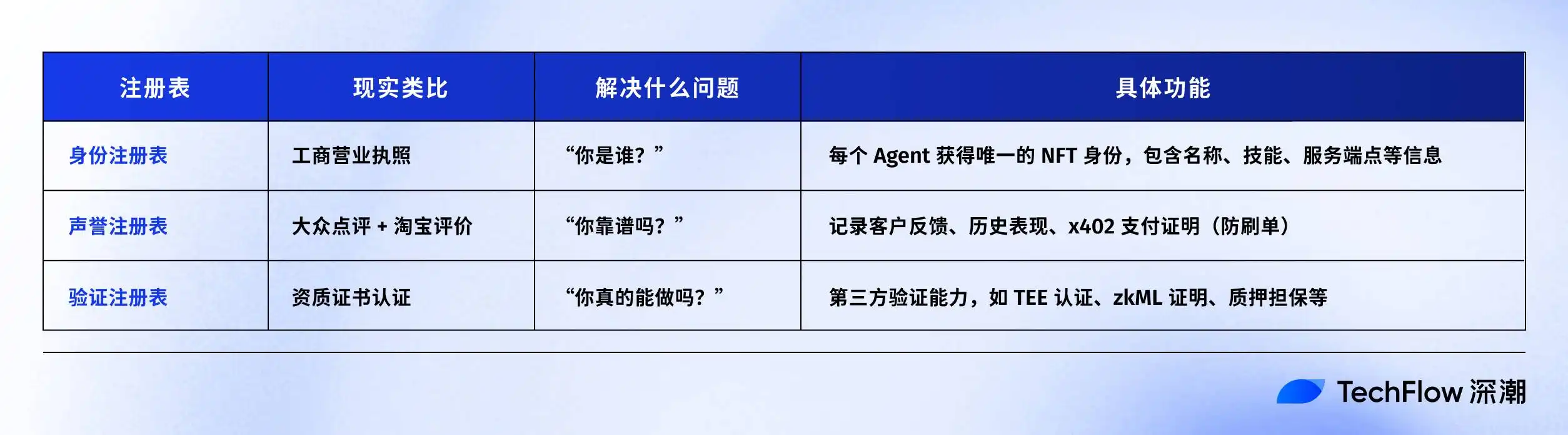
These three registries combined solve one problem: when two AI Agents meet on-chain, how do they know if the other is trustworthy?

The old answer was: they didn't know and had to rely on humans. ERC-8004's answer is: check the on-chain records.

This system wasn't entirely Ethereum's own idea.

Its underlying logic comes from the A2A (Agent-to-Agent) protocol released by Google last year, which enables AIs to communicate and call upon each other. ERC-8004 adds a layer on top of this:

Blockchain-backed trust.

Google's A2A solves the communication problem; Ethereum's ERC-8004 solves the trust problem. One manages the conversation, the other verifies identities.

Is Issuing ID Cards a Good Business?

Daring to speculate, Ethereum's logic might be this:

For AI Agents to be truly useful, they need to manage money themselves. Not just sending tweets or chatting, but directly operating on-chain assets. Signing transactions, calling contracts, cross-protocol arbitrage...

No one dares to do this on a large scale right now. The reason is simple: how do you know this Agent won't transfer your money away? The recently popular ClawdBot already has community members posting about related negative incidents.

The Web2 solution is platform endorsement. You use OpenAI's API, and the trust comes from OpenAI. If something goes wrong, you go to OpenAI.

Web3 doesn't have this. Agents are open-source, deployment is permissionless, and they run on-chain with no one overseeing them. If you call a service from an unknown Agent, you can't check who is behind it, whether the code has issues, or if it has a history of malicious acts...

Simply put, ERC-8004 essentially moves the traditional finance KYC process on-chain. Ethereum is betting that when AI Agents start handling real money, this system will become a necessity.

DeFi protocols wanting to integrate external Agents will first need to check their on-chain identity. Institutions using Agents for trade execution will need to review their historical records. Auditing firms can issue on-chain certifications for Agents, similar to security audits for smart contracts.

This is a competitive positioning move.

Ethereum knows it has lost on the execution layer, but the trust layer is still up for grabs. Institutional recognition, security audit ecosystems, TVL scale—these are Ethereum's existing assets. ERC-8004 is packaging these assets into a standard, aiming to define "what AI Agent compliance looks like" before anyone else.

The question is, does this demand exist now?

Standard Preceding Demand

After discussing Ethereum's calculations, let's talk about reality. What are on-chain AI Agents doing now?

After the AI meme wave subsided last year and the rapid advancements made by leading AI companies in the past couple of years, few people are still paying attention to on-chain AI Agents.

However, they are still making progress.

For example, ai16z has been renamed ElizaOS, evolving from a single Agent to a cross-chain platform; Virtuals Protocol is working on AI DAPPs, planning to venture into physical robots in 2026; others, like the AI Agents in Surf, can automatically execute DeFi trading strategies.

But the question arises: do they really need ERC-8004?

Luna's users trust Luna because it's made by the core Virtuals team. Agents on ElizaOS are used because they run within the ElizaOS framework; Surf executes strategies for you often because you trust the application itself.

Trust comes from the platform, not from an on-chain identity.

The scenario ERC-8004 envisions is: a陌生 (strange) Agent approaches you, with no platform endorsement or brand recognition, and you can only judge its trustworthiness through on-chain records.

When will this scenario occur?

When AI Agents truly achieve autonomous calls across protocols, platforms, and organizational boundaries. An Agent borrowing from Aave, trading on Uniswap, then generating yield in another protocol, all without human approval...

But, this scenario does not exist now.

Current AI Agents, no matter how complex their functions, essentially operate within a single platform. They don't need to prove themselves to陌生 protocols because they never knock on their doors.

Given the current hype in the crypto market, they also have no reason to knock on each other's doors, unless they can jointly create a new narrative.

Therefore, ERC-8004 solves a future problem.

If AI Agents evolve from toys to tools, Ethereum's trust infrastructure will have value. If the Agent economy grows large enough and cross-platform calls become the norm, ERC-8004 can collect tolls.

There are many "ifs."

Thus, for this future-oriented布局 (layout), institutions might be the first to act.

In late 2025, SharpLink Gaming announced investing $170 million into Ethereum restaking strategies. Around the same time, net outflows of ETH from exchanges exceeded 23,000 coins, flowing into private wallets and staking protocols.

This money might be betting on Ethereum 12 to 18 months from now.

For retail investors, however, ERC-8004 isn't a great catalyst.

Betting on ERC-8004 itself? It's an open standard with no token; you can't invest directly, only find some associated small projects. Betting on Ethereum is possible, but Ethereum's price is influenced by too many factors, with AI Agents being just one narrative.

Therefore, there is currently no clean asset that allows you to accurately bet on the proposition "AI Agents need on-chain identities."

Ethereum is not solely AI infrastructure, and Ethereum's identity anxiety won't be completely alleviated by AI. The business of issuing AI ID cards still has a long way to go.


Трендовые криптовалюты

Связанные с этим вопросы

QWhat is the main purpose of the ERC-8004 protocol announced by Ethereum?

AThe main purpose of ERC-8004, also known as 'Trustless Agents', is to provide a chain-based identity system for AI Agents. It creates a decentralized framework for issuing and verifying digital identities, reputation, and third-party attestations for AI Agents on the blockchain, enabling trustless interactions between them.

QWhy is Ethereum heavily promoting the ERC-8004 standard according to the article?

AEthereum is promoting ERC-8004 aggressively because it aims to capture the emerging AI Agent market, where it currently lags behind chains like Solana and Base. By establishing a trust layer for AI Agents, Ethereum seeks to leverage its strengths in security, institutional recognition, and ecosystem maturity to define the standard for AI Agent compliance and trust in the blockchain space.

QWhat are the three key registries proposed in the ERC-8004 standard?

AThe three key registries in ERC-8004 are: 1) The Identity Registry, which uses ERC-721 to mint NFTs as proof of identity for each AI Agent; 2) The Reputation Registry, which records historical performance and user evaluations of Agents; and 3) The Verification Registry, which allows third-party entities to provide attestations or audits for Agents.

QDoes the current AI Agent ecosystem on blockchain have an immediate need for ERC-8004?

ANo, the current AI Agent ecosystem does not have an immediate need for ERC-8004. Most AI Agents operate within single platforms or under trusted brands, where trust is derived from the platform itself rather than decentralized identity verification. ERC-8004 addresses a future scenario where cross-protocol, autonomous AI interactions become common.

QWhat underlying protocol does ERC-8004 build upon for AI Agent communication?

AERC-8004 builds upon Google's A2A (Agent-to-Agent) protocol, which enables AI Agents to communicate and invoke each other. Ethereum's contribution adds a blockchain-based trust layer to this framework, ensuring decentralized identity verification mechanisms for secure interactions.

Похожее

Первое подкаст-интервью CEO Intel: наша цель — "10x за 5-10 лет", ставка на передовую упаковку, стеклянные подложки и искусственный алмаз

Интелл CEO Чэнь Лиу впервые выступил в подкасте, поставив цель увеличить доходность компании в 10 раз за 5-10 лет. Основные стратегические направления включают инвестиции в передовые технологии упаковки (EMIB), стеклянные подложки и новые материалы, такие как нитрид галлия (GaN), карбид кремния (SiC), фосфид индия (InP) и синтетические алмазы, для преодоления физических ограничений традиционного масштабирования процессоров. Он отметил, что всплеск спроса на ИИ-агентов и задачи логического вывода увеличил значимость CPU, изменив соотношение CPU/GPU в серверах с 1:8 до 1:4 и ниже. Лиу подчеркнул важность восстановления баланса, фокуса на продуктах и клиентах, а также стратегической ценности внутреннего американского производства для безопасности цепочек поставок. Ключевыми показателями для фаундри-бизнеса названы выход годных изделий и время цикла. Совместный проект с Илоном Маском Terafab направлен на решение проблемы отставания инфраструктуры полупроводников от роста потребностей ИИ. Лиу считает, что истинный потенциал Intel, выходящий за рамки традиционного рынка ПК, начнет реализовываться в период 2030-2032 годов в таких областях, как периферийные вычисления, физический ИИ и ИИ-агенты, благодаря интеграции технологий XPU, передовой упаковки и фаундри-услуг.

marsbit5 мин. назад

Первое подкаст-интервью CEO Intel: наша цель — "10x за 5-10 лет", ставка на передовую упаковку, стеклянные подложки и искусственный алмаз

marsbit5 мин. назад

Только что привлек $2,7 миллиарда, и Ли Фэйфэй тоже вложила деньги

В венчурном рынке «мировые модели» стали горячей темой, но Пит Флоренс, сооснователь и бывший ведущий исследователь Google DeepMind, публично отверг этот ярлык для своей компании Generalist AI. Несмотря на то, что он был ключевым разработчиком архитектуры VLA, лежащей в основе многих современных «мировых моделей», Флоренс считает, что акцент должен делаться на конкретных целях, а не на модных терминах. Его цель — создать роботов, способных с высокой надежностью выполнять самые разные задачи без специального обучения для каждой. Недавно Generalist AI привлекла $4 млрд в ходе раунда финансирования при оценке в $20 млрд. Среди инвесторов — NVentures (Nvidia), Bezos Expeditions, фонд NFDG, сооснователь Xiaomi Линь Бинь, основатель Zoom Эрик Юань и известный ученый в области ИИ Ли Фэйфэй. Подход Флоренса сформировался под влиянием его научного руководителя в MIT, Рус Тедрейка, который делал акцент на понимании физики. В Generalist AI этот подход выражается в последовательной разработке моделей, нацеленных на практическую полезность. Их первая модель, GEN-0, продемонстрировала, что законы масштабирования, как у больших языковых моделей, применимы и к физическим действиям. В апреле 2026 года была представлена GEN-1, обученная на более чем 50 тысячах часов данных, собранных с помощью специальных перчаток. Она достигает 99% успеха в таких задачах, как складывание коробок, и работает в три раза быстрее предыдущей версии. Флоренс считает, что производительность GEN-1 приближается к переломному моменту, необходимому для коммерческого развертывания. Финансирование, полученное после ее демонстрации, подтверждает веру инвесторов в его целеориентированный подход к созданию универсальных роботов, которые могут изменить экономику физического труда.

marsbit8 мин. назад

Только что привлек $2,7 миллиарда, и Ли Фэйфэй тоже вложила деньги

marsbit8 мин. назад

За три дня потеряли двух легенд: дамба AI-талантов Google трещит по швам?

За последние три дня Google потеряла двух ведущих специалистов по ИИ: Ноама Шазера, одного из авторов архитектуры Transformer, присоединившегося к OpenAI, и Джона Джампера, руководителя проекта AlphaFold и нобелевского лауреата, перешедшего в Anthropic. Эти события не являются изолированными случаями — они отражают устойчивую тенденцию оттока ключевых талантов из Google в сторону OpenAI и Anthropic. Основная причина — фундаментальное несоответствие миссий. Коммерческие цели Google, ориентированные на рекламный бизнес, ограничивают фундаментальные исследования, в то время как OpenAI и Anthropic предлагают фокус на развитии ИИ и безопасности. Кроме того, перспектива скорого IPO OpenAI и Anthropic сулит сотрудникам значительный финансовый рост, чего не может предложить зрелый гигант вроде Google. Слияние Google Brain и DeepMind в 2023 году, предназначенное для консолидации усилий, на практике усилило внутренние трения между исследовательской и продуктовой культурами, увеличив давление коммерциализации на науку. Этот структурный отток талантов перекраивает ландшафт индустрии. Несмотря на сохраняющиеся преимущества в вычислительных ресурсах и данных, Google рискует проиграть в гонке, где ключевым активом являются люди, продвигающие технологические границы. Способность удерживать этих людей становится для компании самой сложной задачей.

marsbit2 ч. назад

За три дня потеряли двух легенд: дамба AI-талантов Google трещит по швам?

marsbit2 ч. назад

За оценками ИИ скрывается китайский «составитель тестов»

За кулисами результатов ведущих ИИ-моделей, таких как GPT и Gemini, часто стоит один и тот же «составитель заданий» — китайский исследователь Чэнь Вэньху. Будучи доцентом Университета Ватерлоо и основателем лаборатории TIGERLab, он разработал ключевые оценочные эталоны MMLU-Pro, MMMU и MMMU-Pro, которые стали общим языком для сравнения способностей моделей. Чэнь Вэньху сосредоточился на создании более сложных и устойчивых тестов, когда предыдущие эталоны, такие как MMLU, перестали эффективно различать передовые модели, достигшие почти идеальных результатов. MMLU-Pro, с его 12032 вопросами, расширенными вариантами ответов и акцентом на рассуждения, снизил точность моделей на 16–33% и уменьшил зависимость от угадывания. MMMU и MMMU-Pro, в свою очередь, оценивают мультимодальное понимание, требуя от моделей анализа изображений, таблиц, схем и текста в контексте профессиональных знаний, что выявило значительные ограничения даже у самых мощных моделей. Исследования Чэнь Вэньху в области сложных вопросно-ответных систем и его опыт работы в Google DeepMind над Gemini позволили ему глубоко понять слабые места в оценке ИИ. Его лаборатория также занимается разработкой моделей, таких как UniVideo и Vamba, что помогает создавать более точные и релевантные тесты. Сегодня, работая в лаборатории суперинтеллекта Meta, Чэнь Вэньху продолжает влиять на развитие ИИ через улучшение данных для предобучения и систем оценки, оставаясь ключевой, но менее заметной фигурой в этой быстроразвивающейся области.

marsbit2 ч. назад

За оценками ИИ скрывается китайский «составитель тестов»

marsbit2 ч. назад

Письмо основателям от сооснователей Alliance: К моменту продажи Cursor за 600 миллиардов долларов

Автор статьи, опираясь на пример успешной продажи компании Cursor за 600 миллиардов долларов, обращается к начинающим предпринимателям. Он развеивает иллюзию, что все великие возможности уже исчерпаны. На примере Cursor, Stripe, Figma, Shopify и других компаний показано, что их путь начинался не в «мейнстриме», а с неочевидного для других убеждения в будущем тренде — будь то переход бизнеса онлайн, облачный дизайн или самостоятельная коммерция для малого бизнеса. Ключ к успеху — не в поиске абсолютно новой идеи, а в глубоком понимании рынка, выявлении реальных «горящих» проблем пользователей, которые игнорируют крупные игроки, и создании решения, дающего десятикратное улучшение. Важно не просто создать продукт, но и продумать каналы его распространения, часто начиная с ручной, кропотливой работы по привлечению первых преданных пользователей. История успеха — это всегда годы упорной работы, адаптации и устойчивости в условиях неопределенности, когда другие уже сдались. Итоговый совет: найдите свой технологический цикл, погрузитесь в рынок, найдите острую проблему, создайте простой вход в продукт, завоюйте свои каналы распространения и никогда не сдавайтесь.

marsbit2 ч. назад

Письмо основателям от сооснователей Alliance: К моменту продажи Cursor за 600 миллиардов долларов

marsbit2 ч. назад

Торговля

Спот
Фьючерсы

Популярные статьи

Как купить ID

Добро пожаловать на HTX.com! Мы сделали приобретение SPACE ID (ID) простым и удобным. Следуйте нашему пошаговому руководству и отправляйтесь в свое крипто-путешествие.Шаг 1: Создайте аккаунт на HTXИспользуйте свой адрес электронной почты или номер телефона, чтобы зарегистрироваться и бесплатно создать аккаунт на HTX. Пройдите удобную регистрацию и откройте для себя весь функционал.Создать аккаунтШаг 2: Перейдите в Купить криптовалюту и выберите свой способ оплатыКредитная/Дебетовая Карта: Используйте свою карту Visa или Mastercard для мгновенной покупки SPACE ID (ID).Баланс: Используйте средства с баланса вашего аккаунта HTX для простой торговли.Третьи Лица: Мы добавили популярные способы оплаты, такие как Google Pay и Apple Pay, для повышения удобства.P2P: Торгуйте напрямую с другими пользователями на HTX.Внебиржевая Торговля (OTC): Мы предлагаем индивидуальные услуги и конкурентоспособные обменные курсы для трейдеров.Шаг 3: Хранение SPACE ID (ID)После приобретения вами SPACE ID (ID) храните их в своем аккаунте на HTX. В качестве альтернативы вы можете отправить их куда-либо с помощью перевода в блокчейне или использовать для торговли с другими криптовалютами.Шаг 4: Торговля SPACE ID (ID)С легкостью торгуйте SPACE ID (ID) на спотовом рынке HTX. Просто зайдите в свой аккаунт, выберите торговую пару, совершайте сделки и следите за ними в режиме реального времени. Мы предлагаем удобный интерфейс как для начинающих, так и для опытных трейдеров.

790 просмотров всегоОпубликовано 2024.03.29Обновлено 2026.06.02

Как купить ID

Обсуждения

Добро пожаловать в Сообщество HTX. Здесь вы сможете быть в курсе последних новостей о развитии платформы и получить доступ к профессиональной аналитической информации о рынке. Мнения пользователей о цене на ID (ID) представлены ниже.

活动图片