Early Trading Made a Fortune? A Comprehensive Guide to Genius's New Rules

Odaily星球日报Опубликовано 2026-01-20Обновлено 2026-01-20

Введение

**Title: Early Traders Made Huge Gains? Understanding Genius' New Rules** Genius, a highly discussed DEX, announced new GP points rules for its Season 1, ending April 12, with a 50% increase in airdrop allocation. The team confirmed that GP points earned from early trading volume remain valid, benefiting users who followed initial interaction guides. Key updates: - Total S1 GP points are fixed at 200 million, with 75 million already distributed from pre-whitepaper trading. The remaining 125 million will be distributed weekly starting January 20, at 10 million GP per week. - Distribution is weighted to prevent whales from dominating, allowing smaller traders to earn points. - Stablecoin swaps (e.g., USDT/USDC) now have a 0.5x weight; other spot trades retain 1.0x. - Previous task-based and referral GP rewards were removed. Now, points are earned solely via spot trading volume. - New trading tiers introduce fee discounts based on cumulative trading volume, though zero-fee trading remains active indefinitely. - Referrals now offer 35% commission on invitees’ trading fees post-zero-fee campaign. - The GENIUS token will be created before April 12, 2026, with a TGE expected randomly before then. Despite platform bugs from high traffic, Genius’ strong backing (including investment from YZi Labs and CZ as advisor) and confirmed TGE make it noteworthy. With a potential $300M FDV and 10% airdrop, each GP point could be worth ~$0.15. Early participants may have profitable opportuniti...

Original | Odaily Planet Daily (@OdailyChina)

Author | Asher (@Asher_ 0210)

Yesterday, Genius, a DEX that has been highly discussed recently, announced new point rules on platform X: Season 1 will end on April 12, with an additional 50% airdrop quota.

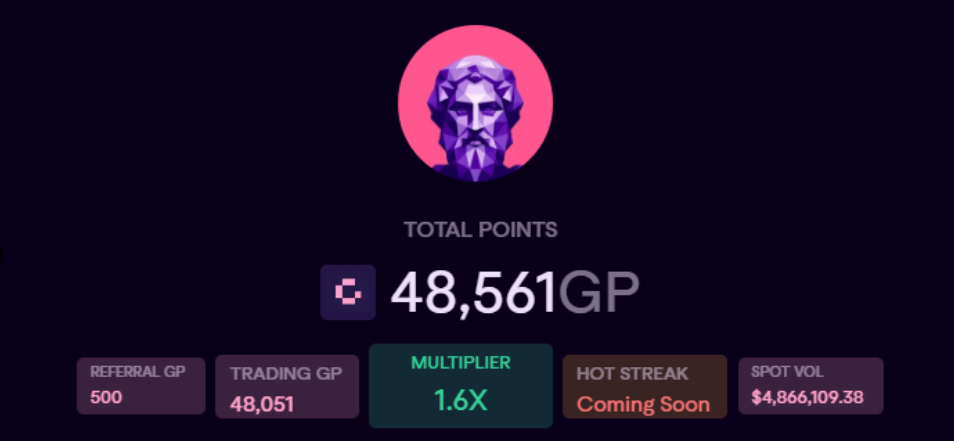
Notably, the Genius team stated that the GP points earned from trading volume have been retained. Congratulations to those who participated early through the point-earning guide shared by Odaily Planet Daily (click here to jump to the article: YZi Labs Invests Tens of Millions, CZ as Advisor—How to Earn Genius Points?). These users may have already "made a fortune" in GP points (platform website: https://www.tradegenius.com/).

Early users "aggressively" traded to earn massive GP points from volume

Below, Odaily Planet Daily explains Genius's new GP point rules to help users better participate in platform interactions and earn GP points.

Season 1 Total of 200 Million GP Points, 125 Million GP Points Still to Be Distributed

The community had many questions about GP point distribution. This time, the official emphasized that Season 1 has a total of 200 million GP points, with no additional issuance. The specific distribution is as follows:

  • 75 million GP points have been distributed, which are the trading points earned by users before the platform updated the whitepaper. GP points from referral rewards have been reclaimed;
  • 125 million GP points are still to be distributed, including 5 million GP points from the wheel-of-fortune reward. Referral reward points and trading task points have been canceled.

The remaining 125 million GP points will be distributed starting at 5:00 AM UTC+8 today (January 20), with 10 million GP points distributed every weekend. Additionally, points are allocated using a weighted distribution to ensure that whale traders do not monopolize all GP releases, allowing smaller traders to also receive GP allocations.

Notably, the trading volume weight for stablecoin USDT to USDC conversions has been adjusted to 0.5x, while the weight for other spot trading volumes remains 1.0x.

Other Changes in the New Rules

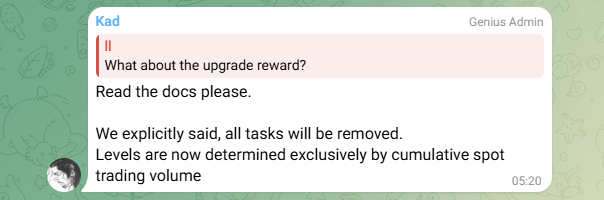
As explained by the team members in the official Telegram, on one hand, all previous GP task points (trading tasks + referral tasks) have been cleared; on the other hand, under the new rules, GP points can only be earned through spot trading volume.

Official explanation of the new rules

New Trading Tiers

The new trading tier divisions and fee discounts are as follows:

  • Level 1—Smart: Cumulative trading volume of $100,000, trading fee 0.3%;
  • Level 2—Ultra Genius: Cumulative trading volume of $1 million, trading fee 0.2%;
  • Level 3—Mastermind: Cumulative trading volume of $10 million, trading fee 0.1%;
  • Level 4—Mogger Genius: Cumulative trading volume of $100 million, trading fee 0.05%.

The current zero-fee trading promotion's end date has not been announced.

Referral Rewards

Referring friends for trading no longer earns GP points, but after the zero-fee promotion ends, users can earn a 35% commission from the trading fees of invited friends.

For example, if an invited user's trading fee tier is 0.2%, the rebate earned would be 0.07% (35% * 0.2%).

GENIUS Token to Be Created Before April 12, 2026

According to the documentation, the GENIUS token will be created before the end of Season 1. Therefore, TGE will occur randomly between now and April 12.

Platform Has Many Bugs, But Strong Funding Background and Confirmed TGE Make It Worth Attention

Since its launch a few days ago, Genius has been overloaded due to a large influx of studios, resulting in frequent bugs. Although the team has been working to resolve issues, some functions still have problems and cannot fully satisfy users. As of now, referral points and trading tasks have not been fully removed, and the wheel-of-fortune reward is still under maintenance.

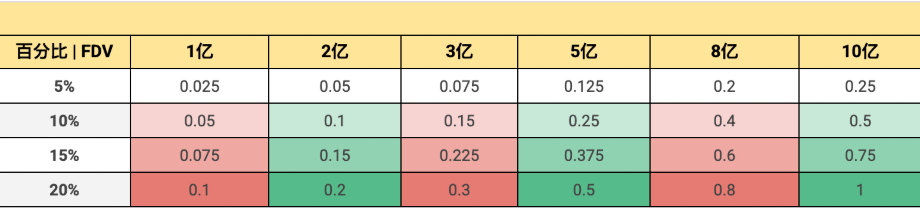
With the new rules update, TGE will occur before April 12, significantly increasing the certainty of earning from Genius. With only 200 million GP points distributed before TGE, GP points will be particularly "valuable," and the cost of earning them will only increase. KOL Nathan stated, "With tens of millions in investment, the FDV should be around $300–500 million. Congratulations to those who got on board early, earning 37.5% of the total airdrop in just 3 days." Based on the data below, with a $300 million FDV and a 10% airdrop allocation, each point would be worth $0.15.

Genius Point Value Estimation

Perhaps it is still worth interacting now, while trading fees are still zero and the new rules have just been launched.

Связанные с этим вопросы

QWhat is the total amount of GP points allocated for Season 1 on Genius, and how much remains to be distributed?

AThe total amount of GP points for Season 1 is 200 million. 75 million GP points have already been distributed, and 125 million GP points remain to be distributed.

QHow has the new rule changed the way users can earn GP points?

AThe new rule has removed all previous GP task points (trading tasks and invitation tasks). Users can now only earn GP points by generating trading volume through spot trades.

QWhat is the new weight assigned to the trading volume of stablecoin USDT to USDC conversions?

AThe trading volume weight for stablecoin USDT to USDC conversions has been adjusted to 0.5x.

QWhen is the GENIUS token expected to be created (TGE)?

AThe GENIUS token is expected to be created before the end of Season 1, which is April 12, 2026. The TGE will occur randomly between now and that date.

QWhat is the referral reward structure under the new rules?

AReferring friends no longer generates GP point rewards. However, after the platform's zero-fee trading activity ends, users can earn a 35% commission from the trading fees of the users they invite.

Похожее

How Risky is the "Death Spiral" of MSTR and STRC?

Summary: This article explores the perceived "death spiral" risk between MicroStrategy (MSTR), its Bitcoin holdings, and its perpetual preferred stock (STRC), drawing comparisons to the LUNA-UST collapse. While both systems feature price anchors, high yields for holders, and potential feedback loops, their core mechanisms differ fundamentally. The MSTR-STRC structure relies on continuous financing to sustain its high dividend payouts, primarily through stock ATM offerings. A negative feedback cycle could occur: falling MSTR stock price makes raising equity capital harder, increasing pressure to sell Bitcoin, which undermines STRC confidence and further depresses MSTR. However, unlike LUNA-UST's automated, direct linkage, the MSTR-STRC loop is weaker and has brakes: STRC dividends can be deferred or rates lowered, and STRC holders have a $100/share liquidation preference in bankruptcy, providing a price floor. The company's sustainability hinges on its ability to continue financing. Its current ~$900 million USD reserves cover only about 6.3 months of its ~$1.71 billion annual interest/dividend burden. The next six months are critical, aligning with both the potential bottom in Bitcoin's four-year cycle and the depletion timeline of its reserves. While a LUNA-style catastrophic collapse is deemed highly unlikely due to structural differences, the key question is whether MicroStrategy can navigate this period through healthy deleveraging to restart its capital engine.

Foresight News18 мин. назад

How Risky is the "Death Spiral" of MSTR and STRC?

Foresight News18 мин. назад

How Much Debt Does Strategy Really Have? Is There a Risk of Implosion?

MicroStrategy's Debt Risk: A Turning Point in the "Never Sell" Strategy As of June 3, 2026, MicroStrategy holds 843,706 bitcoins (valued at ~$53.1B) but faces significant financial obligations. Its capital structure includes $6.75B in convertible notes and $15.48B in perpetual preferred stock (led by the $8.5B STRC series), creating an annual payout burden of ~$1.71B. With software revenue at only ~$500M, interest and dividend obligations far exceed operating income. A critical shift occurred in late May 2026 when the company sold 32 bitcoins for ~$2.5M to cover dividends, breaking CEO Michael Saylor's long-standing "never sell" pledge. This symbolic move triggered a sharp decline in both Bitcoin's price and MSTR stock, reflecting market fears about cash flow sustainability. The core of the strain is the STRC perpetual preferred stock, designed as a "permanent loan" with no maturity date but requiring high monthly dividends (currently 11.5%). Its business model relies on a three-part cycle: issuing new STRC shares, using proceeds to buy more Bitcoin and fund a USD reserve, and using that reserve to pay dividends. This cycle depends on continuous investor demand for STRC and Bitcoin's price appreciation. Analysis shows Bitcoin needs to appreciate at least 2.3% annually to cover the $1.71B in yearly obligations at current holdings. With Bitcoin price down ~22% from March 2026 highs, this pressure has intensified. The company's $900M USD reserve can only cover about 7 months of payments if STRC issuance stalls. Key risks are not immediate bankruptcy or forced Bitcoin liquidation (as BTC is not collateral), but rather: 1) The erosion of MSTR's premium to its Bitcoin holdings (mNAV), which would cripple its ability to raise cheap capital; 2) A vicious cycle where stagnant Bitcoin prices reduce STRC demand, draining the USD reserve and forcing BTC sales, further depressing prices. The period from February 2027 to September 2028 is a crucial test, with over $5.9B in convertible notes facing put options or maturity. In essence, MicroStrategy has evolved from a simple Bitcoin holder into a complex financial entity acting like a "private Bitcoin bank," leveraging its BTC holdings to create layered financial products. Its survival depends on maintaining Bitcoin's price trend, its stock premium, and market appetite for its preferred shares. The recent token sale marks not a betrayal of its Bitcoin thesis, but an admission that the leveraged strategy must eventually be paid for.

marsbit29 мин. назад

How Much Debt Does Strategy Really Have? Is There a Risk of Implosion?

marsbit29 мин. назад

Anthropic Cries Wolf: Is the AGI Threat Real, or Just an IPO Story?

Anthropic has published an article titled "When AI builds itself," discussing the emerging concept of "recursive self-improvement," where AI begins to actively participate in designing, training, testing, and optimizing its own subsequent versions. The company presents internal data showing that by May 2026, over 80% of code merged into its codebase was written by Claude, its AI model. Claude's capabilities have expanded to handling complex, open-ended engineering tasks, achieving a 76% success rate in such areas, and even contributing to research processes, such as optimizing code performance and conducting AI safety experiments. Anthropic outlines an evolution from human-driven development to AI-assisted workflows, culminating in the current stage where AI agents can autonomously write, run, and delegate code. The company cautions that the path toward a "closed loop," where AI continuously improves itself, is becoming visible. It calls for coordinated global mechanisms to potentially slow or pause frontier AI development to allow safety research and societal structures to catch up. However, the timing of this warning coincides with Anthropic's preparations for an IPO, framing the narrative not just as a safety concern but also as a demonstration of Claude's advanced capabilities and its integral role in accelerating Anthropic's own R&D—creating a potential "flywheel" effect for competitive advantage. This contrasts with OpenAI's recent, more policy-oriented discussion of the same risks, highlighting the competitive dynamics in the AI industry as companies position themselves in both the technological and regulatory landscape.

marsbit1 ч. назад

Anthropic Cries Wolf: Is the AGI Threat Real, or Just an IPO Story?

marsbit1 ч. назад

Торговля

Спот
Фьючерсы
活动图片