Digital Gold, Future Payments, Speculative Choice? Bitcoin's 'Narratives' Collapse One by One at the 'Peak of Faith'

华尔街日报Опубликовано 2026-02-22Обновлено 2026-02-22

Введение

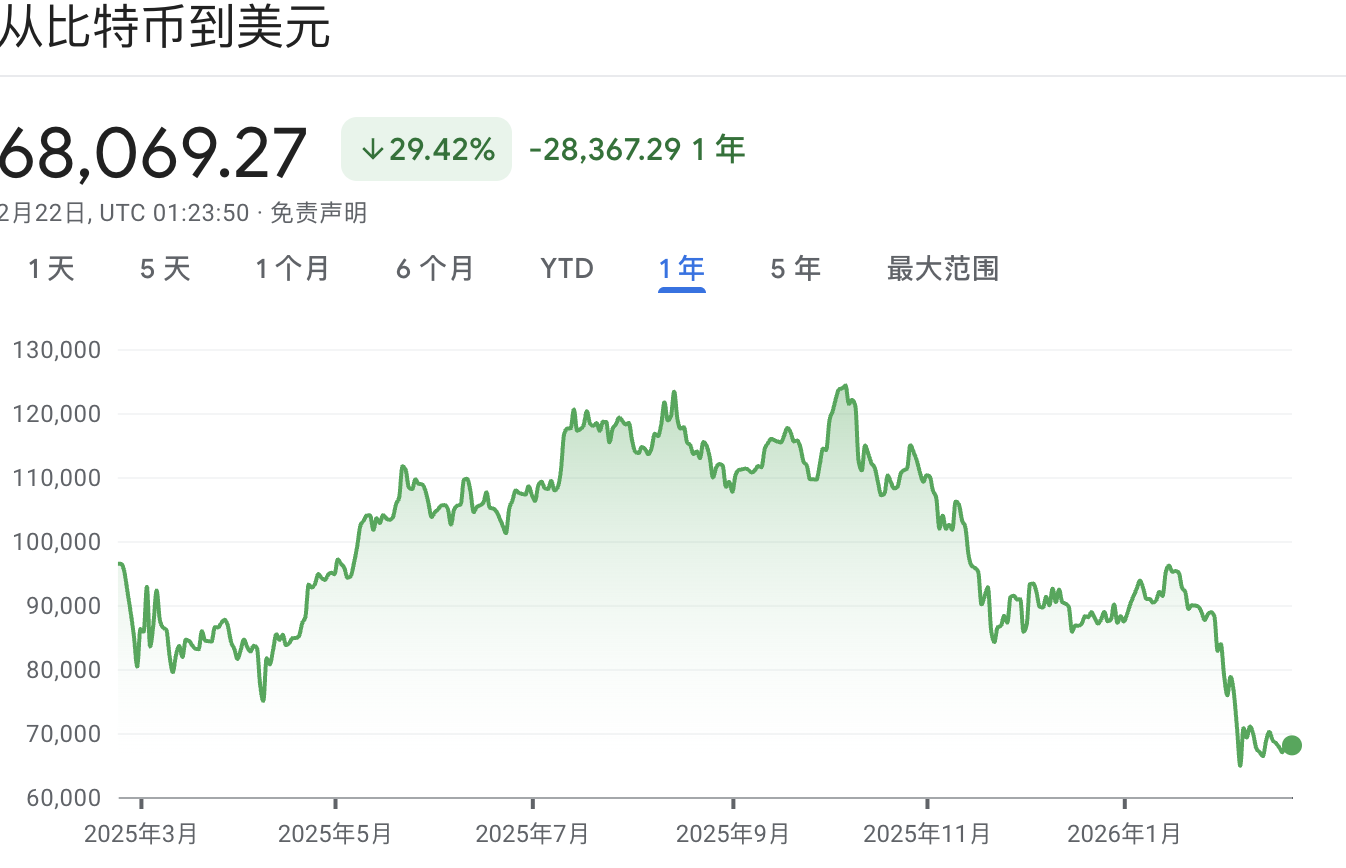
Bitcoin is facing an unprecedented identity crisis as its core value narratives collapse simultaneously. Despite gaining regulatory support and institutional adoption, its price has plummeted over 40% from its high, erasing more than $1 trillion in market value. The cryptocurrency’s fundamental narratives—digital gold, a payment mechanism, and a speculative asset—are all faltering. As a “digital gold” substitute, Bitcoin failed to act as a safe haven during geopolitical tensions, while gold ETFs attracted significant inflows. In payments, stablecoins are now preferred, with key proponents like Jack Dorsey shifting focus. Meanwhile, speculative interest is moving toward prediction markets like Polymarket, offering faster, leveraged outcomes without Bitcoin’s volatility. Though Bitcoin remains highly liquid and has survived past crises, its relevance is now in question. Without a unifying narrative, it risks a gradual loss of attention, capital, and belief—raising the fundamental question: What is Bitcoin’s purpose when its core stories disintegrate?

Bitcoin is mired in an unprecedented identity crisis. The world's largest cryptocurrency has plummeted more than 40% from its peak, but the real problem is not the price itself, but the simultaneous collapse of the core narratives underpinning its value. When "digital gold" loses to real gold, its payment function loses to stablecoins, and its speculative heat loses to prediction markets, Bitcoin is forced to confront a question it has never needed to answer: Why does it exist at all?

Ironically, this crisis comes after Bitcoin got everything it wanted. Regulatory attitudes in Washington have never been friendlier, institutional adoption has never been deeper, and Wall Street has never been more accepting. But these victories did not prevent a market capitalization evaporation of over $1 trillion. The usual rebound script has failed—the bottom-fishing buyers have disappeared, and the forces that typically drive a rally are now working in reverse.

According to a Bloomberg report on Saturday, unlike stocks or commodities, Bitcoin lacks fundamental support; its value relies almost entirely on belief—on the narratives that persuade new buyers to enter the market. And these narratives are faltering. Retail investors who bought into the Trump-induced rally are now deeply underwater. More critically, Bitcoin now must compete with more alternatives that are "easier to understand and easier to explain to trustees, clients, and boards."

Owen Lamont, Portfolio Manager at Acadian Asset Management, said:

Bitcoin's core story is 'the price goes up,' but we don't have that now. What we have now is 'the price goes down,' and that's not a good story.

Complete Rout on the Payment Battlefield

A clear signal emerged last November. Jack Dorsey, one of Bitcoin's most vocal corporate evangelists for a long time, announced that his Cash App would begin supporting stablecoins. For years, Dorsey treated Bitcoin maximalism as a creed; his pivot sent a signal: the payments race had moved to a new arena.

In Washington, stablecoins have become the focus. The bipartisan-supported Genius Act passed easily, and regulators have openly encouraged infrastructure for dollar-backed tokens. Even within the crypto space itself, Bitcoin is no longer the sole focus. Tokenization, blockchain-driven derivatives, and cross-border stablecoin payments are becoming credible use cases—and none of these require Bitcoin's participation.

"If there's any correlation, stablecoin activity might be related to activity on Ethereum or other chains. Stablecoins are for payments," said Carlos Domingo, co-founder and CEO of the tokenization platform Securitize. "I don't think anyone views Bitcoin as a payment mechanism today."

The Bankruptcy of the "Digital Gold" Narrative

Even after years of "digital gold" hype, Bitcoin has failed the most important macro test. Despite geopolitical tensions and persistent dollar weakness, gold and silver have staged volatile rallies this year, while cryptocurrencies have only fallen. Fund flows confirm this divergence. According to data compiled by Bloomberg, over the past three months, US-listed gold and gold-themed ETFs attracted over $16 billion, while spot Bitcoin ETFs saw outflows of about $3.3 billion. Bitcoin's market cap has shrunk by over $1 trillion.

"People are realizing that Bitcoin is what it has always been—just a speculative asset," said Tom Essaye, President and Founder of Sevens Report and a former Merrill Lynch trader. "Bitcoin is not going to replace gold, it's not digital gold, it doesn't do the same things, it can't provide people with the utility that gold provides. It's not an inflation hedge—frankly, there are better hedges out there where you don't have to worry about volatility. It's not a chaos hedge either."

The digital asset treasury model was supposed to be Bitcoin's corporate identity. Companies like Strategy Inc. hoarded Bitcoin during the bull market and issued stock based on it, creating a self-reinforcing cycle that created billions in market capitalization out of thin air and gave institutional investors a way to express conviction without direct exposure to the asset. It worked for a while. But now the cycle has reversed—and with it, the model's credibility has collapsed. The largest digital asset treasury companies have plummeted over the past year—some falling far more than Bitcoin itself. Many now trade below the value of their holdings.

Speculative Frenzy Shifts to Prediction Markets

Bitcoin's grip on speculative culture is also slipping. Prediction platforms like Polymarket and Kalshi—with binary outcomes, fast settlement, and real-world stakes—are now the new playground for the dopamine hunters who once chased meme coins. This is not a fringe phenomenon: Polymarket's weekly nominal trading volume has soared over the past year. Even Coinbase Global Inc. has added prediction contracts. The dopamine hasn't disappeared; it has just moved.

"Prediction markets are becoming the next big thing for DIY investors who like the speculative nature of crypto," said Roxanna Islam, Head of Sector Research at ETF firm TMX VettaFi. "This could mean less overall interest in crypto." However, she added, "It could also mean a shift towards longer-term, more serious investors."

Furthermore, there is a growing mismatch between how Bitcoin is accessed and how it is traded. Spot ETFs have made buying incredibly easy, but Bitcoin's price is still influenced by offshore derivatives markets, where traders often use 100x leverage. These venues employ automatic liquidation engines: when a position breaches a margin threshold, it is force-liquidated and sold into the order book, instantly triggering chain liquidations that can crash the spot price in minutes. The crash last October fully exposed this mechanism, with billions in leveraged positions liquidated in an instant.

The Divide Between Resilience and Relevance

None of this means Bitcoin is finished. It remains the most liquid digital asset, with deeper order books and broader exchange coverage than any competitor. Spot ETFs have made Bitcoin a permanent fixture in investment portfolios. More importantly, it has survived crises before: the Mt. Gox collapse, the 2022 crash—and many others. Each time, the network survived, and the price began setting new records. Resilience is not meaningless.

"There's always fear, uncertainty, and doubt being spread. There are always problems," said Dan Morehead, founder of Pantera Capital. "I just think people who are skeptical about how important phone-based money is to the world naturally want to find new things to worry about all the time."

The bull case lies not in Bitcoin's narratives being unassailable, but in them not needing to be—they just need to be durable enough to outlast each successive crisis of confidence. So far, history is on their side. According to Bloomberg data, Bitcoin has experienced and recovered from numerous major declines before.

But history also shows that survival and relevance are not the same. Bitcoin's greatest threat is not competitors—it's drift. The slow erosion of attention, capital, and belief that follows when no single narrative holds. The asset remains, the network still runs, but the stories that gave Bitcoin its gravity—digital gold, free money, institutional reserve—are collapsing simultaneously. Whether this is a temporary crisis or a permanent shift is one of the biggest questions in the digital economy era.

"For many, it's like a religion, and religious beliefs are hard to shake," said Michael Rosen, Chief Investment Officer at Angeles Investment Advisors. "It's just not my religion."

Связанные с этим вопросы

QWhat is the core identity crisis that Bitcoin is currently facing according to the article?

ABitcoin is facing an unprecedented identity crisis as its core value narratives—being 'digital gold,' a payment mechanism, and a speculative asset—are simultaneously collapsing, forcing it to confront the fundamental question of why it exists.

QHow has the 'digital gold' narrative for Bitcoin been challenged recently?

AThe 'digital gold' narrative has been undermined as Bitcoin failed key macro tests during geopolitical tensions and dollar weakness, with gold and silver experiencing volatile rallies while Bitcoin declined. Gold ETFs attracted over $16 billion in three months, while Bitcoin ETFs saw outflows of about $3.3 billion.

QWhy did Jack Dorsey's Cash App supporting stablecoins signal a shift in the payment competition?

AJack Dorsey, a long-time Bitcoin maximalist, announced that Cash App would support stablecoins, indicating that the payment race has moved to stablecoins, which are now the focus in Washington with bipartisan regulatory support and are seen as more practical for payments without requiring Bitcoin.

QWhat is replacing Bitcoin as the new playground for speculative dopamine seekers?

APrediction markets like Polymarket and Kalshi, with binary outcomes, fast settlement, and real-world stakes, are becoming the new playground for speculative dopamine seekers, attracting activity that once focused on meme coins and cryptocurrencies.

QWhat does the article suggest is the biggest threat to Bitcoin's relevance, beyond competitors?

AThe biggest threat to Bitcoin's relevance is not competitors but 'drift'—the slow erosion of attention, capital, and belief when no single narrative sustains it, leading to a loss of the stories that gave it gravity, such as digital gold, free money, or institutional reserve.

Похожее

Worried about AI's Self-Evolution, Anthropic Intends to Stop Training?

In early 2026, Anthropic signaled a significant shift in its public narrative regarding AI development timelines and safety. In June, its Anthropic Institute published a detailed article, "When AI builds itself," presenting internal data suggesting accelerating AI self-improvement. Key figures included over 80% of merged code being written by Claude and a 52x speedup in certain optimization tasks. The article outlined three future scenarios, with the most speculative being full recursive self-improvement (RSI), where AI autonomously builds better successors. Anthropic stated RSI is "possible" and may arrive faster than most institutions are prepared for. This narrative pivot followed a series of strategic moves. In January, CEO Dario Amodei wrote about a powerful self-improvement feedback loop. In February, Anthropic revised its Responsible Scaling Policy, removing a core commitment to pause training if capabilities outstripped safety controls, citing the risk of falling behind competitors. This change coincided with reported pressure from the US Department of Defense. By May, Anthropic's valuation had soared to $965 billion. Anthropic's stance was mirrored by other industry leaders. DeepMind CEO Demis Hassabis adjusted his AGI timeline to "by 2029" and admitted to using provocative language like "foothills of the singularity" to create urgency. OpenAI also released a model claiming a key role in its own creation process. The article's carefully calibrated tone—presenting dramatic data alongside qualifying footnotes—exemplifies a balancing act between signaling technological acceleration and managing commercial, regulatory, and safety imperatives. External experts offered contrasting interpretations of the same data, from warnings of catastrophic risk akin to Chernobyl to skepticism that current automation merely handles "grunt work," not genius. The coordinated narrative shift among top labs highlights the complex interplay between perceived technical inflection points and strategic communication aimed at investors, regulators, and the public.

marsbit1 мин. назад

Worried about AI's Self-Evolution, Anthropic Intends to Stop Training?

marsbit1 мин. назад

The Macroeconomic Underpinnings of Africa's Payment Market Landscape

The African payments market, characterized by the world's highest mobile money penetration and fastest-growing cryptocurrency adoption, is not a coincidence but a macroeconomic necessity driven by deep structural factors. Two key drivers create this landscape: (1) Africa's heavy reliance on commodity exports, trade, and remittances, generating massive cross-border settlement and remittance demand; and (2) chronically underdeveloped financial infrastructure, exacerbated by international bank de-risking, foreign exchange mismanagement, and persistent inflation. This vacuum has allowed mobile money and crypto to thrive. Mobile money platforms replace banks for domestic payments, while cryptocurrencies serve as a store of value against local currency depreciation and a low-cost medium for cross-border exchange. A crucial division lies along the Sahara Desert. North Africa is integrated into the oil-anchored MENA framework, while Sub-Saharan Africa (SSA), plagued by dollar shortages and fragmented currencies, has become a natural, massive market for mobile money and crypto. Nigeria, Kenya, and South Africa are global leaders in adoption. The SSA economy is deeply dollarized due to currency instability, yet suffers from a severe "dollar shortage" caused by trade deficits and limited export capacity. This creates parallel forex markets and high remittance costs. Cryptocurrencies, particularly stablecoins, fill this gap by providing access to dollar liquidity, cheaper cross-border transfers, and an inflation-resistant store of value, primarily driven by retail users for small-value transactions. While regional initiatives like PAPSS aim to reduce dollar dependence, the fundamental constraints of commodity reliance, trade imbalances, and shallow financial markets persist. Therefore, mobile money and cryptocurrencies are not niche trends but essential financial infrastructure filling a structural void, and they are likely to remain central to Africa's economic landscape for the foreseeable future.

链捕手11 мин. назад

The Macroeconomic Underpinnings of Africa's Payment Market Landscape

链捕手11 мин. назад

Is the Sharp Decline Over? Let the Data Speak

**Has the Sharp Decline Ended? Let Data Speak** Bitcoin's recent significant drop has placed short sellers in a precarious position. Three concurrent pressures—sustained outflows from ETFs, miners offloading coins to exchanges, and short-term holders capitulating—pushed the price near $63k. The asset fell 13% this week and 21% this month, roughly halving from its all-time high. A critical data point is the extremely crowded short positioning, with a short-to-long ratio reaching 8:1, representing nearly $100 billion in short interest overhead. This creates conditions for a potential short squeeze if selling pressure merely pauses, similar to the event in November 2022 which triggered a 24% rally. The selling pressures are real: spot Bitcoin ETFs have seen a record $5.4 billion outflow over 20 days. Short-term holders moved 53k loss-held BTC to exchanges in a day, and miners sent 24k BTC to Binance, a six-month high. Capital is also rotating towards AI and tech stocks like SpaceX, with $400 billion invested in AI infrastructure recently. However, on-chain data shows accumulation by long-term holders, who added 200k BTC in a month, and institutions/miners have absorbed 1.24 million BTC since 2023. This indicates strong buying beneath the surface. Key levels to watch are the $67k-$70k zone (2021 high & 2024 breakout point). A swift recovery above it suggests a leverage washout; failure could test $60k-$55k. The direction also hinges on ETF flow reversal. Currently, the S&P 500 hits new highs driven by AI, while Bitcoin and DeFi (TVL down from $173b to $73.9b) lag. The most probable path is a grinding basing process between $60k-$58k with continued ETF outflows. A less likely but explosive scenario involves a sudden flow reversal, a surge above $70k triggering a short squeeze, and a rally back above $76k. The immediate trigger depends on when the relentless selling pauses. A final cautionary note questions Bitcoin's correlation: if the high-flying U.S. stock market corrects, will Bitcoin once again miss the rally but not the decline?

foresightnews_api26 мин. назад

Is the Sharp Decline Over? Let the Data Speak

foresightnews_api26 мин. назад

Торговля

Спот
Фьючерсы

Популярные статьи

Как купить S

Добро пожаловать на HTX.com! Мы сделали приобретение Sonic (S) простым и удобным. Следуйте нашему пошаговому руководству и отправляйтесь в свое крипто-путешествие.Шаг 1: Создайте аккаунт на HTXИспользуйте свой адрес электронной почты или номер телефона, чтобы зарегистрироваться и бесплатно создать аккаунт на HTX. Пройдите удобную регистрацию и откройте для себя весь функционал.Создать аккаунтШаг 2: Перейдите в Купить криптовалюту и выберите свой способ оплатыКредитная/Дебетовая Карта: Используйте свою карту Visa или Mastercard для мгновенной покупки Sonic (S).Баланс: Используйте средства с баланса вашего аккаунта HTX для простой торговли.Третьи Лица: Мы добавили популярные способы оплаты, такие как Google Pay и Apple Pay, для повышения удобства.P2P: Торгуйте напрямую с другими пользователями на HTX.Внебиржевая Торговля (OTC): Мы предлагаем индивидуальные услуги и конкурентоспособные обменные курсы для трейдеров.Шаг 3: Хранение Sonic (S)После приобретения вами Sonic (S) храните их в своем аккаунте на HTX. В качестве альтернативы вы можете отправить их куда-либо с помощью перевода в блокчейне или использовать для торговли с другими криптовалютами.Шаг 4: Торговля Sonic (S)С легкостью торгуйте Sonic (S) на спотовом рынке HTX. Просто зайдите в свой аккаунт, выберите торговую пару, совершайте сделки и следите за ними в режиме реального времени. Мы предлагаем удобный интерфейс как для начинающих, так и для опытных трейдеров.

1.4k просмотров всегоОпубликовано 2025.01.15Обновлено 2026.06.02

Как купить S

Sonic: Обновления под руководством Андре Кронье – новая звезда Layer-1 на фоне спада рынка

Он решает проблемы масштабируемости, совместимости между блокчейнами и стимулов для разработчиков с помощью технологических инноваций.

2.3k просмотров всегоОпубликовано 2025.04.09Обновлено 2025.04.09

Sonic: Обновления под руководством Андре Кронье – новая звезда Layer-1 на фоне спада рынка

HTX Learn: Пройдите обучение по "Sonic" и разделите 1000 USDT

HTX Learn — ваш проводник в мир перспективных проектов, и мы запускаем специальное мероприятие "Учитесь и Зарабатывайте", посвящённое этим проектам. Наше новое направление .

1.8k просмотров всегоОпубликовано 2025.04.10Обновлено 2025.04.10

HTX Learn: Пройдите обучение по "Sonic" и разделите 1000 USDT

Обсуждения

Добро пожаловать в Сообщество HTX. Здесь вы сможете быть в курсе последних новостей о развитии платформы и получить доступ к профессиональной аналитической информации о рынке. Мнения пользователей о цене на S (S) представлены ниже.

活动图片