Delphi Digital: Three Major Trends in Prediction Markets

链捕手Опубликовано 2026-01-19Обновлено 2026-01-19

Введение

Delphi Digital outlines three key trends shaping the future of prediction markets, now a $600M+ sector. Major players like CME Group, Coinbase, and Robinhood are entering, while incumbents Polymarket and Kalshi aggressively expand. Polymarket focuses on CFTC-compliant crypto-native infrastructure, U.S. re-entry, and Web2 partnerships. Kalshi leverages regulatory advantages and orderbook liquidity for global growth. Layer 1 and Layer 2 networks now have economic incentives to capture prediction market activity. Verticalized markets for specific user groups will outperform generic platforms. Three predictions are highlighted: 1. **Perpetual-ized Options**: Prediction markets simplify options into binary, expiry-free formats (e.g., “Will BTC close above $150K on June 30?”), boosting accessibility. 2. **Native On-Chain Risk Markets**: These will provide DeFi-native insurance (e.g., short-term markets to hedge stETH depegging risks). 3. **Unbundling**: The stack will split to serve different users—professional tools (aggregators, advanced analytics) and social-first interfaces for mass adoption. AI agents may soon dominate arbitrage, pushing innovation toward new mechanisms like impact markets, sentiment prediction, virtual sports, futarchy, and coordination markets. Prediction markets are evolving into foundational infrastructure for options, insurance, and governance.

Compiled by: Ken, Chaincatcher

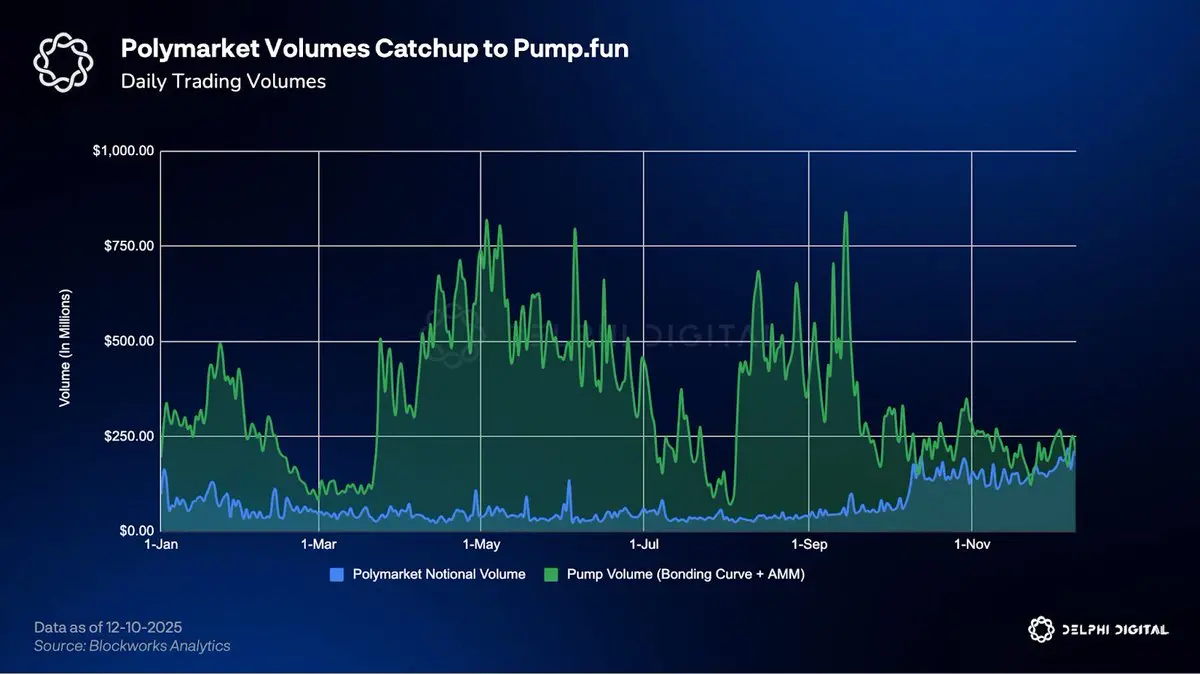
Prediction markets have leaped from a niche field to a sector with a scale exceeding $600 million. What are the development trends for the next phase?

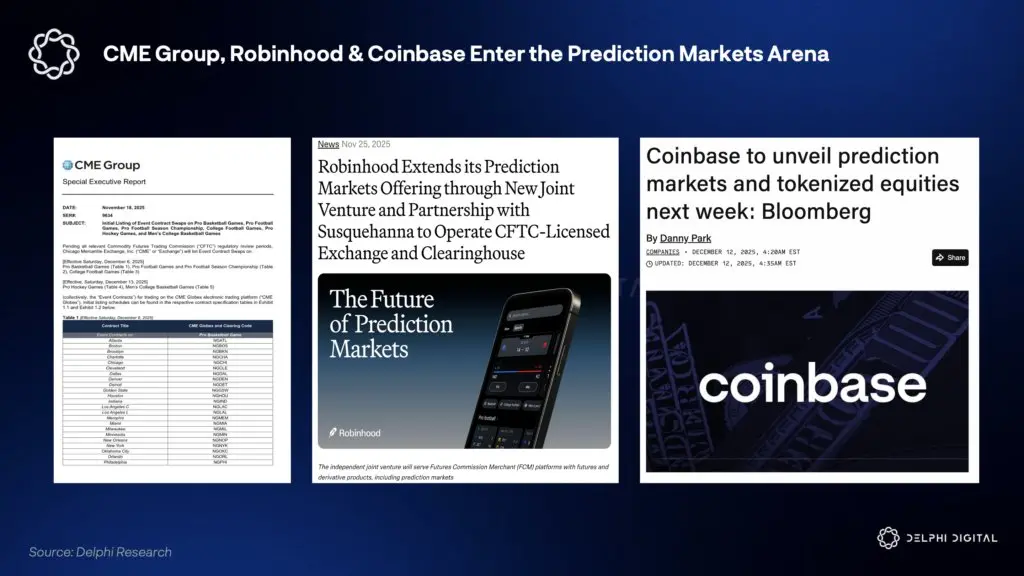
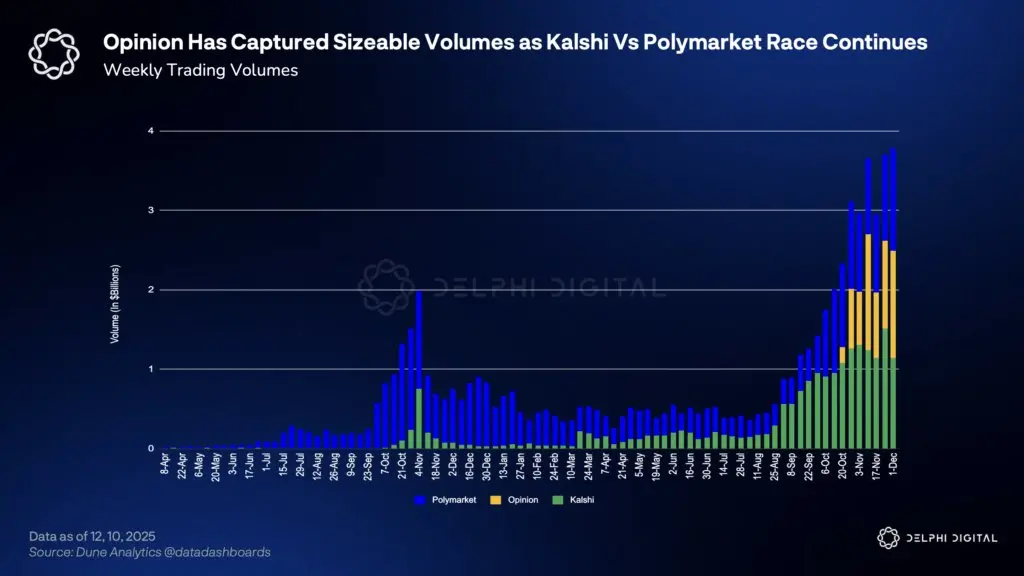
Giants are entering the arena: CME Group plans to launch sports markets, Coinbase is launching prediction markets, Robinhood acquired MIAXdx to offer in-house markets, thereby reducing reliance on Kalshi. Meanwhile, Polymarket and Kalshi are aggressively expanding to compete for market share.

Polymarket's Strategy: Build a crypto-native foundation with a CFTC-compliant architecture to aggregate the largest liquidity.

  • Return to the US Market: Through its acquired licensed exchange, it is about to regain CFTC approval and go live.

  • Web2 Expansion: Reaching entirely new audiences through partnerships with UFC, NFL, and Yahoo Finance.

  • On-Chain Moat: Consolidating dominance and improving user retention through potential airdrop expectations and wallet integrations.

Kalshi's Strategy: Leverage compliance moat and order book liquidity to expand into global and on-chain markets.

  • Global Expansion: With $300 million in funding, Kalshi is expanding to 140 countries, challenging Polymarket's international advantage.

  • On-Chain Integration: Kalshi chooses not to compete directly with DeFi but instead provides liquidity to Jupiter and gains additional volume through high-traffic on-chain hubs like Phantom.

Kingmaker Effect

Layer 1 and Layer 2 now have real economic incentives to compete for prediction market share. Ecosystem grant programs targeting prediction market projects and their trading volume are expected to emerge.

General-purpose prediction market platforms will struggle to compete with existing liquidity giants. The real opportunity lies in verticalized markets built for specific user groups.

Prediction 1: The "Perpetual-ization" of Options

Perpetual contracts simplified derivatives trading by removing expiration dates. Prediction markets can apply the same logic to options.

A market asking "Will Bitcoin close above $150,000 on June 30th?" is essentially a cash-settled binary option. There are no Greeks, no strike chains, no complex pricing models. Just a simple 0-100 probability that anyone can understand. Repackaging volatility into an easily digestible form through prediction markets will drive new demand for on-chain options.

Protocols like @Euphoria_fi are pushing this concept further with "click-to-trade" interfaces designed to feel more like gaming than operating a complex trading terminal.

Prediction 2: On-Chain Native Risk Markets

Prediction markets are poised to become core infrastructure by filling the gap for native insurance. Markets need tools to hedge DeFi risk exposures. To scale, DeFi needs native, trustless ways to规避 these risks.

Short-term (15/30 day rolling) markets like "Will stETH trade below 0.98 ETH for more than 1 hour in January?" allow users to precisely hedge specific risks.

Finding counterparties for these markets is very difficult. LPs can earn small premiums but face tail risk of being wiped out. Nonetheless, platforms that crack this nut will immediately gain favor with players who have massive sums locked in DeFi.

Prediction 3: Unbundling

The real opportunity is not to compete directly with Polymarket, but to unbundle the tech stack to serve different user types.

Professional users need tools to gain an edge and discover new opportunities in an expanding universe of markets.

  • Aggregators: Unified dashboards for trading across multiple platforms. Examples: @ConvergeMarkets, @KairosTradeX, @fireplacegg terminals.

  • Advanced Analytics: Risk modeling, alternative data sources, and wallet tracking. Examples: @hash_dive, @Polysights.

Financial speculation is a large market, but social娱乐 is even larger. Betting with friends is human nature,极其 natural. Today's interfaces are designed primarily for traders, not the broader mass market. An interface aimed at broad adoption should optimize for "social signaling," not just profit maximization.

The "super users" running these tools at scale may not be human. Funds managed by AI Agents will monitor data streams in real-time, discover mispriced markets, and execute arbitrage at speeds far exceeding humans. As these players enter, the easy arbitrage edges in binary markets are expected to disappear.

As the easy edges in prediction markets are arbitraged away, capital and users will shift to new mechanisms:

  • Impact Markets: Price the consequence (impact) of an outcome rather than its likelihood of happening. (e.g., @lightconexyz)

  • Sentiment Markets: Markets where participants predict group sentiment rather than real-world outcomes. (e.g., @meleemarkets)

  • Virtual Sports: Crypto-native versions (e.g., @footballdotfun) turn player cards into tradable liquid assets.

  • Futarchy: Governance decisions driven by market predictions on whether proposals will meet target metrics. (e.g., @MetaDAOProject)

  • Coordination Markets: A protocol sets a goal, participants buy tokens and take action to achieve it. If the goal is met, everyone profits through yields and token appreciation. (e.g., @hyperstiti0ns)

Prediction markets are becoming more than just speculation; they are evolving into infrastructure for options, insurance, and governance.

Recommended Reading:

RootData 2025 Web3 Industry Annual Report

Binance Power Shift: The Dilemma of a 300 Million User Empire

Beyond Stablecoins: Circle Releases 2026 Strategy Report, Internet Financial System Has Fully Emerged

InfoFi Narrative Collapses, Kaito, Cookie and Others Shut Down Related Products

Связанные с этим вопросы

QWhat are the three major trends in prediction markets identified by Delphi Digital?

AThe three major trends are: 1) The 'perpetualization' of options, which simplifies derivatives trading by removing expiration dates. 2) The rise of on-chain native risk markets to provide native, trustless ways to hedge DeFi risk exposure. 3) The unbundling of the tech stack to serve different user types, such as professional traders and the broader social entertainment market.

QHow is Polymarket strategizing to compete in the prediction market space?

APolymarket's strategy is to build a crypto-native base with a CFTC-compliant architecture to aggregate the largest liquidity. Its key moves include re-entering the US market through its acquired licensed exchange, expanding to Web2 audiences via partnerships with organizations like the NFL and Yahoo Finance, and solidifying its dominance through potential airdrop expectations and wallet integrations to improve user retention.

QWhat is Kalshi's approach to global expansion and its relationship with DeFi?

AKalshi is leveraging its compliance moat and order book liquidity to expand globally. With $300 million in funding, it is expanding into 140 countries to challenge Polymarket's international advantage. Instead of competing directly with DeFi, Kalshi is providing liquidity to platforms like Jupiter and acquiring additional trading volume through high-traffic on-chain hubs like Phantom.

QWhat new market mechanisms are expected to emerge as simple arbitrage opportunities in binary markets diminish?

AAs simple arbitrage advantages in binary markets are exhausted, new mechanisms are expected to gain traction. These include impact markets (pricing the consequence of an outcome), sentiment markets (predicting group sentiment rather than real-world outcomes), virtual sports (crypto-native versions that turn player cards into tradable assets), futarchy (governance decisions driven by market predictions), and coordination markets (where participants buy tokens and take actions to achieve a protocol-set goal for collective profit).

QHow are prediction markets evolving beyond mere speculation according to the article?

APrediction markets are evolving to become core infrastructure for options, insurance, and governance. They are being used to create simplified, easy-to-understand derivatives, provide native hedging tools for DeFi risks, and drive governance decisions through futarchy and other novel coordination mechanisms.

Похожее

Near Returns to the AI Stage: Transformation into a Public Chain Due to 'Payroll Difficulties,' Agent and Privacy Emerge as New Growth Narratives

NEAR Returns to AI Origins: From Payroll Struggles to Blockchain, Now Focusing on AI Agents and Privacy NEAR Protocol's journey began not with grand blockchain ambitions, but from a practical hurdle: its AI startup founders, including Transformer paper co-author Illia Polosukhin, couldn't efficiently pay international developers in 2017. This led them to pivot and build a high-performance, scalable blockchain. After years navigating various crypto narratives like sharding and cross-chain interoperability, NEAR is now leveraging its AI roots to re-enter the AI arena. A key driver is its "NEAR Intents" layer, which abstracts complex cross-chain transactions. Users simply state their goal (e.g., swap BTC for ETH), and a solver network finds the optimal route. This system has processed over $20B in cross-chain volume, generating significant fee revenue. A major growth area is private transactions via "Confidential Intents/Swaps," which hide trade details until settlement to protect against MEV and front-running. Remarkably, private swaps recently accounted for over 40% of NEAR's transaction volume, highlighting strong demand but also potential regulatory scrutiny. With its AI-founder pedigree, NEAR is positioning itself at the intersection of blockchain, AI agents, and privacy, aiming to become infrastructure for the emerging agent economy while navigating the challenges of its rapid adoption.

marsbit1 ч. назад

Near Returns to the AI Stage: Transformation into a Public Chain Due to 'Payroll Difficulties,' Agent and Privacy Emerge as New Growth Narratives

marsbit1 ч. назад

From Ethereum to AI's 'CROPS': What Exactly is This Set of 'Slow Variables' That Vitalik Repeatedly Emphasizes?

In recent discussions, Vitalik Buterin has frequently emphasized the concept of "CROPS," a framework defining core values for Ethereum's development. CROPS stands for Censorship Resistance, Capture Resistance, Open Source, Privacy, and Security. Initially outlined in the Ethereum Foundation's "EF Mandate," it represents a commitment to user sovereignty, ensuring that the network resists external control, remains open, protects privacy, and prioritizes security. The relevance of CROPS extends beyond Ethereum's foundational principles, becoming crucial in the context of AI integration. As AI agents begin handling wallet operations and automated transactions, the risk increases that users may cede control over their digital assets, privacy, and intentions to centralized AI service providers. A "CROPS AI" would therefore emphasize local execution where possible, privacy-preserving remote model calls (e.g., using zero-knowledge proofs), and transparent, verifiable processes to maintain user agency. Vitalik highlights a significant convergence between "CROPS Ethereum access layer" and "CROPS AI." Both address the same fundamental challenge: how users can access powerful services—be it blockchain data via RPCs or AI models—without exposing sensitive information or relinquishing ultimate control. This intersection points toward a future digital entry point that is more private, secure, and user-controlled. Ultimately, CROPS is not merely an abstract ideal but a practical guidepost. It steers development—from protocol resilience and wallet design to AI agent safety—towards a future where users retain self-sovereignty even as digital systems grow more complex and powerful. In an era of accelerating AI adoption, these "slow variables" of censorship resistance, openness, privacy, and security may define Ethereum's enduring value.

marsbit1 ч. назад

From Ethereum to AI's 'CROPS': What Exactly is This Set of 'Slow Variables' That Vitalik Repeatedly Emphasizes?

marsbit1 ч. назад

Silicon Valley 'Startup Guru' Steve Hoffman: Web3 + AI Could Be a Trap

Silicon Valley investor and "Godfather of Startups" Steve Hoffman warns that combining Web3 with AI is likely a trap, not a promising venture. In an interview, Hoffman argues that while AI is a foundational technology touching all industries, Web3 adds complexity, friction, and regulatory risk without solving mainstream consumer or business needs. He advises founders to focus on deep, specialized applications where startups can out-iterate giants, rather than on generic features easily replicated by large tech companies. Hoffman observes that Silicon Valley will lead foundational AI research, while China excels at rapid, large-scale application and commercialization, particularly in robotics. He stresses that AI-driven autonomous agents capable of collaborative, multi-step tasks are 2-4 years away, which will cause significant job displacement. The solution is not to slow AI but to redesign business models around human-AI collaboration and reform social systems like education and retraining. For startups, Hoffman recommends focusing on vertical, expertise-heavy domains to build defensibility. He sees major opportunities in AI fraud detection and cybersecurity. Key founder mindsets include systemic thinking over feature-focus, relentless customer centricity, building adaptive teams, and deeply understanding AI's capabilities and limits. Hoffman is also leading a non-profit initiative to establish university centers aimed at training future leaders in responsible, human-value-aligned AI innovation.

marsbit3 ч. назад

Silicon Valley 'Startup Guru' Steve Hoffman: Web3 + AI Could Be a Trap

marsbit3 ч. назад

Token Inefficient, Economy Tokenless

The article "Tokens Aren't Economical, Economics Aren't Tokenized" analyzes a pivotal shift in the AI industry from a technology-driven narrative to one dominated by capital efficiency. It highlights two concurrent trends: a severe capital shortage due to the exorbitant and recurring costs of compute (e.g., OpenAI's high burn rate) and a wave of corporate spin-offs where major tech companies are separating their AI units (like Kuaishou's Kling and Baidu's Kunlunxin). The core argument is that AI's "anti-internet" business model, where user growth increases costs rather than profits, has created a disconnect between high valuations and actual cash flow. Spin-offs address this by allowing AI assets to be valued independently. Within a parent company, they are seen as cost centers, but as standalone entities, they are priced based on their growth potential and scarcity in the primary market, leading to massive valuation premiums (e.g., Kling's estimated value tripling post-spin-off). The industry is at an inflection point, moving from "model worship" to "value realization." The competition is evolving from a pure compute (GPU) race to a broader focus on systemic efficiency and full-stack engineering (involving CPUs and orchestration) to achieve viable commercialization. The year 2026 is framed as a critical moment where the industry must definitively answer how to economically translate AI capability into tangible business value, reshaping the sector's future power structure.

marsbit3 ч. назад

Token Inefficient, Economy Tokenless

marsbit3 ч. назад

Торговля

Спот
Фьючерсы
活动图片