Deciphering Messari's 100,000-Word Annual Report (Part 2): ETH Underperforms BTC—Marginalization or Pricing Dilemma?

marsbitОпубликовано 2025-12-29Обновлено 2025-12-29

Введение

Analysis of Messari's 2025 Annual Report: Why ETH Underperformed BTC ETH's underperformance against BTC in 2025 is not a sign of its marginalization but rather a reflection of its complex and evolving pricing logic. While BTC thrives on a singular narrative as a macro hedge and institutional asset, ETH serves multiple roles: a decentralized settlement layer, DeFi infrastructure, and a production network with ongoing upgrades. Key data shows Ethereum's usage grew significantly in stablecoins, RWA, and institutional settlements, often occurring on L2s rather than L1. This shift reduced direct fee revenue for ETH, weakening its value capture despite increased network utility. Competition from chains like Solana and Hyperliquid further pressured L1 fee income, but Ethereum remained the dominant settlement layer for high-value, institutional-grade activity. ETH's asset narrative remains tied to BTC's macro momentum. While ETH ETF flows eventually improved, its monetary premium is still derivative of BTC's consensus. The core issue is structural: Ethereum is becoming essential global financial infrastructure, but ETH's value relies more on abstract security premiums and macro risk sentiment than direct cash flows. In conclusion, ETH is not being replaced. It operates as the financial operating system built atop BTC's monetary anchor—critically important, yet not yet independently priced.

Author: Merkle3s Capital

This article is based on the annual report "The Crypto Theses 2026" released by Messari in December 2025. The full report exceeds 100,000 words, with an official estimated reading time of 401 minutes.

This content is supported by Block Analytics Ltd X Merkle 3s Capital. The information herein is for reference only and does not constitute any investment advice or offer. We are not responsible for the accuracy of the content, nor do we assume any consequences arising therefrom.

"Deciphering Messari's 100,000-Word Annual Report (Part 1): Why Did Market Sentiment Collapse Completely in 2025?"

Introduction: When ETH Starts Underperforming, What's the Problem?

Over the past year, ETH underperforming BTC has almost become an indisputable fact.

Whether in terms of price performance, market sentiment, or narrative strength, BTC has been continuously reinforced as the "only core asset":

ETFs, institutional allocation, macro hedging, dollar hedging... Every narrative is converging on BTC.

In contrast, ETH's situation seems somewhat awkward.

It remains the most important underlying network for DeFi, stablecoins, RWA, and on-chain finance, yet it continues to lag in asset performance.

This raises a question that has been repeatedly discussed but never thoroughly dissected:

Is ETH underperforming BTC because it is being marginalized, or because the market is pricing it using a flawed method?

The answer given by Messari in their latest 100,000-word annual report is not one that caters to sentiment or takes sides with any particular chain.

They are more concerned with: where capital is actually being deployed, and what institutions are truly putting on-chain.

From this perspective, ETH's "problem" might be different from what most people imagine.

This article will not discuss beliefs or compare TPS, Gas, or technical roadmaps. We will do only one thing:

Follow Messari's data to clearly break down why ETH is underperforming BTC.

Chapter 1: ETH Underperforming BTC Is Not Inherently Abnormal

If you only at the price performance from 2024–2025, ETH underperforming BTC might lead many to an intuitive judgment:

Has something gone wrong with ETH?

But from a historical and structural perspective, ETH underperforming BTC is not an "anomaly" in itself.

BTC is an asset with a highly singular narrative.

Its pricing logic is clear, consensus is concentrated, and variables are extremely few.

When the market enters a phase of macro uncertainty, regulatory shifts, or institutions reassessing risk assets, BTC often captures the premium first.

ETH is the complete opposite.

ETH simultaneously plays three roles:

  • Decentralized settlement layer

  • Infrastructure for DeFi and stablecoins

  • A "productive network" with a technical upgrade path and execution risks

This means that ETH's price does not only reflect "macro consensus" but is also forced to absorb multiple variables such as technical节奏 (rhythm/timing), ecological changes, and value capture structure.

Messari clearly states in the report:

ETH's problem is not "disappearing demand," but "increasingly complex pricing logic."

In 2025, ETH still held a dominant position in key metrics like on-chain activity, stablecoin settlement, and RWA hosting.

But this growth does not immediately translate into asset premium, unlike BTC's ETF or macro narratives.

In other words, ETH underperforming BTC does not mean the market is rejecting Ethereum.

It more likely means the market temporarily doesn't know how to price it.

What is truly worth警惕 (vigilance/caution) is not the "underperformance" itself,

but rather: when ETH is heavily used, whether this usage can continue to feedback into the ETH asset.

This is the real issue Messari is concerned about.

Chapter 2: Usage is Increasing, But Value Isn't Keeping Up? ETH's Value Capture Dilemma

What really made the market start doubting ETH was not the price underperforming BTC,

but a more glaring fact: Ethereum is being heavily used, but ETH asset itself is not benefiting proportionally.

Messari provides a set of key data in the report:

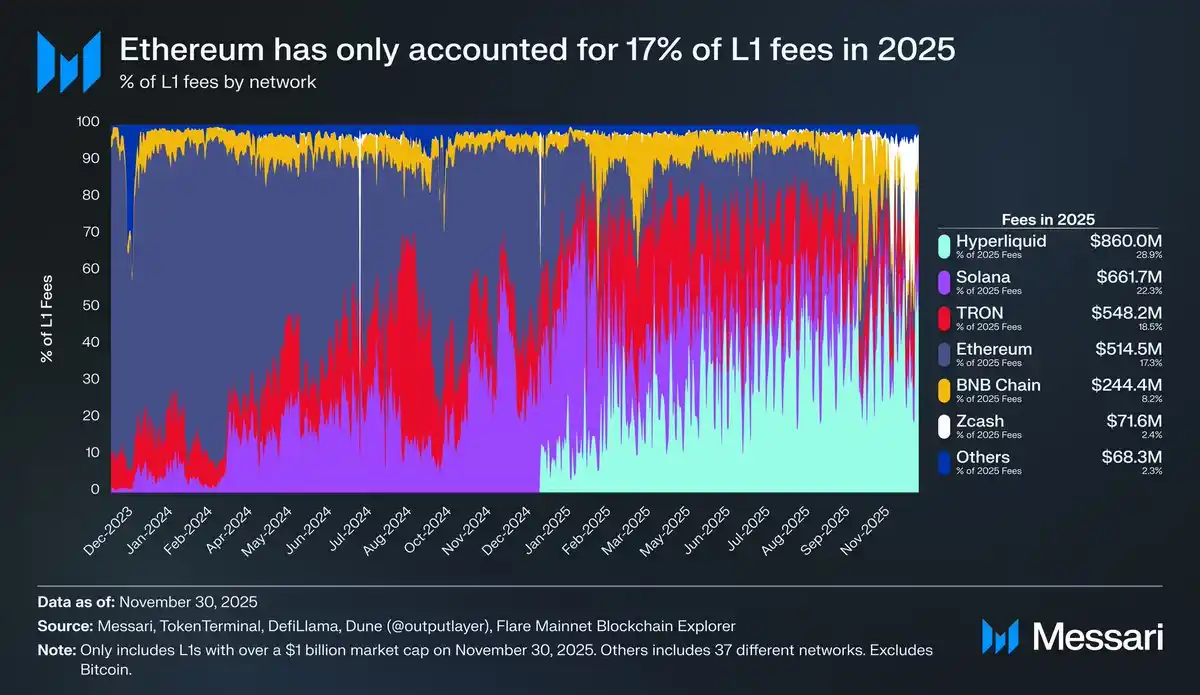
With the rise of competitive L1s, Ethereum's share of L1 transaction fees has been continuously declining.

  • Solana re-established its position as a high-performance execution layer in 2024,

  • Hyperliquid rapidly scaled through on-chain derivatives in 2025,

  • Together, they squeezed Ethereum's share in the dimension of "direct monetization of economic activity."

By 2025, Ethereum's share of L1 fees had fallen to about 17%,

dropping to fourth place among L1s.

Just a year earlier, it firmly held the top spot.

Fees are not the only indicator of network value, but they are an extremely honest signal:

Where fees are collected is where real trading behavior and risk appetite reside.

This is also where ETH's core矛盾 (contradiction) begins to show.

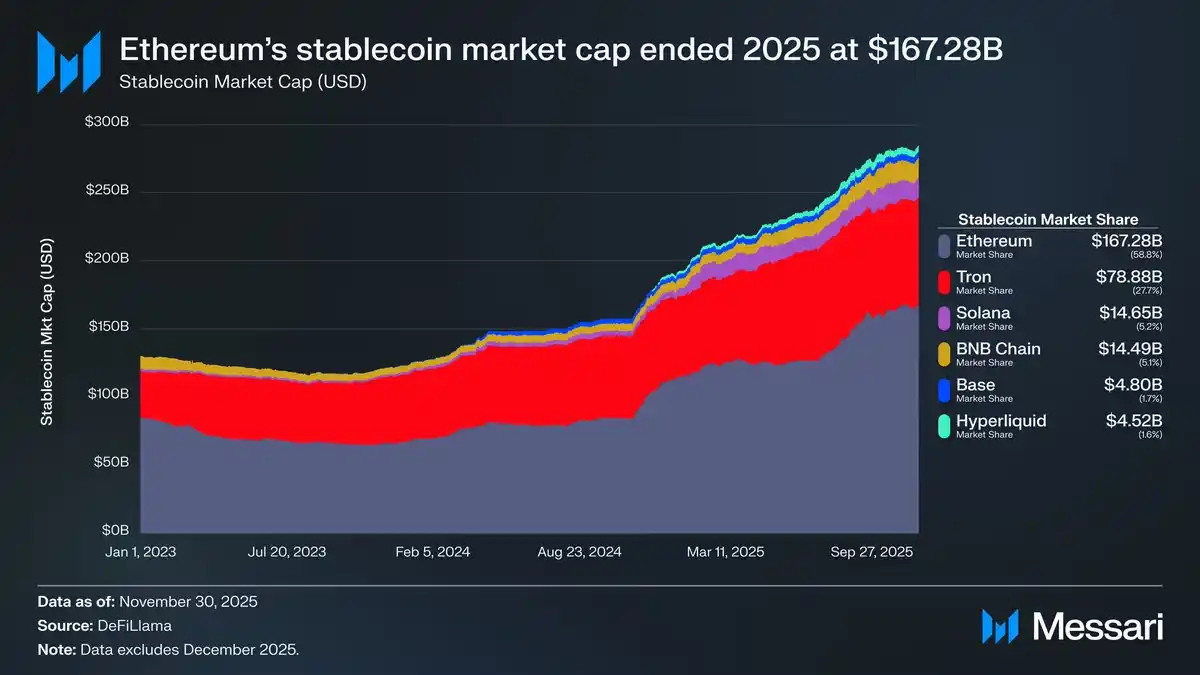
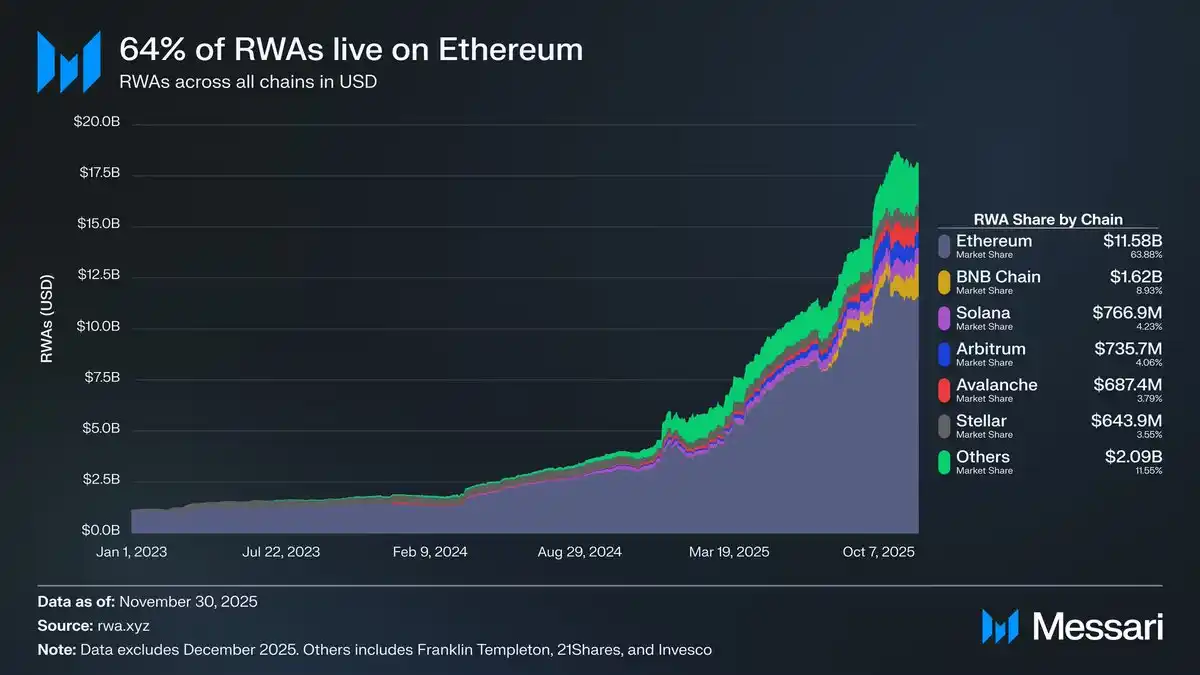
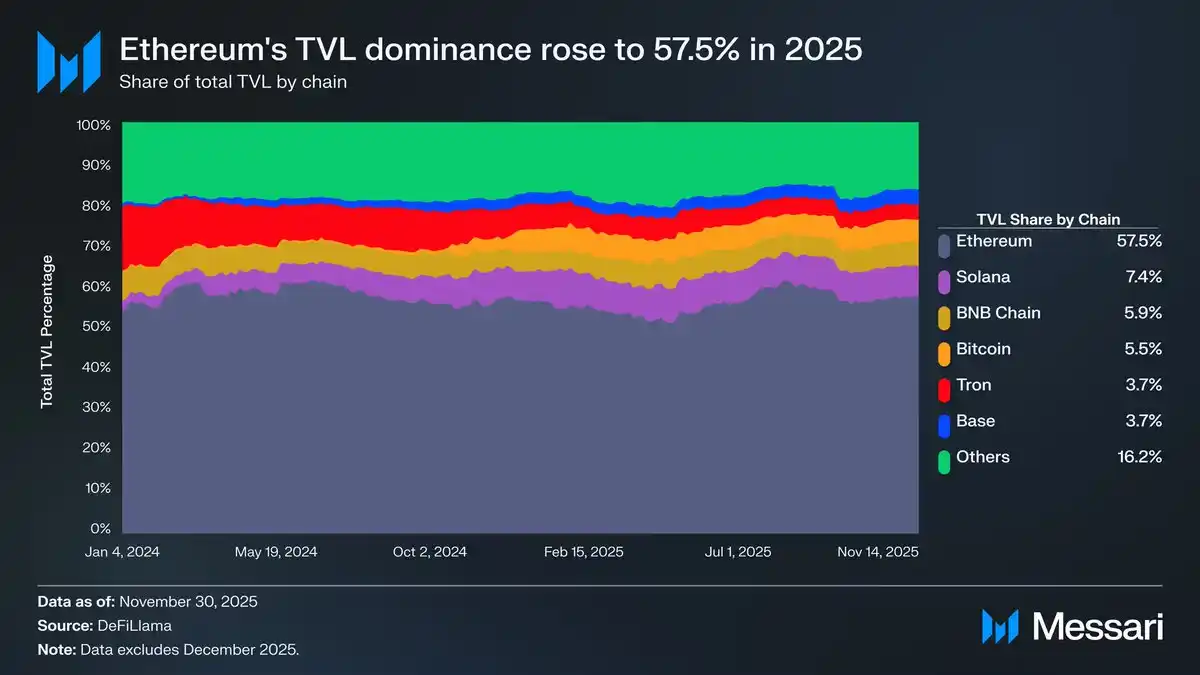
Ethereum has not lost users. On the contrary, its position in areas like stablecoins, RWA, and institutional settlement has become more solid. The problem is, these activities are increasingly happening on L2s or at the application layer, rather than being directly reflected as L1 fee revenue.

In other words: Ethereum as a system is becoming more important, while ETH as an asset is increasingly resembling "diluted equity."

This is not a technical failure, but an inevitable consequence of architectural choices.

The Rollup scaling route successfully reduced transaction costs and increased throughput, but it also objectively weakened ETH's ability to directly capture usage value.

When usage is "outsourced" to L2s, ETH's revenue comes more from abstract security premiums and monetary expectations, rather than cash flow.

This is also why the market hesitates when pricing ETH:

Is it an asset that compounds with usage growth, or is it becoming more like a "public infrastructure" neutral settlement layer?

This issue is further amplified as multi-chain competition intensifies.

Chapter 3: Multi-Chain is Not the Threat, the Real Pressure Comes from "Execution Layer Substitution"

If you only look at the narrative level, ETH seems to have more and more competitors.

Solana, various high-performance L1s, app-chains, even dedicated trading chains have emerged one after another,

easily leading to the conclusion: ETH is being marginalized by a "multi-chain world."

But Messari's judgment is calmer, and also more残酷 (cruel/harsh).

Multi-chain itself is not a threat to ETH.

The real pressure comes from the continuous substitution of the execution layer, while the value of the settlement layer is difficult for the market to price directly.

Take Solana as an example:

  • Solana recaptured the主场 (home ground) for high-frequency trading and retail activity in 2024–2025,

  • Leading明显 (significantly) in spot trading volume, on-chain activity, and low-latency experience.

But this growth is more reflected in "trading experience" and "traffic density," rather than stablecoin清算 (settlement/clearing), RWA custody, or institutional-grade settlement.

Messari repeatedly emphasizes a fact in the report:

When institutions actually put money on-chain, they still首选 (prefer/choose first) Ethereum.

Stablecoin issuance, Tokenized T-bills, on-chain fund shares, compliant custody paths—these most "boring" but most critical financial infrastructures—are still highly concentrated in the Ethereum ecosystem.

This also explains a seemingly contradictory phenomenon: ETH's asset performance is under pressure, but Ethereum has反而 (instead) further consolidated its leading advantage in the dimension of "blockchain institutions are willing to use."

The problem is, the market does not automatically pay a premium just because "you are important."

When execution layer revenue is taken by other chains, and the value of the settlement layer is more reflected in "security" and "compliance credibility," ETH's pricing logic inevitably becomes abstract.

In other words:

ETH is not "being replaced," but is being pushed to assume a role more akin to public infrastructure.

And infrastructure often sees higher usage rates, yet finds it harder to tell a story for asset premiums.

This is where the fundamental difference between ETH and BTC begins to彻底 (thoroughly) diverge.

Chapter 4: ETH Still Relies on BTC's "Macro Anchor"

If the first three chapters answer one question—Has ETH been marginalized?

Then this chapter must face a more残酷 (cruel/harsh) and realistic judgment:

Even if ETH is not replaced, at the asset pricing level, it remains deeply依附于 (dependent on) BTC.

Messari repeatedly emphasizes a fact overlooked by many in the report:

The market is not pricing "blockchain networks," but rather things that can be abstracted as macro assets.

On this point, the divergence between BTC and ETH is extremely clear.

BTC's narrative has been彻底 (completely) simplified to three things:

  • Macro hedging asset

  • Digital gold

  • A "monetary asset" acceptable to institutions, ETFs, and national balance sheets

ETH's narrative, however, is much more complex.

It is both a settlement layer and a technical platform; it承载 (carries/bears) financial activities while constantly undergoing upgrades and structural adjustments.

This makes it very difficult for ETH to be directly纳入 (incorporated into) a "macro asset basket" like BTC.

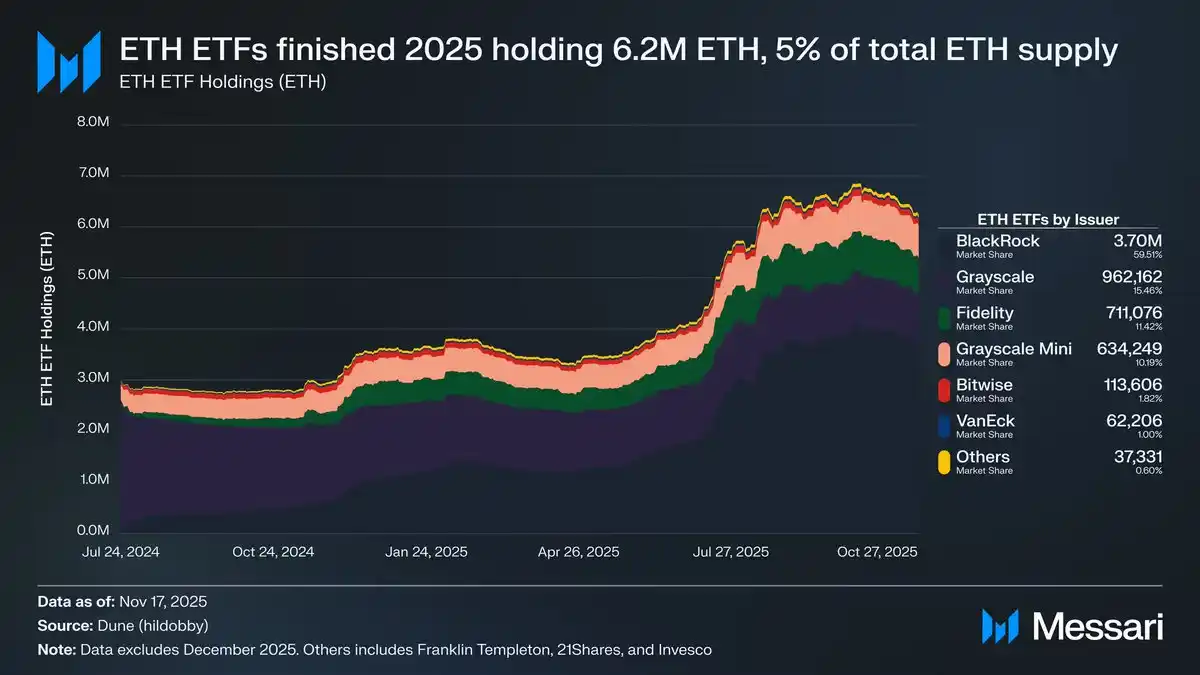
This difference is particularly evident in ETF fund flows.

When the ETH spot ETF was first launched in early 2024, the market一度 (once) believed: institutions had almost no interest in ETH.

For the first six months, ETH ETF inflows were significantly weaker than BTC's, reinforcing the narrative that "BTC is the only institutional asset."

But Messari points out that this conclusion itself is misleading.

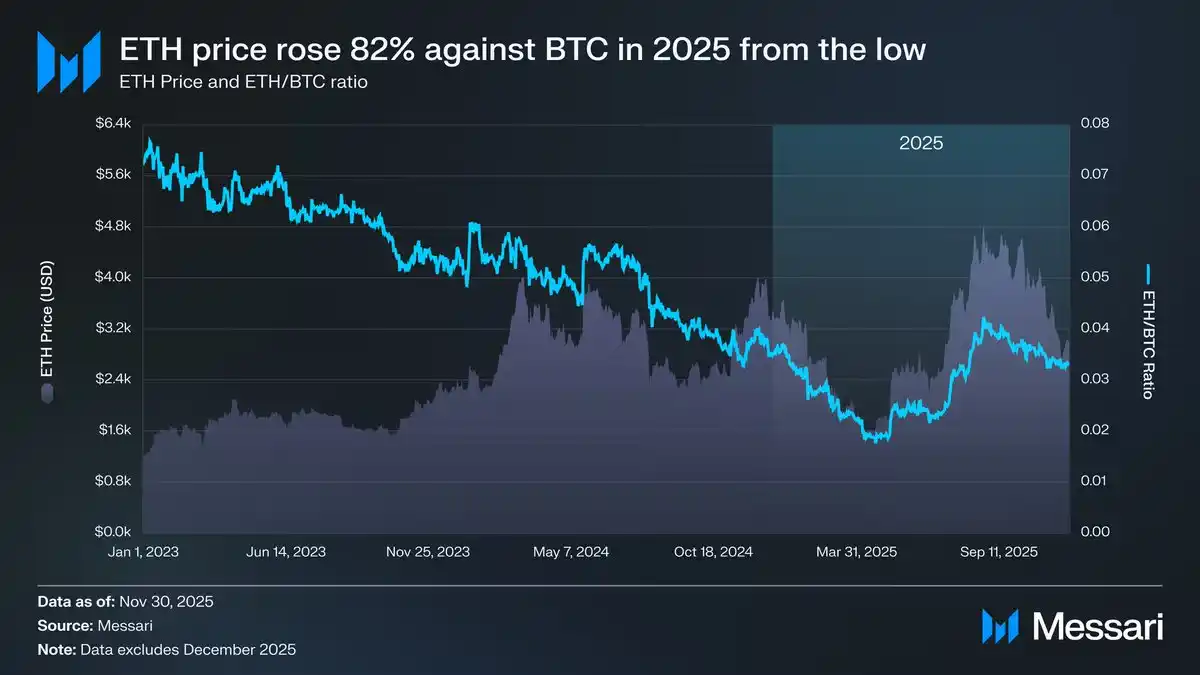
As the ETH price and the ETH/BTC ratio rebounded simultaneously in mid-2025, fund behavior began to change.

  • ETH/BTC rebounded from a low of 0.017 to 0.042, a gain of over 100%

  • ETH's USD price rose nearly 200% in the same period

  • ETH ETF inflows began to accelerate significantly

In some periods, new inflows into ETH ETFs even briefly surpassed those of BTC.

This说明 (indicates/shows) one thing:

Institutions are not unwilling to buy ETH, but are waiting for "narrative certainty."

Even so, Messari still offers a sobering conclusion:

ETH's monetary premium remains, to this day, a "secondary derivative" of BTC's monetary consensus.

In other words, the reason the market is willing to embrace ETH again at certain stages is not because ETH has become an independent macro asset, but because BTC's macro narrative remains valid and spills over to the risk curve.

As long as BTC remains the pricing anchor for the entire crypto market, ETH's strength or weakness will inevitably be measured in BTC's shadow.

This does not mean ETH has no upside potential. On the contrary,前提 (provided that) the BTC trend holds, ETH often possesses higher elasticity and stronger Beta.

But it also means:

ETH's asset narrative has not yet completed its "de-BTC-ification."

Until ETH can demonstrate, over longer cycles, lower BTC correlation, more stable independent demand sources, and a clearer value capture path,

it will still be viewed by the market as:

A second-layer belief asset built on top of BTC.

Chapter 5: Is ETH Threatened? The Real Question Was Never About Winning or Losing

By discussing this far, we can actually answer a question that is repeatedly raised:

Will ETH be "replaced" by other chains?

Messari's answer is clear:

No.

At least for the foreseeable future, Ethereum remains the default foundation for on-chain finance, stablecoins, RWA, and institutional settlement.

It is not the fastest chain, but it is the chain最先 (first) allowed to carry real funds.

What is truly worth worrying about is not "whether ETH will lose to Solana, Hyperliquid, or the next new chain,"

but another, more uncomfortable question:

As an asset, can ETH still持续 (continuously) benefit from Ethereum's success?

This is a structural problem, not a technical one.

Ethereum is increasingly resembling "public financial infrastructure":

  • Usage is growing

  • System importance is increasing

  • Institutional reliance is deepening

But at the same time, ETH's value capture relies increasingly on:

  • Monetary premium

  • Security premium

  • Spillover from macro risk appetite

Rather than direct cash flow or fee growth.

This is also why ETH's asset performance increasingly resembles a "high-Beta derivative asset of BTC," rather than a network equity with an independent pricing system.

In a multi-chain world, execution layers can be competed for, traffic can be分流 (diverted/split), but settlement layers do not migrate frequently.

Ethereum恰恰 (precisely) stands in this most stable, yet最难 (most difficult) position to be rewarded by market sentiment.

Therefore, ETH underperforming BTC does not signify failure.

It is more like a result of role division:

  • BTC承担 (bears/undertakes) macro narrative, monetary consensus, and asset anchoring

  • ETH承担 (bears/undertakes) settlement, financial infrastructure, and system security

The only problem is, the market is more willing to pay a premium for the former, while remaining克制 (restrained/cautious) towards the latter.

Messari's conclusion is not激进 (radical), but足够 (sufficiently) honest:

ETH's monetary story has been repaired, but is not yet complete. It can rise significantly when the BTC trend is established, but it has not yet proven it can be priced independently脱离 (detached from) BTC.

This is not a negation of ETH, but a阶段性 (stage-specific) positioning.

In an era where BTC remains the only macro anchor of the crypto market,

ETH is more like the financial operating system built upon this anchor.

It is important, it is irreplaceable, but for now, it is not yet the asset that gets "priced first."

At least for now, it is not.

Связанные с этим вопросы

QAccording to the Messari report, why has ETH underperformed BTC in terms of asset performance?

AETH's underperformance is not due to being marginalized, but because its pricing logic has become more complex. While BTC has a clear, singular macro narrative, ETH must absorb multiple variables including technical upgrades, ecosystem changes, and value capture structures, making its pricing less straightforward.

QWhat key data point from Messari highlights a core contradiction in Ethereum's value capture?

AA key contradiction is that while its usage is growing (e.g., in stablecoins, RWA, and institutional settlement), Ethereum's share of L1 transaction fees has declined significantly to around 17%, ranking fourth among L1s, indicating that value is not being directly captured by the ETH asset.

QWhat does Messari identify as the real pressure on ETH, rather than competition from other chains?

AThe real pressure is not multi-chain competition itself, but the 'substitution of the execution layer.' While other chains like Solana capture high-frequency trading, Ethereum remains the preferred settlement layer for institutional, high-value activities, but this foundational role is harder for the market to price directly compared to execution-based revenue.

QHow does the report describe the relationship between ETH's asset narrative and BTC's?

AThe report states that ETH's monetary premium is still a 'secondary derivative' of BTC's monetary consensus. ETH's asset narrative is deeply tied to BTC's; it benefits when BTC's macro narrative is strong but has not yet proven it can be priced independently as a standalone macro asset.

QWhat is the fundamental structural problem for ETH as an asset, according to the analysis?

AThe structural problem is that Ethereum is becoming crucial 'public financial infrastructure' with growing usage and institutional reliance, but the value capture for the ETH asset is increasingly dependent on abstract monetary and security premiums rather than direct cash flow, making its pricing more indirect and complex.

Похожее

Jensen Huang 'Saves' South Korean Stock Market: Locks In SK Hynix Memory, Chip Shortage to Continue

On June 5th, South Korea's stock market experienced a sharp decline, with major chipmakers like Samsung and SK Hynix dropping nearly 10%. Amidst the turmoil, NVIDIA CEO Jensen Huang's visit to Seoul played a dramatic role in boosting market sentiment. Following a dinner meeting with SK Group Chairman Chey Tae-won and SK Hynix CEO Kwak Noh-Jung, Huang confirmed that NVIDIA's new Vera CPU will utilize SK Hynix DRAM. The companies announced a multi-year technical partnership to co-develop next-generation memory for NVIDIA's AI infrastructure, covering products from data centers to personal AI and robotics. This collaboration extends beyond memory supply. SK Hynix is integrating NVIDIA's AI and Omniverse platform into its own semiconductor design and manufacturing processes, including computational lithography and creating digital twins of its fabrication plants for autonomous operation. While strengthening ties with SK Hynix, NVIDIA is diversifying its supply chain for the upcoming HBM4 memory, with Samsung, SK Hynix, and Micron all certified as suppliers for its Vera Rubin platform. Despite this, Huang warned that the global chip shortage, driven by relentless demand from AI factory construction, is expected to persist for several years across the entire supply chain. His visit underscores NVIDIA's systematic effort to deepen integration with South Korea's broader tech industry.

marsbit13 мин. назад

Jensen Huang 'Saves' South Korean Stock Market: Locks In SK Hynix Memory, Chip Shortage to Continue

marsbit13 мин. назад

Nasdaq Plunges 4.2% in a Single Day: Does "Black Friday" Burst the U.S. Stock Market Bubble?

The Nasdaq plunged 4.18% on June 5, 2026, its worst single-day drop in over a year, as a much stronger-than-expected US jobs report triggered fears of economic overheating and delayed Federal Reserve interest rate cuts. The selloff, centered on high-valuation tech and AI stocks like Nvidia and Broadcom, spread across major indices. The article examines whether this signals a market top. The strong May non-farm payrolls data, nearly double expectations, pushed bond yields higher, directly hurting rate-sensitive tech stocks. This exposed vulnerabilities in the crowded AI trade, where valuations had soared on narratives of infinite growth, despite emerging signs of slowing order momentum and corporate AI monetization challenges. Prior to the drop, market indicators flashed warning signs: historically high valuations (e.g., Shiller CAPE ratio near 39.5), extreme bullish sentiment, and high levels of leverage. Technical charts showed key support levels being breached. Wall Street is divided on the outlook. Bears, citing risks of "stagflation" and AI bubble comparisons to the dot-com era, warn of a potential significant correction. Bulls view the drop as a healthy correction within a bull market, underpinned by a strong economy and expected corporate earnings growth of around 7% in 2026. The immediate future hinges on upcoming key events: the May CPI inflation data and the mid-June FOMC meeting. Their outcomes will critically shape market expectations for the Fed's rate path. The article concludes that conditions for a major market top are aligning, marking a fragile transition from narrative-driven gains to a phase demanding validation from macroeconomic data and corporate fundamentals. Caution is advised.

marsbit17 мин. назад

Nasdaq Plunges 4.2% in a Single Day: Does "Black Friday" Burst the U.S. Stock Market Bubble?

marsbit17 мин. назад

Nasdaq Plunges 4.2% in a Single Day, Did 'Black Friday' Pop the U.S. Stock Bubble?

The Nasdaq Composite plummeted 4.18% on June 5, its biggest single-day drop since April 2025, triggering widespread debate over whether the U.S. stock market has peaked. The sell-off was sparked by a stronger-than-expected U.S. non-farm payrolls report, which fueled fears of economic overheating and pushed back market expectations for Federal Reserve rate cuts, leading to a sharp rise in Treasury yields. The AI sector, the primary driver of the recent bull market, suffered severe losses, with the Philadelphia Semiconductor Index crashing over 10%. Stocks like Nvidia, Broadcom, and Micron led the decline. Concerns are mounting about the sustainability of AI capital expenditures and high valuations, with signs of order cuts for next-generation chips emerging. Analyses point to several warning signs: historically high market valuations (e.g., elevated Shiller CAPE ratio, Buffett Indicator), extreme bullish sentiment indicators, and significant insider selling. The sell-off also caused a key technical breakdown, with the S&P 500 breaking below its short-term moving average and testing its 200-day moving average. Wall Street is divided on the outlook. Bears warn this could be the start of a bubble deflation or a "stagflation" scenario, while bulls view it as a healthy, overdue correction within a bull market driven by solid corporate earnings growth. A more moderate view suggests the easy liquidity-driven rally is over, and markets are entering a phase of fundamental stock-picking with potential for consolidation. The immediate future hinges on key upcoming events: the May CPI report and the mid-June FOMC meeting. Their outcomes will be critical in determining whether this is a temporary pullback or the beginning of a more significant trend reversal. The consensus is that the era of one-directional market gains may be ending, requiring increased investor caution.

Odaily星球日报22 мин. назад

Nasdaq Plunges 4.2% in a Single Day, Did 'Black Friday' Pop the U.S. Stock Bubble?

Odaily星球日报22 мин. назад

The First Case on AI Agents: What Was Adjudicated?

"The First 'Agent' Ruling: What Was Decided?" On April 30, the Guangzhou Internet Court issued a ruling—China's first behavior preservation order in the intelligent agent (AI agent) field. The defendant, an open-source AI agent software, was ordered to stop downloads, cease actions that bypassed a platform's technical protection measures, and delete related tutorials and data. The core issue: the software used the operating system's "accessibility service" permissions to automate user interactions within other apps without those platforms' authorization. This mirrors a recent US case where Amazon sued Perplexity for similar reasons—bypassing Amazon's API to directly scrape and interact with its pages—and won a preliminary injunction. Both rulings establish a crucial legal boundary for the AI agent era: agents cannot operate unchecked. The article argues the fundamental legal principle emerging is one of **dual authorization**. An AI agent requires both **user consent** AND **platform consent** to operate legitimately within that platform's ecosystem. Bypassing platform rules through system-level permissions, even with user permission, undermines platform responsibilities for content moderation, data security, and user privacy, creating liability issues. The piece uses the evolution of "Doubao Phone" (an AI-integrated smartphone) as a case study. Its initial, aggressive version that bypassed platform controls faced roadblocks. Its upcoming 2.0 version is reportedly pivoting to negotiate API access and authorization deals with major platforms (like Alibaba's ecosystem), seen as a strategic adaptation to the new regulatory reality. A global trend is identified: the era of unregulated, "wild west" growth for AI agents is ending, replaced by a **compliance race**. This raises barriers to entry, as securing platform authorizations becomes a new cost. Open-source status is also not a legal shield if the code facilitates bypassing technical protections. In conclusion, these first rulings target not the largest, but the most **aggressive and representative** cases. By setting precedent with them, regulators are efficiently steering the entire industry towards a new, more regulated operating paradigm defined by dual authorization and platform cooperation.

marsbit27 мин. назад

The First Case on AI Agents: What Was Adjudicated?

marsbit27 мин. назад

Fired by Google Over a 14-Page Paper, Over 4,000 Rallied for Her. 6 Years Later: She Almost Predicted the Entire AI Era Back Then.

In late 2020, Google AI researcher Timnit Gebru was effectively dismissed following a conflict over a 14-page, unpublished research paper she co-authored titled "On the Dangers of Stochastic Parrots." The paper, which has since been cited over 14,000 times, raised critical early warnings about the risks of large language models (LLMs). It argued that these models, trained on vast, biased internet data, are essentially "stochastic parrots" that mimic language without true understanding, potentially amplifying societal biases, generating plausible but false information (later termed "AI hallucination"), consuming massive energy, and obscuring their training data contents. Gebru's stance led to a clash with Google management, who requested the paper's withdrawal. Her subsequent internal criticism of the company's diversity efforts and handling of the matter culminated in her termination, which sparked protests from over 4,000 Google employees and researchers. Six years later, the paper's predictions have proven remarkably prescient. Issues like AI hallucination, embedded bias (evident in resume screening and healthcare algorithms), soaring energy consumption from AI data centers, unvetted training data containing harmful content, and the risk of "model collapse" from AI-generated internet content have become central industry challenges. The incident also highlighted concerns about AI development being driven primarily by commercial competition within a handful of powerful tech companies, often at the expense of ethical considerations. After leaving Google, Gebru founded the Distributed AI Research Institute (DAIR) to explore these issues independently. The controversy underscores how her early, critical insights into the fundamental limitations and societal impacts of LLMs anticipated many of the most pressing dilemmas in today's AI era.

marsbit28 мин. назад

Fired by Google Over a 14-Page Paper, Over 4,000 Rallied for Her. 6 Years Later: She Almost Predicted the Entire AI Era Back Then.

marsbit28 мин. назад

Торговля

Спот
Фьючерсы

Популярные статьи

Как купить S

Добро пожаловать на HTX.com! Мы сделали приобретение Sonic (S) простым и удобным. Следуйте нашему пошаговому руководству и отправляйтесь в свое крипто-путешествие.Шаг 1: Создайте аккаунт на HTXИспользуйте свой адрес электронной почты или номер телефона, чтобы зарегистрироваться и бесплатно создать аккаунт на HTX. Пройдите удобную регистрацию и откройте для себя весь функционал.Создать аккаунтШаг 2: Перейдите в Купить криптовалюту и выберите свой способ оплатыКредитная/Дебетовая Карта: Используйте свою карту Visa или Mastercard для мгновенной покупки Sonic (S).Баланс: Используйте средства с баланса вашего аккаунта HTX для простой торговли.Третьи Лица: Мы добавили популярные способы оплаты, такие как Google Pay и Apple Pay, для повышения удобства.P2P: Торгуйте напрямую с другими пользователями на HTX.Внебиржевая Торговля (OTC): Мы предлагаем индивидуальные услуги и конкурентоспособные обменные курсы для трейдеров.Шаг 3: Хранение Sonic (S)После приобретения вами Sonic (S) храните их в своем аккаунте на HTX. В качестве альтернативы вы можете отправить их куда-либо с помощью перевода в блокчейне или использовать для торговли с другими криптовалютами.Шаг 4: Торговля Sonic (S)С легкостью торгуйте Sonic (S) на спотовом рынке HTX. Просто зайдите в свой аккаунт, выберите торговую пару, совершайте сделки и следите за ними в режиме реального времени. Мы предлагаем удобный интерфейс как для начинающих, так и для опытных трейдеров.

1.4k просмотров всегоОпубликовано 2025.01.15Обновлено 2026.06.02

Как купить S

Sonic: Обновления под руководством Андре Кронье – новая звезда Layer-1 на фоне спада рынка

Он решает проблемы масштабируемости, совместимости между блокчейнами и стимулов для разработчиков с помощью технологических инноваций.

2.3k просмотров всегоОпубликовано 2025.04.09Обновлено 2025.04.09

Sonic: Обновления под руководством Андре Кронье – новая звезда Layer-1 на фоне спада рынка

HTX Learn: Пройдите обучение по "Sonic" и разделите 1000 USDT

HTX Learn — ваш проводник в мир перспективных проектов, и мы запускаем специальное мероприятие "Учитесь и Зарабатывайте", посвящённое этим проектам. Наше новое направление .

1.8k просмотров всегоОпубликовано 2025.04.10Обновлено 2025.04.10

HTX Learn: Пройдите обучение по "Sonic" и разделите 1000 USDT

Обсуждения

Добро пожаловать в Сообщество HTX. Здесь вы сможете быть в курсе последних новостей о развитии платформы и получить доступ к профессиональной аналитической информации о рынке. Мнения пользователей о цене на S (S) представлены ниже.

活动图片