Culper Research: Why We Are Firmly Shorting ETH?

marsbitОпубликовано 2026-03-09Обновлено 2026-03-09

Введение

Culper Research, a Wall Street short-selling firm, presents a case for shorting Ethereum (ETH) and related securities. Their report argues that the Fusaka upgrade in December 2025 severely damaged Ethereum's tokenomics by increasing the gas limit, which caused a 90% collapse in transaction fees—far worse than the 10-30% drop predicted. This created a surplus of cheap block space, enabling a massive increase in "address poisoning" or "wallet dusting" attacks. The analysis claims that 95% of new wallet growth and over 50% of the increased transaction volume are inorganic, stemming from these spam attacks rather than genuine adoption. The report further states that Vitalik Buterin is aware of these issues and has been selling significant amounts of ETH. It also criticizes prominent bull Tom Lee for using flawed on-chain activity data as evidence of strength. Additionally, lower validator earnings are reducing staking incentives, and Ethereum is losing developer mindshare and market share to competitors like Solana, which is attracting major institutional partnerships. Culper concludes that Ethereum's economic model is broken and its value will continue to decline.

Author: Culper Research(@CulperResearch)

Compiled by: Deep Tide TechFlow

Deep Tide Introduction: Culper Research is a well-known short-selling institution on Wall Street, having accurately targeted several prominent companies. This report directly addresses the core issues of Ethereum: the Fusaka upgrade in December 2025 brought a large amount of cheap block space, but real organic demand has not kept up—the "prosperous" on-chain data is actually fabricated by address poisoning attacks. Vitalik himself has been selling a significant amount of ETH, while Tom Lee, Ethereum's most staunch bull advocate, continues to defend it with incorrect data. This article is not a prediction; it is a well-researched short thesis with data and verification, worth reading carefully for every ETH holder.

We are shorting Ethereum and ETH-linked securities, including BMNR.

We believe that the Fusaka upgrade in December 2025 has severely damaged Ethereum's token economic model. Vitalik himself knows this and is continuously selling; meanwhile, Tom Lee, ETH's most steadfast bull, is pouring good money into a bad bet.

$ETH will continue to decline.

Tom Lee's Defense: Active Addresses and Transaction Volume Are Rising

Tom Lee's $BMNR defends ETH, claiming that "ETH is not entering a death spiral because utility is increasing." He cites the surge in ETH active addresses and transaction volume after Fusaka as evidence of "strengthening fundamentals" and institutional adoption.

Lee's logic is wrong.
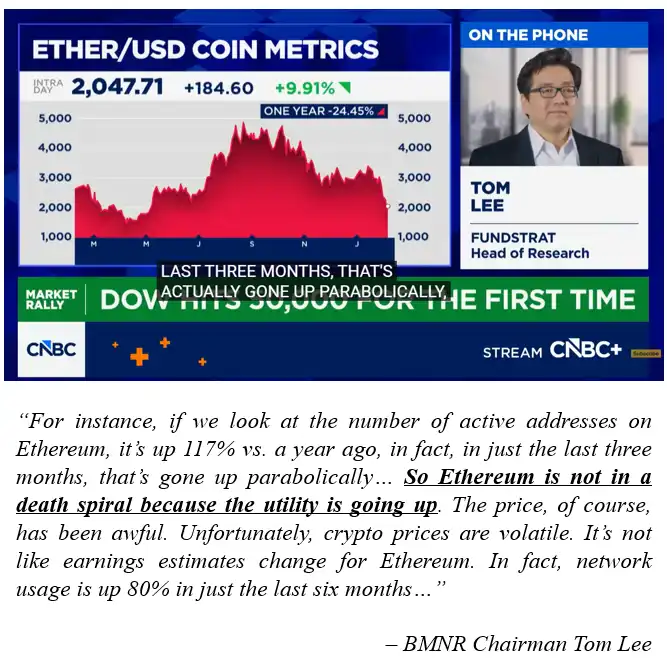
By his own logic, if ETH's on-chain activity does not reflect real utility growth, then ETH is heading toward a death spiral.

Our research shows that this is exactly what is happening.

The full report and disclosure information are now available at culperresearch.com.

The Truth About On-Chain Data: 95% of New Wallets Are Poisoning Attacks

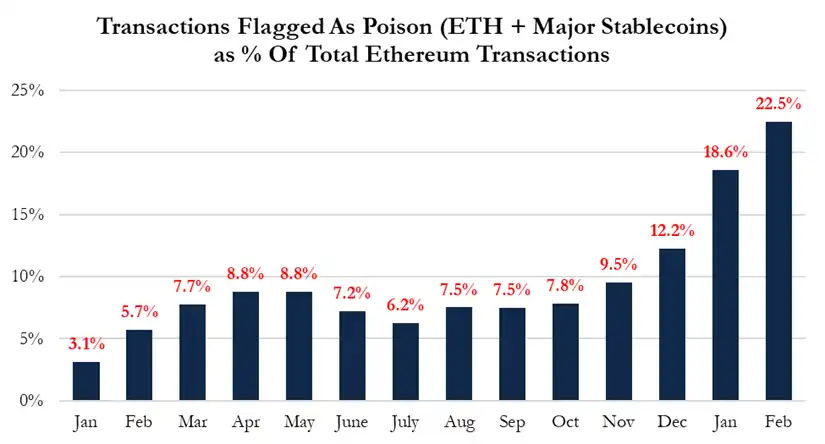
Our comprehensive analysis of on-chain data from January 2025 to February 2026 shows: the "institutional adoption" data cited by Tom Lee is actually explained by large-scale low-value address poisoning/wallet dusting attacks triggered by the block space surplus brought by Fusaka.
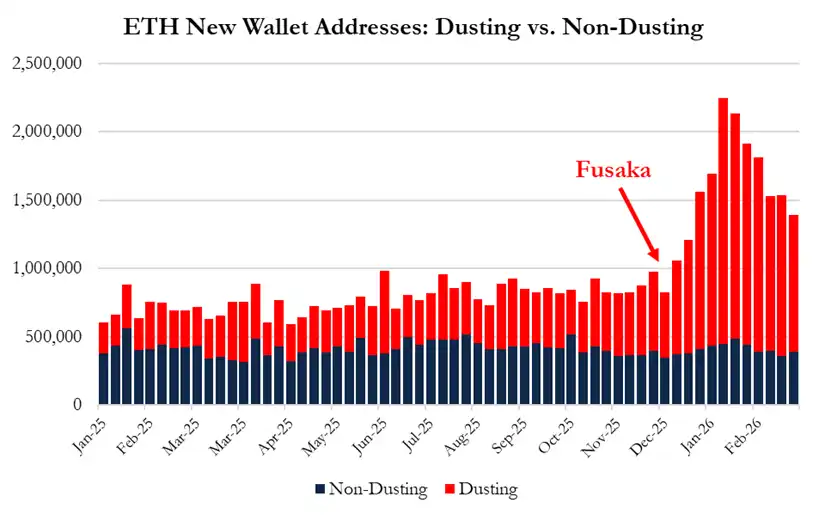
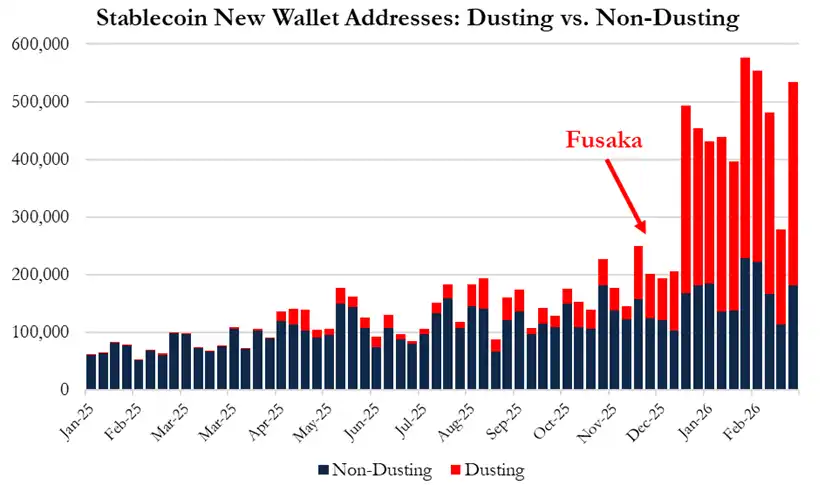
Specific data after Fusaka:

  • 95% of new wallet growth is explained by newly created "poisoned" wallets
  • Address poisoning attacks have increased more than 3 times
  • Poisoning attacks explain over 50% of ETH transaction volume growth
  • Poisoning attacks now account for 22.5% of all ETH transactions
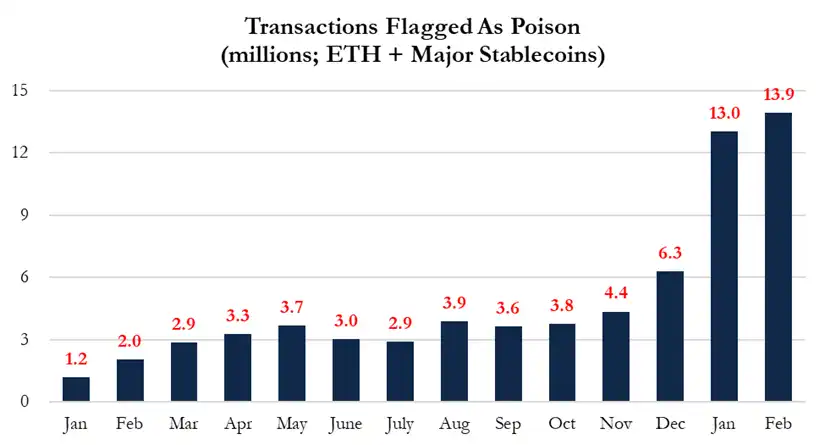
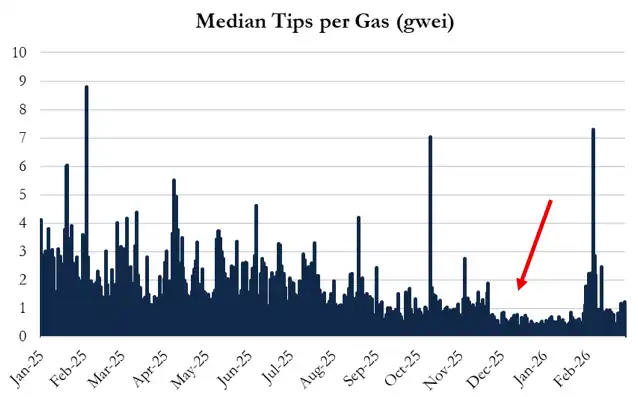
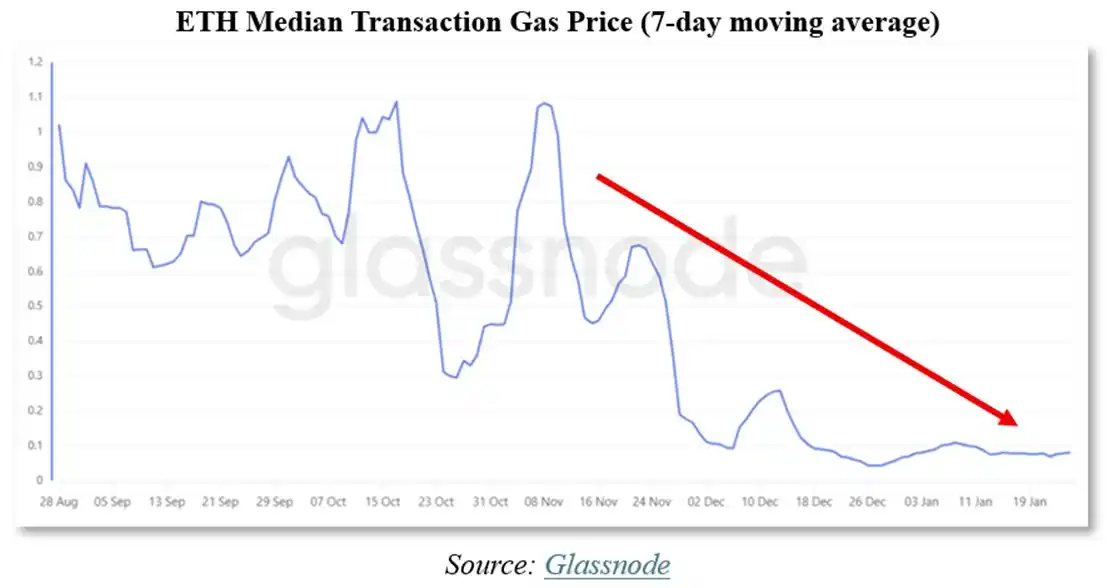
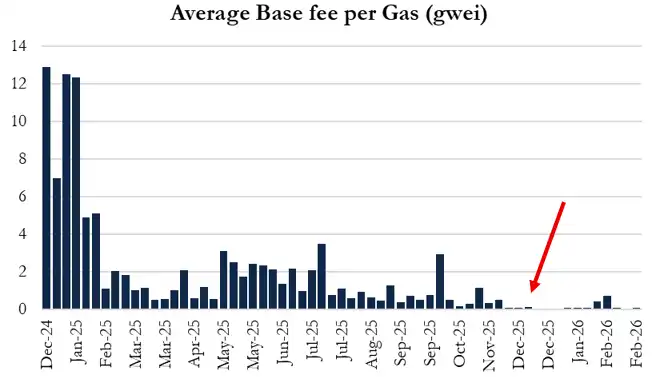
Fusaka Upgrade: Gas Fees Collapsed by 90%, 3-9 Times Worse Than Expected

Fusaka increased the gas limit from 45 million to 60 million, aiming to scale Ethereum L1. Vitalik and PTG estimated that gas fees would drop by 10-30%.

The reality is: gas fees dropped by approximately 90%.

Vitalik and the validators severely underestimated L1 demand elasticity, with an error of 3-9 times—using outdated mathematical models from before EIP-1559 and before L2s emerged.

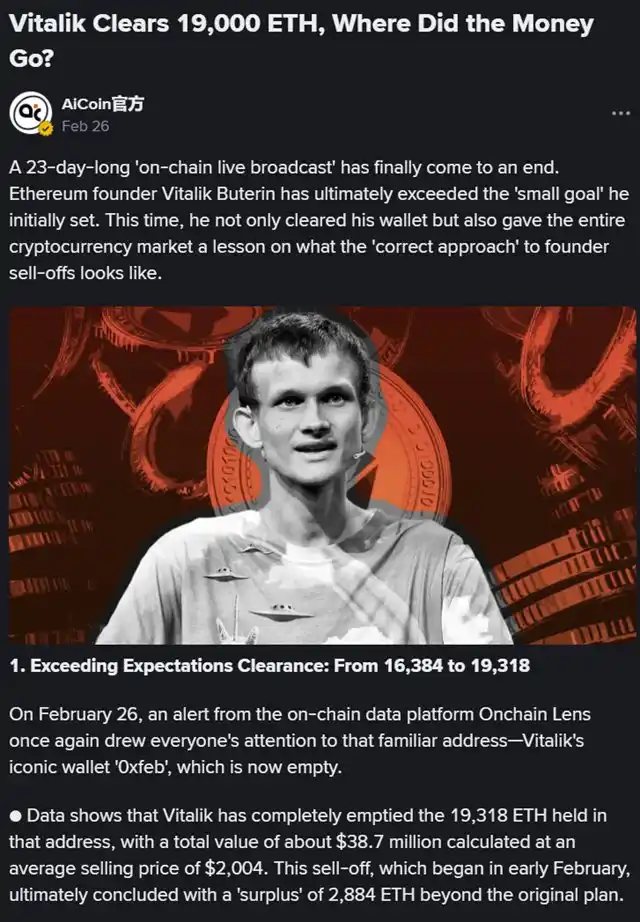
Vitalik Is Selling Like Crazy

This is why we believe Vitalik is selling ETH heavily. On January 30, he announced he would sell 16,384 ETH to fund the Ethereum Foundation's "austerity period." Since then, he has sold over 19,300 ETH and is still continuing.

He knows what Tom Lee does not: ETH's token economic model has broken.
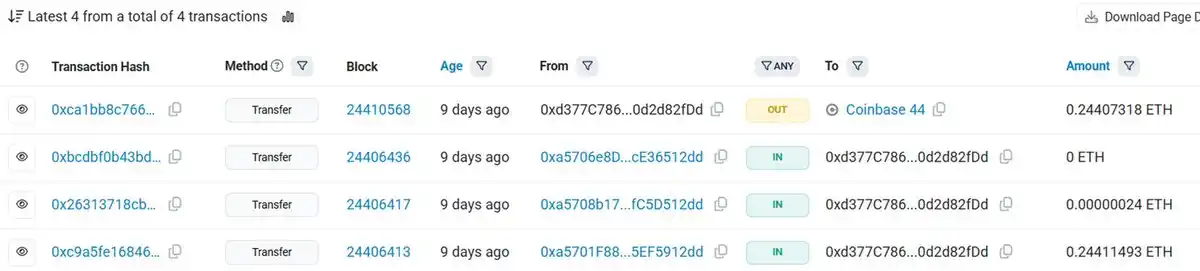
We Personally Verified the Address Poisoning Attack

We documented the ETH address poisoning process firsthand: we created two new wallets, initiated a transfer between them, and were targeted by a poisoning attack within 5 minutes.

We encourage readers to verify this themselves.

Losses from poisoning attacks have grown at a rate more than 8 times faster than before Fusaka.
The Validator Flywheel Is Reversing

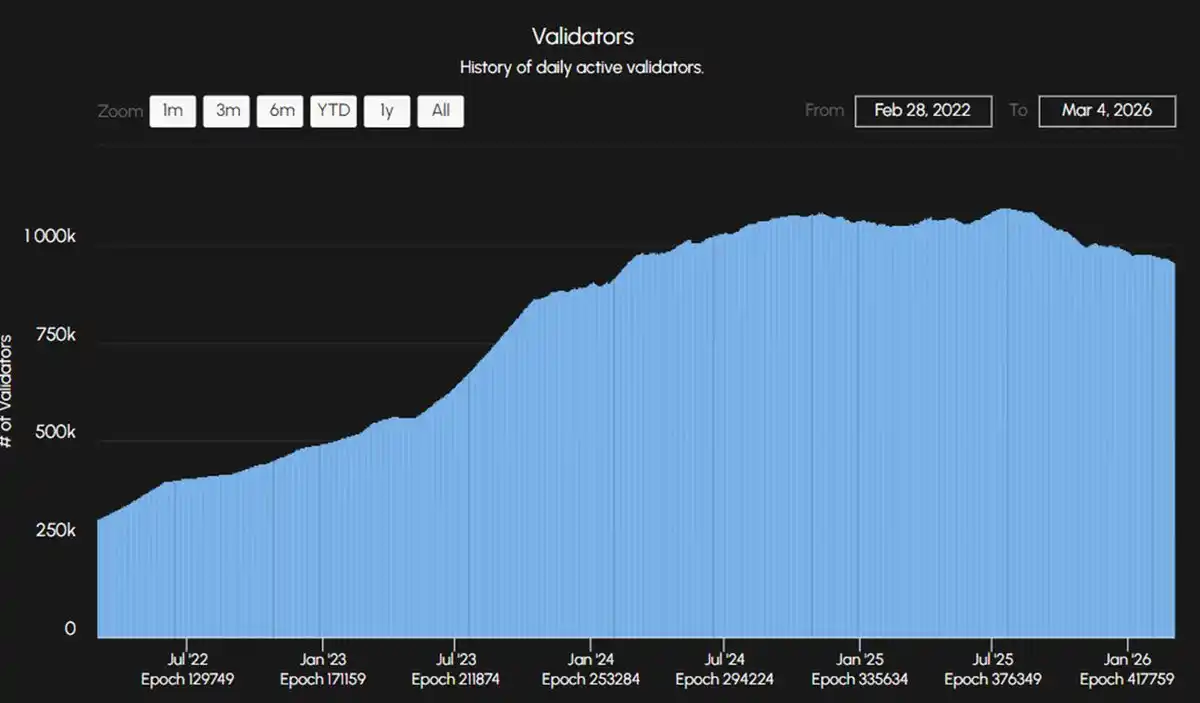
Additionally, the gas limit increase has severely impacted ETH validators, who now see a 40-50% drop in tips per unit of gas. Lower returns reduce staking demand and high-value activity, thereby weakening the foundation for institutional adoption.

The flywheel is now reversing.
Ethereum Is Losing to Solana and Its Own L2s

Meanwhile, ETH continues to lose market share:

  • Solana developers grew by 29% in 2025, while Ethereum only grew by 6%; talent is draining away
  • Visa and Citigroup chose Solana to build DeFi applications
  • Solana DEX trading volume is now more than double that of Ethereum

Conclusion: The Next Nokia

During the internet bubble era, Netscape and Nokia dominated the market for over a decade, but ultimately, Google and Apple reaped the rewards.

We view ETH in the same light.

We believe the token economic model has broken, Tom Lee is in over his head, and $ETH will continue to decline.


Связанные с этим вопросы

QWhat is the main argument presented by Culper Research for shorting ETH?

ACulper Research argues that the Fusaka upgrade in December 2025 severely damaged Ethereum's tokenomics by creating an oversupply of cheap block space, which led to a surge in artificial 'address poisoning' attacks rather than genuine organic demand. They claim this has caused a breakdown in ETH's economic model, leading to a downward price spiral.

QAccording to the report, what percentage of new wallet growth is attributed to 'poisoned' wallets post-Fusaka?

AAccording to the report, 95% of new wallet growth is explained by newly created 'poisoned' wallets following the Fusaka upgrade.

QHow did the actual gas fee reduction after Fusaka compare to the initial estimates by Vitalik and the Ethereum team?

AVitalik and the Ethereum team initially estimated that gas fees would decrease by 10-30% after the Fusaka upgrade. However, the actual reduction was about 90%, which was 3 to 9 times more severe than their projections.

QWhat evidence does the report provide to suggest that Vitalik Buterin is selling his ETH holdings?

AThe report states that on January 30th, Vitalik announced he would sell 16,384 ETH to fund the Ethereum Foundation during a 'period of austerity.' Since then, he has sold over 19,300 ETH and continues to sell, indicating his awareness of the broken tokenomics.

QWhat is 'address poisoning' or 'wallet dusting' as described in the article, and what impact does it have on Ethereum's metrics?

AAddress poisoning or wallet dusting is a type of attack where spammers send tiny, worthless amounts of ETH to a large number of wallets to create artificial on-chain activity. According to the report, this attack accounts for 95% of new wallet growth, over 50% of transaction volume growth, and 22.5% of all ETH transactions post-Fusaka, artificially inflating metrics like active addresses and transaction counts.

Похожее

Standing in the Light: A Comprehensive Guide to the Optical Module and CPO Supply Chain

"Standing in the Light: Understanding the Optical Module and CPO Industry Chain" This article analyzes the critical role of optical communication technology, specifically optical modules and Co-Packaged Optics (CPO), as the "nervous system" for modern AI data centers. With exponential growth in AI computational demands (e.g., NVIDIA's Vera Rubin architecture), traditional electrical interconnects using copper cables face severe bottlenecks in bandwidth, power consumption, and signal integrity over distance. The core function of an optical module is to act as a "translator," converting electrical signals from chips into optical signals for transmission over fiber (and vice-versa). Key internal components include lasers, modulators, photodetectors, drivers, and DSP chips. The industry is currently transitioning from 800G to 1.6T modules. However, the future lies in CPO. This next-generation technology integrates the optical engine directly with the switch ASIC/XPU on the same package substrate, drastically reducing power consumption (by ~3.5x according to NVIDIA), overcoming bandwidth density limits, and minimizing signal attenuation compared to traditional pluggable modules. Key challenges for CPO include advanced packaging capacity (dominated by TSMC), thermal management, repairability, and standardization. The article details the broader technology landscape, including Near-Packaged Optics (NPO, a pragmatic intermediate step), Linear-drive Pluggable Optics (LPO), Optical I/O (OIO for chip-level integration), and Optical Circuit Switches (OCS). A comprehensive CPO industry chain is mapped, highlighting shifting power dynamics: * **Architecture Definers:** NVIDIA, Broadcom, and Marvell now hold greater influence. * **Advanced Packaging & Manufacturing:** TSMC is central; Fabrinet is a key EMS player. * **Lasers ("The Heart"):** A strategic bottleneck. EML lasers are led by Lumentum and Coherent (both receiving major NVIDIA investments). CW lasers, favored for CPO/silicon photonics, see strong Chinese players like Source Photonics and Sicoya. * **Silicon Photonics Chips:** The mainstream path for CPO engines, with key players like Broadcom, Intel, Marvell, and China's Accelink. * **Fiber Connectivity Components:** A major new, high-growth market created by CPO, including Fiber Array Units (FAU), Polarization-Maintaining Fiber (PMF), and MPO connectors. Companies like Tianfu Communication and US Conec are leaders. * **Fiber & Cable:** Experiencing a super-cycle (e.g., Corning, Yangtze Optical Fiber). * **PCB/Substrates:** Requiring advanced materials (e.g., Shengyi Tech). * **DSP & SerDes:** Functions are integrated into switch ASICs in the CPO era (e.g., Broadcom, Astera Labs). * **Optical Module Makers:** Transitioning from standalone module suppliers to providers of optical engines and NPO/LPO solutions while riding the current pluggable boom (e.g., Zhongji Innolight, Eoptolink). The investment timeline is segmented: Short-term (2026-2027) features the "last feast" for pluggable modules and CPO's initial rollout. Medium-term (2027-2029) will see CPO expand and NPO peak. Long-term (2029-2032+) involves CPO/OIO penetration into intra-rack scaling. In conclusion, optical interconnects are fundamental to AI infrastructure. The competitive landscape sees US firms leading in architecture and high-end chips, TSMC in advanced packaging, and Chinese firms holding strong positions in modules, connectivity components, CW lasers, and fiber/cable. The future belongs to companies that can navigate the technological shift from "selling shovels" (modules) to "building highways" (CPO/OIO infrastructure).

marsbit7 мин. назад

Standing in the Light: A Comprehensive Guide to the Optical Module and CPO Supply Chain

marsbit7 мин. назад

Торговля

Спот
Фьючерсы

Популярные статьи

Manyu: восходящая мем-звезда на Ethereum, готовая открыть новую эру культуры Shiba

Manyu - это мемтокен на Ethereum, который приносит децентрализованную культурную и развлекательную ценность через вирусное влияние в соцсетях и вовлечённость сообщества.

1.9k просмотров всегоОпубликовано 2025.11.27Обновлено 2025.11.27

Manyu: восходящая мем-звезда на Ethereum, готовая открыть новую эру культуры Shiba

Неделя обучения по популярным токенам 14: Glamsterdam — самое ожидаемое обновление Ethereum в 2026 году

Ordinals/Runes по-прежнему стимулируют доходы от комиссий за блоки и активность разработчиков, рассматриваются как отправная точка «нативной эмиссии активов» в сети.

1.5k просмотров всегоОпубликовано 2026.04.29Обновлено 2026.04.29

Неделя обучения по популярным токенам 14: Glamsterdam — самое ожидаемое обновление Ethereum в 2026 году

Обсуждения

Добро пожаловать в Сообщество HTX. Здесь вы сможете быть в курсе последних новостей о развитии платформы и получить доступ к профессиональной аналитической информации о рынке. Мнения пользователей о цене на ETH (ETH) представлены ниже.

活动图片