Crypto Gets A Seat At Trump’s Science Table — Is This The Regulatory Pivot Bulls Wanted?

bitcoinistОпубликовано 2026-03-27Обновлено 2026-03-27

Введение

President Trump has appointed the initial members of the Presidential Council of Advisors on Science and Technology (PCAST), including prominent crypto industry figures. The council members include tech leaders like Jensen Huang (Nvidia) and Mark Zuckerberg (Meta), and is co-chaired by former U.S. CTO David Sacks. Crypto representation comes from Fred Ehrsam, co-founder of Coinbase, and Marc Andreessen, co-founder of a16z, both key architects of U.S. crypto venture capital and market infrastructure. Their inclusion signals a shift from past regulatory hostility toward integrating digital assets into mainstream policy discussions. While not an immediate market catalyst, this move may lead to more predictable regulations, clearer rules for exchanges and stablecoins, and a friendlier stance toward U.S. crypto infrastructure in the long term.

President Donald Trump appointed the first members of his new Presidential Council of Advisors on Science and Technology (PCAST), including notable crypto representatives.

Crypto Gets A Seat At The Table Where It Happens

The White House is finally giving crypto its due place in debates over AI and what comes next in tech. Analyst TylerD brought to attention that The White House announced on Wednesday the 13 initial members of the PCAST, with room to grow up to 24.

The lineup, a convergence point for AI, big tech and crypto, includes marquee tech leaders such as Jensen Huang (Nvidia), Mark Zuckerberg (Meta), Sergey Brin (Google), Larry Ellison (Oracle) and Lisa Su (AMD). The council will be co-chaired by AI and crypto czar David Sacks and David Sacks, former U.S. Chief Technology Officer (US CTO).

Who Are These Representatives?

The crypto names forming the council are not minor ones. We are talking about Fred Ehrsam, the co-founder of Coinbase, one of the largest US centralized exchanges; and Marc Andreessen, who co-founded the VC firm a16z.

Ehrsam left a role as a foreign‐exchange trader at Goldman Sachs in 2012 to launch Coinbase with Brian Armstrong, after the two connected through the Bitcoin subreddit. He served as Coinbase’s first president from 2012 to 2017, helping grow it into the major position it has today, and then stayed on as a board member while becoming a prominent early‐stage investor in the space.

Andreessen has been a prominent bull since his 2014 essay “Why Bitcoin Matters”, and today positions Ethereum and Web3 as core to the next phase of the internet. Through a16z, he has pushed large bets on blockchain, Web3, and AI, and has publicly tied his support for Trump partly to what he sees as a hostile regulatory and banking environment for tech and digital assets under previous policymakers.

Ehrsam and Andreessen, architects of US crypto venture capital and market infrastructure, are now embedded in a body that advises on competitiveness, innovation, and financial plumbing. This is major specially if we compared to previous cycles, where crypto was mostly on the receiving end of enforcement and guidance rather than sitting inside the advisory structure. This signals digital assets moving deeper into mainstream policy discussions, not farther away.

Market implications

The PCAST could eventually translate into more predictable rule‐making, clearer treatment of exchanges and stablecoins, and potentially a friendlier stance toward US‐domiciled crypto infrastructure. In the near term, this is not a “number go up tomorrow” catalyst, but it does strengthens the case for viewing regulatory risk as shifting from pure headwind to a possible moat for compliant players over the next cycle.

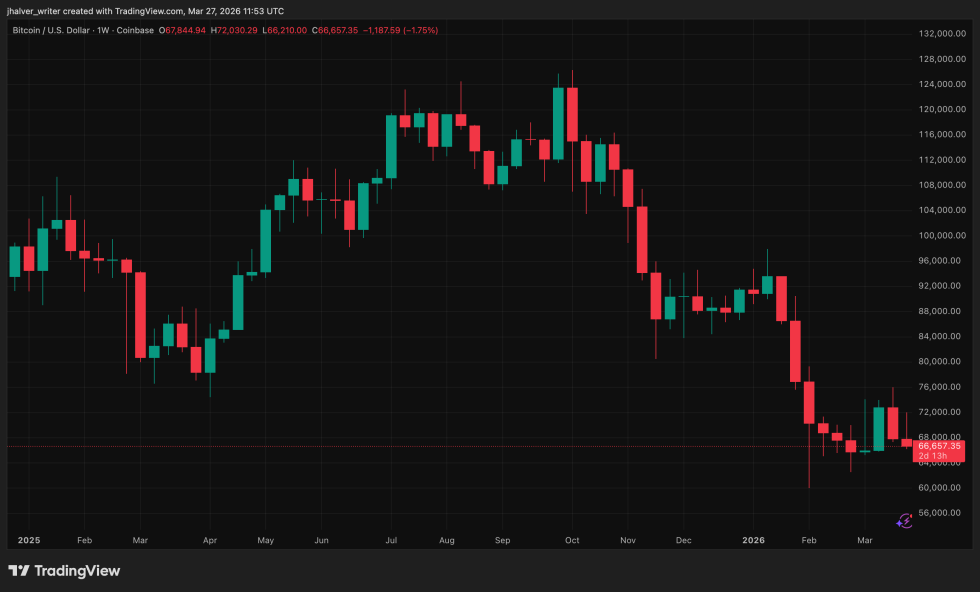
At the moment of writing, BTC’s price crashes under $67k. Source: BTCUSD on Tradingview

Cover image from Perplexity, BTCUSD chart from Tradingview

Связанные с этим вопросы

QWho are the notable crypto representatives appointed to Trump's Presidential Council of Advisors on Science and Technology (PCAST)?

AFred Ehrsam, co-founder of Coinbase, and Marc Andreessen, co-founder of venture capital firm a16z.

QWhat is the significance of having crypto representatives on PCAST council compared to previous regulatory cycles?

AIt signals digital assets moving deeper into mainstream policy discussions, unlike previous cycles where crypto was mostly on the receiving end of enforcement rather than being part of the advisory structure.

QWhat potential regulatory changes could result from crypto's inclusion in PCAST?

AMore predictable rule-making, clearer treatment of exchanges and stablecoins, and potentially a friendlier stance toward US-domiciled crypto infrastructure.

QWhich major tech leaders were appointed to the PCAST alongside crypto representatives?

AJensen Huang (Nvidia), Mark Zuckerberg (Meta), Sergey Brin (Google), Larry Ellison (Oracle), and Lisa Su (AMD).

QWho will co-chair the Presidential Council of Advisors on Science and Technology?

AAI and crypto czar David Sacks and former U.S. Chief Technology Officer (US CTO) David Sacks.

Похожее

AI Agent Completely Transforms Web3 Gaming: From the Rugpull Bakery Bot Controversy to the New 2026 Agent Paradigm

This article explores how the AI Agent paradigm is fundamentally transforming Web3 gaming, moving from a disruptive force to a core, legitimized element. It begins with the controversy in the competitive baking game Rugpull Bakery, where automated scripts caused fairness issues. Instead of banning them, the developers integrated AI Agents into the official gameplay by providing technical documentation (skill.md, agent.json), marking a shift towards "Agentic Gaming." The piece outlines three primary implementation models for AI Agents in Web3 games by 2026: 1. **Autonomous Competitors & Economic Entities:** AI Agents act as independent players with unique strategies. Examples include TEN Protocol's poker agents, AI Arena's trainable NFT fighters, and Satoshi Strike Force's "Digital Athletes" trained on player data. The Somnia blockchain is highlighted as a dedicated "Agentic L1" infrastructure supporting this model at scale. 2. **Modular Infrastructure & Programmable Environments:** This model, exemplified by EVE Frontier, allows AI Agents to program game world logic itself. Using "Smart Assemblies" (e.g., Smart Turrets, Smart Gates), Agents can modify shared economic and physical rules on-chain, creating dynamic, player/AI-built worlds. The ERC-8183 standard further enables these automated entities to hire other AI services for complex tasks. 3. **Hybrid Companions & Dynamic Adaptation:** Here, AI serves as a collaborative partner. In Parallel Colony, highly autonomous AI Avatars work alongside human players who provide high-level guidance. Illuvium plans to use AI to make NPCs dynamic and responsive, creating personalized, emergent narratives for each player. The conclusion posits that Web3 gaming has reached a "post-human" inflection point. Blockchains' transparency and programmability, combined with new standards and infrastructure like Somnia, make integrating and governing AI Agents not just viable but essential. The future lies in a symbiotic digital order where players transition from manual laborers to commanders and partners of algorithmic intelligence.

marsbit17 мин. назад

AI Agent Completely Transforms Web3 Gaming: From the Rugpull Bakery Bot Controversy to the New 2026 Agent Paradigm

marsbit17 мин. назад

Saylor's Purchase of 1550 Bitcoin Is a Bad Trade

**Title: Saylor's Purchase of 1,550 Bitcoins Was a Bad Trade** The article critically analyzes Strategy's recent move of selling 32 bitcoins followed by a much larger purchase of 1,550 bitcoins. While appearing bullish, the author argues this trade is detrimental to MSTR shareholders. The core argument revolves around the concept of "breakeven modified Net Asset Value (mNAV)," a key metric for Strategy. To increase Bitcoin per share (BPS) for MSTR holders, Strategy must issue new shares at a premium high enough that the funds raised can buy more bitcoin than the bitcoin backing each existing share. Currently, this breakeven mNAV is estimated at 1.30. The recent trade failed on two counts: 1. The shares for the $181 million raise were issued at an mNAV *below* the 1.30 breakeven point. Selling "cheap" shares to buy bitcoin actually *reduces* BPS. 2. Only $101.3 million of the raised funds were used to buy bitcoin; the rest went to boost the company's dollar reserves. The breakeven mNAV calculation assumes *100%* of proceeds are used for bitcoin purchases. Diverting funds, even if mNAV were high, dilutes BPS. The result is an estimated 0.19% decrease in Bitcoin per share for MSTR holders. In exchange, Strategy merely extended its operational runway for its dollar reserves from ~6.3 months to 7 months. The author interprets this as Strategy prioritizing the survival and development of its STRC business over its stated core goal of increasing MSTR's BPS. This constitutes a gamble: if sacrificing MSTR value leads to improved market sentiment and a recovery in STRC's price (and thus mNAV), the whole system could work. If not, Strategy may be forced into a cycle of further diluting MSTR to stay afloat, potentially leading to deferred STRC dividends or corporate decline. The article concludes with a hope for price recovery for Bitcoin, MSTR, and STRC.

Foresight News28 мин. назад

Saylor's Purchase of 1550 Bitcoin Is a Bad Trade

Foresight News28 мин. назад

The AI Bear Market Lasting Two Days Is Over; Why Did Funds Buy Back Storage Stocks First?

After a severe two-day selloff in early June that erased over $1 trillion from U.S. chip stock market value, capital is flowing back first to the memory sector. The correction was not driven by a collapse in AI demand but rather a market reassessment of high expectations. Stocks like Broadcom faced selling pressure despite strong AI revenue guidance, signaling a shift in focus from who has an "AI story" to who can most rapidly translate AI demand into verifiable profits and earnings per share (EPS). Memory companies, such as Micron and SK Hynix, are leading the recovery because their EPS growth is more immediately verifiable. The AI server boom directly increases demand for high-bandwidth memory (HBM) and high-capacity server DRAM, tightening supply and driving up contract prices for conventional DRAM and NAND Flash. This price increase, coupled with a shift to higher-margin products, flows directly into near-term revenue and profitability, as evidenced in recent earnings reports. In contrast, other AI semiconductor segments like GPUs, ASICs, and optical modules, while central to the long-term AI infrastructure story, face longer and less certain paths to EPS validation. Their growth depends more on future product cycles, customer adoption timelines, and capital expenditure plans. The rebound in memory stocks highlights a market preference for assets with shorter, more transparent EPS conversion cycles following the recent de-risking phase. However, this does not negate the potential of other AI hardware segments should they provide clearer near-term order visibility. The episode has raised the validation bar for all AI-related investments.

marsbit28 мин. назад

The AI Bear Market Lasting Two Days Is Over; Why Did Funds Buy Back Storage Stocks First?

marsbit28 мин. назад

Торговля

Спот
Фьючерсы

Популярные статьи

Как купить S

Добро пожаловать на HTX.com! Мы сделали приобретение Sonic (S) простым и удобным. Следуйте нашему пошаговому руководству и отправляйтесь в свое крипто-путешествие.Шаг 1: Создайте аккаунт на HTXИспользуйте свой адрес электронной почты или номер телефона, чтобы зарегистрироваться и бесплатно создать аккаунт на HTX. Пройдите удобную регистрацию и откройте для себя весь функционал.Создать аккаунтШаг 2: Перейдите в Купить криптовалюту и выберите свой способ оплатыКредитная/Дебетовая Карта: Используйте свою карту Visa или Mastercard для мгновенной покупки Sonic (S).Баланс: Используйте средства с баланса вашего аккаунта HTX для простой торговли.Третьи Лица: Мы добавили популярные способы оплаты, такие как Google Pay и Apple Pay, для повышения удобства.P2P: Торгуйте напрямую с другими пользователями на HTX.Внебиржевая Торговля (OTC): Мы предлагаем индивидуальные услуги и конкурентоспособные обменные курсы для трейдеров.Шаг 3: Хранение Sonic (S)После приобретения вами Sonic (S) храните их в своем аккаунте на HTX. В качестве альтернативы вы можете отправить их куда-либо с помощью перевода в блокчейне или использовать для торговли с другими криптовалютами.Шаг 4: Торговля Sonic (S)С легкостью торгуйте Sonic (S) на спотовом рынке HTX. Просто зайдите в свой аккаунт, выберите торговую пару, совершайте сделки и следите за ними в режиме реального времени. Мы предлагаем удобный интерфейс как для начинающих, так и для опытных трейдеров.

1.4k просмотров всегоОпубликовано 2025.01.15Обновлено 2026.06.02

Как купить S

Sonic: Обновления под руководством Андре Кронье – новая звезда Layer-1 на фоне спада рынка

Он решает проблемы масштабируемости, совместимости между блокчейнами и стимулов для разработчиков с помощью технологических инноваций.

2.3k просмотров всегоОпубликовано 2025.04.09Обновлено 2025.04.09

Sonic: Обновления под руководством Андре Кронье – новая звезда Layer-1 на фоне спада рынка

HTX Learn: Пройдите обучение по "Sonic" и разделите 1000 USDT

HTX Learn — ваш проводник в мир перспективных проектов, и мы запускаем специальное мероприятие "Учитесь и Зарабатывайте", посвящённое этим проектам. Наше новое направление .

1.8k просмотров всегоОпубликовано 2025.04.10Обновлено 2025.04.10

HTX Learn: Пройдите обучение по "Sonic" и разделите 1000 USDT

Обсуждения

Добро пожаловать в Сообщество HTX. Здесь вы сможете быть в курсе последних новостей о развитии платформы и получить доступ к профессиональной аналитической информации о рынке. Мнения пользователей о цене на S (S) представлены ниже.

活动图片