Crypto ETFs Are Coming To Thailand: SEC To Launch New Rules This Year

bitcoinistОпубликовано 2026-01-23Обновлено 2026-01-23

Введение

Thailand's Securities and Exchange Commission (SEC) is preparing to introduce new regulations to support crypto investment, including exchange-traded funds (ETFs) and futures trading. The SEC plans to issue guidelines for digital asset ETFs, allowing investors to gain exposure to cryptocurrencies like Bitcoin without directly managing wallets or facing security risks. Crypto futures will also be enabled on the Thailand Futures Exchange (TFEX) to provide hedging tools. The regulatory changes are expected early this year. This follows similar approvals in the US and Hong Kong. Meanwhile, US Bitcoin ETFs have recently seen significant net outflows amid a market downturn, with Bitcoin's price falling over 8% to around $89,100.

Thailand’s Securities and Exchange Commission (SEC) is preparing to launch new rules related to crypto, including exchange-traded funds (ETFs).

Thailand To Regulate Crypto ETFs And Futures This Year

As reported by Bangkok Post, the Thailand SEC is preparing regulatory changes related to crypto to support the growth of investment in the sector. Jomkwan Kongsakul, deputy secretary-general of the SEC, said the regulator is planning to issue guidelines supporting the launch of digital asset ETFs, while also working to enable crypto futures trading on the Thailand Futures Exchange (TFEX).

ETFs are investment vehicles that allow investors to gain exposure to an underlying asset without having to directly own it. In the context of digital assets, ETFs enable traders to invest into coins like Bitcoin without interacting with any on-chain element like wallets or exchanges.

In the United States, spot ETFs gained approval by the nation’s SEC in January 2024 for Bitcoin and July 2024 for Ethereum. Since then, these funds have attracted notable attention, capturing demand from traditional investors who were reluctant to deal with blockchain infrastructure.

Kongsakul noted:

A key advantage of crypto ETFs is ease of access; they eliminate concerns over hacking and wallet security, which has been a major barrier for many investors.

Within Asia, Hong Kong approved spot ETFs for both Bitcoin and Ethereum in April 2024, while South Korea is planning to roll out similar investment vehicles this year.

According to Kongsakul, Thailand’s SEC board has already approved crypto ETFs in principle, with detailed investment and operational rules currently being finalized. Although an exact timeline is unknown, the SEC is expected to introduce the regulations “early this year.”

Alongside ETFs, the SEC is also moving to formally recognize crypto within Thailand’s derivatives framework, allowing digital asset futures products to trade on the TFEX. Kongsakul said crypto futures would provide traders with hedging tools and more sophisticated risk management options.

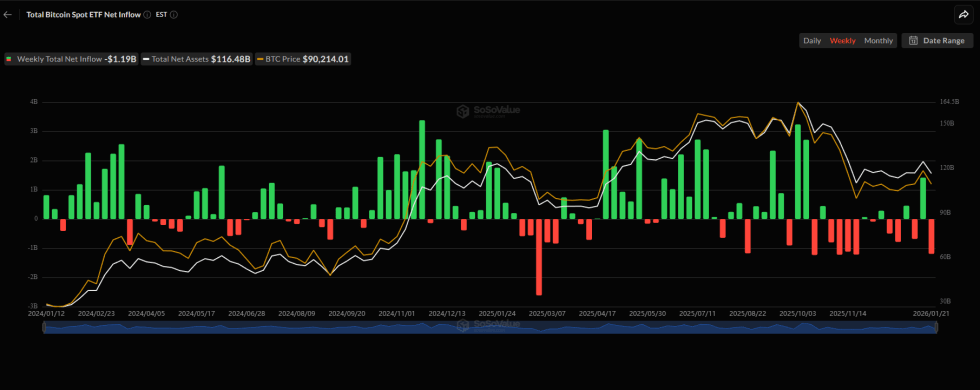
In related news, the US spot Bitcoin ETFs have faced weak demand recently, with the netflow for the current week sitting at a notable negative value, according to data from SoSoValue.

The trend in the weekly US BTC spot ETF netflow over the past two years | Source: SoSoValue

As displayed in the above graph, the US Bitcoin spot ETFs have witnessed net outflows of $1.19 billion this week so far. These negative netflows have come as the asset’s price has gone through a bearish shift, retracing the recovery it had made earlier this year.

Last week, the funds actually saw net inflows of $1.42 billion, breaking the trend of weak inflows or outright outflows that had persisted since mid-October. But this week’s netflow suggests the bullish market mood couldn’t last.

BTC Price

At the time of writing, Bitcoin is trading around $89,100, down more than 8% over the last week.

Looks like the price of the coin has plunged over the last few days | Source: BTCUSDT on TradingView

Связанные с этим вопросы

QWhat new crypto-related rules is Thailand SEC preparing to launch this year?

AThe Thailand SEC is preparing to launch new rules to support the launch of digital asset ETFs and enable crypto futures trading on the Thailand Futures Exchange (TFEX).

QWhat is a key advantage of crypto ETFs mentioned by SEC deputy secretary-general Jomkwan Kongsakul?

AA key advantage of crypto ETFs is ease of access; they eliminate concerns over hacking and wallet security, which has been a major barrier for many investors.

QWhich other Asian regions have already approved or are planning to launch spot Bitcoin and Ethereum ETFs?

AHong Kong approved spot ETFs for both Bitcoin and Ethereum in April 2024, while South Korea is planning to roll out similar investment vehicles this year.

QWhat was the netflow trend for US Bitcoin spot ETFs this week, according to data from SoSoValue?

AAccording to SoSoValue, US Bitcoin spot ETFs witnessed net outflows of $1.19 billion this week, a significant negative value following a week of net inflows.

QAt what price was Bitcoin trading at the time of writing, and what was its weekly performance?

AAt the time of writing, Bitcoin was trading around $89,100, down more than 8% over the last week.

Похожее

The Value Distribution of Stablecoins

**Summary: The Value Distribution of Stablecoins** The article argues that stablecoins are evolving from mere trading tools into broader channels for dollar access. It divides the stablecoin ecosystem into four layers to analyze how value is distributed: 1. **Issuance Layer:** Mints stablecoins, holds reserve assets, and captures the spread between reserve yield and user costs (e.g., Tether, Circle). This layer currently earns the largest profit margin. 2. **Infrastructure Layer:** Connects stablecoins to the traditional financial system, handling fiat on/off-ramps, banking integration, compliance (KYC/AML), and asset management (e.g., Bridge, BVNK). This is the "unglamorous" but critical work, building the essential bridges between crypto and real-world finance. 3. **Acquiring/Distribution Layer:** Integrates stablecoins into merchant systems, manages payment flows, and provides enterprise financial software (e.g., Stripe, Coinbase). They act as the access point for businesses. 4. **Application Layer:** The end-users and businesses that ultimately use stablecoins for payments, settlements, or as a store of value. They benefit from convenience but have little pricing power. The core thesis is that while the issuance layer currently dominates profits, the often-overlooked **infrastructure layer holds significant long-term potential**. The real challenge and barrier to mass adoption is not the on-chain transfer of stablecoins (which is simple), but the complex "last mile" integration into existing business workflows, banking systems, and regulatory frameworks across different countries. Companies in this layer are currently in a "land grab" phase, investing heavily to build networks, secure bank partnerships, and establish compliance pathways. While their position is currently pressured by the profitable issuers above and distribution platforms below, the article suggests that if stablecoins become a default financial rail for businesses, the infrastructure providers who have done the hard work of integration will ultimately gain strong pricing power and become entrenched, essential players.

marsbit6 ч. назад

The Value Distribution of Stablecoins

marsbit6 ч. назад

The Value Distribution of Stablecoins

The Value Distribution of Stablecoins The article argues that stablecoins are evolving from a mere trading tool into a broad "dollar channel." It analyzes the industry's value chain through four layers: 1. **Issuance Layer (e.g., Tether, Circle):** The top layer that mints stablecoins, holds reserve assets, and captures the thickest interest rate spread. 2. **Infrastructure Layer (e.g., Bridge, BVNK):** Connects stablecoins to the traditional financial system, handling critical but complex "dirty work" like fiat on/off-ramps, banking integration, compliance (KYC/AML), and cross-border settlement. 3. **Acquiring/Distribution Layer (e.g., Stripe, Coinbase):** Embeds stablecoins into merchant systems, manages payment flows, and integrates with enterprise software. 4. **Application Layer:** End-users and businesses that ultimately use stablecoins for payments, settlement, or storing value. The author posits that while the issuance layer currently captures the most profit, the most overlooked and potentially critical layer is infrastructure. The core challenge for stablecoin adoption isn't the on-chain transfer (which is simple), but bridging the gap between blockchain and the real-world financial system. This involves solving practical problems for businesses: fiat conversion, reconciliation, tax handling, and user onboarding. Infrastructure companies are currently in a difficult "land-grab" phase—building networks, securing banking relationships, and achieving compliance country-by-country. They face pressure from both the profitable issuance layer above and distribution platforms below. However, the author suggests this layer is building a crucial moat. Once stablecoins become a default business rail, the infrastructure players who have done the hard work of integration may gain significant, durable value and pricing power.

链捕手6 ч. назад

The Value Distribution of Stablecoins

链捕手6 ч. назад

Торговля

Спот
Фьючерсы

Популярные статьи

Как купить S

Добро пожаловать на HTX.com! Мы сделали приобретение Sonic (S) простым и удобным. Следуйте нашему пошаговому руководству и отправляйтесь в свое крипто-путешествие.Шаг 1: Создайте аккаунт на HTXИспользуйте свой адрес электронной почты или номер телефона, чтобы зарегистрироваться и бесплатно создать аккаунт на HTX. Пройдите удобную регистрацию и откройте для себя весь функционал.Создать аккаунтШаг 2: Перейдите в Купить криптовалюту и выберите свой способ оплатыКредитная/Дебетовая Карта: Используйте свою карту Visa или Mastercard для мгновенной покупки Sonic (S).Баланс: Используйте средства с баланса вашего аккаунта HTX для простой торговли.Третьи Лица: Мы добавили популярные способы оплаты, такие как Google Pay и Apple Pay, для повышения удобства.P2P: Торгуйте напрямую с другими пользователями на HTX.Внебиржевая Торговля (OTC): Мы предлагаем индивидуальные услуги и конкурентоспособные обменные курсы для трейдеров.Шаг 3: Хранение Sonic (S)После приобретения вами Sonic (S) храните их в своем аккаунте на HTX. В качестве альтернативы вы можете отправить их куда-либо с помощью перевода в блокчейне или использовать для торговли с другими криптовалютами.Шаг 4: Торговля Sonic (S)С легкостью торгуйте Sonic (S) на спотовом рынке HTX. Просто зайдите в свой аккаунт, выберите торговую пару, совершайте сделки и следите за ними в режиме реального времени. Мы предлагаем удобный интерфейс как для начинающих, так и для опытных трейдеров.

1.5k просмотров всегоОпубликовано 2025.01.15Обновлено 2026.06.02

Как купить S

Sonic: Обновления под руководством Андре Кронье – новая звезда Layer-1 на фоне спада рынка

Он решает проблемы масштабируемости, совместимости между блокчейнами и стимулов для разработчиков с помощью технологических инноваций.

2.3k просмотров всегоОпубликовано 2025.04.09Обновлено 2025.04.09

Sonic: Обновления под руководством Андре Кронье – новая звезда Layer-1 на фоне спада рынка

HTX Learn: Пройдите обучение по "Sonic" и разделите 1000 USDT

HTX Learn — ваш проводник в мир перспективных проектов, и мы запускаем специальное мероприятие "Учитесь и Зарабатывайте", посвящённое этим проектам. Наше новое направление .

1.8k просмотров всегоОпубликовано 2025.04.10Обновлено 2025.04.10

HTX Learn: Пройдите обучение по "Sonic" и разделите 1000 USDT

Обсуждения

Добро пожаловать в Сообщество HTX. Здесь вы сможете быть в курсе последних новостей о развитии платформы и получить доступ к профессиональной аналитической информации о рынке. Мнения пользователей о цене на S (S) представлены ниже.

活动图片