Crypto Donations Branded ‘Dangerous’? UK Security Panel Urges Immediate Ban

bitcoinistОпубликовано 2026-03-18Обновлено 2026-03-18

Введение

A UK National Security Panel has called for an immediate ban on political donations made with cryptocurrency, labeling them an "unnecessary and unacceptably high risk" to the integrity of the political finance system. The cross-party committee warns that crypto donations create a "gaping hole" in national security defenses, making it difficult to verify donors due to pseudonymous wallets, mixers, and foreign payment processors. The report urges stricter donor-identity checks, wealth-source verification, and a single-agency lead for enforcement to prevent foreign interference and illicit finance. Proposed rules would require donations to go through FCA-registered platforms, prohibit mixed coins, and mandate conversion to pounds within 48 hours. This is framed as a national security measure, not a blanket attack on crypto.

UK National Security Panel has deemed donations made with crypto assets as an “unnecessary and unacceptably high risk” and it is asking the government for an immediate ban.

Too High Of A Crypto-Risk

The Joint Committee on the National Security Strategy has called today for a moratorium on crypto political donations (an official temporary ban), alongside new donor‐verification rules, to tackle illicit finance and foreign interference in UK politics. The latest report of the Joint Committee warns that crypto donations to UK political parties are a high‐risk channel for illicit and foreign money. Crypto donations pose an “unnecessary and unacceptably high risk to the integrity of the political finance system”, the report reads.

The Government must immediately ban political donations made through cryptocurrency until firm rules can be developed, in order to keep UK politics safe from illicit finance, a cross-party Committee has found.

This decision follows a letter issued on February 24 by Committee Chair of the House of Commons Matt Western to Housing Secretary Steve Reed, urging the government to act before the next general election, warning that hostile states may exploit opaque crypto flows, as reported by Bitcoinist.

Inside The Warning Report

The main concerns expressed by the parliamentary include pseudonymous wallets, mixers and foreign‐based payment processors make it hard to verify who is really bankrolling UK parties, creating a “gaping hole” in national‐security defenses. In order to tackle this, the committee is asking for stricter donor‐identity checks and wealth‐source verification, plus a clear single‐agency lead over political finance enforcement to avoid the current fragmentation across multiple bodies.

Responsibility for policing risks of foreign influence in political finance is dispersed across several services, including the Electoral Commission, Metropolitan Police, Counter Terrorism Policing, MI5, the National Crime Agency and other police services. The Committee argues that accountability and governance are “inadequate”, and notes that a clearer set up with a single national lead would help address low public trust in enforcement of the rules.

What Happens Next?

Under the specific conditions proposed for any future digital assets donations after the moratorium, parties would only be allowed to accept coins that move through fully FCA‐registered platforms, closing off the offshore exchanges and bespoke portals currently used to route funds into Westminster. Any crypto that has passed through mixers or tumblers would be flat‐out prohibited and, on top of that, parties would have to convert donated tokens into pounds within roughly 48 hours, sharply limiting the time funds remain on‐chain and making it easier for regulators and watchdogs to audit who is really paying for UK politics.

The UK is trying to position itself as a “global hub” for digital assets in trading and custody, even as its national‐security apparatus moves aggressively to regulate crypto assets.

The committee frames this as a national‐security and anti‐corruption issue, not a blanket attack on crypto markets, but the political narrative still feeds into a broader crackdown theme investors cannot ignore. While spot crypto trading in the UK remains unaffected in the short term, headlines about “illicit money” and “foreign interference” can sap risk appetite, weigh on politically exposed tokens, and add another layer of regulatory overhang for any UK‐facing exchanges or payment rails.

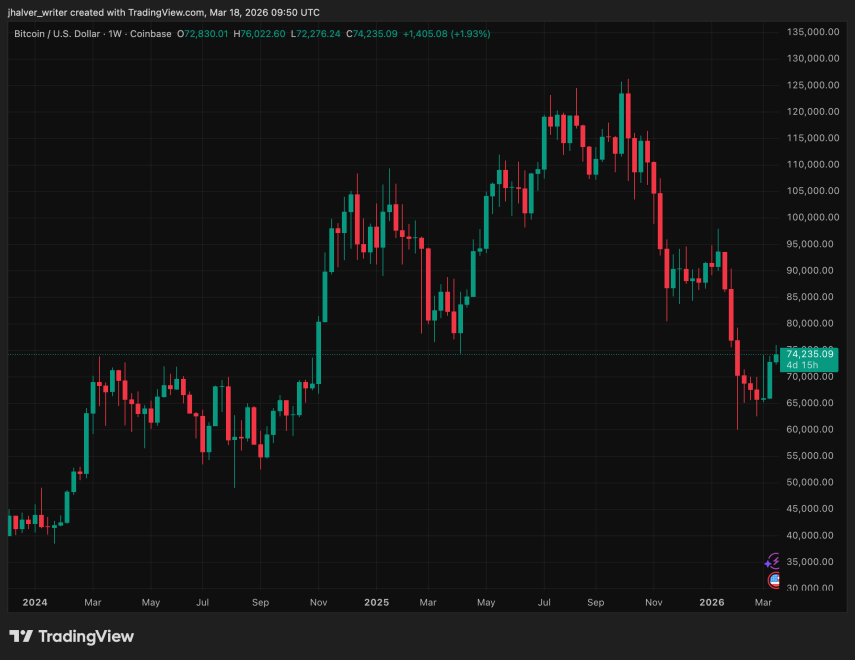
At the time of writing, BTC’s price stays on the $74k. Source: BTCUSD on Tradingview

Cover image from Perplexity, BTCUSD chart from Tradingview

Связанные с этим вопросы

QWhat is the main recommendation of the UK National Security Panel regarding crypto political donations?

AThe UK National Security Panel has recommended an immediate ban (moratorium) on political donations made through cryptocurrency to protect the integrity of the political finance system from illicit finance and foreign interference.

QWhat specific risks did the committee identify with crypto donations?

AThe committee identified risks including pseudonymous wallets, mixers, and foreign-based payment processors that make it difficult to verify the true source of donations, creating a 'gaping hole' in national security defenses.

QWhat conditions are proposed for allowing crypto donations after the moratorium?

AAfter the moratorium, parties would only be allowed to accept crypto that moves through fully FCA-registered platforms, must convert donated tokens to pounds within 48 hours, and any crypto that has passed through mixers or tumblers would be prohibited.

QWhich UK agencies are currently responsible for policing risks of foreign influence in political finance?

AResponsibility is dispersed across several services including the Electoral Commission, Metropolitan Police, Counter Terrorism Policing, MI5, the National Crime Agency, and other police services.

QHow does the committee frame this issue in relation to the UK's broader crypto ambitions?

AThe committee frames this as a national security and anti-corruption issue, not a blanket attack on crypto markets, even as the UK tries to position itself as a 'global hub' for digital assets in trading and custody.

Похожее

Near Returns to the AI Stage: Transformation into a Public Chain Due to 'Payroll Difficulties,' Agent and Privacy Emerge as New Growth Narratives

NEAR Returns to AI Origins: From Payroll Struggles to Blockchain, Now Focusing on AI Agents and Privacy NEAR Protocol's journey began not with grand blockchain ambitions, but from a practical hurdle: its AI startup founders, including Transformer paper co-author Illia Polosukhin, couldn't efficiently pay international developers in 2017. This led them to pivot and build a high-performance, scalable blockchain. After years navigating various crypto narratives like sharding and cross-chain interoperability, NEAR is now leveraging its AI roots to re-enter the AI arena. A key driver is its "NEAR Intents" layer, which abstracts complex cross-chain transactions. Users simply state their goal (e.g., swap BTC for ETH), and a solver network finds the optimal route. This system has processed over $20B in cross-chain volume, generating significant fee revenue. A major growth area is private transactions via "Confidential Intents/Swaps," which hide trade details until settlement to protect against MEV and front-running. Remarkably, private swaps recently accounted for over 40% of NEAR's transaction volume, highlighting strong demand but also potential regulatory scrutiny. With its AI-founder pedigree, NEAR is positioning itself at the intersection of blockchain, AI agents, and privacy, aiming to become infrastructure for the emerging agent economy while navigating the challenges of its rapid adoption.

marsbit1 ч. назад

Near Returns to the AI Stage: Transformation into a Public Chain Due to 'Payroll Difficulties,' Agent and Privacy Emerge as New Growth Narratives

marsbit1 ч. назад

From Ethereum to AI's 'CROPS': What Exactly is This Set of 'Slow Variables' That Vitalik Repeatedly Emphasizes?

In recent discussions, Vitalik Buterin has frequently emphasized the concept of "CROPS," a framework defining core values for Ethereum's development. CROPS stands for Censorship Resistance, Capture Resistance, Open Source, Privacy, and Security. Initially outlined in the Ethereum Foundation's "EF Mandate," it represents a commitment to user sovereignty, ensuring that the network resists external control, remains open, protects privacy, and prioritizes security. The relevance of CROPS extends beyond Ethereum's foundational principles, becoming crucial in the context of AI integration. As AI agents begin handling wallet operations and automated transactions, the risk increases that users may cede control over their digital assets, privacy, and intentions to centralized AI service providers. A "CROPS AI" would therefore emphasize local execution where possible, privacy-preserving remote model calls (e.g., using zero-knowledge proofs), and transparent, verifiable processes to maintain user agency. Vitalik highlights a significant convergence between "CROPS Ethereum access layer" and "CROPS AI." Both address the same fundamental challenge: how users can access powerful services—be it blockchain data via RPCs or AI models—without exposing sensitive information or relinquishing ultimate control. This intersection points toward a future digital entry point that is more private, secure, and user-controlled. Ultimately, CROPS is not merely an abstract ideal but a practical guidepost. It steers development—from protocol resilience and wallet design to AI agent safety—towards a future where users retain self-sovereignty even as digital systems grow more complex and powerful. In an era of accelerating AI adoption, these "slow variables" of censorship resistance, openness, privacy, and security may define Ethereum's enduring value.

marsbit1 ч. назад

From Ethereum to AI's 'CROPS': What Exactly is This Set of 'Slow Variables' That Vitalik Repeatedly Emphasizes?

marsbit1 ч. назад

Silicon Valley 'Startup Guru' Steve Hoffman: Web3 + AI Could Be a Trap

Silicon Valley investor and "Godfather of Startups" Steve Hoffman warns that combining Web3 with AI is likely a trap, not a promising venture. In an interview, Hoffman argues that while AI is a foundational technology touching all industries, Web3 adds complexity, friction, and regulatory risk without solving mainstream consumer or business needs. He advises founders to focus on deep, specialized applications where startups can out-iterate giants, rather than on generic features easily replicated by large tech companies. Hoffman observes that Silicon Valley will lead foundational AI research, while China excels at rapid, large-scale application and commercialization, particularly in robotics. He stresses that AI-driven autonomous agents capable of collaborative, multi-step tasks are 2-4 years away, which will cause significant job displacement. The solution is not to slow AI but to redesign business models around human-AI collaboration and reform social systems like education and retraining. For startups, Hoffman recommends focusing on vertical, expertise-heavy domains to build defensibility. He sees major opportunities in AI fraud detection and cybersecurity. Key founder mindsets include systemic thinking over feature-focus, relentless customer centricity, building adaptive teams, and deeply understanding AI's capabilities and limits. Hoffman is also leading a non-profit initiative to establish university centers aimed at training future leaders in responsible, human-value-aligned AI innovation.

marsbit2 ч. назад

Silicon Valley 'Startup Guru' Steve Hoffman: Web3 + AI Could Be a Trap

marsbit2 ч. назад

Token Inefficient, Economy Tokenless

The article "Tokens Aren't Economical, Economics Aren't Tokenized" analyzes a pivotal shift in the AI industry from a technology-driven narrative to one dominated by capital efficiency. It highlights two concurrent trends: a severe capital shortage due to the exorbitant and recurring costs of compute (e.g., OpenAI's high burn rate) and a wave of corporate spin-offs where major tech companies are separating their AI units (like Kuaishou's Kling and Baidu's Kunlunxin). The core argument is that AI's "anti-internet" business model, where user growth increases costs rather than profits, has created a disconnect between high valuations and actual cash flow. Spin-offs address this by allowing AI assets to be valued independently. Within a parent company, they are seen as cost centers, but as standalone entities, they are priced based on their growth potential and scarcity in the primary market, leading to massive valuation premiums (e.g., Kling's estimated value tripling post-spin-off). The industry is at an inflection point, moving from "model worship" to "value realization." The competition is evolving from a pure compute (GPU) race to a broader focus on systemic efficiency and full-stack engineering (involving CPUs and orchestration) to achieve viable commercialization. The year 2026 is framed as a critical moment where the industry must definitively answer how to economically translate AI capability into tangible business value, reshaping the sector's future power structure.

marsbit2 ч. назад

Token Inefficient, Economy Tokenless

marsbit2 ч. назад

Торговля

Спот
Фьючерсы

Популярные статьи

Как купить BAN

Добро пожаловать на HTX.com! Мы сделали приобретение Comedian (BAN) простым и удобным. Следуйте нашему пошаговому руководству и отправляйтесь в свое крипто-путешествие.Шаг 1: Создайте аккаунт на HTXИспользуйте свой адрес электронной почты или номер телефона, чтобы зарегистрироваться и бесплатно создать аккаунт на HTX. Пройдите удобную регистрацию и откройте для себя весь функционал.Создать аккаунтШаг 2: Перейдите в Купить криптовалюту и выберите свой способ оплатыКредитная/Дебетовая Карта: Используйте свою карту Visa или Mastercard для мгновенной покупки Comedian (BAN).Баланс: Используйте средства с баланса вашего аккаунта HTX для простой торговли.Третьи Лица: Мы добавили популярные способы оплаты, такие как Google Pay и Apple Pay, для повышения удобства.P2P: Торгуйте напрямую с другими пользователями на HTX.Внебиржевая Торговля (OTC): Мы предлагаем индивидуальные услуги и конкурентоспособные обменные курсы для трейдеров.Шаг 3: Хранение Comedian (BAN)После приобретения вами Comedian (BAN) храните их в своем аккаунте на HTX. В качестве альтернативы вы можете отправить их куда-либо с помощью перевода в блокчейне или использовать для торговли с другими криптовалютами.Шаг 4: Торговля Comedian (BAN)С легкостью торгуйте Comedian (BAN) на спотовом рынке HTX. Просто зайдите в свой аккаунт, выберите торговую пару, совершайте сделки и следите за ними в режиме реального времени. Мы предлагаем удобный интерфейс как для начинающих, так и для опытных трейдеров.

740 просмотров всегоОпубликовано 2024.10.27Обновлено 2026.06.02

Как купить BAN

Обсуждения

Добро пожаловать в Сообщество HTX. Здесь вы сможете быть в курсе последних новостей о развитии платформы и получить доступ к профессиональной аналитической информации о рынке. Мнения пользователей о цене на BAN (BAN) представлены ниже.

活动图片