Competitors Going Public, Kimi Can't Sit Still

marsbitОпубликовано 2026-05-28Обновлено 2026-05-28

Введение

Competitors Go Public, Kimi Feels the Pressure Yue Zhi An Mian (Moonshot AI), the company behind the AI assistant Kimi, has begun dismantling its VIE and red-chip structure, clearing a key obstacle for a potential Hong Kong IPO. This marks a significant shift from six months ago when founder Yang Zhilin stated the company was in "no hurry" to list. The move comes as rivals like Zhipu AI and MiniMax have successfully listed on the Hong Kong Stock Exchange in early 2026, experiencing massive surges in market value. This has reset valuation logic for AI companies, turning "going public" from an end goal into a competitive necessity. Analysts suggest Kimi is both seizing a favorable market window and responding to competitive pressure. Kimi's valuation has skyrocketed from around $3 billion at its 2023 founding to over $20 billion by May 2026. Capital is betting on its potential as a future AI platform and gateway, though some caution this "emotional valuation" depends on sustained technological leadership and successful commercialization. Traditionally focused on core model R&D over user growth, Kimi has recently pivoted strategy. While its monthly active users declined through 2025, it shifted focus to Agent development and reducing marketing spend. The release of its K2.5 model in early 2026 reportedly generated substantial revenue, with annual recurring revenue reaching $200 million by April, driven by subscriptions and API services. A $2 billion D-round financing in May ...

Recent reports indicate that Moonshot AI has notified its shareholders, officially initiating the dismantling of its VIE and red chip structure to clear obstacles for a Hong Kong IPO.

Just half a year ago, Moonshot AI founder Yang Zhilin reiterated in an internal letter that the company was "in no hurry to go public in the short term."

"This step is more like clearing structural hurdles before an IPO, meaning the company has seriously entered the IPO preparation phase. But several hurdles remain: equity structure, regulatory communication, domestic filing, security review, HKEX materials, financial audits, and market timing," said Huang Lichong, President of Huisheng International Capital. Dismantling VIE and red chip structures essentially clarifies the positions of control rights, responsible entities, and regulatory boundaries. If smooth, the window could be six months to a year; if complex due to regulations, shareholders, tax, or foreign capital arrangements, it might take longer.

Phoenix WEEKLY Finance inquired with Moonshot AI regarding the IPO, but received no reply by the time of publication.

Regarding expectations, the capital market has already given its answer in advance. When founded in 2023, Moonshot AI's valuation was approximately $3 billion; by May 2026, this figure had surpassed $20 billion.

In reality, with the successive listings of Zhipu AI and MiniMax on the Hong Kong stock market, the valuation logic of the secondary market for large model companies has suddenly been unlocked. The long-term reliance on narratives to support valuations in the primary market has become a thing of the past. "Going public" itself is also shifting from an outcome to a competitive method.

"Moonshot AI's move considers both seizing the golden window for a Hong Kong listing and is forced by industry competition prompting proactive layout," said Zhang Yi, CEO of iiMedia Consulting Group.

Perhaps for Moonshot AI, the real question is no longer "whether to go public," but rather, when other competitors have already entered the next round, Moonshot AI cannot afford to stand still.

$20 Billion Valuation May Be Tinged with Capital Market Sentiment

Since the beginning of 2026, the capital "atmosphere" in the large model industry has rapidly heated up.

Over the past three years, Chinese AI startups have undergone a transformation from being neglected to becoming darlings of capital. However, what truly turned the industry sentiment around was the successive Hong Kong listings of Zhipu AI and MiniMax earlier this year.

On January 8, 2026, Zhipu AI took the lead in listing on the HKEX with an issue price of HK$116. On its first trading day, the stock closed at HK$131.5 per share, up 13.17%, with a total market capitalization reaching HK$57.89 billion. In the following months, Zhipu AI's stock price continued to rise. As of the close on May 26, its total market capitalization had exceeded HK$599.6 billion, nearly a tenfold increase from its initial listing.

On January 9, MiniMax followed suit, listing on the HKEX with an issue price of HK$165. On its first trading day, the stock closed at HK$345 per share, a surge of 109% from the issue price, with a total market capitalization surpassing HK$106.7 billion. Currently, its total market capitalization exceeds HK$241.1 billion.

This provided the entire industry with pricing benchmarks. Since then, AI is no longer seen as just a technological story but as the next platform-level opportunity.

With such precedents, Moonshot AI's valuation also rapidly climbed.

In November 2025, Moonshot AI's valuation was $4.3 billion; by May 2026, it had exceeded $20 billion. In just half a year, its valuation nearly quadrupled, with cumulative financing exceeding $3.2 billion. Moonshot AI has also completed a rare capital leap for a domestic large model startup.

"Revenue is the foundation. Capital pricing mainly focuses on three things: first, foundational model capabilities; second, user access and developer ecosystem; third, the imaginative space for future platformization," Huang Lichong believes. For companies like Moonshot AI, capital is buying not today's profit statement, but a scarce ticket in the Chinese large model race. Whoever can become the next-generation AI gateway may gain access to new profit pools like search, office work, developer tools, enterprise services, and Agent execution.

This year, information about unofficial financing shares not from Kimi has even frequently appeared in the market.

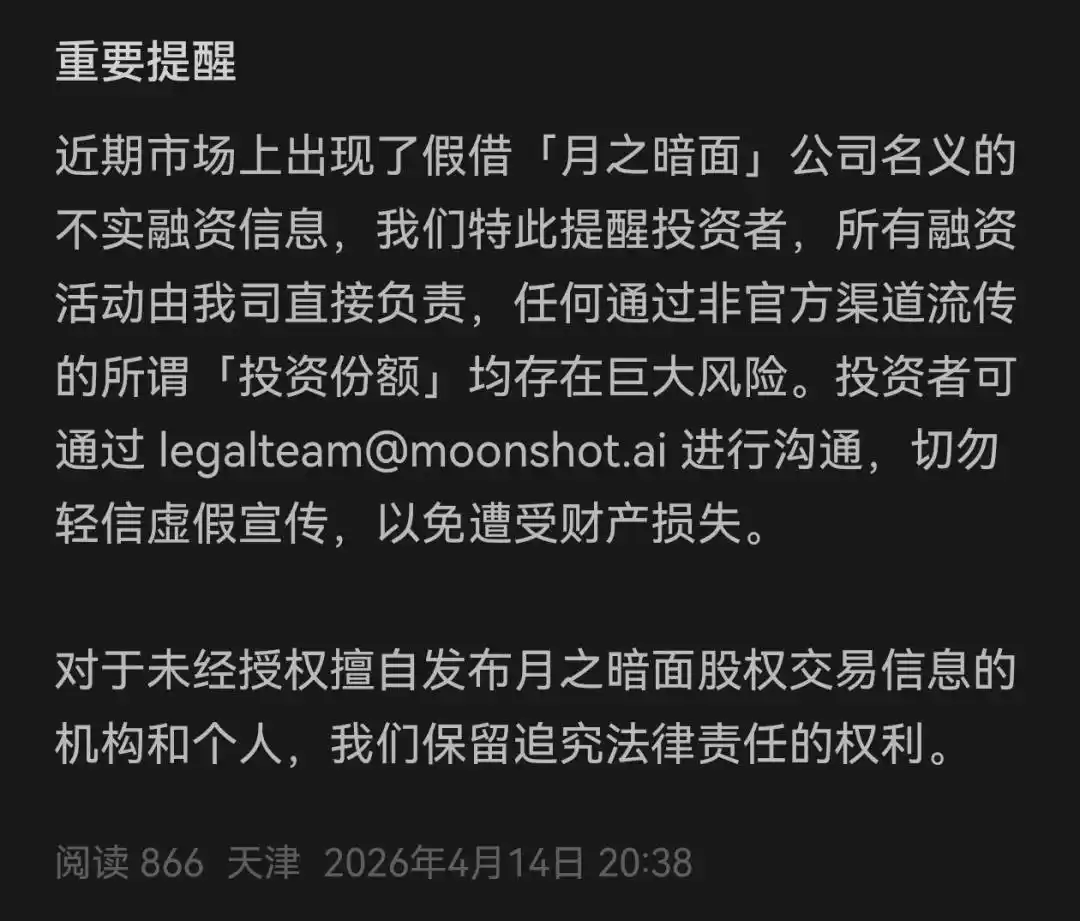
In April, Kimi publicly refuted rumors, stating, "Recently, false financing information purporting to be from 'Moonshot AI' has appeared in the market. We hereby remind investors that all financing activities are directly handled by Moonshot AI. Any so-called 'investment shares' circulated through unofficial channels carry significant risks."

Screenshot of Kimi's response.

When capital frantically searches for the "next Zhipu AI" or "next MiniMax," it's difficult for Moonshot AI to keep capital at bay.

"A $20 billion valuation seems more like an advance payment on the future," Zhang Yi believes, attributing it to the capital market pricing in growth dividends ahead of time.

Huang Lichong stated, "This valuation only holds up if three things materialize: continued model leadership, sustained commercialization scaling, and declining unit inference costs. Otherwise, it's just sentiment-driven valuation."

R&D Pace May Be Constrained, Commercialization Moves to the Forefront

Among domestic large model startups, Moonshot AI is an "outlier."

For a long time, Yang Zhilin has been one of the most typical "tech-focused" representatives among domestic AI entrepreneurs. Compared to traffic competition and commercial expansion, he emphasizes foundational model capabilities, organizational efficiency, and long-term R&D investment. This has long positioned Moonshot AI as one of the domestic teams closest to the routes of OpenAI and Anthropic.

QuestMobile data shows that the monthly active user (MAU) count for the Kimi App dropped from 21.653 million in Q1 2025 to 9.027 million in Q4 2025.

In his year-end all-staff letter in 2025, Yang Zhilin clarified the direction of this round of adjustment: focus on Agents, not targeting absolute user numbers, persistently pursuing intelligence limits and productivity value, and significantly cutting annual advertising spending, shifting to technology-driven commercialization.

In January 2026, Kimi released its flagship model K2.5. According to multiple media reports, less than a month after the model's release, the company's revenue over nearly 20 days had already exceeded its total revenue for the entire year of 2025; as of April 2026, the company's Annual Recurring Revenue (ARR) exceeded $200 million, with paid subscriptions and API revenue gradually becoming new growth engines.

Moonshot AI is attempting to prove to the outside world that despite reduced MAU, Kimi's commercial capabilities remain intact.

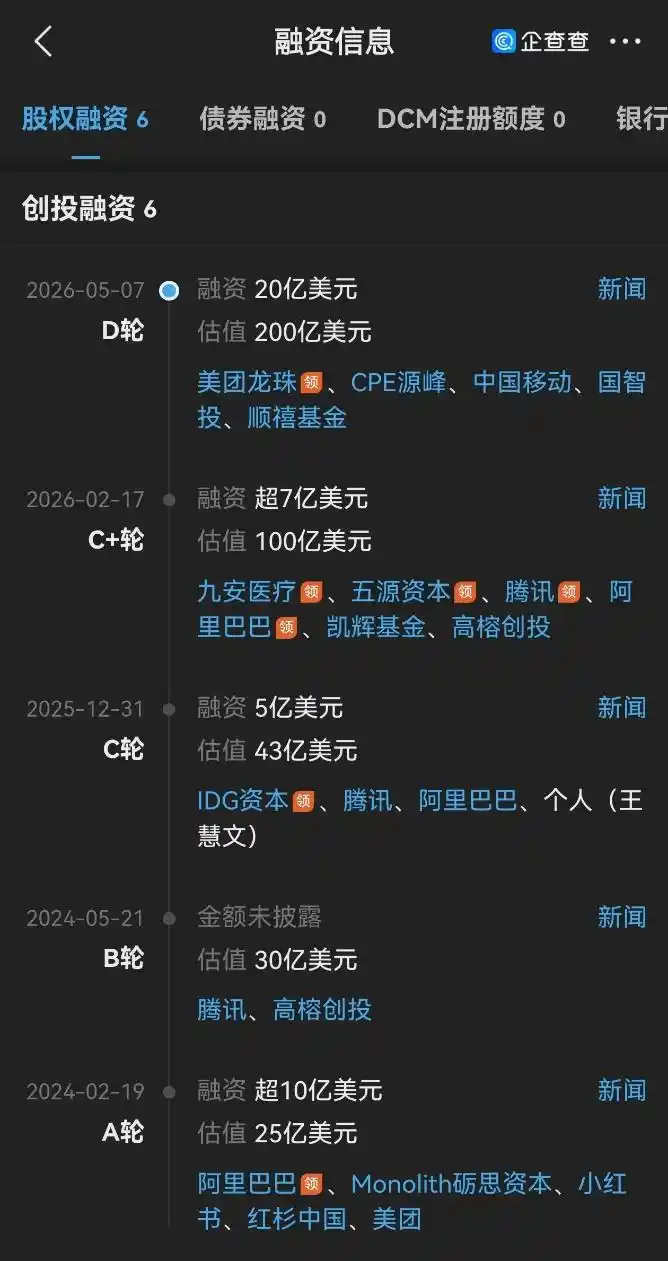
Qichacha shows that in May this year, Moonshot AI completed another $2 billion Series D financing round, led by Meituan Longzhu, with participation from institutions like China Mobile and CPE, which may indicate capital's approval of Kimi's adjustments in its business model.

Screenshot of Moonshot AI's $2 billion Series D financing.

However, post-financing, AI companies cannot avoid the continuous investment race. Training compute, inference costs, data resources, and talent reserves all imply massive capital consumption.

If entering the secondary market, the rules begin to change. Beyond investment, investors will also demand corresponding returns.

Huang Lichong predicts significant changes for Moonshot AI post-IPO. First, the organization will become heavier. Financial disclosure, internal controls, compliance, model safety, and data governance will become institutionalized. Second, the R&D pace will be more constrained. In the past, it could focus solely on model breakthroughs; post-IPO, it must explain input-output ratios, compute expenses, loss boundaries, and commercialization paths. Third, commercialization will be brought to the forefront. Investors won't pay for "model leadership" indefinitely; they will look at subscriptions, APIs, enterprise clients, Agent revenue, and gross margins.

"Only raising funds without model leadership will eventually be disproven. Only making models without capital and commercialization won't survive to the end," in Huang Lichong's view. The real test for Moonshot AI post-IPO is whether it can transform "technological scarcity" into "sustainable revenue" and "explainable valuation."

(Image source: Moonshot AI official)

This article is from the WeChat public account "Phoenix WEEKLY Finance", author: Wang Han

Связанные с этим вопросы

QAccording to the article, what is the primary purpose of Kimi's parent company, Moonshot AI, dismantling its VIE and red-chip structure?

ATo clear structural obstacles for its planned IPO in Hong Kong, officially entering the IPO preparation phase.

QWhat significant change in valuation logic for large model companies does the article mention after the IPOs of Zhipu AI and MiniMax?

AThe IPOs have shifted the valuation logic from a primary market reliance on narrative to a secondary market focus on concrete financial performance, turning 'listing' itself from an end result into a competitive method.

QHow does the article characterize the $20 billion valuation of Moonshot AI as of May 2026?

AAnalysts in the article suggest the $20 billion valuation may be inflated by capital market sentiment, representing a premium paid for a 'scarce ticket' in the Chinese large model race and a pricing that anticipates future growth. Its sustainability depends on continued model leadership, commercialization scale-up, and reduced unit inference costs.

QWhat key strategic shift in Kimi's focus did founder Yang Zhilin outline in late 2025, according to the article?

AYang Zhilin outlined a shift in focus towards Agent (intelligent agent) development, prioritizing intelligence limits and productivity value over absolute user numbers. The company also significantly reduced annual advertising spending to rely more on technology-driven commercialization.

QWhat are the three major changes that capital market expert Huang Lichong predicts for Moonshot AI after its potential IPO?

AHuang Lichong predicts post-IPO changes will include: 1) A heavier organization with more formalized financial disclosure, internal controls, and compliance. 2) More constrained R&D节奏 (rhythm/pace), requiring justification for inputs, outputs, and commercialization paths. 3) Commercialization being brought to the forefront, with investors demanding to see revenue from subscriptions, APIs, enterprise clients, and agent services, along with gross margins.

Похожее

Blocked Its Own Treasure, WeChat AI Steps Up

Tencent's stock surged over 10% on June 2nd amid reports that WeChat, with 1.43 billion monthly users, is finalizing tests for a native AI Agent. The reported feature, accessible by swiping right from the main interface, allows users to issue commands in natural language. The AI then decomposes tasks and automatically calls upon relevant Mini Programs within WeChat to complete actions like ordering food, booking tickets, or making payments, creating a closed-loop service execution system. This strategic shift follows the internal conflict and subsequent "blocking" of Tencent's standalone AI app, Yuanbao, by WeChat for violating sharing rules during a 2026 Spring Festival promotion. The incident highlighted a lack of internal consensus and exposed the weakness of competing in the standalone AI assistant arena against rivals like ByteDance's Doubao (345M MAU) and Alibaba's Qianwen. The new WeChat AI Agent aims to leverage WeChat's unique assets—its massive user base, standardized Mini Program APIs, WeChat Pay, and identity system—to move from simple content generation to actual task execution. Analysts note this changes the competitive landscape from model benchmarks to which AI can connect to more real-world services. However, success depends on key variables: the capability of Tencent's underlying Hunyuan model, managing massive inference costs, and redesigning incentives for Mini Program developers whose traffic might be bypassed. The move is seen as an attempt to keep user service intent within WeChat's ecosystem as AI begins to redefine how users access services.

marsbit16 мин. назад

Blocked Its Own Treasure, WeChat AI Steps Up

marsbit16 мин. назад

ByteDance Adopts Arm CPUs, Jensen Huang: So Sad I Didn't Buy Arm

**Summary:** At Computex 2026, Arm CEO Rene Haas announced that ByteDance and Oracle have adopted Arm's self-designed Arm AGI data center CPU. The company expects significant revenue growth from this product, projecting $20 billion in demand for the 2027/2028 fiscal years. Haas noted that restricting AI-capable CPUs from the US to China is nearly impossible due to their widespread applications. Arm's stock has surged dramatically this year, notably rising 16% after NVIDIA's Arm-based Vera CPU and RTX Spark announcements. A highlight was the informal, humorous on-stage conversation between Haas and NVIDIA CEO Jensen Huang. Huang joked about NVIDIA's failed attempt to acquire Arm and playfully lamented selling his Arm shares. Both executives showed a clear sense of camaraderie and shared regret over the missed merger. Key technical topics were discussed: 1. **AI PC Design:** Huang explained NVIDIA's RTX Spark superchip (with a 20-core Arm CPU) is designed for future AI agents that will autonomously run and use tools on PCs, blending local and cloud processing. 2. **Agent vs. OS:** Huang emphasized the operating system remains crucial, as AI agents rely on its APIs and tools to function. 3. **Growth Constraints:** He identified the shift to "useful AI" that generates profitable tokens as a primary driver for immense, almost limitless, computational demand. Haas outlined Arm's strategy across PC and data centers. For PCs, Arm collaborates with partners like NVIDIA and MediaTek, offering its compute subsystem (CSS) for custom SoCs. In data centers, its Arm AGI CPU (built on TSMC's 3nm process) has gained major partners including OpenAI, Meta, and now ByteDance and Oracle. Arm presented a multi-year roadmap for its in-house CPU line. The article concludes that while GPUs dominated the AI training race, the explosion of AI agents is shifting significant focus to CPUs for inference, state management, and tool orchestration. The industry is trending towards vertical integration, with companies like cloud providers designing chips and chip/IP firms offering full solutions, all competing to deliver more efficient computing per watt.

marsbit36 мин. назад

ByteDance Adopts Arm CPUs, Jensen Huang: So Sad I Didn't Buy Arm

marsbit36 мин. назад

New Wall Street Play: Yen Shorts Still Adding, But Japan Stocks Don't Rely on Carry Trade Unwinding

On June 3rd, USD/JPY hit 160.44, its highest level since July 2024, while the Nikkei 225 surged past 68,000 points. Contrary to popular narratives of an imminent "carry trade unwind" akin to August 2024, data reveals a more complex picture. Speculative net short positions in yen futures have actually increased, reaching -114,667 contracts by late May, suggesting traders are doubling down rather than retreating. Meanwhile, Japan's Finance Ministry conducted its largest-ever single-round FX intervention (11.73 trillion yen) in April-May but failed to hold the 160 yen line. The Nikkei's rally is not driven by carry trade dynamics. Foreign investors are aggressively buying Japanese stocks, with net purchases in 2026 running nearly 16 times higher than 2025 levels. This inflow is concentrated in AI and semiconductor-related stocks like SoftBank and Socionext, fueled by positive sector outlooks, rather than being a flight from unwinding yen shorts. Furthermore, the Nikkei has continued climbing despite the Bank of Japan's (BOJ) rate hikes to 0.75%. This disconnect exists because the current equity boom is fueled by AI-driven foreign investment, not reliant on cheap yen funding. However, this relationship remains fragile. Should the BOJ hike rates further (e.g., to 1.0%) while dollar weakness increases carry trade costs, the trajectories of the yen and Japanese stocks could reconverge, potentially triggering volatility.

marsbit40 мин. назад

New Wall Street Play: Yen Shorts Still Adding, But Japan Stocks Don't Rely on Carry Trade Unwinding

marsbit40 мин. назад

Broadcom's Q3 Guidance Misses Expectations by $12 Billion, After-Hours Trading Plummets Over 13%, AI Narrative "Cooling"?

On June 3, Broadcom released record Q2 FY26 results with revenue of $22.19B, up 48% YoY, and AI chip sales of $10.8B, up 143%. Adjusted EPS of $2.44 beat estimates. However, its Q3 AI semiconductor revenue guidance of $16B, while up over 200% YoY, fell roughly $1.2B (7%) short of analyst consensus expectations of $17.2B. This miss, coupled with slightly weaker-than-expected software revenue, triggered a severe market reaction. CEO Hock Tan maintained the FY26 AI revenue outlook of over $100B but did not raise it, disappointing investors who had priced in more robust growth. The stock plummeted over 13% in after-hours trading, erasing roughly $270B in market cap. The sell-off extended to peers like Marvell. A key concern for markets, particularly for Chinese optical module suppliers, was Tan's comment that the contribution of AI networking (e.g., Ethernet switches, optical interconnect chips) to AI revenue, currently near 40%, is expected to normalize to around 30% over time, signaling a potential peak in growth for that segment. Despite the guidance shortfall, Tan reiterated that AI demand remains "insatiable" and reaffirmed the long-term target of exceeding $100B in AI revenue by FY27. The reaction highlights the heightened sensitivity and premium valuation placed on AI-exposed stocks, where anything less than stellar guidance can prompt significant profit-taking. The broader question is whether this represents a cooling AI narrative or a correction in overstretched valuations.

marsbit40 мин. назад

Broadcom's Q3 Guidance Misses Expectations by $12 Billion, After-Hours Trading Plummets Over 13%, AI Narrative "Cooling"?

marsbit40 мин. назад

Торговля

Спот
Фьючерсы

Популярные статьи

Неделя обучения по популярным токенам (2): 2026 может стать годом приложений реального времени, сектор AI продолжает оставаться в тренде

2025 год — год институциональных инвесторов, в будущем он будет доминировать в приложениях реального времени.

1.8k просмотров всегоОпубликовано 2025.12.16Обновлено 2025.12.16

Неделя обучения по популярным токенам (2): 2026 может стать годом приложений реального времени, сектор AI продолжает оставаться в тренде

Обсуждения

Добро пожаловать в Сообщество HTX. Здесь вы сможете быть в курсе последних новостей о развитии платформы и получить доступ к профессиональной аналитической информации о рынке. Мнения пользователей о цене на AI (AI) представлены ниже.

活动图片