CoinShares Quantum Risk Report Protects Bitcoin Hyper Network Integrity

bitcoinistОпубликовано 2026-02-09Обновлено 2026-02-09

Введение

The CoinShares Quantum Risk Report shifts focus from Bitcoin's theoretical quantum vulnerability to the more immediate engineering challenge of network congestion. While quantum threats remain distant, requiring systems 100,000 times more powerful than current technology, scalability is the critical near-term issue. The report highlights Bitcoin Hyper ($HYPER) as a solution, integrating Solana Virtual Machine (SVM) as a Bitcoin Layer 2 to combine Bitcoin's security with high-speed execution. This enables DeFi, gaming, and high-frequency trading on Bitcoin without congesting the main chain. With $31M raised and significant whale accumulation, smart money is positioning for Bitcoin's L2 growth, betting on HYPER's ability to bridge Bitcoin's liquidity with scalable utility.

Institutional analysis of Bitcoin’s long-term security architecture has moved on. It is no longer just about hash rates; the conversation has shifted to complex threat modeling. While ‘quantum risk,’ the theoretical point where supercomputers could crack encryption, dominates headlines, recent findings from digital asset manager CoinShares suggest the immediate danger isn’t code-breaking.

A new report by Bitcoin research lead Christopher Bendiksen clarifies that breaking Bitcoin’s cryptography would require quantum systems roughly 100K times more powerful than today’s hardware, estimating that only about 10,200 $BTC in legacy addresses face a real threat of market disruption. Instead of a cryptographic crisis, the more pressing foreseeable engineering challenge is network congestion.

The Bitcoin network must evolve without compromising its settlement layer. As transaction volumes surge, the ‘quantum’ leap required isn’t cryptographic; it’s throughput. The market is increasingly pricing in a reality where Layer 1 remains the immutable bedrock, while execution moves to high-speed layers.

CoinShares’ research cautions against aggressive interventions like burning vulnerable coins, arguing that Bitcoin ‘can adopt post-quantum signatures’ and continue evolving defensively. This structural necessity is driving capital toward infrastructure that can handle millions of transactions without clogging the main chain or undermining core property rights.

Enter Bitcoin Hyper ($HYPER). The project has emerged within this high-stakes environment not merely as a token, but as a structural hedge against network obsolescence. By integrating the speed of the Solana Virtual Machine (SVM) directly with Bitcoin’s settlement guarantees, it tackles the core institutional concern: scaling utility without breaking the bank.

SVM Integration Solves the ‘Velocity Gap’

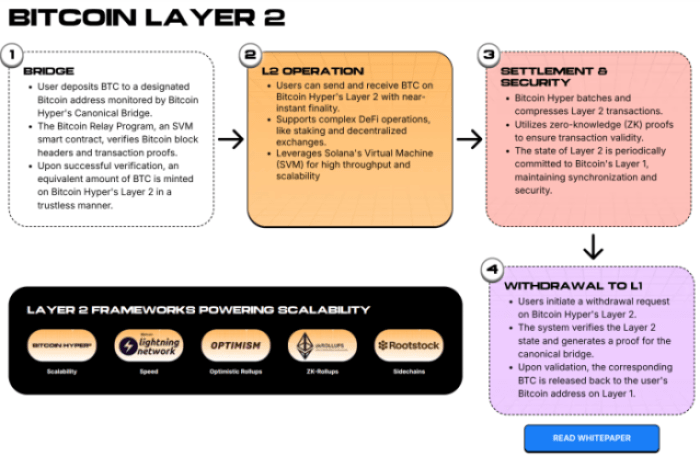
The driver here is Bitcoin Hyper’s integration of the Solana Virtual Machine (SVM) as a Bitcoin Layer 2. That matters. It bridges the ecosystem’s single largest gap: the disparity between Bitcoin’s liquidity and Solana’s execution speed. Bitcoin provides the gold standard for settlement, but its lack of native smart contract capabilities has historically forced liquidity to bridge out to Ethereum or Solana, fragmenting security in the process.

Bitcoin Hyper keeps that value in orbit. Using a decentralized canonical bridge (and a single trusted sequencer with periodic L1 state anchoring), the network delivers sub-second finality while inheriting the security properties of the Bitcoin base layer. This isn’t just a technical upgrade; it’s an economic unlock.

Developers can now build high-frequency trading applications, Rust-based gaming dApps, and complex DeFi protocols on Bitcoin that were previously impossible due to block time constraints.

The market implications are stark. Historically, ‘Bitcoin L2’ meant payment channels like Lightning. The introduction of full programmability via SVM changes the competitive landscape. It suggests the future of DeFi isn’t an ‘$ETH killer’ L1, but rather a ‘$BTC enabler’ L2. For developers, the availability of an SDK and API in Rust lowers the barrier to entry, allowing existing Solana builders to deploy on Bitcoin instantly.

EXPLORE THE $HYPER ECOSYSTEM

Whales Accumulate $31M as Smart Money Positions for L2 Summer

Capital flows surrounding Bitcoin Hyper indicate smart money is front-running a broader rotation into Bitcoin application layers. $HYPER has already rasied over $31M, a figure that significantly outpaces typical seed rounds for comparable infrastructure plays. With the token currently priced at $0.0136753, the valuation suggests early investors are betting on a repricing event once the mainnet stabilizes.

On-chain analysis reveals specific high-value accumulation patterns that often precede wider retail attention. Etherscan data shows multiple whale purchases in the six figure mark, the largest being $500K. This type of concentration usually implies institutional or syndicate positioning rather than scattered retail ‘FOMO.’

Plus, the incentive structure is designed to lock in long-term liquidity. The protocol offers high APY for immediate staking after the Token Generation Event (TGE), combined with a modest 7-day vesting period for presale stakers. That short vesting window is unusual, it suggests the team is confident in immediate utility demand rather than relying on artificial lock-ups to prop up the price.

GET YOUR $HYPER ON THE OFFICIAL PRESALE WEBPAGE

The information provided in this article is for educational purposes only and does not constitute financial advice. Cryptocurrency investments, including presales and Layer 2 tokens, carry inherent high risks and volatility. Always conduct your own due diligence before making investment decisions.

Связанные с этим вопросы

QWhat is the CoinShares Quantum Risk Report's main finding about the immediate threat to Bitcoin?

AThe report finds that the immediate danger isn't quantum code-breaking, but rather the more pressing foreseeable engineering challenge of network congestion and the need for increased transaction throughput.

QAccording to the report, how much more powerful would quantum systems need to be to break Bitcoin's cryptography?

AQuantum systems would need to be roughly 100,000 times more powerful than today's hardware to break Bitcoin's cryptography.

QWhat is the core innovation of Bitcoin Hyper ($HYPER) as described in the article?

ABitcoin Hyper integrates the Solana Virtual Machine (SVM) as a Bitcoin Layer 2, bridging Bitcoin's liquidity with Solana's execution speed to provide sub-second finality while inheriting Bitcoin's security.

QHow much capital has the $HYPER project raised, and what does this indicate?

AThe project has raised over $31 million, which outpaces typical seed rounds for comparable infrastructure and indicates smart money is positioning for a broader rotation into Bitcoin application layers.

QWhat specific advantage does the SVM integration provide for developers?

AThe SVM integration allows developers to build high-frequency trading applications, Rust-based gaming dApps, and complex DeFi protocols on Bitcoin that were previously impossible due to block time constraints.

Похожее

Has the 'Digital Gold' Narrative for BTC Failed?

**Title: Has the "Digital Gold" Narrative for Bitcoin Failed?** The article argues that Bitcoin's "digital gold" narrative remains valid despite a recent sharp price decline (from a peak near $126k in Oct 2025 to briefly under $61k in Feb 2026). It presents a long-term investment framework based on three core points: **1. Viewing Bitcoin as an Asset:** Bitcoin is presented as a superior potential store of value compared to gold. Key arguments are its absolute scarcity (21 million cap), superior portability, and transparent auditability via its public ledger. While acknowledging its current use in early, volatile stages (~3-4% global adoption), the author draws parallels to the early, disruptive phases of the internet and e-commerce. **2. Understanding the Recent Downturn:** The current ~50% correction is framed as a predictable, consensus-driven cycle following its post-halving peak (the 2024 halving preceded the Oct 2025 high). A crucial factor is a historic "changing of hands": the influx of new institutional buyers via ETFs allowed early, low-cost holders (miners, OG believers) to take profits. The author notes that while severe, Bitcoin's historical drawdowns (e.g., 93% in 2011, 77% in 2021-22) have been progressively smaller, suggesting maturing holder structure and decreasing volatility over time. **3. The Long-Term Perspective:** The long-term thesis hinges on Bitcoin capturing a portion of gold's market value. With Bitcoin's market cap at ~$1.4 trillion (at $70k) versus gold's ~$20 trillion, significant upside potential exists if the "digital gold" narrative is partially realized. However, the author strongly cautions that short-term risks remain, the bottom is unpredictable, and high volatility is inherent. The real risk is not Bitcoin failing but poor personal position management (over-leverage, wrong capital) and a lack of deep understanding, which can force investors out during severe downturns. The conclusion uses Amazon's 95% crash post-2000 dot-com bubble and subsequent 42x recovery as an analogy. The ultimate question is not if Bitcoin's price will rise, but if an investor's strategy and conviction can withstand the volatility to see the long-term play out. The recent divergence (gold up, Bitcoin down) is posed not as a narrative failure, but as potential evidence of this ongoing, painful transition from a speculative asset to a mainstream allocation.

marsbit5 ч. назад

Has the 'Digital Gold' Narrative for BTC Failed?

marsbit5 ч. назад

Has BTC's 'Digital Gold' Narrative Failed?

The article discusses Bitcoin's "digital gold" narrative, its recent price drop, and long-term outlook through the perspective of "Jason". It argues the narrative is not a failure but that Bitcoin represents a superior, new asset class due to its fixed supply (21 million), portability, and auditability. The piece compares its current ~3-4% global adoption rate to early internet/e-commerce, suggesting significant growth potential. Regarding the 2025-2026 price decline (from ~$126k to briefly under $61k), the author views it as a predictable, consensus-driven sell-off within Bitcoin's ~4-year cycle post-halving, exacerbated by a major "handover" from early, low-cost holders to new institutional buyers via ETFs. A key observation is that historical peak-to-trough drawdowns have lessened over time (e.g., 93% in 2011 to ~50% in 2026), indicating maturing volatility as holder structure changes. For the long term, the author uses a simple framework: Bitcoin's total market cap (~$1.4T at $70k) is only about 7% of gold's (~$20T). Even capturing 30-50% of gold's value would imply substantial upside. However, the article strongly cautions against viewing this as investment advice, emphasizing extreme volatility and the critical importance of risk management, position sizing, and deep fundamental understanding to survive severe drawdowns. It concludes by drawing a parallel to Amazon's 95% crash in 2000 and subsequent 42x recovery, stressing that the key is surviving market cycles to realize long-term potential.

链捕手5 ч. назад

Has BTC's 'Digital Gold' Narrative Failed?

链捕手5 ч. назад

From Code to Cognition: A Ten-Thousand-Word Guide to the Evolution of the Robot Brain

"From Code to Cognition: The Evolution of Robot Brains" The journey of robotic intelligence has shifted dramatically from manually coded systems to AI-driven brains. For decades, robots relied on layered software stacks—perception, state estimation, planning, control—each handcrafted. While predictable, they lacked adaptability. The 2010s saw deep learning revolutionize perception (e.g., object detection) and control (via reinforcement learning), but learned skills remained narrow. The arrival of Large Language Models (LLMs) marked a turning point. LLMs acted as high-level planners, interpreting natural language instructions and generating sequences of actions for traditional robotic systems to execute. However, true integration came with Visual-Language-Action (VLA) models, which fused vision, language, and motion prediction into a single network. Pioneered by models like RT-2 and open-source projects like OpenVLA, VLAs enable robots to reason and act directly from visual input and commands. The most advanced humanoid robots now employ a "dual-brain" architecture: a slow-thinking, large VLA (System 2) for reasoning and planning, and a fast-reacting, small network (System 1) for high-frequency motion control, sometimes with an even lower-level System 0 for balance. This split balances cognition with the physics of real-time movement. Computation is split between onboard hardware (e.g., NVIDIA Jetson) for safety-critical control loops and cloud/edge servers for non-critical tasks like learning and interfaces. A crucial driver is the open-source ecosystem—models like GR00T and OpenVLA allow startups to build upon pre-trained brains and fine-tune them with their own data, accelerating development. Despite progress, current systems struggle with recovery from errors, sample inefficiency, and long-horizon tasks. This has spurred the rise of **World Models**—neural networks that predict the consequences of actions. By simulating possible futures before acting (like NVIDIA Cosmos or Meta V-JEPA), robots can plan, recover, and generalize better. This represents the next frontier: shifting intelligence from learned reactions to an internal model of physics and cause-and-effect. The field is rapidly evolving. While not yet at its "ChatGPT moment," the convergence of cheaper hardware, scalable simulation, and world models points toward robots that are increasingly capable, adaptive, and useful. The question is shifting from "what can robots do?" to "what *should* they do?"

marsbit5 ч. назад

From Code to Cognition: A Ten-Thousand-Word Guide to the Evolution of the Robot Brain

marsbit5 ч. назад

Торговля

Спот
Фьючерсы

Популярные статьи

Как купить S

Добро пожаловать на HTX.com! Мы сделали приобретение Sonic (S) простым и удобным. Следуйте нашему пошаговому руководству и отправляйтесь в свое крипто-путешествие.Шаг 1: Создайте аккаунт на HTXИспользуйте свой адрес электронной почты или номер телефона, чтобы зарегистрироваться и бесплатно создать аккаунт на HTX. Пройдите удобную регистрацию и откройте для себя весь функционал.Создать аккаунтШаг 2: Перейдите в Купить криптовалюту и выберите свой способ оплатыКредитная/Дебетовая Карта: Используйте свою карту Visa или Mastercard для мгновенной покупки Sonic (S).Баланс: Используйте средства с баланса вашего аккаунта HTX для простой торговли.Третьи Лица: Мы добавили популярные способы оплаты, такие как Google Pay и Apple Pay, для повышения удобства.P2P: Торгуйте напрямую с другими пользователями на HTX.Внебиржевая Торговля (OTC): Мы предлагаем индивидуальные услуги и конкурентоспособные обменные курсы для трейдеров.Шаг 3: Хранение Sonic (S)После приобретения вами Sonic (S) храните их в своем аккаунте на HTX. В качестве альтернативы вы можете отправить их куда-либо с помощью перевода в блокчейне или использовать для торговли с другими криптовалютами.Шаг 4: Торговля Sonic (S)С легкостью торгуйте Sonic (S) на спотовом рынке HTX. Просто зайдите в свой аккаунт, выберите торговую пару, совершайте сделки и следите за ними в режиме реального времени. Мы предлагаем удобный интерфейс как для начинающих, так и для опытных трейдеров.

1.4k просмотров всегоОпубликовано 2025.01.15Обновлено 2026.06.02

Как купить S

Sonic: Обновления под руководством Андре Кронье – новая звезда Layer-1 на фоне спада рынка

Он решает проблемы масштабируемости, совместимости между блокчейнами и стимулов для разработчиков с помощью технологических инноваций.

2.3k просмотров всегоОпубликовано 2025.04.09Обновлено 2025.04.09

Sonic: Обновления под руководством Андре Кронье – новая звезда Layer-1 на фоне спада рынка

HTX Learn: Пройдите обучение по "Sonic" и разделите 1000 USDT

HTX Learn — ваш проводник в мир перспективных проектов, и мы запускаем специальное мероприятие "Учитесь и Зарабатывайте", посвящённое этим проектам. Наше новое направление .

1.8k просмотров всегоОпубликовано 2025.04.10Обновлено 2025.04.10

HTX Learn: Пройдите обучение по "Sonic" и разделите 1000 USDT

Обсуждения

Добро пожаловать в Сообщество HTX. Здесь вы сможете быть в курсе последних новостей о развитии платформы и получить доступ к профессиональной аналитической информации о рынке. Мнения пользователей о цене на S (S) представлены ниже.

活动图片