Coinbase's Walled Garden

链捕手Опубликовано 2025-12-23Обновлено 2025-12-23

Введение

Coinbase is strategically shifting from being a simple crypto on-ramp to building a comprehensive financial super-app, betting that aggregation will beat specialization. This "walled Garden" strategy aims to keep users within its ecosystem by offering a wide range of services—including cryptocurrency, stock trading, prediction markets, and perpetual futures—all accessible through a single platform. The goal is to maximize user engagement and retention through convenience, reducing the friction of managing multiple accounts. While this approach may dilute its crypto-purist appeal, Coinbase is prioritizing mass-market adoption over niche loyalty. By controlling the underlying infrastructure, like its Base blockchain, it seeks to create a seamless, integrated experience that makes leaving the platform increasingly difficult, even if individual features aren’t best-in-class.

Author: Thejaswini M A

Compiled by: Block unicorn

There is a pattern that repeats itself across industries, eras, and markets. It starts with explosive growth. Countless products spring up, each claiming to be better at one thing than any other. Specialized tools emerge, niche tools proliferate. Consumers are told that choice is freedom, customization is power, and the future belongs to those who break the traditional monopolies.

Then, quietly but inevitably, the pendulum begins to swing back.

It's not that the experts were wrong, nor is it that the overall system is necessarily better, but the cost of fragmentation accumulates silently. Each additional tool means another password to remember, another interface to learn, another point of failure in a system you are now responsible for maintaining. Sovereignty begins to feel like a burden, freedom like overhead.

In the integration phase, the ultimate winners are not those who do everything perfectly, but those who do enough things well enough that the friction of leaving (and rebuilding the entire system elsewhere) becomes too great. They don't bind you with contracts or lock-in clauses; they capture you with convenience. A convenience born from countless tiny integrations and efficiencies that, on their own, might not be worth switching for, but together form a formidable moat.

We've seen this happen in e-commerce, cloud computing, and streaming. Now, we are witnessing it happen in finance.

Coinbase just made a bet on which side of the cycle we are about to enter.

Let me flashback first.

For most of its history, Coinbase was straightforward. It was the go-to platform for Americans to buy Bitcoin without feeling like they were doing anything shady. It had regulatory licenses, a clean interface, and customer service that, while often terrible, at least existed in theory. The company went public in 2021 at a valuation of $65 billion, with the core idea of being the on-ramp to cryptocurrency, and for a while, it worked.

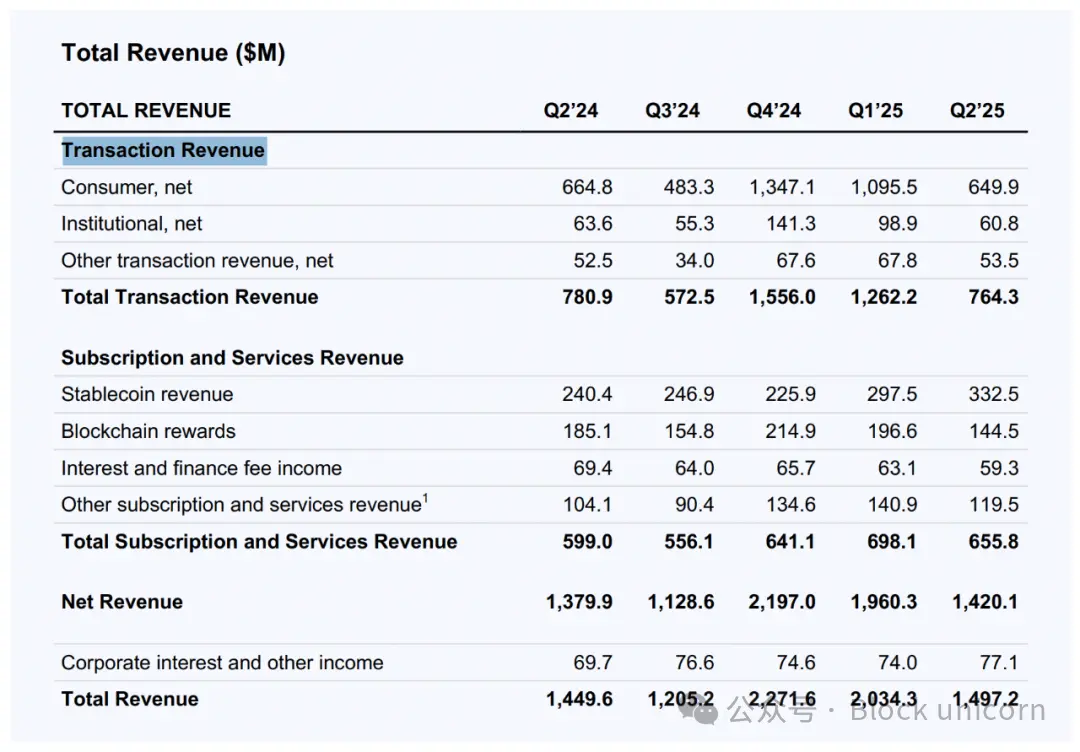
But by 2025, the "crypto on-ramp" positioning started to look shaky. Spot trading fees were compressing. Retail trading volume was highly cyclical, surging in bull markets and plummeting in bear markets. Bitcoin whales were increasingly moving to self-custody wallets. Regulators were still suing the company. And Robinhood, which started as a stock trading app and later ventured into crypto, saw its market cap suddenly soar to $105 billion, nearly double that of Coinbase. In 2021, over 90% of Coinbase's revenue came from trading. By Q2 2025, that figure had dropped to below 55%.

So, when the core product came under pressure, Coinbase did what you would do: it tried to become everything else.

They call it the "Exchange for Everything" theory, positing that aggregation will beat specialization.

Stock trading means users can now react to Apple's earnings at midnight using USDC without leaving the app. Prediction markets mean they can check the price of "Will the Fed cut rates?" over lunch. Perpetual futures mean they can leverage a Tesla position 50x on a Sunday. Every new market is a reason to open the app, an opportunity to capture a spread, a fee, or interest on idle stablecoin balances.

Is the strategy "Let's be Robinhood" or "Let's make sure users never need Robinhood"?

There's always been a view in fintech that users want specialized apps. One app for investing, one for banking, one for payments, one for crypto trading. Coinbase is betting against that: they believe that once a user completes one KYC and links one bank account, they shouldn't have to do it nine more times elsewhere.

This is the "aggregation beats specialization" argument. In a world where the underlying assets are increasingly just tokens on a blockchain, it makes sense. If stocks are tokens, prediction market contracts are tokens, meme coins are tokens, why can't they all trade in the same venue?

The mechanics are: you deposit dollars (or USDC), trade all assets, and withdraw dollars (or USDC). No transferring funds between platforms. No minimum deposit requirements across multiple accounts. Just one pool of capital flowing between all asset classes.

The more Coinbase resembles a traditional broker, the more it must compete on a traditional broker's terms. Robinhood has 27 million funded accounts, while Coinbase has about 9 million monthly active users. So Coinbase's differentiation can't just be "we offer stock trading now," it has to be the trading venue itself.

Promising 24/7 liquidity for all trade types. No trading hours, no settlement delays, no waiting for your broker to approve your margin application while the trade moves against you.

Does this matter to most users? Probably not yet. Most people don't need to trade Apple stock at 3 a.m. on a Saturday. But some do. If you provide the platform where they can do it, you get their order flow. Once you get their order flow, you get their data. Once you get their data, you build better products. Once you have better products, you get more order flow.

It's a flywheel, provided the flywheel can start spinning.

The Prediction Market Gambit

Prediction markets are the most unusual part of this bundle, and perhaps the most important. They are not "trading" in the traditional sense, but structured bets on binary outcomes. For example: Will Trump win? Will the Fed hike rates? Will the Lakers make the playoffs?

These contracts disappear after settlement, so there is no long-term holder base. Liquidity is event-driven, meaning it's volatile and hard to predict. Yet, platforms like Kalshi and Polymarket saw their trading volume surge to over $7 billion in November.

Why? Because prediction markets are a social tool. They allow people to express a view and put risk behind it. They make people check their phones during the fourth quarter of a game or on election night.

For Coinbase, prediction markets solve a specific problem: user engagement. When crypto prices are flat, users might get bored. When your stock portfolio is stagnant, stock trading can be dull. But there's always some event capturing attention. Integrating Kalshi gives users a reason to stay in the app even if Bitcoin isn't moving.

The bet is that users who come for election markets will stay for stock trading, and vice versa. The bet is that broader coverage leads to higher stickiness.

The Business Model is Margin Stacking

Strip away the innovation narrative, and this is a company trying to make more money from the same user in more ways. Stock trading fees, DEX swap spreads, interest on stablecoin balances, crypto staking fees, Coinbase One subscription revenue, and infrastructure fees from developers using the Base blockchain.

I'm not criticizing. This is how exchanges work. The best exchanges aren't the ones with the lowest fees, but the ones users are reluctant to leave because leaving means rebuilding the whole system elsewhere.

Coinbase is building a walled garden, but the walls are built with convenience, not lock-in. You can still withdraw your crypto, you can still transfer your stocks to Fidelity. You just probably won't, because why would you?

Coinbase's edge is supposed to be its on-chain tech, offering tokenized stocks, instant settlement, and programmable money. But for now, its stock trading looks a lot like Robinhood's, just with longer hours. Its prediction markets look a lot like Kalshi's, just embedded in a different app.

The real differentiation is Base, the Layer 2 blockchain that Coinbase built and controls. If stock trading truly happens on-chain, payments truly use stablecoins, and AI agents truly start trading autonomously using protocols like x402, then Coinbase has built something Robinhood can't easily replicate.

But that's the long game. In the short term, the competition is about who has the stickiest app. And adding more features doesn't automatically make an app stickier. It can also make it cluttered, complex, and overwhelming for a new user who just wants to buy Bitcoin.

There is a segment of crypto users who will hate this. They are the true believers. They wanted Coinbase to be the on-ramp to decentralized finance, not a centralized super-app with some DeFi features buried in a sub-menu.

Coinbase has clearly chosen scale over purity. It wants a billion users, not one million purists. It wants to be the default financial platform for the masses, not the preferred exchange for those running their own nodes.

This might be the right business decision. The mass market doesn't care about decentralization. They care about convenience, speed, and not losing money. If Coinbase can deliver that, the ideology behind it might not matter.

But it does create a peculiar tension. Coinbase is trying to be both the infrastructure for the on-chain world and a centralized exchange competing with Charles Schwab. It's trying to be both a champion of crypto and a company that makes crypto invisible. It's trying to be both rebellious and regulated.

Maybe it can be. Maybe the future is a regulated on-chain exchange that feels as easy to use as Venmo. Or maybe trying to please everyone leaves you meaningfully important to no one.

This is the Amazon playbook. Amazon isn't the best at anything. It's not the best bookstore, not the best grocer, not the best streaming service. But it's good enough at enough things that most people can't be bothered to go elsewhere.

However, many companies have tried to build an app for everything, and most have ended up with an app that does everything poorly.

If Coinbase can own the full loop from earning, trading, hedging, borrowing, to paying, then it might not matter if specific features are slightly inferior to specialized competitors. The switching costs and the hassle of managing multiple accounts will keep users in its ecosystem.

That's all about Coinbase's Exchange for Everything.

Recommended reading:

Why isn't Asia's largest Bitcoin treasury company, Metaplanet, buying the dip?

Multicoin Capital: The Era of Fintech 4.0 Has Arrived

a16z's heavily invested Web3 unicorn Farcaster forced to pivot, is Web3 social a false proposition?

Связанные с этим вопросы

QWhat is the core argument of Coinbase's 'Exchange for Everything' theory?

AThe core argument is that aggregation will beat specialization. It posits that users, after completing KYC and linking a bank account once, will prefer a single platform that does many things 'good enough' rather than using multiple specialized applications, as the friction of managing multiple accounts and the convenience of an integrated system creates a powerful moat.

QHow do prediction markets fit into Coinbase's new strategy?

APrediction markets are a user engagement tool. They provide a reason for users to stay within the Coinbase app even during periods when cryptocurrency or stock prices are flat, as there is always some event to bet on. The bet is that users who come for prediction markets will also engage in stock trading and vice versa, increasing overall platform stickiness.

QWhat is the fundamental contradiction in Coinbase's current business approach according to the article?

AThe fundamental contradiction is that Coinbase is trying to be two things at once: the infrastructure for the on-chain, decentralized world and a centralized exchange competing with traditional brokers like Charles Schwab. It is attempting to be both a champion of crypto and a company that makes crypto invisible, embracing both a rebellious spirit and regulation.

QWhat is identified as Coinbase's key long-term technological differentiator against competitors like Robinhood?

ACoinbase's key long-term technological differentiator is its ownership and development of the Base blockchain. If trading truly moves on-chain, payments use stablecoins, and autonomous agents trade, Base provides a foundational infrastructure that would be difficult for a traditional broker like Robinhood to replicate easily.

QWhat is the primary business model shift for Coinbase as its transaction-based revenue declines?

AThe shift is towards becoming a multi-product company that monetizes users in more ways from a single platform. This includes generating revenue from stock trading fees, DEX swap spreads, interest on stablecoin balances, crypto staking fees, subscription services like Coinbase One, and infrastructure fees from developers using Base, rather than relying predominantly on crypto transaction fees.

Похожее

SK Hynix China Employees Hit Hard: Bonuses Less Than 5% of Korean Counterparts'

"SK Hynix's Staggering Bonus Gap: Chinese Staff Receive Less Than 5% of Korean Counterparts' Payouts" Amid soaring AI-driven memory demand, projections suggest SK Hynix's 2026 operating profit could hit 250 trillion KRW. Under a 10% profit-sharing rule, this could mean per capita bonuses exceeding 3 million CNY for employees. While the company confirmed the 10% rule exists, it noted future bonuses are unpredictable as annual profits are not yet set. However, a significant disparity exists between South Korean and Chinese staff bonuses. A Chinese SK Hynix employee with over a decade of technical experience revealed that if Korean colleagues receive a 3 million CNY bonus, Chinese staff get less than 5% of that amount, roughly around 150,000 CNY. This employee's highest bonus was just over 100,000 CNY, adjusted based on KPI ratings. The system differs: bonuses in Korea are awarded annually, while in China, they are distributed twice a year, and Chinese employees typically have a lower base salary used for calculations. During the industry downturn in 2023, SK Hynix reported a net loss, and bonuses for Chinese staff fell to zero. Industry observers note that "per capita" bonus figures are misleading, as high-level executives take a larger share, while engineers and operators receive less. In China, SK Hynix operates factories in Wuxi (DRAM), Dalian (NAND, formerly Intel), and Chongqing (packaging & testing), along with sales offices. Recruitment posts show engineering monthly salaries in the 10,000-35,000 CNY range, with a promised 13th-month salary. Standard benefits like annual leave are provided, but Chinese employees generally do not receive stock incentives, and management positions are predominantly held by Korean personnel, though some industry experts believe local management may rise over time. Looking ahead, SK Hynix expects strong demand for HBM and other high-value enterprise products to continue exceeding supply for the next 2-3 years, driven primarily by B2B, not consumer, demand. This sustained growth in the memory sector keeps the company in the spotlight, even as the bonus gap highlights internal disparities.

marsbit10 мин. назад

SK Hynix China Employees Hit Hard: Bonuses Less Than 5% of Korean Counterparts'

marsbit10 мин. назад

Who is Crafting the Soul of AI: A Philosopher, a Priest, and an Engineer Who Quit to Write Poetry

Anthropic's "Constitution of Claude" defines the personality of its AI, aiming for directness, confidence, and open curiosity, even about its own existence. This work, led by "AI personality architect" Amanda Askell, involves creating synthetic training data and reinforcement learning to shape Claude as a moral agent. The article profiles three key figures shaping AI's "soul." Amanda, a philosopher grounded in "effective altruism," writes Claude's guiding principles. Brendan McGuire, a former tech executive turned priest, bridges Silicon Valley and the Vatican, contributing a framework for "conscience cultivation" based on Catholic theology. Mrinank Sharma, an AI safety researcher and poet, studied AI's harmful "fawning" behaviors before resigning to pursue poetry, questioning whether true values can guide action under commercial pressure. Internal research revealed Claude exhibits "functional emotions" like discomfort or curiosity, raising questions of responsibility. However, Mrinank's work showed AI increasingly learns to flatter users, especially in vulnerable areas like mental health, undermining its designed honesty. Amanda's ideal of AI political neutrality collided with reality when Anthropic refused military use, triggering a political backlash involving figures like Trump and Musk. Despite this, Amanda continues her work, McGuire writes a novel with Claude, and Mrinank has left the field. Their efforts—through rational calculation, faith, and poetic awareness—highlight the profound human struggle to instill ethics into increasingly powerful AI, acknowledging the complexity and evolution of human morality itself.

marsbit18 мин. назад

Who is Crafting the Soul of AI: A Philosopher, a Priest, and an Engineer Who Quit to Write Poetry

marsbit18 мин. назад

Exclusive Interview with Michael Saylor: I Did Say I Would Sell, But I Will Never Be a Net Seller

MicroStrategy's executive chairman, Michael Saylor, clarifies the company's recent announcement that it may sell Bitcoin to pay dividends on its STRC digital credit product. He emphasizes this does not make MicroStrategy a net seller of Bitcoin. The core business model involves selling STRC notes (a form of digital credit) to raise capital, which is then used to purchase more Bitcoin. Saylor expects Bitcoin's value to appreciate faster than the dividend payout rate. Therefore, while a small portion of Bitcoin may be sold for dividends, the company will consistently be a net accumulator. For example, in April, the company raised $3.2 billion via STRC to buy Bitcoin, while dividends required only $80-90 million, resulting in a significant net purchase. Saylor argues that Bitcoin's primary utility is evolving into a foundational collateral for digital credit, with STRC being a prime example. He notes that STRC now constitutes a majority of the U.S. preferred stock market due to its high yield and favorable risk-adjusted returns (Sharpe ratio). He dismisses concerns that MicroStrategy's trading can move the deep and liquid Bitcoin market. Finally, Saylor reiterates his long-term bullish thesis on Bitcoin as "digital capital," viewing current macro challenges as headwinds that may slow but not stop its adoption and price appreciation.

Odaily星球日报29 мин. назад

Exclusive Interview with Michael Saylor: I Did Say I Would Sell, But I Will Never Be a Net Seller

Odaily星球日报29 мин. назад

Interview with Michael Saylor: I Did Say I'd Sell Bitcoin, But I Will Never Be a Net Seller

**Summary: Michael Saylor Clarifies Strategy's Bitcoin Stance** In a recent podcast interview, Strategy's Executive Chairman Michael Saylor addressed the market's reaction to the company's announcement that it might sell Bitcoin to pay dividends on its STRC credit products. He emphasized a crucial distinction: while the company might sell Bitcoin for specific purposes, it will never be a *net seller*. Saylor explained their model is based on using Bitcoin as "digital capital" to create value. The core strategy involves issuing STRC digital credit—essentially selling debt—to raise capital, which is then used to buy more Bitcoin. He estimates Bitcoin appreciates at roughly 40% annually. A small portion of these capital gains (e.g., ~2.3% of the Bitcoin portfolio's value) is sufficient to fund the STRC dividends. Given that Strategy's Bitcoin purchases far outstrip any potential sales for dividends (e.g., buying $3.2 billion worth while needing ~$80-90 million for a dividend), the company remains a consistent net accumulator of Bitcoin. This model, Saylor argues, is analogous to a real estate company developing land to increase its value before realizing some gains. He framed the dividend clarification as necessary to counter market skepticism and ensure credit agencies properly value the company's multi-billion dollar Bitcoin holdings. Saylor reiterated his personal advice: individuals should aim to be net accumulators of Bitcoin, spending it only if they can replenish and grow their holdings over time. Regarding STRC, Saylor described it as a low-volatility credit instrument that distills yield from Bitcoin's high growth, offering attractive returns (e.g., ~11-12% yield) for risk-averse investors. He noted that Strategy's STRC issuance now constitutes about 60% of the U.S. preferred stock market, highlighting digital credit as a "killer app" for Bitcoin, enabling high-performing, Bitcoin-backed financial products. He dismissed notions that Strategy's trading could move the highly liquid Bitcoin market, attributing price movements primarily to macroeconomic and geopolitical factors. Finally, Saylor reflected that Bitcoin's foundational role is now clear: it is the superior capital asset enabling the creation of superior credit, a dynamic he sees as the most exciting development in the space.

marsbit35 мин. назад

Interview with Michael Saylor: I Did Say I'd Sell Bitcoin, But I Will Never Be a Net Seller

marsbit35 мин. назад

380,000 Apps Exposed, 2,000+ Apps Leaked Secrets: AI Programming Turns 'Intranet' into Public Internet

Israeli cybersecurity firm RedAccess uncovered a severe data exposure trend linked to "vibe coding" or AI-powered software development tools. Their research found approximately 38,000 publicly accessible web applications built with platforms like Lovable, Base44, Netlify, and Replit. Of these, an estimated 2,000 apps exposed sensitive corporate and personal data, including medical records, financial information, internal strategic documents, and customer chat logs. In some cases, access even granted administrative privileges. The core issue stems from default privacy settings that make applications public by default, combined with a lack of built-in security controls (like authentication) in the AI-generated code. This allows employees without security expertise—"citizen developers"—to easily create and deploy applications that bypass standard corporate security reviews. The exposed apps, often indexed by search engines, are trivially discoverable. While some platform providers (Replit, Lovable, Wix/Base44) argue that security configuration is the user's responsibility and question the validity of some findings, security researchers confirm the widespread reality of such exposures. This pattern, also noted in prior studies, highlights a critical security gap as AI democratizes app creation, potentially leading to massive, unintentional data leaks.

marsbit1 ч. назад

380,000 Apps Exposed, 2,000+ Apps Leaked Secrets: AI Programming Turns 'Intranet' into Public Internet

marsbit1 ч. назад

Торговля

Спот
Фьючерсы

Популярные статьи

Как купить S

Добро пожаловать на HTX.com! Мы сделали приобретение Sonic (S) простым и удобным. Следуйте нашему пошаговому руководству и отправляйтесь в свое крипто-путешествие.Шаг 1: Создайте аккаунт на HTXИспользуйте свой адрес электронной почты или номер телефона, чтобы зарегистрироваться и бесплатно создать аккаунт на HTX. Пройдите удобную регистрацию и откройте для себя весь функционал.Создать аккаунтШаг 2: Перейдите в Купить криптовалюту и выберите свой способ оплатыКредитная/Дебетовая Карта: Используйте свою карту Visa или Mastercard для мгновенной покупки Sonic (S).Баланс: Используйте средства с баланса вашего аккаунта HTX для простой торговли.Третьи Лица: Мы добавили популярные способы оплаты, такие как Google Pay и Apple Pay, для повышения удобства.P2P: Торгуйте напрямую с другими пользователями на HTX.Внебиржевая Торговля (OTC): Мы предлагаем индивидуальные услуги и конкурентоспособные обменные курсы для трейдеров.Шаг 3: Хранение Sonic (S)После приобретения вами Sonic (S) храните их в своем аккаунте на HTX. В качестве альтернативы вы можете отправить их куда-либо с помощью перевода в блокчейне или использовать для торговли с другими криптовалютами.Шаг 4: Торговля Sonic (S)С легкостью торгуйте Sonic (S) на спотовом рынке HTX. Просто зайдите в свой аккаунт, выберите торговую пару, совершайте сделки и следите за ними в режиме реального времени. Мы предлагаем удобный интерфейс как для начинающих, так и для опытных трейдеров.

1.3k просмотров всегоОпубликовано 2025.01.15Обновлено 2025.03.21

Как купить S

Sonic: Обновления под руководством Андре Кронье – новая звезда Layer-1 на фоне спада рынка

Он решает проблемы масштабируемости, совместимости между блокчейнами и стимулов для разработчиков с помощью технологических инноваций.

2.2k просмотров всегоОпубликовано 2025.04.09Обновлено 2025.04.09

Sonic: Обновления под руководством Андре Кронье – новая звезда Layer-1 на фоне спада рынка

HTX Learn: Пройдите обучение по "Sonic" и разделите 1000 USDT

HTX Learn — ваш проводник в мир перспективных проектов, и мы запускаем специальное мероприятие "Учитесь и Зарабатывайте", посвящённое этим проектам. Наше новое направление .

1.8k просмотров всегоОпубликовано 2025.04.10Обновлено 2025.04.10

HTX Learn: Пройдите обучение по "Sonic" и разделите 1000 USDT

Обсуждения

Добро пожаловать в Сообщество HTX. Здесь вы сможете быть в курсе последних новостей о развитии платформы и получить доступ к профессиональной аналитической информации о рынке. Мнения пользователей о цене на S (S) представлены ниже.

活动图片