Circle's Q2 Earnings Report is Out, Does It Answer Wall Street's Bull-Bear Split?

marsbitОпубликовано 2026-08-05Обновлено 2026-08-05

Введение

Circle released its Q2 2026 financial results. Total revenue and reserve income reached $7.01B, slightly below expectations but reversing a previous declining trend. Adjusted EBITDA was $143M, and net income from continuing operations was $48M. Key financial metrics showed mixed signals. USDC's average circulation grew to $76.5B, but the quarter-end circulation shrank to $73.3B, and its market share among dollar stablecoins slightly declined. Reserve income remained the primary revenue driver at $6.68B. Other revenue was $34M, down sequentially, but the full-year guidance for this segment was nearly doubled to $3.1-3.3B, mainly due to the inclusion of ARC token pre-sale revenue. The core RLDC Margin held strong at 41%. Operationally, the Arc network mainnet is scheduled for launch on September 16th, with major validators like BlackRock and Visa. The Circle Payments Network (CPN) showed significant growth in transaction volume. The company also secured key regulatory approvals, including a federal trust charter from the OCC. The report highlighted Wall Street's ongoing valuation debate. Morgan Stanley's downgrade reflects concerns about USDC growth and over-reliance on interest income. TD Cowen's bullish view finds support in Circle's expanding infrastructure platform, including Arc and CPN. The earnings confirm Circle's strategic pivot towards building a broader digital finance platform, but the success of this transition in generating sustainable non-interest revenue rema...

Author|Azuma(@azuma_eth)

At 8:05 AM ET on August 5th, stablecoin issuer Circle officially released its Q2 2026 earnings report.

The financial report data shows that Circle's total revenue and reserve income for Q2 was $701 million (below market expectations of $717 million), a year-over-year increase of 7%; adjusted EBITDA was $143 million, a year-over-year increase of 8%; net income from continuing operations was $48 million (above market expectations of $43 million), an increase of $530 million year-over-year.

Affected by the earnings release, CRCL surged in pre-market trading but subsequently weakened. As of 8:45 PM ET, it was temporarily quoted at $61.55, down 2.84% pre-market.

Core Data Analysis

1. Total Revenue Missed Expectations, But Reversed the Trend

As shown in the report, this quarter Circle's Total Revenue and Reserve Income was $701 million. Although it did not meet market expectations ($717 million), it reversed the contraction trend from the previous quarter ($579 million ➡️ $658 million ➡️ $740 million ➡️ $770 million ➡️ $694 million ➡️ $701 million).
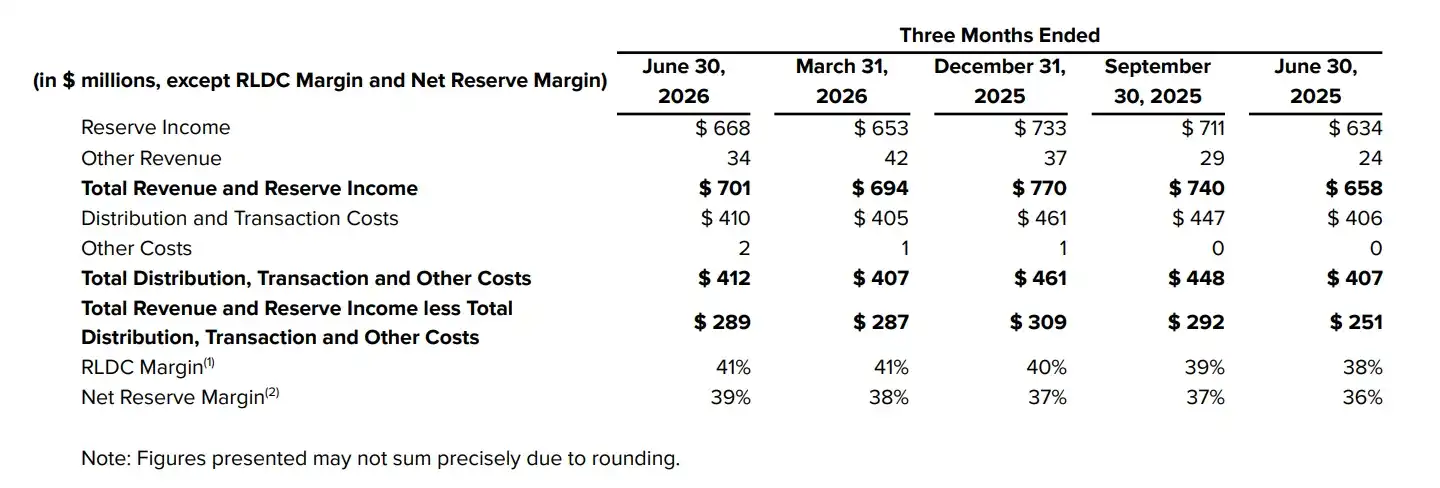
Breaking down the revenue structure, Reserve Income remains the absolute main contributor, recording $668 million in Q2, up 5% year-over-year and 2% quarter-over-quarter.

2. USDC Average Circulation Still Growing, but Saw Significant Outflow at Quarter-End

The growth in reserve income primarily benefited from the increase in USDC circulation volume —— In Q2, USDC circulation exhibited a divergent pattern of "average growth, quarter-end contraction."
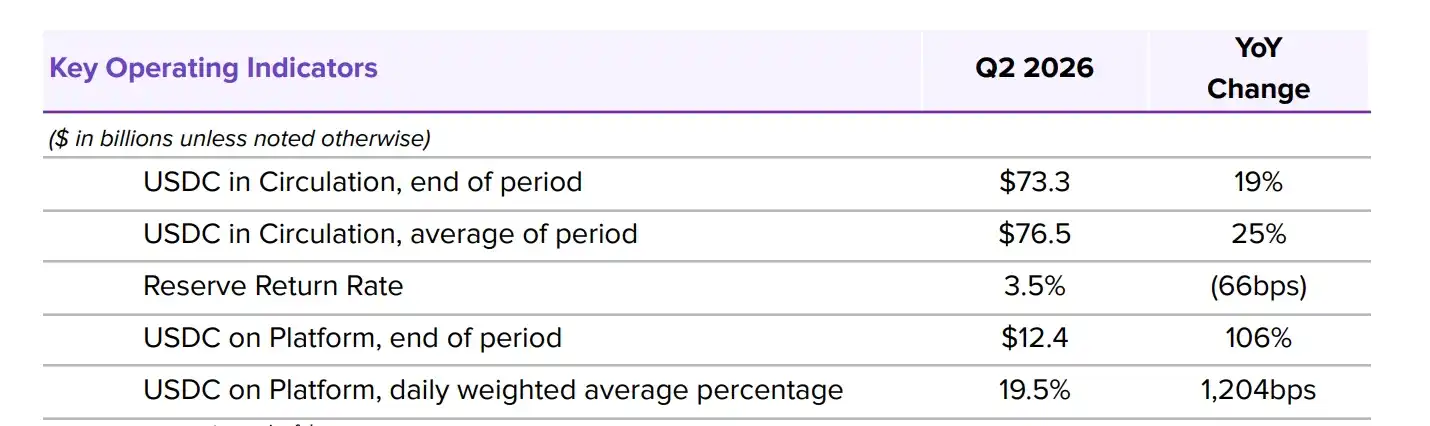
Financial report data shows that the average USDC circulation in Q2 was $76.5 billion, a 25% year-over-year increase and about a 2% quarter-over-quarter increase (previous quarter average was $75.2 billion); however, the quarter-end circulation was $73.3 billion, which, while up 19% year-over-year, decreased by about 4.8% from the previous quarter-end's $77 billion.This indicates that the outflow of USDC funds mainly occurred at the quarter-end window. While the overall scale is still expanding, the marginal trend warrants caution.
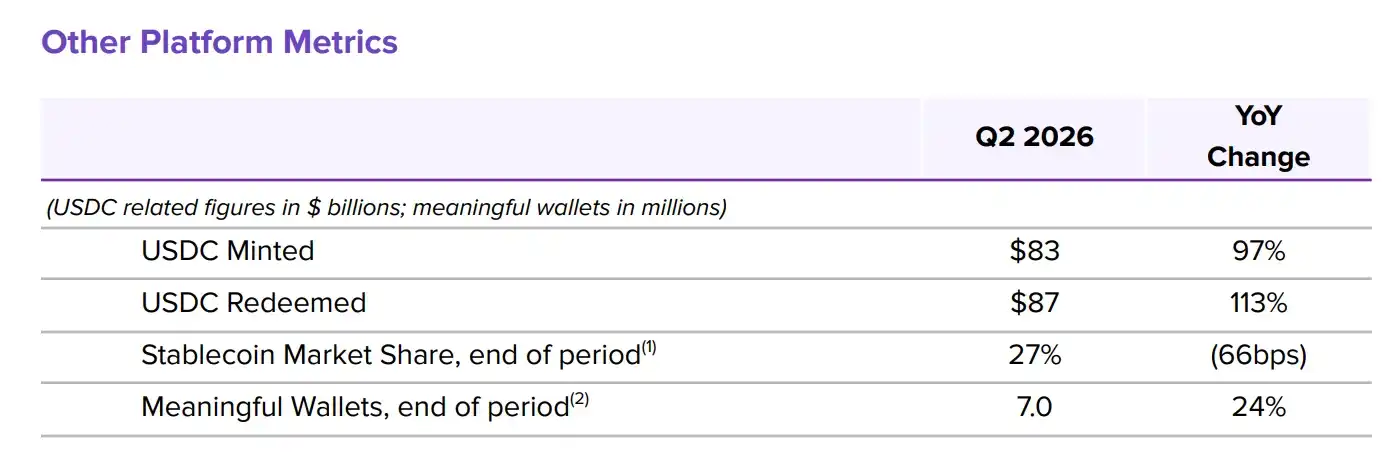
Another concerning metric is market share. The report shows that USDC's market share in dollar-denominated stablecoins at the end of this quarter was 27%, down 66 basis points year-over-year —— Against the backdrop of shrinking total industry supply, USDC failed to gain market share and instead lost some ground.

3. Other Revenue Declined Quarter-over-Quarter, but Full-Year Guidance Significantly Revised Upward

Excluding reserve income, Circle's Other Revenue for this quarter was $34 million, a significant 41% year-over-year increase, but down 19% quarter-over-quarter, breaking the previous streak of five consecutive quarters of growth ($21 million ➡️ $24 million ➡️ $29 million ➡️ $37 million ➡️ $42 million ➡️ $34 million).

Notably, Circle simultaneously revised its full-year 2026 Other Revenue guidance significantly upward, from $150–170 million to $310–330 million, nearly doubling, specifically explaining that this guidance includes recognized ARC token presale revenue.
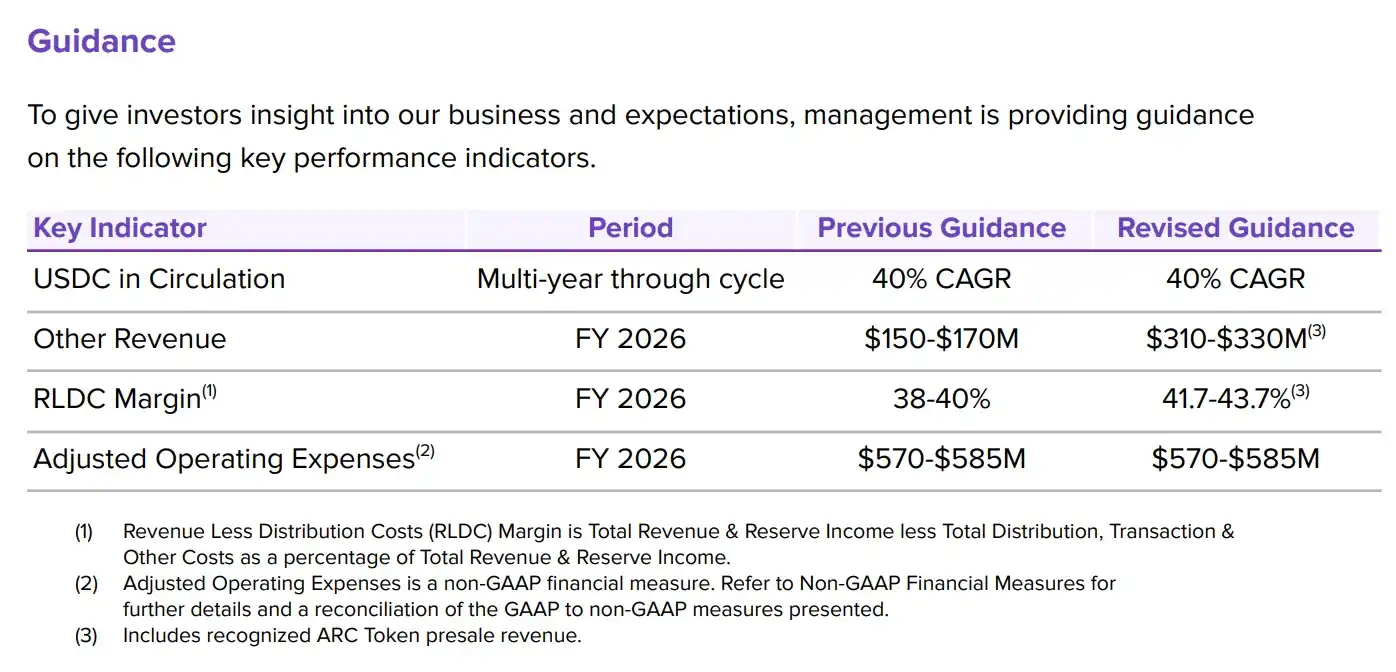
According to explanations from the Q1 earnings call, ARC tokens held by Circle, after fulfilling presale agreement obligations, will be recognized at fair value as "Other Revenue" and directly included in RLDC and adjusted EBITDA. This means that Other Revenue in the coming quarters will be significantly elevated due to ARC token recognition. However, it's important to note that this portion of revenue is closer to a one-time accounting gain rather than sustainable subscription or service income; excluding the ARC impact, the growth trajectory of core Other Revenue still requires ongoing observation.

4. RLDC Margin Remains High, Distribution Cost Control Optimized

RLDC Margin was the most resilient metric in Circle's quarterly report this time —— This figure refers to the profit margin after subtracting distribution costs from revenue, reflecting the core business profitability level after accounting for distribution expenses, and is widely regarded as Circle's most crucial profitability metric.

In Q2, Circle's RLDC (Revenue Less Distribution Costs) was $289 million, a year-over-year increase of 15%; RLDC Margin reached 41%, up 3.02% basis points year-over-year, flat compared to last quarter, and stable with slight increases over the past five quarters (38% ➡️ 39% ➡️ 40% ➡️ 41% ➡️ 41%).

The significance of this data is that, in the headwind environment of declining reserve yields (attributed to the Federal Reserve lowering the federal funds rate), Circle still maintained its profit margin. The key behind this lies in refined control over distribution costs —— Q2 distribution and transaction costs were $410 million, up only 1% year-over-year, far lower than the 5% year-over-year growth rate of reserve income.

Similar to Other Revenue, Circle's management also raised the full-year RLDC Margin guidance from 38–40% to 41.7–43.7%. However, it's important to note that this revision also includes recognized ARC token presale revenue. Therefore, the profit margin figures for the second half of the year will carry a certain "non-recurring" characteristic.

5. Distribution Remains Largest Expense, Product Development Investment Increases

On the expense side, distribution and transaction costs remain Circle's largest cost item, reaching $410 million in Q2, up only 1% year-over-year, with quarter-over-quarter growth also controlled below 1%.

Looking at operating expenses under GAAP, Q2 was $254 million, a sharp 56% year-over-year decrease. However, this is largely due to a high base effect from last year's IPO-related stock-based compensation expenses ($435 million), offering limited reference value.

More meaningful are the Adjusted Operating Expenses, which were $146 million in Q2, a 23% year-over-year increase, reflecting Circle's continued investment in product development, infrastructure, and AI capabilities. Breaking it down specifically, general and administrative expenses increased to $66.3 million, IT infrastructure costs rose to $16.4 million, and depreciation and amortization expenses more than doubled year-over-year to $29.9 million. Combined with management's statements about ongoing investment in product development, infrastructure, and AI capabilities, these expense increases are likely highly correlated with businesses like Arc, Agent Stack, and CPN.

Business Progress: Platformization Layout Continues to Advance

Beyond financial data, the multiple business-level developments disclosed by Circle in the Q2 earnings report are also noteworthy.

First is the formal countdown to the Arc network launch. Circle announced that the Arc mainnet will officially launch on September 16th, with the first batch of network validators including a host of traditional financial institutions such as BlackRock, DTCC, Galaxy, Visa, Mastercard, and Standard Chartered Bank. Simultaneously, BlackRock's tokenized money market fund BUIDL will be deployed on the Arc network, while DTCC plans to support the tokenization of assets custodied by DTC on Arc.

Compared to previous introductions that remained more at the level of technical roadmaps and visions, this disclosure signifies that Arc has begun to gain actual participation from traditional financial institutions. For Circle, Arc's positioning is no longer merely a public chain built around USDC, but rather an attempt to become the underlying infrastructure connecting stablecoins, RWAs, and traditional financial institutions.

Another notable business is the Circle Payments Network (CPN). The report shows that as of the end of Q2, CPN's annualized transaction volume over the past 30 days has increased to $14.7 billion, a roughly 76% increase from the $8.3 billion disclosed in Q1; the number of connected financial institutions has grown from 136 to 175, a 29% quarter-over-quarter increase. Although CPN's direct contribution to revenue is still relatively limited, both transaction volume and the number of institutions indicate that this payment network is gradually accumulating network effects.

On the regulatory front, Circle also achieved a significant breakthrough this quarter. The company officially received approval from the U.S. Office of the Comptroller of the Currency (OCC) to establish Circle National Trust, becoming one of the first stablecoin issuers to receive a U.S. federal trust bank charter; concurrently, its application to establish Circle New York Trust was also approved by the New York State Department of Financial Services (NYDFS).

For a stablecoin issuer that prioritizes compliance as a core competitive advantage, these two charters not only further elevate Circle's regulatory standing within the U.S. financial system but also provide a more solid institutional foundation for the future development of custody, payment, and institutional finance businesses.

Does the Earnings Report Answer Wall Street's Valuation Disagreement?

Yesterday, we published an article titled "On the Eve of Circle's Earnings, Wall Street Shows Huge Divergence in CRCL Valuation." The article mentioned that on the eve of this quarter's earnings release, Wall Street had already shown significant divergence regarding Circle's future value.

On August 3rd, Morgan Stanley (hereafter "MS") downgraded Circle's rating from "Equal Weight" to "Underweight" and significantly lowered its target price from $106 to $38; meanwhile, TD Cowen initiated coverage of Circle for the first time, giving it a "Buy" rating and setting a target price of $82.

The two institutions offered completely different rating judgments. The core divergence reflected behind this lies in how to evaluate Circle's revenue growth expectations —— Does Circle's long-term value come from USDC? Or from the digital financial infrastructure built around USDC?

Looking at this earnings report, both sides' viewpoints have been validated to some extent.

On one hand, several issues Morgan Stanley raised concerns about still exist —— USDC quarter-end circulation continues to decline quarter-over-quarter, and market share hasn't improved; company revenue still mainly comes from reserve earnings; the full-year guidance for Other Revenue was significantly revised upward, but the new additions primarily come from ARC token presale revenue recognition, not from sustained scaling of payment, API, or RWA businesses. This means that, in the short term, Circle's profit model remains highly dependent on USDC's growth situation and the interest rate environment.

On the other hand, new evidence supporting TD Cowen's bullish thesis also seems to be increasing. The Arc mainnet launch date is officially set, traditional financial institutions like BlackRock and DTCC are joining the ecosystem, CPN continues its rapid expansion, and a federal trust bank charter is obtained... These businesses, while not yet revenue pillars, are continuously enriching Circle's platformization layout.

In summary, the definitive answer we can truly find from this earnings report seems to be only that "Circle is moving forward in the direction of platformization." As for whether these layouts can ultimately translate into sustained non-interest revenue growth and support a valuation logic based on a digital financial infrastructure platform, it may still require validation in the coming quarters.


Трендовые криптовалюты

Связанные с этим вопросы

QWhat were Circle's Q2 2026 total revenue and reserve income, and how did it compare to market expectations?

ACircle's Q2 2026 total revenue and reserve income was $701 million. This was below the market expectation of $717 million.

QWhat was the key trend in USDC circulation during Q2 2026, and why was the quarter-end figure concerning?

AThe key trend was a divergence between average daily circulation and quarter-end circulation. The average circulation grew 2% quarter-over-quarter to $76.5 billion. However, the quarter-end circulation was $73.3 billion, a decrease of 4.8% from the previous quarter-end ($77.0 billion), indicating significant net outflows at the end of the period.

QWhy did Circle significantly raise its full-year 2026 guidance for Other Revenue, and what is a key caveat about this increase?

ACircle raised its full-year Other Revenue guidance from $150-170 million to $310-330 million, primarily due to the inclusion of confirmed ARC token presale revenue. A key caveat is that this portion of the revenue is more akin to a one-time accounting gain rather than sustainable subscription or service income.

QWhat was a major business milestone announced regarding the Arc network, and which traditional financial institutions are involved?

ACircle announced that the Arc mainnet is scheduled to launch on September 16. Initial network validators include traditional financial institutions such as BlackRock, DTCC, Galaxy, Visa, Mastercard, and Standard Chartered Bank.

QHow did the Q2 2026 earnings report reflect the differing investment theses of Morgan Stanley (bearish) and TD Cowen (bullish) on Circle's stock (CRCL)?

AThe report provided evidence supporting aspects of both views. It confirmed Morgan Stanley's concerns, showing a decline in USDC's quarter-end circulation and continued heavy reliance on reserve income. Simultaneously, it supported TD Cowen's bullish platform thesis with progress on Arc (launch date, institutional partners), growth in the Circle Payments Network (CPN), and the acquisition of key federal and state trust bank charters.

Похожее

Криптованютные киты накапливают активы по мере приближения медвежьего рынка к поздней стадии: CryptoQuant

Крупные держатели криптовалют (киты) наращивают запасы биткойна (BTC) и эфира (ETH) на фоне падения цен, что может указывать на позднюю стадию медвежьего рынка, сообщает аналитическая компания CryptoQuant. Балансы китов растут, сокращая доступное предложение и концентрируя собственность. С декабря 2025 года холдинги биткойн-китов (без учёта бирж и пулов) выросли с 2,87 млн до примерно 3,06 млн BTC, причём накопление ускорилось после падения цены ниже $60 000 в июне. Крупные эфириум-кошельки также достигли рекордных показателей. Аналитики также отмечают, что рыночные оценки указывают на приближение к дну. Биткойн торговался выше своей реализованной цены (средней цены приобретения), в то время как эфир — ниже. Подобная модель накопления китами активов в периоды слабости рынка исторически часто предшествовала рыночным минимумам. Однако эксперты предупреждают о возможности дальнейшего снижения. Другие исследователи, такие как 10x Research и K33, также указывают на потенциальные признаки формирования дна, связывая его с конкретными ценовыми уровнями и долей монет в убытке.

cointelegraph13 мин. назад

Криптованютные киты накапливают активы по мере приближения медвежьего рынка к поздней стадии: CryptoQuant

cointelegraph13 мин. назад

Германия потеряла лидерство, удерживаемое десятилетиями, а китайские станки незаметно вышли на первое место в мире

В 2025 году Китай впервые стал мировым лидером по объёму экспорта станков, составив 86 миллиардов евро и обогнав Германию (71 миллиард евро). Это знаковое достижение, учитывая историческую зависимость от импорта высокоточного оборудования из Германии, Японии и Швейцарии. Прорыв стал результатом многолетней работы, начатой с государственной программы 2009–2020 годов, которая подняла уровень отечественных систем ЧПУ и увеличила среднее время наработки на отказ оборудования. Ключевую роль сыграл спрос со стороны стремительно растущих отраслей, таких как производство электромобилей, где потребовались новые решения (например, для обработки крупногабаритных деталей кузова и аккумуляторных блоков). Хотя Китай теперь лидирует по объёму экспорта, особенно в страны Азии (Вьетнам, Россия, Индия), сохраняются вызовы: зависимость от импорта критически важных компонентов (приводов, шпинделей), необходимость наращивать глобальную сервисную сеть и подтверждать долгосрочную надёжность оборудования в глазах международных клиентов.

marsbit21 мин. назад

Германия потеряла лидерство, удерживаемое десятилетиями, а китайские станки незаметно вышли на первое место в мире

marsbit21 мин. назад

Американские топ-инвестконсультанты о полной картине американского фондового рынка в августе: акции стоимости возвращаются, капитальные затраты на ИИ взлетают, но рынок облигаций рассказывает другую историю

Ведущие инвестиционные консультанты Creative Planning анализируют ключевые тенденции августа на рынке США: резкая ротация активов в пользу недооцененных акций (рост ~20%), спекулятивная лихорадка на рынке полупроводников и коррекция после 14-месячного роста на 237%, а также рекордный объем IPO, возглавляемый SpaceX. При этом рынок облигаций сигнализирует о тревоге: доходность 30-летних гособлигаций достигла 5,2%, что является максимумом с 2007 года, и впервые растет в цикле снижения ставок ФРС. Инфляция остается устойчивой (ядро PCE выше 2% уже 64 месяца), а государственный долг приближается к 40 триллионам долларов. Крупные технологические компании (Amazon, Google, Microsoft, Meta) резко увеличивают капитальные затраты на ИИ, что негативно сказывается на их свободном денежном потоке. Несмотря на риски, есть и позитивные сигналы: рост числа новых предприятий в IT-секторе и улучшение данных по занятости.

marsbit1 ч. назад

Американские топ-инвестконсультанты о полной картине американского фондового рынка в августе: акции стоимости возвращаются, капитальные затраты на ИИ взлетают, но рынок облигаций рассказывает другую историю

marsbit1 ч. назад

Означают ли атаки на Coldcard, что теперь все аппаратные кошельки ненадежны?

Открытие уязвимости в генерации энтропии в аппаратных кошельках Coldcard, приведшее к потере средств, вызвало серьезные вопросы о безопасности всех аппаратных кошельков. Ошибка, связанная со слабой генерацией случайных чисел в некоторых версиях прошивки, оставалась незамеченной более пяти лет. Производители кошельков, такие как Ledger, Trezor и Foundation, подчеркивают, что инцидент касается конкретной реализации, а не всей концепции. Они используют разные подходы для обеспечения безопасности: специализированные защищенные элементы, несколько источников энтропии и открытое программное обеспечение. Эксперты считают, что этот случай должен послужить сигналом для всей отрасли к ужесточению стандартов проверки и сертификации. Для пользователей ключевой вывод — важность архитектурных решений, таких как мультиподпись и независимо генерируемая энтропия, чтобы сбой одного устройства не мог привести к потере средств.

cointelegraph1 ч. назад

Означают ли атаки на Coldcard, что теперь все аппаратные кошельки ненадежны?

cointelegraph1 ч. назад

MoonPay внедряет безгазовые транзакции в сети TRON, упрощая платежи стейблкоинами

Нью-Йорк, 5 августа 2026 г. — Компания MoonPay, занимающаяся обменом фиатных и цифровых активов, объявила об интеграции с сетью TRON. Это позволяет пользователям совершать транзакции в сети TRON, включая переводы и обмен стейблкоинов, без необходимости хранить собственный токен сети TRX для оплаты комиссий (gas). Технология gasless-транзакций MoonPay упрощает взаимодействие с одной из крупнейших сетей для расчетов стейблкоинами, где среднедневной объем переводов превышает $22 млрд. Интеграция устраняет ключевое препятствие для новых и существующих пользователей, упрощая вход в экосистему TRON, включая такие приложения, как SunSwap и JustLend. Первым кошельком, поддерживающим новую функцию, стал Trust Wallet. Джастин Сан, основатель TRON, отметил, что сотрудничество с MoonPay делает ежедневные платежи в сети проще и доступнее. Генеральный директор MoonPay Иван Сото-Райт подчеркнул, что устранение необходимости владеть TRX снижает трение для миллионов пользователей стейблкоинов в экосистеме TRON. Партнерство укрепляет позиции TRON как ведущей сети для расчетов стейблкоинами и расширяет возможности для более плавного взаимодействия с блокчейном для пользователей MoonPay.

cointelegraph1 ч. назад

MoonPay внедряет безгазовые транзакции в сети TRON, упрощая платежи стейблкоинами

cointelegraph1 ч. назад

Торговля

Спот

Популярные статьи

Как купить S

Добро пожаловать на HTX.com! Мы сделали приобретение Sonic (S) простым и удобным. Следуйте нашему пошаговому руководству и отправляйтесь в свое крипто-путешествие.Шаг 1: Создайте аккаунт на HTXИспользуйте свой адрес электронной почты или номер телефона, чтобы зарегистрироваться и бесплатно создать аккаунт на HTX. Пройдите удобную регистрацию и откройте для себя весь функционал.Создать аккаунтШаг 2: Перейдите в Купить криптовалюту и выберите свой способ оплатыКредитная/Дебетовая Карта: Используйте свою карту Visa или Mastercard для мгновенной покупки Sonic (S).Баланс: Используйте средства с баланса вашего аккаунта HTX для простой торговли.Третьи Лица: Мы добавили популярные способы оплаты, такие как Google Pay и Apple Pay, для повышения удобства.P2P: Торгуйте напрямую с другими пользователями на HTX.Внебиржевая Торговля (OTC): Мы предлагаем индивидуальные услуги и конкурентоспособные обменные курсы для трейдеров.Шаг 3: Хранение Sonic (S)После приобретения вами Sonic (S) храните их в своем аккаунте на HTX. В качестве альтернативы вы можете отправить их куда-либо с помощью перевода в блокчейне или использовать для торговли с другими криптовалютами.Шаг 4: Торговля Sonic (S)С легкостью торгуйте Sonic (S) на спотовом рынке HTX. Просто зайдите в свой аккаунт, выберите торговую пару, совершайте сделки и следите за ними в режиме реального времени. Мы предлагаем удобный интерфейс как для начинающих, так и для опытных трейдеров.

1.9k просмотров всегоОпубликовано 2025.01.15Обновлено 2026.06.02

Как купить S

Sonic: Обновления под руководством Андре Кронье – новая звезда Layer-1 на фоне спада рынка

Он решает проблемы масштабируемости, совместимости между блокчейнами и стимулов для разработчиков с помощью технологических инноваций.

2.4k просмотров всегоОпубликовано 2025.04.09Обновлено 2025.04.09

Sonic: Обновления под руководством Андре Кронье – новая звезда Layer-1 на фоне спада рынка

HTX Learn: Пройдите обучение по "Sonic" и разделите 1000 USDT

HTX Learn — ваш проводник в мир перспективных проектов, и мы запускаем специальное мероприятие "Учитесь и Зарабатывайте", посвящённое этим проектам. Наше новое направление .

1.9k просмотров всегоОпубликовано 2025.04.10Обновлено 2025.04.10

HTX Learn: Пройдите обучение по "Sonic" и разделите 1000 USDT

Обсуждения

Добро пожаловать в Сообщество HTX. Здесь вы сможете быть в курсе последних новостей о развитии платформы и получить доступ к профессиональной аналитической информации о рынке. Мнения пользователей о цене на S (S) представлены ниже.

活动图片