China Mobile Launches Token-Included Phone Plan

marsbitОпубликовано 2026-05-19Обновлено 2026-05-19

Введение

China's three major telecom operators—China Telecom, China Mobile, and China Unicom—have simultaneously launched nationwide "Token packages" for consumers. Starting from as low as 9.9 RMB per month for 10 million tokens, these plans allow direct payment via phone bills, positioning AI usage tokens as a new type of basic telecom commodity akin to traditional data or call packages. Each operator has adopted slightly different strategies: China Telecom offers tiered personal and enterprise plans bundled with bandwidth and security services; China Mobile integrates tokens with cloud computing packages and partners with Tencent; while China Unicom provides free trial tokens and team plans. Despite minor price variations, their core approach is unified: selling computational tokens directly to their massive combined user base of over 1.7 billion subscribers. The significance lies not in groundbreaking pricing but in the unparalleled distribution channel. By embedding token sales into existing billing systems, operators are demystifying AI access, transforming tokens from a niche developer resource into a mainstream utility. This collective move by state-backed carriers signals a strategic industry shift from "traffic management" to "computing power management," potentially reshaping the AI API market landscape and making token purchases as simple as topping up phone credit.

Breaking News! China Telecom, China Mobile, and China Unicom All Enter the Fray

From May 16th to 17th, the three major telecom operators successively launched nationwide Token plans within two days.

Starting as low as 9.9 yuan/month for 10 million Tokens.

Direct payment via phone bill is supported.

AI has evolved from a tech circle concern into a line item on your phone bill.

What does this mean—Tokens are becoming the new generation of "data packages."

Different Selling Methods, Strikingly Similar Direction

First, look at China Telecom's offering.

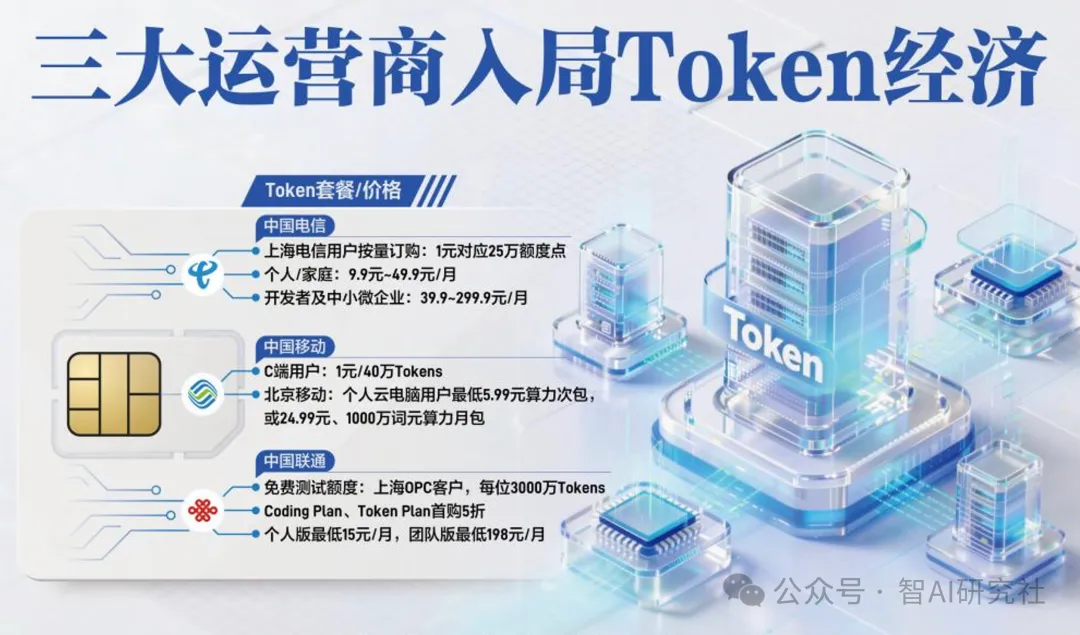
Individual plan: Minimum 9.9 yuan/month, includes 10 million Tokens.

Higher tiers include 29.9 yuan and 49.9 yuan, corresponding to 40 million and 80 million Tokens respectively.

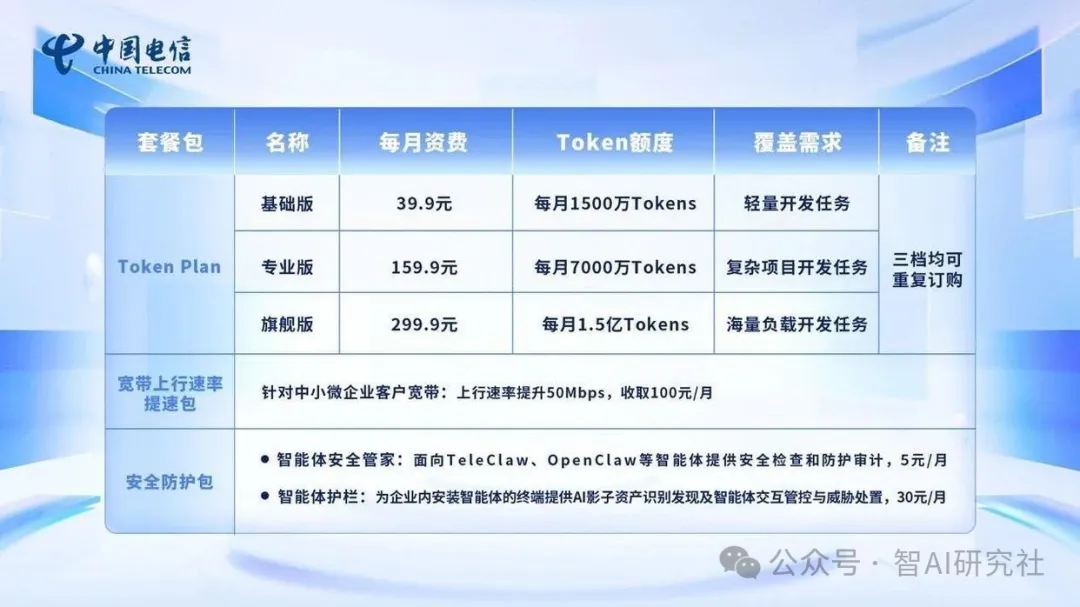
For developers and enterprises: Basic version at 39.9 yuan for 15 million Tokens, Professional version at 159.9 yuan, and Flagship version at 299.9 yuan.

China Telecom's selling point is a bundled package of "Tokens + Connectivity + Security," offering broadband uplink speed boost and security protection along with Tokens.

Next, China Mobile.

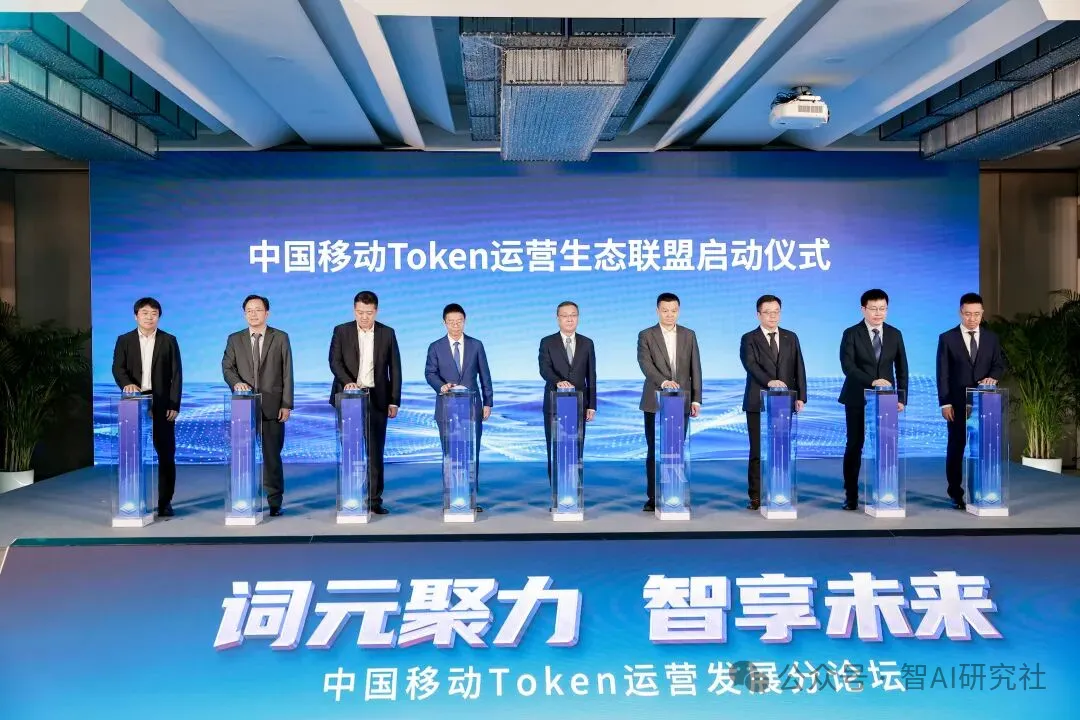
Shanghai Mobile, in collaboration with Tencent, launched an AI-native workbench, with 1 yuan buying 400k Tokens. Beijing Mobile was even earlier—minimum 5.99 yuan for a computing resource sub-package, and 24.99 yuan for 10 million Tokens.

The most notable move is that China Mobile integrated Tokens into its cloud computer service.

Users without a cloud computer can directly purchase a bundled cloud computer plan with built-in OpenClaw, ready to use upon startup.

China Unicom's approach is also different.

Shanghai Unicom is giving them away—OPC customers can receive a 30 million Token testing quota for free.

Personal version: 15 yuan/month for 6 million Tokens. Team version: 198 yuan/month, also including a one-month free trial of AI cloud desktop.

The prices of the three operators are similar, with each having its own strategic focus.

But the core logic is exactly the same—selling Tokens like phone credit packages.

What's More Worth Noting Than the 9.9 Yuan Price

The 9.9 yuan Token plan itself is not cheaper than offerings from major tech giants.

Some market commentators note that compared to API pricing from major model providers, the operators do not have a clear price advantage.

But the key point here is not the price; it's the distribution channel.

Major tech companies sell Tokens to developers and power users—there's a ceiling there.

Telecom operators sell Tokens to everyone who has a mobile phone.

China Mobile has nearly 1 billion subscribers, China Telecom has nearly 400 million, and China Unicom also has over 300 million.

This user pool is on a completely different scale.

And most importantly, this represents the collective entry of state-owned enterprises.

The shift in the telecom industry from traffic management to computing power management is not the decision of a single company.

It is a synchronous pivot by the three major operators.

The data from the National Data Administration is also on the table—the daily Token consumption volume in China surged from 100 billion in early 2024 to over 140 trillion by March 2026.

An increase of over a thousand times in two years.

Tokens are no longer a niche unit in the AI circle; they are becoming a basic telecom commodity alongside data and call credit.

Some telecommunications industry experts judge that if all three operators follow through,

the distribution market for large model APIs might partially shift from cloud providers to the operator system.

In the future, you won't need to understand what an API or a model is to buy Tokens.

You could just go to a service center and say, "Top up 100 yuan worth of Tokens for me," and another line would appear on your phone bill.

Связанные с этим вопросы

QWhat is the core new product that China's three major telecom operators (China Telecom, China Mobile, and China Unicom) have recently launched?

AThey have collectively launched national "Token packages" or "Token plans." These are data-like packages where users pay a monthly fee to receive a certain amount of AI model processing tokens.

QWhat is the lowest monthly price point mentioned for these Token packages, and how many tokens does it offer?

AThe lowest monthly price mentioned is 9.9 yuan per month, which offers 10 million tokens. The article cites this as China Telecom's entry-level personal plan.

QWhy is the launch of these Token packages by telecom operators considered significant beyond just pricing?

AThe significance lies in the channel and scale. Unlike AI companies selling primarily to developers, operators can sell Token packages to their entire mobile user base—totaling hundreds of millions of customers—making AI consumption as easy and common as paying a phone bill.

QHow is China Mobile specifically integrating its Token offering?

AChina Mobile is integrating Tokens into its cloud computer service. For users without a cloud computer, they can purchase a fused package that includes a cloud computer pre-installed with 'OpenClaw' AI tools, ready to use upon startup.

QWhat broader industry shift does the article suggest this move by the telecom operators represents?

AIt represents a strategic shift for the telecom industry from 'traffic operation' (focusing on data/bandwidth) to 'computing power operation' (focusing on AI processing tokens and services). This is a coordinated move by the state-backed operators, signaling Tokens are becoming a fundamental telecom commodity.

Похожее

How to Define "Real U.S. Stocks": Differences Between On-Chain Tokens, Price Contracts, and Direct Broker Connections

**Title:** Defining "Real US Stocks": Differences Among On-Chain Tokens, Price Contracts, and Broker-Direct Access **Summary:** In 2026, using stablecoins to purchase US stocks is mainstream, but products marketed as "buying US stocks with USDT" offer fundamentally different assets. This article analyzes three primary models. **1. Tokenized Stocks:** These are on-chain tokens representing economic exposure to underlying stocks, held by an issuer or custodian. They offer benefits like 24/7 trading and DeFi composability (e.g., use as loan collateral). However, users lack direct legal shareholder status; dividends may not be paid in cash, and voting rights are typically non-binding advisory expressions. Examples include platforms like Ondo Finance. **2. Stock Futures / Equity Perpetuals:** These are derivative contracts tracking a stock's price, allowing leveraged long/short positions 24/7, similar to crypto perpetuals. They offer high efficiency and flexibility but involve funding fees, which can be a significant long-term cost, especially during strong trends. Crucially, they confer no ownership rights (dividends, voting) to the holder. **3. Broker-Direct Model:** This model provides access to real securities via licensed broker-dealers. Stocks/ETFs are bought and held within the US clearing and custodial system (e.g., DTCC), making it the only path to genuine stock ownership. Users receive cash dividends and formal proxy voting rights (where applicable). It supports thousands of stocks and ETFs, far exceeding the coverage of the other two models. Key advantages include no funding fees, a clean cost structure for long-term holds, and the potential to transfer holdings to other brokers. Some platforms facilitate stablecoin (USDT/USDC) deposits, reducing reliance on traditional banking. A critical distinction exists *within* the broker-direct model: the underlying brokerage architecture (e.g., Fully Disclosed IB, Omnibus IB, Self-Clearing) determines how client assets are held, protected, and how safeguards like SIPC insurance are conveyed. Users should verify the specific clearing structure and regulatory compliance of any platform. In conclusion, "buying US stocks with USDT" can mean holding an on-chain economic proxy (Tokenized Stocks), trading a price derivative (Stock Futures), or owning the actual security (Broker-Direct). For users seeking full ownership rights and long-term investment, the broker-direct model is the definitive choice, though its implementation details require careful scrutiny.

marsbit38 мин. назад

How to Define "Real U.S. Stocks": Differences Between On-Chain Tokens, Price Contracts, and Direct Broker Connections

marsbit38 мин. назад

NVIDIA Launches DSX Platform, Expanding into AI Factory Infrastructure

NVIDIA has unveiled the DSX platform at its GTC Taipei event, marking a strategic expansion from GPU sales into comprehensive AI factory infrastructure solutions. The platform addresses challenges like power supply, cooling, and resource orchestration as AI models scale, shifting the industry focus from single-chip performance to overall infrastructure efficiency. DSX integrates NVIDIA's chips, systems, software, and partner technologies to cover the entire AI factory lifecycle—from design and simulation to deployment and operations. It aims to accelerate deployment, improve reliability and operational efficiency, and reduce the cost per generated token in AI inference. The software suite includes DSX MaxLPS, which uses 45°C liquid cooling and rack-level optimization to allow up to 40% more GPUs per megawatt, and DSX OS, an open-source platform for AI factory operations. The platform also encompasses reference designs, digital twin simulation (DSX Sim), dynamic workload adjustment based on grid conditions (DSX Flex), and data exchange between systems. Early adopters include cloud providers like CoreWeave and Lambda. Major hardware partners, including Dell, HPE, Lenovo, and Supermicro, are developing DSX-ready systems. Pilot projects for DSX Flex are underway with energy providers. Strategically, DSX represents NVIDIA's ongoing transition from an AI chip supplier to a full-stack AI infrastructure platform provider, aiming to set industry standards and solidify its market leadership.

marsbit44 мин. назад

NVIDIA Launches DSX Platform, Expanding into AI Factory Infrastructure

marsbit44 мин. назад

After Burning Tens of Billions of Dollars in Tokens, Silicon Valley Giants Start Limiting Employee Token Usage

After burning tens of billions of dollars on AI tokens, major Silicon Valley firms are now restricting employee usage. Companies like Microsoft, Uber, and Salesforce, which heavily promoted AI for "efficiency," are facing a cost crisis. The practice of "tokenmaxxing"—pushing employees to maximize AI tool usage—led to wasteful spending on trivial tasks like checking the weather or writing birthday messages, with studies showing significant hidden costs for bug fixes and code rewrites. The core issue is a misalignment between individual productivity gains and actual business value. While employees use AI to automate tasks they dislike, such as writing reports, this often doesn't translate to increased company revenue or improved core business outcomes. For instance, AI-generated code speeds up development but also sees an 800% increase in "code churn" (code being discarded or rewritten). As a result, only 14% of CFOs report seeing a clear, measurable return on AI investments. Firms are now shifting strategies. Microsoft has revoked most internal licenses for Claude Code, while others are implementing monitoring and cost controls. New tools from companies like Harness and CloudZero aim to track AI spending and tie costs to business results. Some AI vendors, like HubSpot, are moving from token-based pricing to charging based on outcomes, such as "resolved conversations" or "leads generated." This represents a necessary correction in the AI adoption cycle. The challenge now is for companies to move beyond using AI merely to speed up old tasks and instead rethink their workflows and business models fundamentally. The future of enterprise AI depends on proving its value, not just its usage.

marsbit1 ч. назад

After Burning Tens of Billions of Dollars in Tokens, Silicon Valley Giants Start Limiting Employee Token Usage

marsbit1 ч. назад

I've Been a VC in Web3 for Nine Years: Asian Funds Are Experiencing "Hell Mode"

After nine years as a Web3 VC, the author observes a severe downturn in Asia's crypto venture capital scene, with many funds disappearing or pivoting away. The market has cooled dramatically since the 2021-2024 frenzy, leading to fewer deals and active investors. IOSG Ventures, a firm that has endured three market cycles, has adapted its strategy: shifting from 80-90% early-stage investments to a 50% early-stage, 30% post-TGE, and 20% OTC portfolio to find better value and liquidity. The current bear market is described as "hell mode" for Asian funds due to scarce LP capital, forcing extreme precision in targeting only top projects. The author argues the core industry problem has been the disconnect between tokens and real value, where tokens served as fundraising tools without granting holders rights to protocol revenue. A positive shift is emerging where projects like Uniswap and Morpho are programmatically binding token value to protocol profits. Investment focus has moved towards fundamentals: real-yield financial infrastructure (stablecoins, lending) and crypto-native AI infrastructure, while avoiding narrative-driven projects. The conclusion is that true, durable companies are born in pessimistic times when focus shifts to real user needs and sustainable business models. The industry's future will be shaped by those who remain after the泡沫 dissipates.

marsbit1 ч. назад

I've Been a VC in Web3 for Nine Years: Asian Funds Are Experiencing "Hell Mode"

marsbit1 ч. назад

Торговля

Спот
Фьючерсы
活动图片