Century-Old S&P Goes On-Chain for the First Time: Who's Taking CME's Weekend Business?

marsbitОпубликовано 2026-03-19Обновлено 2026-03-19

Введение

On March 18, S&P Dow Jones Indices authorized the S&P 500 index to Trade.xyz for perpetual contracts on the Hyperliquid blockchain—the first time the flagship index has been licensed to an on-chain protocol. The move targets non-U.S. investors with 24/7 trading, USDC margin, and no expiration. The shift reflects traditional finance actively adopting on-chain infrastructure to reach underserved users and time windows. Hyperliquid’s HIP-3 protocol, launched in October 2025, saw open interest surge from near zero to $1.43 billion in six months, driven largely by traditional assets like Nasdaq 100, WTI crude oil, and gold—not crypto. A key catalyst was the March 9 Iran crisis, which occurred during traditional market closures. Hyperliquid’s oil contracts saw daily volume spike to $1.2 billion as traders sought 24/7 access. Trade.xyz, HIP-3’s largest market maker, has reached over $100 billion in cumulative volume in five months. Hyperliquid, with no VC funding, airdropped tokens to users and now holds a $40 billion fully diluted valuation. Its S&P 500 perpetual contract offers lower barriers and global access compared to CME’s traditional futures. S&P DJI’s endorsement signals that on-chain traders are now viewed as a mature investor class.

On March 18, S&P Dow Jones Indices announced the licensing of the S&P 500 index to Trade.xyz for the issuance of perpetual contracts on the Hyperliquid blockchain. This marks the first time in S&P's history that it has granted a brand license for its flagship index to an on-chain protocol.

The difference is, this time S&P took the initiative, handing its brand license to a decentralized protocol. The contracts use USDC as margin, target non-U.S. investors, and trade 24/7 with no expiration date. According to an S&P Global press release, over $1 trillion in S&P 500-linked exposure is traded daily through traditional markets. Now, a small portion of that access has moved on-chain.

But the key point of this event isn't compliance. Traditional finance is beginning to actively seek out on-chain infrastructure to reach users and time periods it cannot cover. The reason S&P chose Hyperliquid is hidden in the data from the past six months.

HIP-3 is a permissionless perpetual contract deployment protocol launched by Hyperliquid in 2025, allowing anyone to create new trading markets on it. Trade.xyz operates on Hyperliquid's HIP-3 protocol and is the largest market creator on HIP-3, accounting for 90% of its total open interest, according to The Block.

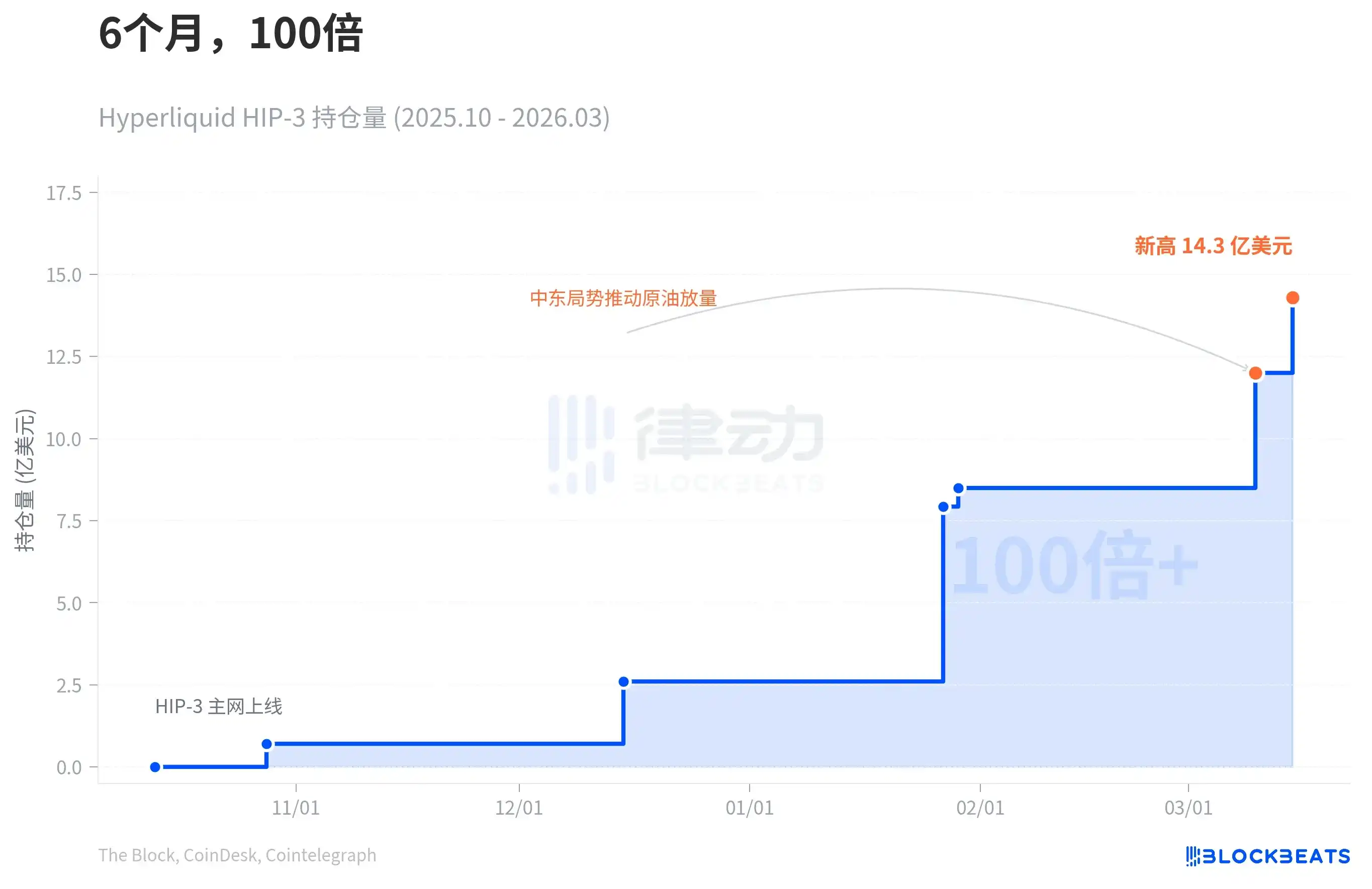
When the HIP-3 mainnet launched on October 13, 2025, its open interest was near zero. Two weeks later, it grew to $70 million. By January 27, 2026, this number reached $793 million, with a month-over-month growth exceeding 200%. According to a March 15 report by The Block, HIP-3 open interest hit a new all-time high of $1.43 billion. From the mainnet launch, this represents over 100x growth in 6 months.

The interesting part is that this growth curve is driven by traditional asset traders.

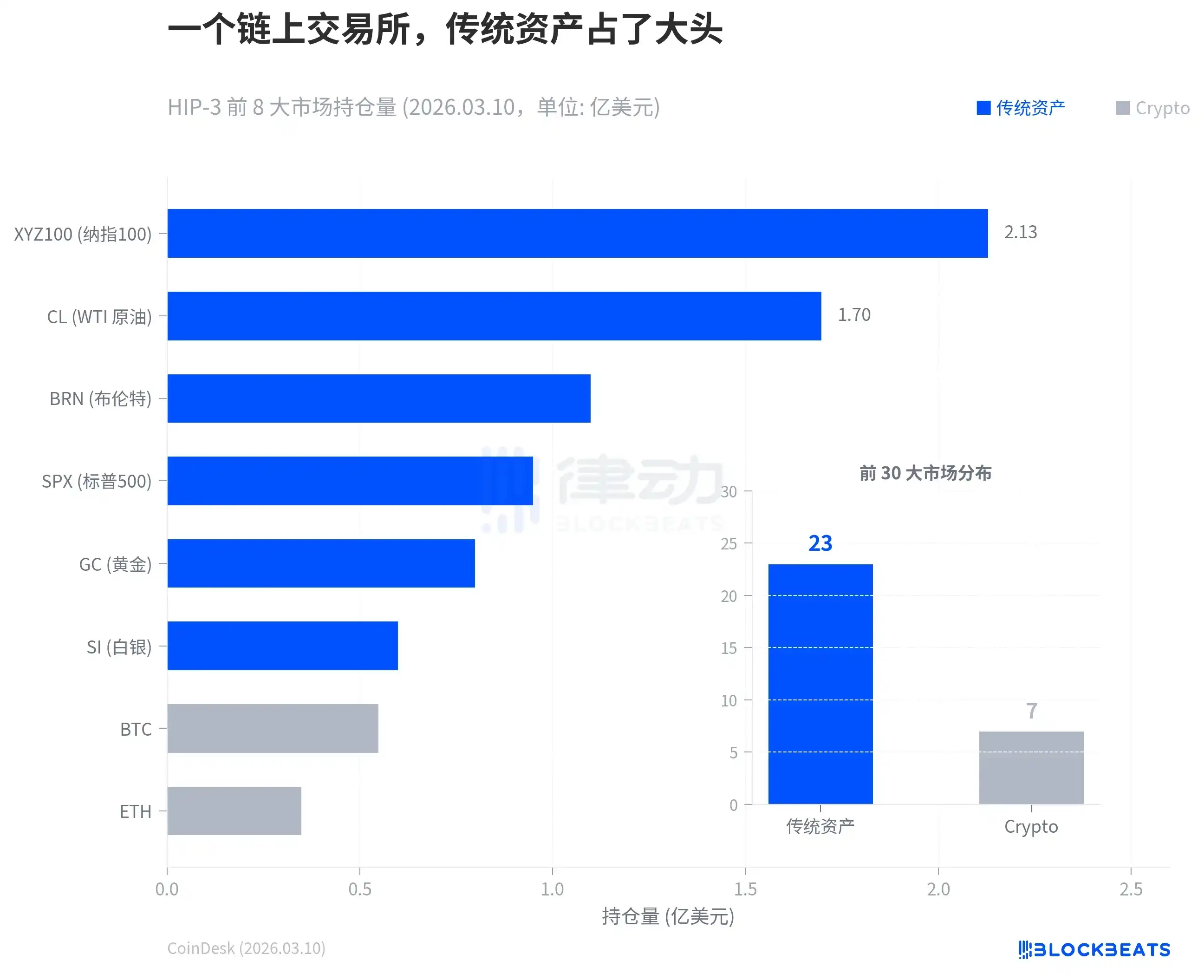
Among the top 30 markets on HIP-3, only 7 are crypto trading pairs. The other 23 are all traditional assets. Ranking first is XYZ100, a contract tracking the Nasdaq 100, with $213 million in open interest. Second is CL, tracking WTI crude oil, with $170 million. Following are Brent crude oil, S&P 500, gold, silver. BTC and ETH rank seventh and eighth.

The top six markets on an on-chain exchange are not a single crypto asset.

The formation of this structure had a specific catalyst. On March 9, the escalation of the Iran situation occurred while traditional futures markets were closed for the weekend. According to AMBCrypto, the trading volume for the crude oil contract CL-USDC surged from approximately $21 million to over $1.2 billion in a single day. According to DL News, Hyperliquid's crude oil contract trading volume on that day briefly surpassed BTC, becoming the second-largest market after perpetual BTC. The same CoinDesk report pointed out that HIP-3 markets accounted for nearly 80% of Hyperliquid's total platform volume that day.

The logic here is straightforward: geopolitical events don't wait for Monday's open. When traditional futures exchanges are closed, Hyperliquid is the only venue to trade crude oil and stock indices. Traders voted with their feet, and capital flowed to the one that never closes.

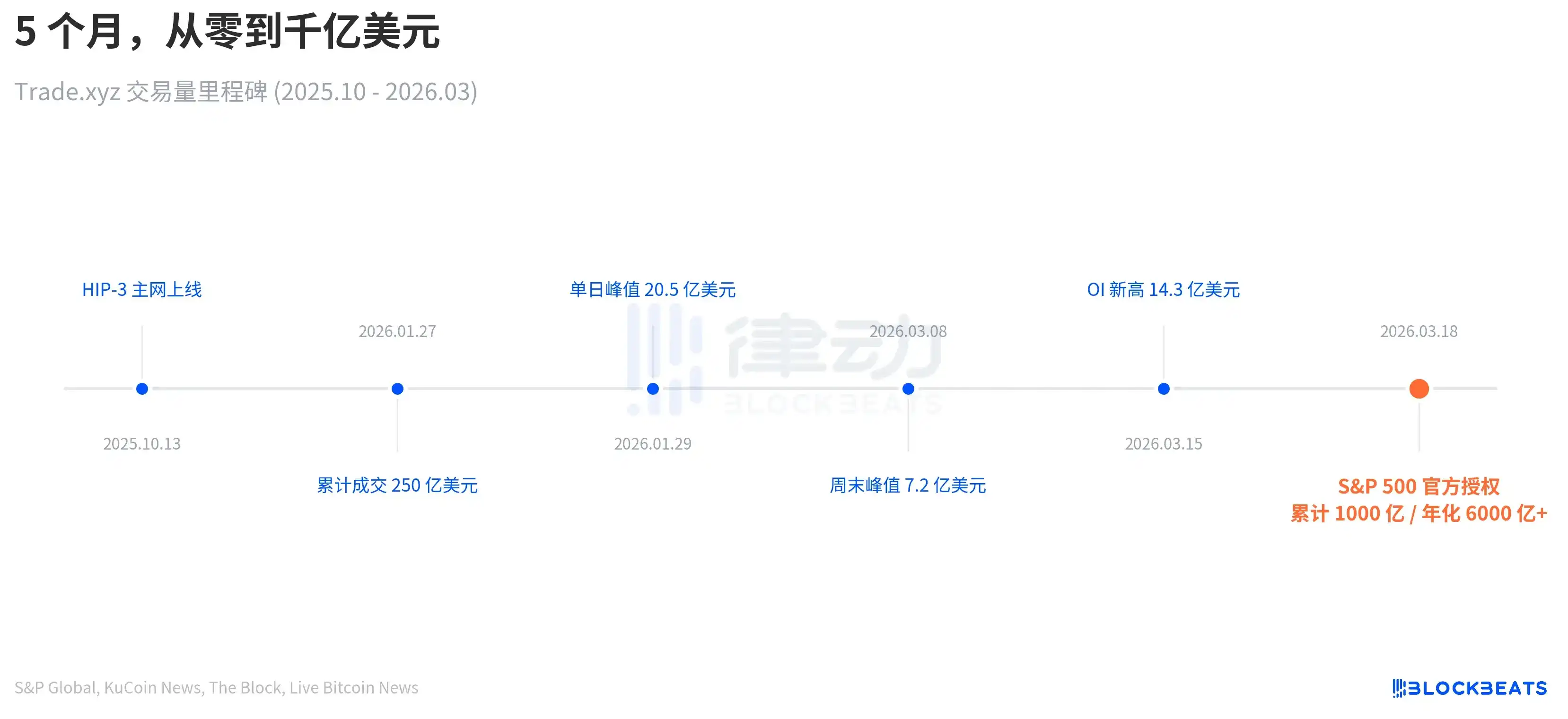
Trade.xyz's cumulative trading volume has exceeded $100 billion since its launch in October 2025, with a current annualized run rate exceeding $600 billion. At the end of January 2026, Trade.xyz's single-day trading volume peaked at $2.05 billion. According to Live Bitcoin News, the weekend trading volume on March 8 reached $720 million, setting a new weekend record for HIP-3. From zero to one hundred billion in cumulative trading volume in five months.

This growth curve leads directly to S&P's official authorization. The wording of S&P DJI's Chief Product and Operations Officer, Cameron Drinkwater, in the press release is worth reading carefully. He skipped the usual 'we are exploring blockchain' tentative language and directly stated that 'digital-native investors deserve the same institutional-grade standards as traditional investors.' The implication is that on-chain traders are now a mature investor group in S&P's eyes.

Hyperliquid's own structure is also an integral part of this story. Substack blogger Lex pointed out that Hyperliquid's annualized revenue is approximately $550 million, with a fully diluted valuation of about $40 billion, holding about a 60% share in the decentralized derivatives market. Unlike the vast majority of crypto projects, Hyperliquid has no VC funding.

Zero institutional investors, zero private rounds. The HYPE token, launched in November 2024, had 31% airdropped to approximately 94,000 early users, worth about $1.2 billion at the time. According to Tokenomics.com data, HYPE holders receive approximately $65 million in monthly revenue from trading fees and profit sharing from the HLP market-making pool. All growth comes from the product itself and the alignment of interests with community holders.

Putting CME and Trade.xyz side by side makes the contrast clearer. CME's S&P 500 E-mini futures require an initial margin of about $5,060, a futures brokerage account, and a full KYC process, with hours from Sunday to Friday, 23 hours a day. Trade.xyz's S&P perpetual contract uses USDC as margin, connects directly via an on-chain wallet, and is open 24/7/365. Both products track the same index using the same set of official S&P licensed data. But CME's entry point is in New York, while Trade.xyz's entry point is anywhere with an internet connection.

According to CoinGecko data, on the same day the S&P 500 perpetual contract launched, the HYPE token rose 14.7%, with a market cap of about $10 billion, ranking 14th in the crypto market. An on-chain exchange that never took a penny of VC money received the official license for the world's most widely tracked stock index. Trade.xyz COO and General Counsel Collins Belton said in the press release that the S&P 500 is the 'natural starting point'. He didn't say where the finish line is.

Связанные с этим вопросы

QWhat is the significance of S&P Dow Jones Indices licensing the S&P 500 to Trade.xyz on the Hyperliquid blockchain?

AIt marks the first time in S&P's history that it has licensed its flagship index brand to an on-chain protocol, representing a major shift where traditional finance is actively seeking on-chain infrastructure to reach users and time periods it previously could not access.

QWhat specific event catalyzed the massive surge in trading volume for traditional assets like oil on Hyperliquid's HIP-3 protocol?

AThe escalation of the Iran situation on March 9th, which occurred while traditional futures markets were closed for the weekend. This led to a single-day trading volume for the crude oil contract (CL-USDC) skyrocketing from around $21 million to over $1.2 billion.

QHow does the structure and funding of Hyperliquid differ from most other crypto projects?

AHyperliquid has no venture capital (VC) funding. It had zero institutional investors and zero private rounds. Its HYPE token was largely airdropped to early users, and all of its growth has come from the product itself and the alignment of interests with its community token holders.

QWhat are the key operational differences between trading the S&P 500 on CME versus on Trade.xyz?

ACME's S&P 500 E-mini futures require an initial margin of ~$5,060, a futures broker account, full KYC, and trade 23 hours a day from Sunday to Friday. Trade.xyz's perpetual contract uses USDC as margin, connects directly via an on-chain wallet, and is available 24/7/365 from anywhere with an internet connection.

QWhat does the composition of the top markets on the HIP-3 protocol indicate about its user base?

AThe top markets are dominated by traditional assets, not cryptocurrencies. Of the top 30 markets, 23 are traditional assets (like the Nasdaq 100 index, WTI crude oil, and gold), indicating that the platform's growth is being driven primarily by traditional asset traders.

Похожее

Why Hasn't the U.S. Seen the Rise of 'Huabei' or 'Jiebei'?

The article explores why the U.S. lacks large-scale consumer credit products like China's "Huabei" and "Jiebei," despite having a developed financial sector. Key reasons include: 1. **Structural Barriers**: A fragmented federal and state regulatory system, reinforced by post-2008 reforms like the Dodd-Frank Act, raises compliance costs and protects traditional banks, stifling fintech innovation. 2. **Credit Card Dominance**: Credit cards, used by 70-80% of adults, form a $1.28 trillion debt market with high APRs (avg. 22.3%). This system cross-subsidizes users who pay in full with those carrying balances, creating a predatory yet entrenched ecosystem. 3. **Data Privacy Laws**: Strict regulations (e.g., FCRA, CCPA) prevent tech giants from leveraging behavioral data for credit scoring, unlike in China where such data fuels fintech models. 4. **Capital Market Disincentives**: Wall Street penalizes tech firms entering finance due to lower valuations associated with heavy regulation and risk, as seen in Apple’s failure with Apple Card. 5. **Banking Oligopoly**: Major banks control consumer lending, leveraging lobbying power and consumer habits to maintain high-cost credit, while alternatives like payday loans (400% APR) or "unbanked" services remain niche or exploitative. Ultimately, regulatory, structural, and corporate interests collectively block the emergence of accessible, low-cost digital lending in the U.S.

Odaily星球日报43 мин. назад

Why Hasn't the U.S. Seen the Rise of 'Huabei' or 'Jiebei'?

Odaily星球日报43 мин. назад

More and More 'Model Supermarkets' Are Opening: ByteDance, Alibaba, and Tencent Compete to Integrate

Chinese tech giants like ByteDance, Alibaba, and Tencent are accelerating the rollout of integrated AI model subscription services—dubbed “model supermarkets”—to provide developers with bundled access to multiple leading domestic large language models (LLMs). ByteDance’s Volcengine recently upgraded its "Coding Plan" by adding newer models like GLM-5.1, Minimax M2.7, and Kimi k2.6, allowing subscribers to use various top models under a single monthly fee starting at ¥40. However, user feedback reveals significant issues, including rapid consumption of usage limits (e.g., hitting caps within hours), frequent server errors (like HTTP 429), and slow response times during peak hours. Complaints about misleading deduction rates—where calls to advanced models consume more quota—are also common. The trend is industry-wide: Alibaba, Tencent, and Baidu have all launched similar multi-model coding plans. While these platforms reduce trial costs for developers, they also expose challenges in balancing affordability with service quality and computational stability. Amid this shift, independent AI companies like Zhipu, MiniMax, and Moonlight Face (Kimi) are developing strategies to avoid becoming mere “pipes” in this ecosystem—focusing on vertical applications, autonomous agents, and long-context models to retain competitiveness. Analysts suggest that, while platform aggregation may pressure model firms in the short term, specialized and vertical AI capabilities will remain differentiated in the long run.

marsbit47 мин. назад

More and More 'Model Supermarkets' Are Opening: ByteDance, Alibaba, and Tencent Compete to Integrate

marsbit47 мин. назад

Торговля

Спот
Фьючерсы

Популярные статьи

Как купить S

Добро пожаловать на HTX.com! Мы сделали приобретение Sonic (S) простым и удобным. Следуйте нашему пошаговому руководству и отправляйтесь в свое крипто-путешествие.Шаг 1: Создайте аккаунт на HTXИспользуйте свой адрес электронной почты или номер телефона, чтобы зарегистрироваться и бесплатно создать аккаунт на HTX. Пройдите удобную регистрацию и откройте для себя весь функционал.Создать аккаунтШаг 2: Перейдите в Купить криптовалюту и выберите свой способ оплатыКредитная/Дебетовая Карта: Используйте свою карту Visa или Mastercard для мгновенной покупки Sonic (S).Баланс: Используйте средства с баланса вашего аккаунта HTX для простой торговли.Третьи Лица: Мы добавили популярные способы оплаты, такие как Google Pay и Apple Pay, для повышения удобства.P2P: Торгуйте напрямую с другими пользователями на HTX.Внебиржевая Торговля (OTC): Мы предлагаем индивидуальные услуги и конкурентоспособные обменные курсы для трейдеров.Шаг 3: Хранение Sonic (S)После приобретения вами Sonic (S) храните их в своем аккаунте на HTX. В качестве альтернативы вы можете отправить их куда-либо с помощью перевода в блокчейне или использовать для торговли с другими криптовалютами.Шаг 4: Торговля Sonic (S)С легкостью торгуйте Sonic (S) на спотовом рынке HTX. Просто зайдите в свой аккаунт, выберите торговую пару, совершайте сделки и следите за ними в режиме реального времени. Мы предлагаем удобный интерфейс как для начинающих, так и для опытных трейдеров.

1.2k просмотров всегоОпубликовано 2025.01.15Обновлено 2025.03.21

Как купить S

Sonic: Обновления под руководством Андре Кронье – новая звезда Layer-1 на фоне спада рынка

Он решает проблемы масштабируемости, совместимости между блокчейнами и стимулов для разработчиков с помощью технологических инноваций.

2.2k просмотров всегоОпубликовано 2025.04.09Обновлено 2025.04.09

Sonic: Обновления под руководством Андре Кронье – новая звезда Layer-1 на фоне спада рынка

HTX Learn: Пройдите обучение по "Sonic" и разделите 1000 USDT

HTX Learn — ваш проводник в мир перспективных проектов, и мы запускаем специальное мероприятие "Учитесь и Зарабатывайте", посвящённое этим проектам. Наше новое направление .

1.8k просмотров всегоОпубликовано 2025.04.10Обновлено 2025.04.10

HTX Learn: Пройдите обучение по "Sonic" и разделите 1000 USDT

Обсуждения

Добро пожаловать в Сообщество HTX. Здесь вы сможете быть в курсе последних новостей о развитии платформы и получить доступ к профессиональной аналитической информации о рынке. Мнения пользователей о цене на S (S) представлены ниже.

活动图片