Cardano Sentiment Turns Cautious as NIGHT Token Fallout and $0.45 Resistance Cap Price Action

bitcoinistОпубликовано 2025-12-13Обновлено 2025-12-13

Введение

Cardano (ADA) faces a complex mix of technical and sentiment-driven challenges, struggling to break the $0.45 resistance and declining 2% to around $0.42. The drop was influenced by broader market reactions to a Federal Reserve rate cut and exacerbated by the sharp 90% crash of Midnight Network’s NIGHT token, which amplified negative sentiment. With 54% of active positions short, traders expect further downside. Key support lies at $0.42–$0.43, with a potential fall toward $0.38–$0.39 if broken. Technical indicators like MACD and RSI remain bearish. Despite a $750 million inflow to Binance, demand remains modest. Social sentiment has turned cautious due to ADA’s repeated failure at $0.45 and a lack of major ecosystem updates. With no clear internal catalysts, ADA’s near-term direction depends heavily on broader market trends and Bitcoin’s price action.

Cardano is about to end the week with a complex mix of technical pressure, token fallout, and shifting sentiment, as ADA struggles to break beyond its familiar resistance zone.

The market is attempting to digest a sharp correction triggered by wider macro moves, while internal ecosystem developments offer little support. For now, ADA’s direction continues to depend on how well it can hold established support, particularly as market mood turns more cautious.
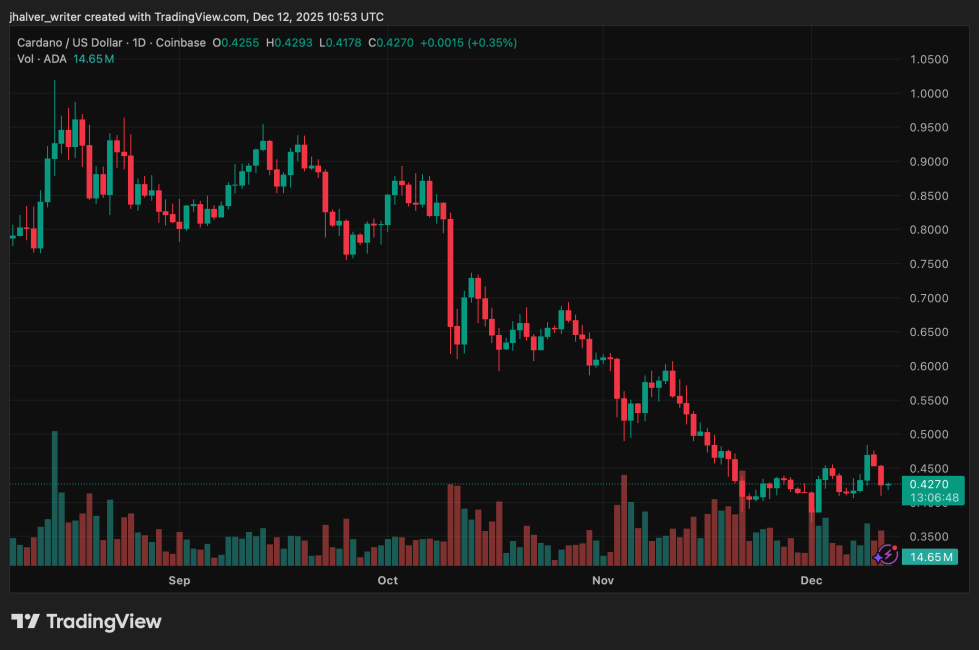
ADA's price trends to the downside on the daily chart. Source: ADAUSD on Tradingview

NIGHT Token Crash Adds Pressure to ADA’s Decline

ADA’s 2% drop to around $0.42 arrived just as the broader market reacted to the recent Federal Reserve rate cut. The decline pushed Cardano below the $0.45 level, a zone it has struggled to reclaim, placing renewed focus on its next support levels.

A major driver of the negative sentiment was the steep decline of Midnight Network’s NIGHT token, which fell roughly 90% from an early surge to $1.50 before settling near $0.05. The sell-off was largely driven by airdrop recipients offloading their allocations immediately after launch.

Despite earlier expectations around Midnight’s debut, the rapid reversal highlighted the speculative nature of the event. Market data also shows that 54% of active positions are leaning short, signaling that traders expect further downside.

Key Support Levels Hold, but Momentum Remains Weak

Cardano’s ADA is now trading near the lower edge of its established range, testing support between $0.42 and $0.43.

Analysts note that this area aligns with a broader weekly support cluster that stretches toward the $0.38–$0.39 region. Technical readings reinforce a cautious outlook, the MACD continues to trend bearish, while the RSI sits near 40, approaching oversold territory.

Traders are watching to see if ADA can stabilize above $0.42. A breakdown could expose the next lower supports, while a reclaim of the $0.45 zone would be required to shift momentum toward $0.48–$0.50.

Despite a recent $750 million inflow to Binance, the market absorbed the volume with limited price reaction, suggesting demand remains modest.

Sentiment Softens as Cardano Repeatedly Fails at $0.45

Social sentiment across major crypto forums has turned noticeably cautious. Conversations remain active, but the tone reflects trader fatigue as ADA continues to struggle against the same resistance.

With no new updates from core Cardano development efforts, including Hydra scaling, Mithril upgrades, or governance milestones, market participants have shifted their focus to external forces, such as BTC’s price direction and overall risk appetite.

ADA trades around $0.41–$0.42 at the time of writing, holding its range but without clear signs of a breakout. Until a fresh catalyst emerges, Cardano is likely to remain in a consolidation phase, with sentiment triggered more by broader market trends than internal progress.

Cover image from ChatGPT, ADAUSD chart from Tradingview

Похожее

Understanding the New Economic Model of Tokenization

Understanding the New Token Economics Model The commercialization of AI applications is evolving from selling software and subscriptions to selling token call capacity. Tokens, the fundamental unit of information processing for large language models (LLMs), have become the basis for API billing and consumption. With call volumes exploding, tokens themselves are now being traded—procured, routed, split, and resold—forming a new intermediary market. This layer connects upstream LLM providers with downstream developers and enterprises, acting as a global wholesale-to-retail liquidity network. The rise of this business is fueled by a massive surge in China's daily token call volume—growing over a thousandfold from 100 billion in early 2024 to over 140 trillion by March 2026—and significant improvements in domestic LLM capabilities, which are now competitive globally. The core value of token distribution platforms extends beyond simple arbitrage. Key functions include aggregating multiple models (like GPT, Claude, and domestic models such as Kimi and DeepSeek) under a unified API, lowering network and payment barriers, and providing enterprise services like model selection, prompt engineering, and system integration. Profit models are diversifying: (1) resale margins; (2) technical premiums from proprietary inference acceleration (e.g., reducing costs to 1/10 of the industry standard); and (3) enterprise value-added services. High-consumption scenarios like marketing, short-form video, gaming, and e-commerce are primary drivers. Investment opportunities are seen in both companies with strong model capabilities (e.g., Alibaba, Tencent, MiniMax) and those with high-consumption client scenarios (e.g., marketing agencies with overseas reach). However, risks are significant: low entry barriers leading to intense competition, capital requirements and bad debt risks from advance payments, and dependency on policy changes from upstream LLM providers who control API pricing and access.

marsbit6 мин. назад

Understanding the New Economic Model of Tokenization

marsbit6 мин. назад

Farewell to the Copper Era: Understanding the Logic of the AI Silicon Photonics Industry Chain and Key US Stock Players

**Summary: The Era of Silicon Photonics and Key AI Infrastructure Stocks** The article delves into the transition from copper-based interconnects to silicon photonics (SiPh) as a critical enabler for next-generation AI data centers. It explains that copper faces fundamental physical limits—the bandwidth wall, density wall, and power wall—at high data rates (1.6T+), making a material shift essential. Silicon photonics, which integrates components like lasers, modulators, and detectors onto a silicon chip, offers a solution by leveraging mature CMOS manufacturing for cost-effective, high-volume production. A key challenge is that silicon itself is not an efficient light source, making Indium Phosphide (InP) lasers a critical and supply-constrained component. A major industry catalyst was NVIDIA's 2025 GTC announcement, declaring optical interconnects a "standard" from its Rubin platform onward, followed by strategic investments to secure the supply chain. The industry is structured in four key layers: 1. **Foundries:** TSMC leads with its COUPE platform, while Tower Semiconductor (specialized SiPh foundry) and GlobalFoundries are major players. 2. **Core Component Suppliers:** Lumentum is highlighted as the sole volume manufacturer of the crucial 200G/lane EML laser, with orders locked by NVIDIA through 2027. 3. **Module & System Manufacturers:** Coherent holds significant market share, with Chinese manufacturers like InnoLight also noted for scale. 4. **System Integrators:** NVIDIA, Broadcom, and Marvell dominate this layer, setting standards and integrating technology. The article identifies core public investment targets: **NVIDIA (NVDA)** as the ecosystem driver; **Broadcom (AVGO)** and **Marvell (MRVL)** in networking/switching chips; **Lumentum (LITE)** and **Coherent (COHR)** for critical components; and foundries **TSMC (TSM)** and **Tower Semiconductor (TSEM)**. Private companies Lightmatter and Ayar Labs are noted as key IPO candidates. The silicon photonics shift is driving a re-rating of company valuations, moving them from traditional telecom/industrial metrics to premium AI infrastructure multiples. The industry features high barriers to entry (e.g., multi-year lead times for InP laser capacity, complex 3D integration/thermal management, and lengthy customer qualification cycles), suggesting a "winner-takes-most" dynamic. Risks include dependence on hyperscaler capex cycles, potential technology disruption among competing optical approaches (LPO, CPO, OCS, Optical I/O), and a timeline where widespread CPO deployment may not occur until ~2028, with LPO serving as a transitional technology. The conclusion advises that betting on the overall industry trend may be safer than betting on any single company.

marsbit45 мин. назад

Farewell to the Copper Era: Understanding the Logic of the AI Silicon Photonics Industry Chain and Key US Stock Players

marsbit45 мин. назад

Deconstructing the Real Risks of DeFi Lending: Annual Loss Rate Only 0.03%

Deconstructing the true risks of DeFi lending reveals an annual loss rate of only 0.03% from hacks and exploits. Analysis of DeFi Llama data (excluding cross-chain bridge incidents) for EVM and Solana lending protocols shows that despite high historical attack frequency due to concentrated assets, the sector's security has matured significantly. Over the past year, non-cross-chain lending on these chains saw gross losses of $309M, with net losses after recoveries at $301M. Against a daily average TVL of $99.6B, this translates to a minimal annualized loss rate of approximately 0.03%. The Euler Finance case in 2023, where $197M was fully recovered, exemplifies improving asset recovery capabilities, which now account for roughly 20% of losses in this sector. Loss events follow a log-normal distribution: most are small-scale, with catastrophic losses being rare outliers. This pattern, combined with the massive scale of the total lending market, means single incidents rarely impact the broader ecosystem. It underscores the effectiveness of portfolio diversification and provides a basis for sustainable insurance models. The data indicates DeFi lending has entered a mature phase where risks are quantifiable, categorized, and manageable. The actual financial loss relative to the total capital deployed is extremely low, challenging prevailing narratives of systemic risk.

marsbit46 мин. назад

Deconstructing the Real Risks of DeFi Lending: Annual Loss Rate Only 0.03%

marsbit46 мин. назад

POLY's Appearance Hints Are Getting Denser, How Far Away Is the Polymarket Airdrop?

**POLY Debut Hints Grow More Frequent: How Far is the Polymarket Airdrop?** Recent continuous hints from Polymarket team members regarding the POLY token have sparked widespread analysis within airdrop communities about its launch timeline and potential scale. According to predict.fun data, the probability of "Polymarket launching its official token before year-end 2025" currently stands at 56%. Hints about POLY began in October 2024. CEO Shayne Coplan's social media post mentioning $POLY alongside major cryptocurrencies first fueled speculation. This was followed by Growth Lead William LeGate discussing "prospective airdrop farmers," and CMO Matthew Modabber explicitly confirming that "Polymarket will have a token, and there will be an airdrop." The momentum continued into 2025. In April, major crypto data platforms CoinGecko and CoinMarketCap created placeholder pages for POLY, further solidifying expectations. May saw discussions shift towards token utility and airdrop criteria. A team member's "Soon" reply to a question about staking POLY for fee reductions, and a leaked internal screenshot showing an "Airdrop" tab, significantly increased anticipation. LeGate also outlined potential airdrop qualifiers, mentioning badges for employees, high-volume/high-profit traders, and ecosystem builders. He suggested that linking a Polymarket account to X (Twitter), sharing trades and market insights, and actively engaging with the community might constitute part of the eligibility criteria, leading to a surge in related social media activity. Despite the growing hype, the article's author expresses a personal view that Polymarket might prioritize platform stability and infrastructure upgrades—especially with the upcoming World Cup—over an immediate token launch, opting for a post-event release. Their current strategy involves hedging positions across prediction markets, actively trading on Polymarket, and engaging on social media to potentially qualify for a future airdrop.

Odaily星球日报1 ч. назад

POLY's Appearance Hints Are Getting Denser, How Far Away Is the Polymarket Airdrop?

Odaily星球日报1 ч. назад

Торговля

Спот
Фьючерсы

Популярные статьи

Как купить ADA

Добро пожаловать на HTX.com! Мы сделали приобретение Cardano (ADA) простым и удобным. Следуйте нашему пошаговому руководству и отправляйтесь в свое крипто-путешествие.Шаг 1: Создайте аккаунт на HTXИспользуйте свой адрес электронной почты или номер телефона, чтобы зарегистрироваться и бесплатно создать аккаунт на HTX. Пройдите удобную регистрацию и откройте для себя весь функционал.Создать аккаунтШаг 2: Перейдите в Купить криптовалюту и выберите свой способ оплатыКредитная/Дебетовая Карта: Используйте свою карту Visa или Mastercard для мгновенной покупки Cardano (ADA).Баланс: Используйте средства с баланса вашего аккаунта HTX для простой торговли.Третьи Лица: Мы добавили популярные способы оплаты, такие как Google Pay и Apple Pay, для повышения удобства.P2P: Торгуйте напрямую с другими пользователями на HTX.Внебиржевая Торговля (OTC): Мы предлагаем индивидуальные услуги и конкурентоспособные обменные курсы для трейдеров.Шаг 3: Хранение Cardano (ADA)После приобретения вами Cardano (ADA) храните их в своем аккаунте на HTX. В качестве альтернативы вы можете отправить их куда-либо с помощью перевода в блокчейне или использовать для торговли с другими криптовалютами.Шаг 4: Торговля Cardano (ADA)С легкостью торгуйте Cardano (ADA) на спотовом рынке HTX. Просто зайдите в свой аккаунт, выберите торговую пару, совершайте сделки и следите за ними в режиме реального времени. Мы предлагаем удобный интерфейс как для начинающих, так и для опытных трейдеров.

2.2k просмотров всегоОпубликовано 2024.03.29Обновлено 2025.07.02

Как купить ADA

SNEK: ведущий мемкоин на блокчейне Cardano, открывающий новую эпоху для экосистемы Cardano

SNEK - это дефляционный мемкоин, выпущенный на блокчейне Cardano. Он создаёт децентрализованную культурную и развлекательную ценность за счёт участия глобального сообщества.

2.0k просмотров всегоОпубликовано 2025.10.15Обновлено 2025.10.15

SNEK: ведущий мемкоин на блокчейне Cardano, открывающий новую эпоху для экосистемы Cardano

Неделя обучения по популярным токенам 8: запуск основной сети Ouroboros Leios для ADA ожидается в 2026 году

Основная сеть Ouroboros Leios для ADA, как ожидается, будет запущена в 2026 году, а хардфорк до версии протокола 11 запланирован на I квартал 2026 года.

1.9k просмотров всегоОпубликовано 2026.02.10Обновлено 2026.02.12

Неделя обучения по популярным токенам 8: запуск основной сети Ouroboros Leios для ADA ожидается в 2026 году

Обсуждения

Добро пожаловать в Сообщество HTX. Здесь вы сможете быть в курсе последних новостей о развитии платформы и получить доступ к профессиональной аналитической информации о рынке. Мнения пользователей о цене на ADA (ADA) представлены ниже.

活动图片