Cardano Is Already Running Behind 200 German Companies, Foundation CEO Says

bitcoinistОпубликовано 2026-04-17Обновлено 2026-04-17

Введение

Cardano Foundation CEO Frederik Gregaard revealed that approximately 200 large German companies are already using Cardano’s blockchain infrastructure—without being aware of it—through agentic AI deployments. These firms leverage Cardano as a security, digital identity, and accountability layer, particularly for verifying AI agents and ensuring data privacy without disclosure. Gregaard emphasized blockchain’s evolving role as a foundational trust layer for AI systems rather than just a payment rail. He noted that regulated stablecoins like USDM are used for microtransactions between AI agents, aligning incentives and enhancing security. He also highlighted Cardano’s regulatory positioning as a commodity, its quantum security features, and potential growth under emerging US and EU legislation. At the time of reporting, ADA was trading at $0.2566.

Cardano is already being used by roughly 200 large companies in Germany through agentic AI deployments, even if those firms do not realize the blockchain is sitting underneath their stack, according to Cardano Foundation CEO Frederik Gregaard. The claim, made during an interview with Jane King on GBBC’s Markets on Chain series from the New York Stock Exchange published April 16, points to a version of blockchain adoption that is less visible to end users but potentially more embedded in enterprise infrastructure.

200 German Companies Use Cardano Without Even Knowing It

Gregaard framed the Cardano Foundation’s role as pushing blockchain into systems people use without necessarily recognizing it. “We have about 200 companies in Germany who live on agentic AI, fairly large companies, and they don’t even know they’re using Cardano as a security layer, as a digital identity layer and as an accountability layer,” he said. “Part of when you have, for instance, agentic AI who’s using data from two different databases, [is] ensuring that the agentic AI is who they say they are, that they have the data they claim without disclosing it, because we want privacy.”

That argument was central to Gregaard’s broader pitch: blockchain, in his view, is becoming an underlying trust and coordination layer for AI-driven systems rather than simply a rails story for tokens or payments. He described a model where users could interact with seamless consumer applications while Cardano handles provenance, identity and compliance in the background. The point was less about visible crypto branding than about infrastructure-level deployment.

Payments still featured prominently. Gregaard said AI agents in some of these systems are already transacting using a regulated stablecoin called USDM, with microtransactions used to meter prompt activity and align incentives between participants. “The AIs are actually paying themselves using regulatory compliant stablecoins,” he said. “There’s a microtransaction happening just to do the prompts. And that’s also part of the security layer, which ensures that one database who has more computing power than the other doesn’t do unlimited prompts and can circumvent the security.”

Why Cardano Could Strive In The EU And US

The interview also tied that enterprise and AI narrative to policy. Gregaard said the US stablecoin framework under the GENIUS Act had moved the market closer to Europe’s MiCA regime, but argued the more consequential shift could come from the Clarity Act. He said he expects that legislation, if passed, to unlock materially broader blockchain usage beyond financial applications, adding that “hundreds of companies” are already waiting on that kind of legal certainty. He further claimed that recent regulatory language had made clear that “Cardano is a commodity,” and suggested the US could move faster than Europe on this front.

Alongside adoption, Gregaard leaned heavily on security. He said Cardano’s on-chain governance model and distributed validator base make it harder to compromise through a single point of failure, a contrast with networks he described as effectively controlled by a small number of insiders. He also argued that Cardano is emerging as a “first level quantum secure environment” through its interoperability with legal entity identity standards, which he said is drawing interest from banks, brokers, exchanges and central securities depositories.

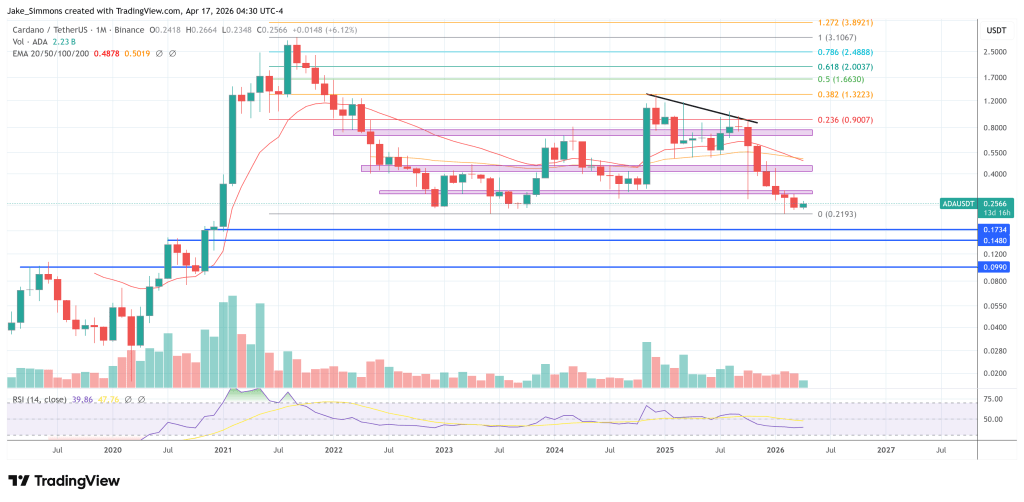
At press time, Cardano traded at $0.2566.

ADA hovers below key resistance, 1-monthly chart | Source: ADAUSDT on TradingView.com

Связанные с этим вопросы

QAccording to the Cardano Foundation CEO, how many large companies in Germany are using Cardano without realizing it, and for what purposes?

AAccording to Cardano Foundation CEO Frederik Gregaard, roughly 200 large companies in Germany are using Cardano as a security layer, a digital identity layer, and an accountability layer in their agentic AI deployments, without even knowing the blockchain is underneath their stack.

QWhat specific type of digital currency are the AI agents using for microtransactions in these systems, and what is its purpose?

AThe AI agents are using a regulated stablecoin called USDM for microtransactions. These microtransactions are used to meter prompt activity and align incentives between participants, and they form part of the security layer to prevent abuse.

QWhat US legislation does Gregaard suggest could unlock significantly broader blockchain usage beyond financial applications?

AGregaard suggests that the Clarity Act, if passed, could unlock materially broader blockchain usage beyond financial applications. He claims that 'hundreds of companies' are waiting for this kind of legal certainty.

QHow does Gregaard contrast Cardano's security model with that of other networks?

AGregaard contrasts Cardano's security by highlighting its on-chain governance model and distributed validator base, which make it harder to compromise through a single point of failure. He contrasts this with networks he describes as effectively controlled by a small number of insiders.

QWhat two key regulatory frameworks does the article mention in the context of stablecoins, and which region does Gregaard suggest might move faster on classifying assets like Cardano?

AThe article mentions the US stablecoin framework under the GENIUS Act and Europe's MiCA regime. Gregaard suggests that the US could move faster than Europe on providing regulatory clarity, recently stating that regulatory language has made clear that 'Cardano is a commodity.'

Похожее

STRC Breaks Below $95: Why Does It Continue to Depeg? Is There Default Risk?

"STRC Falls Below $95: Why the Persistent Depegging and Is There Default Risk?" The article discusses the recent decline in the price of STRC, a perpetual preferred stock issued by Strategy (MSTR) designed to trade around a $100 par value. As of publication, STRC traded at $94.65, raising market concerns. STRC is described as a high-yield cash flow product, offering an 11.50% annual dividend paid monthly. Its "preferred" status grants it priority over common stock for dividends and in liquidation. Key reasons cited for the price depegging include: 1. **Bitcoin's Price Drop:** MSTR's assets are heavily tied to Bitcoin (BTC), which fell over 21% from its recent high, pressuring all Strategy-related products. 2. **Competitive Pressure:** Rival Strive Asset Management's similar product, SATA, offers daily dividends and has maintained its $100 par value with a ~13% yield. In response, Strategy has proposed changing STRC's dividend frequency from monthly to bi-weekly, pending shareholder vote. 3. **Technical Selling:** A break below $100 may have triggered algorithmic selling and stop-losses, exacerbating the decline. Regarding default risk, the analysis suggests it is currently low. Strategy founder Michael Saylor confirmed the June 2026 dividend rate remains at 11.50% with no cuts or suspensions. The company's massive reserve of 843,706 BTC provides a significant backstop for its obligations. Industry opinions are mixed. Some analysts view the BTC holdings as reliable support for dividends, while critics like Peter Schiff warn of potential dividend cuts leading to price crashes and lawsuits. Others highlight inflation risk and the company's ability to reduce dividends without a formal default. In summary, STRC's drop is attributed to BTC volatility, competition, and technical factors. While immediate default risk appears contained, the product faces challenges from market conditions and competitive dynamics.

marsbit1 ч. назад

STRC Breaks Below $95: Why Does It Continue to Depeg? Is There Default Risk?

marsbit1 ч. назад

AI Trading Cools, South Korean Stocks Plunge 1.8%, Spot Gold Rises 1%, Bitcoin Dives

A sell-off in AI-related stocks, triggered by Broadcom's disappointing earnings forecast, sent shockwaves through global markets. South Korea's KOSPI led Asia's decline, plunging 1.8% as the risks from concentrated chip stock gains and surging leveraged investments came to the fore. The tech-heavy Nasdaq 100 futures fell 0.5% following Broadcom's 14% after-hours plunge, which signaled a slower-than-expected transition to AI clients. This pullback extended Wall Street's weakness, halting the S&P 500's nine-day rally amid hawkish Fed signals and renewed Middle East tensions. South Korean authorities convened an emergency meeting, pledging "immediate measures" against market volatility and warning of record-high stock margin debt. The adjustment rippled across assets: Bitcoin fell to around $64,000, its lowest since February, while safe-haven gold rose 1% on bargain hunting. Oil prices dipped on Middle East ceasefire news. Market analysts noted the sell-off was driven by profit-taking after massive gains, particularly in chip stocks like Samsung and SK Hynix, which now dominate the KOSPI. Wall Street banks are divided on Korea's outlook, with Goldman Sachs raising its target while Citigroup and others warn of overvaluation and a potential bubble. Bridgewater's Ray Dalio noted that great technological shifts often create bubbles. Meanwhile, Fed officials' hints at potential future rate hikes added to the cautious mood ahead of key U.S. jobs data.

华尔街日报2 ч. назад

AI Trading Cools, South Korean Stocks Plunge 1.8%, Spot Gold Rises 1%, Bitcoin Dives

华尔街日报2 ч. назад

Торговля

Спот
Фьючерсы

Популярные статьи

Как купить ADA

Добро пожаловать на HTX.com! Мы сделали приобретение Cardano (ADA) простым и удобным. Следуйте нашему пошаговому руководству и отправляйтесь в свое крипто-путешествие.Шаг 1: Создайте аккаунт на HTXИспользуйте свой адрес электронной почты или номер телефона, чтобы зарегистрироваться и бесплатно создать аккаунт на HTX. Пройдите удобную регистрацию и откройте для себя весь функционал.Создать аккаунтШаг 2: Перейдите в Купить криптовалюту и выберите свой способ оплатыКредитная/Дебетовая Карта: Используйте свою карту Visa или Mastercard для мгновенной покупки Cardano (ADA).Баланс: Используйте средства с баланса вашего аккаунта HTX для простой торговли.Третьи Лица: Мы добавили популярные способы оплаты, такие как Google Pay и Apple Pay, для повышения удобства.P2P: Торгуйте напрямую с другими пользователями на HTX.Внебиржевая Торговля (OTC): Мы предлагаем индивидуальные услуги и конкурентоспособные обменные курсы для трейдеров.Шаг 3: Хранение Cardano (ADA)После приобретения вами Cardano (ADA) храните их в своем аккаунте на HTX. В качестве альтернативы вы можете отправить их куда-либо с помощью перевода в блокчейне или использовать для торговли с другими криптовалютами.Шаг 4: Торговля Cardano (ADA)С легкостью торгуйте Cardano (ADA) на спотовом рынке HTX. Просто зайдите в свой аккаунт, выберите торговую пару, совершайте сделки и следите за ними в режиме реального времени. Мы предлагаем удобный интерфейс как для начинающих, так и для опытных трейдеров.

2.2k просмотров всегоОпубликовано 2024.03.29Обновлено 2026.06.02

Как купить ADA

SNEK: ведущий мемкоин на блокчейне Cardano, открывающий новую эпоху для экосистемы Cardano

SNEK - это дефляционный мемкоин, выпущенный на блокчейне Cardano. Он создаёт децентрализованную культурную и развлекательную ценность за счёт участия глобального сообщества.

2.1k просмотров всегоОпубликовано 2025.10.15Обновлено 2025.10.15

SNEK: ведущий мемкоин на блокчейне Cardano, открывающий новую эпоху для экосистемы Cardano

Неделя обучения по популярным токенам 8: запуск основной сети Ouroboros Leios для ADA ожидается в 2026 году

Основная сеть Ouroboros Leios для ADA, как ожидается, будет запущена в 2026 году, а хардфорк до версии протокола 11 запланирован на I квартал 2026 года.

2.0k просмотров всегоОпубликовано 2026.02.10Обновлено 2026.02.12

Неделя обучения по популярным токенам 8: запуск основной сети Ouroboros Leios для ADA ожидается в 2026 году

Обсуждения

Добро пожаловать в Сообщество HTX. Здесь вы сможете быть в курсе последних новостей о развитии платформы и получить доступ к профессиональной аналитической информации о рынке. Мнения пользователей о цене на ADA (ADA) представлены ниже.

活动图片