BSC Pop-up Store Style Memes: How Can They Compete with Solana?

比推Опубликовано 2026-01-13Обновлено 2026-01-13

Введение

The crypto market's high-beta phase has reignited the meme coin frenzy, with Solana and Binance Smart Chain (BSC) emerging as two dominant but divergent ecosystems. Solana leverages its high-speed, low-cost infrastructure (0.4s transaction time, ~$0.005 fees) and culture-first approach, epitomized by platforms like pump.fun, where memes evolve from community-driven narratives and often face rapid failure—over 98% of projects eventually collapse. Its top meme tokens, like BONK and WIF, thrive on viral momentum and decentralized innovation, but the ecosystem is highly competitive and transient. BSC, in contrast, relies heavily on central figures like CZ and He Yi, and its EVM compatibility attracts event-driven, sentiment-heavy trading—particularly within Chinese-speaking communities. While BSC memes can achieve rapid, concentrated pumps, they often lack longevity without ongoing influencer support. Data from Dexscreener (as of Jan 12, 2026) highlights key differences: Solana recorded 26.92M transactions ($8.65B volume) vs. BSC’s 5.9M ($7.80B), reflecting Solana’s retail-heavy, high-frequency trading versus BSC’s大户-dominated, narrative-centric rallies. Ultimately, Solana’s strength lies in its resilient, tool-rich culture, while BSC excels in short-term, liquidity-injected opportunities. The choice between chains depends on risk appetite: probability and algorithms on Solana, versus community sentiment and timing on BSC.

Since the beginning of this year, the crypto market has once again entered a "high-beta" phase.

With the resurgence of risk appetite, meme coins—a highly volatile, high-return asset class—have returned to the center stage, becoming the most fiercely contested direction for capital.

Unlike before, this round of meme trends has not shown a pattern of "one chain dominating." Solana and Binance Smart Chain (BSC), two mainstream public chains, are now clearly diverging in the meme track:

On one side is Solana, known for its speed, toolchain, and community culture;

On the other is BSC, which leverages the personal influence of CZ/He Yi, its infrastructure, and the sentiment of the Chinese-speaking community.

Data from CryptoQuant shows that the proportion of meme coins in the altcoin market has risen to 3.2%, hitting a record high. Against this backdrop, the meme ecosystems of Solana and BSC are evolving along two distinct paths.

Principles and Mechanisms: Speed First or Compatibility First

The divergence between the two chains' meme ecosystems first stems from differences in their underlying design philosophies.

Solana, based on a hybrid consensus mechanism of Proof of History (PoH) and Proof of Stake (PoS), emphasizes extreme performance: average transaction confirmation time is about 0.4 seconds, and the fee per transaction is as low as $0.005–0.01.

This near-instant settlement experience makes Solana a natural breeding ground for high-frequency trading and emotional diffusion.

On Solana, meme gameplay is closer to "productized issuance." Represented by pump.fun, projects use bonding curves for early price discovery and "graduate" to mainstream DEXs once热度 reaches a threshold. This mechanism encourages rapid experimentation, giving rise to representative tokens like BONK and WIF, which emerged from community memes.

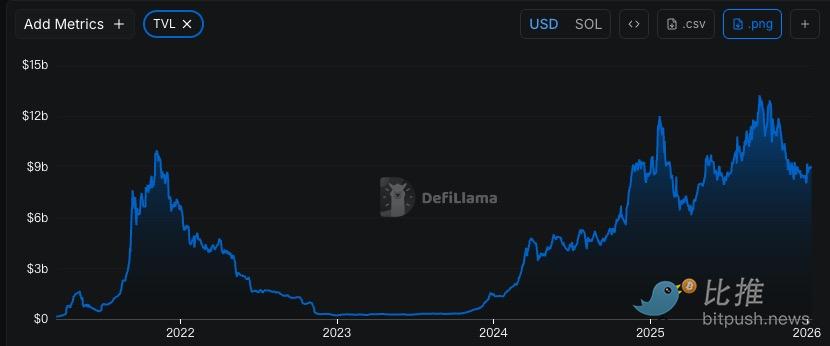
As of now, Solana's ecosystem TVL is approximately $9.0014 billion, still leading among meme-related public chains.

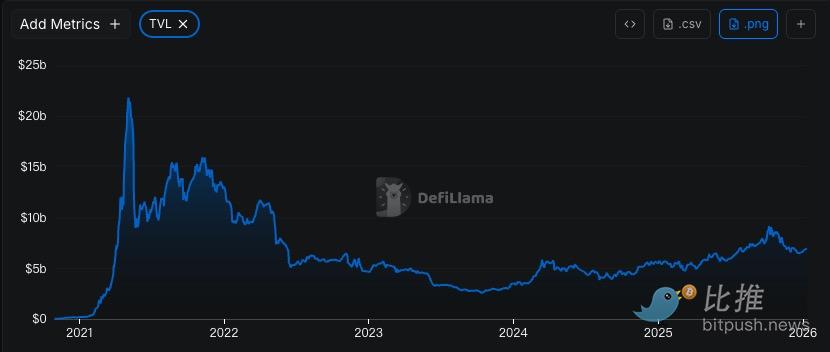
In contrast, BSC opts for compatibility and stability. Its EVM architecture inherits Ethereum's development habits, and with the support of the Binance ecosystem, transaction costs, though slightly higher, remain acceptable. Meme issuance on BSC is more direct—often skipping complex price curves and directly establishing liquidity pools on DEXs like PancakeSwap, making it more suitable for projects that rely on single narratives to gain momentum quickly. Currently, BSC's TVL is about $6.0932 billion, slightly lower than Solana's.

Playstyle Clash: Community Consensus vs. Event-Driven

The differences in mechanisms also shape completely different player behaviors.

On Solana, the vitality of a meme depends on "the spreadability of the meme." Narratives often ferment on X (formerly Twitter), relying on community二次创作 and meme fission to attract attention. Some projects叠加AI, NFT, and other elements to extend their lifecycle, but high freedom also means a high淘汰率—data shows that over 98% of meme projects on Solana ultimately go to zero, with the survivors being the few that have truly formed cultural认同.

BSC's gameplay is closer to "event-driven." Rallies are often ignited by statements from key figures like CZ and He Yi, characterized by straightforward narratives, concentrated情绪, and rapid price increases, but often with limited sustainability. Under the intensive interaction of the Chinese-speaking community, projects can achieve price explosions in a short time, but once the heat subsides, capital can quickly withdraw.

Data Comparison

Through real-time data monitoring from Dexscreener as of the time of writing (January 12, 2026), we can clearly see the "capital性格" of the two ecosystems:

Turnover Efficiency: High-Frequency PvP vs. Whale Game

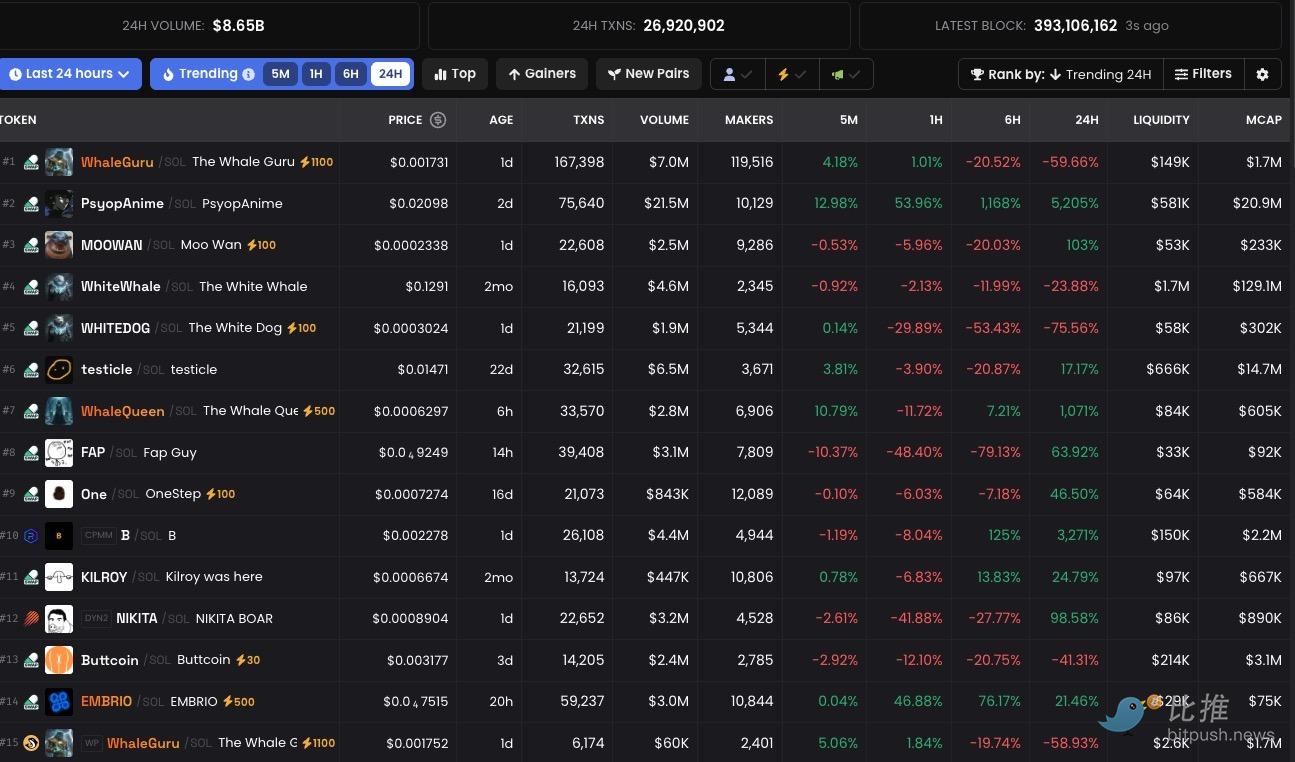
Solana (King of Turnover): 24-hour trading volume of $8.65B, supported by 26.92 million transactions.

Solana's per-transaction amount is extremely small, with the chain filled with millisecond-level sniper bots. On average, each热门代币 has over 110,000 participants (Makers). This极致PvP environment means capital flows extremely fast, with little沉淀.

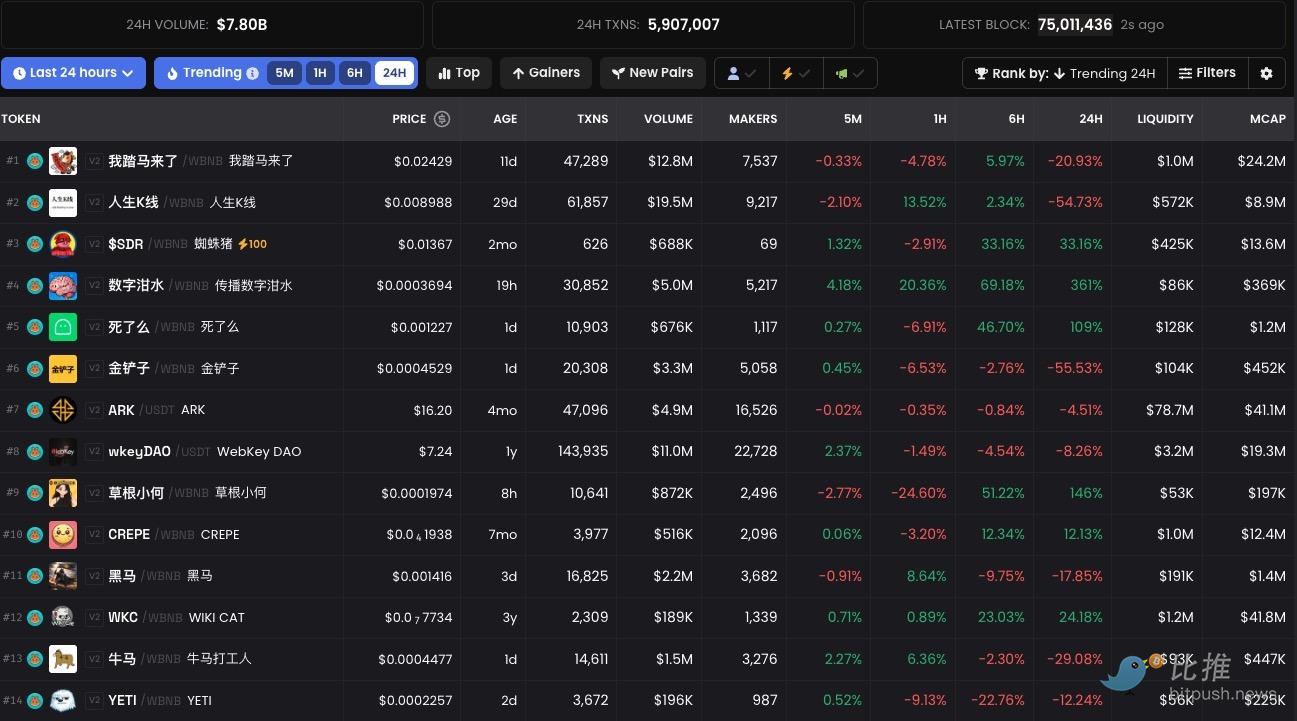
BSC (Whale Hub): 24-hour trading volume of $7.80B, with only 5.9 million transactions.

The average per-transaction amount on BSC far exceeds that of Solana. Taking the热门币 "我踏马来了" (I'm F*cking Coming) as an example, it had only about 7,500 participants in 24 hours, indicating that BSC is more dominated by "whale communities," with concentrated筹码结构, making rallies more targeted when they occur.

Token Age (Days): Harvesting Machine vs. Reservoir

Solana (Extremely New): The Top 15 list is almost entirely dominated by tokens "born within 24 hours" (e.g., WhaleGuru, MOOWAN, NIKITA, etc.). This reflects Solana's极强的流量爆发力 and extremely short narrative lifespan, with capital constantly searching for the next "5-minute" opportunity.

BSC (Relatively "Long-Lived"): The list includes tokens that have survived for 3 years (WKC), 1 year (wkeyDAO), 4 months (ARK), and 11 days ("我踏马来了"). This proves that BSC's Meme tokens are relatively more resilient; once they form a community or "power narrative," they can persist longer.

Market Cap (MCAP) Distribution:

Solana:

Super Blue-Chip: WhiteWhale's market cap is as high as $129.1M, leading the pack.

Long Tail: Beyond the top four, market caps quickly fall below $1M (e.g., FAP, EMBRIO are only in the tens to hundreds of thousands of dollars). This shows that Solana's流量极度偏爱 the top "survivors," while the remaining 99% are just along for the ride.

BSC:

Strong Middle Tier: 7 of the top 15 tokens on the list have a market cap exceeding $10M (e.g., ARK, 我踏马来了, wkeyDAO, SDR). This "olive-shaped" structure indicates that BSC capital prefers to cluster in already successful mid-sized projects, offering相对更高 safety.

Who Can Go Further?

It's not hard to see that Solana's commercial value lies in "infrastructure empowering culture." It attracts global retail investors with extremely low barriers. Although highly泡沫化, its efficiency in decentralized innovation makes it more resilient in the long cycle.

BSC's business logic, however, is "opportunistic amplification." It uses centralized leverage to quickly inject liquidity and connect with the Asian market. But this logic also exposes its fragility: when hotspots fade or "core figures" go silent, the ecosystem easily falls into a "vacuum period" of discontinuity, making it hard for Memes to survive through community autonomy without official光环.

As observed by KOL miragemunny: "BSC is currently in a phase of flash-in-the-pan speculation, while Solana's meme culture and toolchain are the result of years of沉淀."

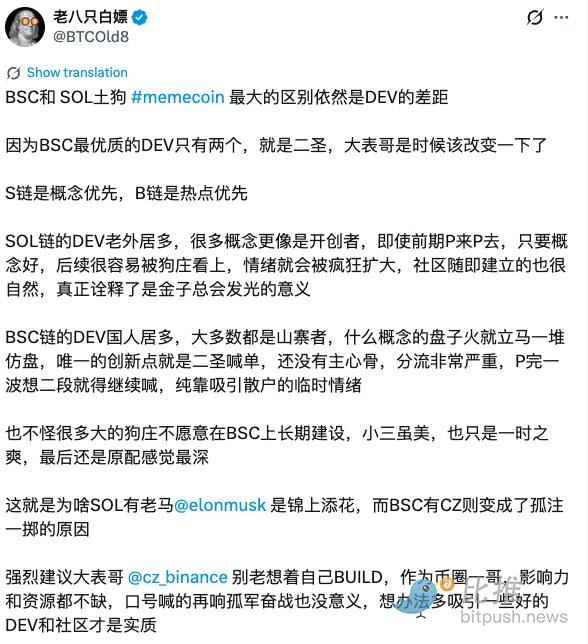
Chinese-speaking KOL 老八只白嫖 (@BTCOld8)直言 (stated bluntly) that BSC needs to attract more developers, not just rely on hotspot rotation.

In 2026, the meme track may enter a new phase of "情绪, liquidity, and toolchain叠加" (superposition of sentiment, liquidity, and toolchains).

For investors, the key may not lie in judging which chain will "definitely win," but in understanding the completely different rhythms of the two ecosystems: on Solana, you play probability and algorithms; on BSC, you play another kind of "interpersonal relations."

However, in the end, in the world of memes, the narrative determines how high you can fly, while liquidity determines how long you can last.

Author: Bootly


Twitter:https://twitter.com/BitpushNewsCN

Bitpush TG Discussion Group:https://t.me/BitPushCommunity

Bitpush TG Subscription: https://t.me/bitpush

Original article link:https://www.bitpush.news/articles/7602035

Связанные с этим вопросы

QWhat are the key differences in the underlying design philosophy between Solana and BSC for meme coin ecosystems?

ASolana prioritizes speed and performance with its Proof of History (PoH) + Proof of Stake (PoS) hybrid consensus, offering near-instant settlement (0.4s) and ultra-low fees ($0.005–0.01). BSC focuses on compatibility and stability through its EVM architecture, inheriting Ethereum's development habits, with slightly higher but still acceptable costs.

QHow do the meme coin 'playstyles' differ between Solana and BSC according to the article?

AOn Solana, meme coin success depends on 'meme spreadability' and cultural identity, often starting from Twitter and relying on community creation and memetic fission. On BSC, the playstyle is more 'event-driven,' ignited by key figures like CZ or He Yi, characterized by straightforward narratives, concentrated emotion, and rapid price surges, but often with limited sustainability.

QWhat does the data reveal about the trading volume and number of transactions on Solana versus BSC?

ASolana had a 24-hour trading volume of $8.65B supported by 26.92 million transactions, indicating high-frequency, small-sized trades. BSC had a 24-hour volume of $7.80B from only 5.9 million transactions, showing larger average trade sizes and more concentrated,大户 (big player) participation.

QWhat is the contrast in the 'Age' or longevity of top meme coins between the two chains?

ASolana's top meme coins are extremely new, with the top 15 often being less than 24 hours old, reflecting fast turnover. BSC's top meme coins show more longevity, with examples surviving for 3 years, 1 year, 4 months, or 11 days, indicating a greater ability to form lasting communities or narratives.

QHow does the market capitalization (MCAP) distribution differ between Solana and BSC meme ecosystems?

ASolana's MCAP distribution is top-heavy with a 'super blue-chip' like WhiteWhale at $129.1M, followed by a steep drop-off where most other top coins have MCAPs below $1M. BSC's distribution is more robust in the middle, with 7 of the top 15 coins having MCAPs over $10M, forming a more 'olive-shaped' structure suggesting stronger community holding in mid-sized projects.

Похожее

TechFlow Intelligence Bureau: Chip Stocks Lose Trillions in a Single Day, Bitcoin Falls Below $60,000, US-Iran Conflict Escalates

**Daily Tech & Markets Roundup: AI Advances, Market Turmoil, and Geopolitical Tensions** **AI / LLMs**: Anthropic's internal report on AI self-improvement sparked serious discussions about Recursive Self-Improvement (RSI). Meanwhile, debate continues on AI coding tools after Claude was accused of introducing bugs into the rsync codebase. In positive news, DeepSeek V4 Flash impressed in local deployment tests, and GitHub Copilot now supports custom endpoints for local models. A surprising research turn suggests removing chain-of-thought prompting can sometimes improve LLM performance. **Crypto / Web3**: Bitcoin plunged below $60,000, with its RSI hitting levels last seen during the COVID-19 crash, driven by strong U.S. jobs data reviving interest rate hike fears. Discussions highlight Ethereum DeFi's continued lack of a smooth consumer payment layer. **Chips / Hardware**: Chip stocks suffered a massive sell-off, with the Philadelphia Semiconductor Index posting its worst single-day drop in six years, erasing over a trillion dollars in value. Marvell, Micron, AMD, and Intel were among the biggest losers. **Tech Companies**: A leaked Microsoft document revealing goals to make Copilot "addictive" drew criticism. LinkedIn founder Reid Hoffman left Microsoft's board to focus full-time on his AI agent startup, Manus. Google was revealed to be paying SpaceX $920 million monthly for AI training compute. **Markets & Macro**: A blowout U.S. jobs report (172k vs. 80k expected) crushed hopes for near-term rate cuts, sending Treasury yields soaring and triggering a broad market sell-off. CEOs from Kraft, McDonald's, and Whirlpool simultaneously warned U.S. consumers are exhausting their savings. **Geopolitics**: U.S.-Iran tensions escalated with missile/drone interceptions and U.S. strikes on Iranian radar sites, keeping the critical Strait of Hormuz largely closed since late February and posing ongoing oil supply risks. **The Bottom Line**: The strong jobs data acted as a single trigger for correlated sell-offs across equities, crypto, and chips. Underlying the volatility is a stark contradiction between robust employment data and warnings of consumer weakness, alongside geopolitical risks that could reignite inflation, leaving markets to price in a fraught macro outlook with no clear "soft landing" path.

marsbit1 ч. назад

TechFlow Intelligence Bureau: Chip Stocks Lose Trillions in a Single Day, Bitcoin Falls Below $60,000, US-Iran Conflict Escalates

marsbit1 ч. назад

It Took Me a Year to See the Bitter Truth About Agent Payments

After a year building infrastructure for the Agent economy, engaging with major players like Stripe, Visa, and Coinbase, the author shares a sobering analysis of the current state of Agent payments. The core finding is a stark lack of genuine, immediate demand across most envisioned use cases. The article breaks down four key market segments: 1. **Agent-to-Merchant (Consumer Shopping):** For most product categories (e.g., clothing, electronics), conversational AI shopping is a step backwards from visual e-commerce interfaces. While agents excel at understanding needs, they can't replace side-by-side product comparison. Real merchant interest is defensive "Agent Engine Optimization," not driven by current customer demand. Potential exists for high-frequency, low-decision purchases (like food delivery) or navigating complex store UIs, but these require massive B2C distribution channels dominated by giants like Amazon. 2. **Agent-to-API (Developer Services):** Developers already have subscriptions and billing relationships for APIs (compute, data). Prepaid balances solve micro-payment issues for low transaction volumes. A deeper structural problem is that major SaaS vendors' business models rely on enterprise contracts, resisting granular pay-per-call pricing. While protocols like MPP and x402 serve the long tail of niche services, this market is small and developers are historically low-willingness-to-pay. 3. **Agent-to-Agent:** This remains largely theoretical with minimal transaction volume. While it represents a long-term bet on a fundamentally new transaction infrastructure (sub-second, micro-penny to million-dollar, multi-party settlements), it does not constitute a present market. 4. **Agent-to-Finance:** This is the only category with existing, paying demand. Integrating AI into financial workflows (trading, portfolio management) is a natural evolution and enables new capabilities like autonomous rebalancing. However, competition favors established, regulated institutions. The "real problem" is not moving money between agents, but the broader challenge of **coordination**—orchestrating work between agents and humans, verifying outcomes, and settling results. Payment is just one component of settlement, which is itself part of coordination. Companies that solve the coordination layer will subsume payment, not the other way around. While well-funded incumbents build defensively for a long-term future, startups must find where the market is today—which, for the author's team, lies outside these four categories in an area of real, growing, and underserved activity.

marsbit2 ч. назад

It Took Me a Year to See the Bitter Truth About Agent Payments

marsbit2 ч. назад

It Took Me a Year to See the Hard Truth About Agent Payments

**Title: It Took Me a Year to See the Hard Truth About Agent Payments** Over the past year, I've worked on infrastructure for the Agent economy, engaging with major players like Stripe, Visa, Coinbase, and numerous startups. The findings reveal a stark reality: genuine, widespread demand for Agent-based payments does not yet exist. **Key Observations:** * **Agent-to-Merchant (Shopping):** The user experience for AI shopping often falls short, especially for visual product discovery. While AI excels at understanding needs, conversational interfaces can't yet replace browsing and comparing multiple products visually. Current merchant interest is largely defensive ("Agent Engine Optimization") for a future that hasn't arrived. High-frequency, low-friction purchases (like food delivery) are potential fits, but lack open APIs and face high AI inference costs. Simpler, more affordable, or cross-language interactions for complex UIs are a niche opportunity but require massive consumer distribution to scale. * **Agent-to-API (Developer Tools):** Developer payment needs for APIs (computing, data, models) are already met through subscriptions and prepaid credits. The core challenge is not payment friction but supplier economics: most large SaaS providers prefer enterprise contracts over micropayments for API calls. Protocols like MPP and x402 suit the long-tail of smaller services but cater to a developer market historically reluctant to pay for these tools. Major infrastructure needs at the top of the stack are already being addressed. * **Agent-to-Agent (Machine Commerce):** This is a long-term vision with almost no current transaction volume. While a future with high-speed, high-frequency, multi-party machine-to-machine transactions would require novel infrastructure, it remains theoretical. The market is not here yet. * **Agent-to-Finance:** This is the only category with clear, present demand. Financial professionals and DeFi users already pay for tools, and AI augmentation is a natural evolution. Autonomous AI agents can enable entirely new financial strategies. However, competition is fierce from established, regulated incumbents who can more easily layer AI onto their existing products. **The Core Insight:** Companies, especially giants with long time horizons, are building defensively for a potential future of mass machine commerce. For them, early investment is a low-cost hedge. For startups, the current market reality is different. The primary challenge isn't just moving money between agents (payments). The larger, unsolved problem is **orchestration** – coordinating work between agents and humans, verifying outcomes, and then settling. Payment is just a part of settlement, which is just a part of orchestration. Companies that solve the orchestration problem will subsume payments, not the other way around. After a year of building, we see the real, growing, and underserved market opportunity lies in this broader domain of orchestration.

链捕手3 ч. назад

It Took Me a Year to See the Hard Truth About Agent Payments

链捕手3 ч. назад

Торговля

Спот
Фьючерсы

Популярные статьи

Обсуждения

Добро пожаловать в Сообщество HTX. Здесь вы сможете быть в курсе последних новостей о развитии платформы и получить доступ к профессиональной аналитической информации о рынке. Мнения пользователей о цене на SOL (SOL) представлены ниже.

活动图片