Breaking: OpenAI Chip Veteran Joins Anthropic

marsbitОпубликовано 2026-06-07Обновлено 2026-06-07

Введение

Breaking News: OpenAI Chip Veteran Joins Anthropic Clive Chan, a key early member of OpenAI's in-house chip development team, has announced his departure from OpenAI to join rival AI company Anthropic. In his statement, Chan highlighted his experience as the second hire on OpenAI's hardware team, praising its exceptional talent density but expressing a desire to "climb a new mountain from the base." He cited Anthropic's talent, values, and ambitious pace as key reasons for his move. Chan also referenced OpenAI's disclosed partnership with Broadcom, aimed at deploying a 10GW AI accelerator system starting in the second half of 2026. His career includes roles at Tesla, Google, and SpaceX, focusing on AI infrastructure and hardware. This move continues a notable trend of talent flow from OpenAI to Anthropic, following other high-profile departures like researcher Andrej Karpathy. With Anthropic's recent $65 billion funding round valuing it near $1 trillion, the competition for top AI talent between these leading firms remains intense.

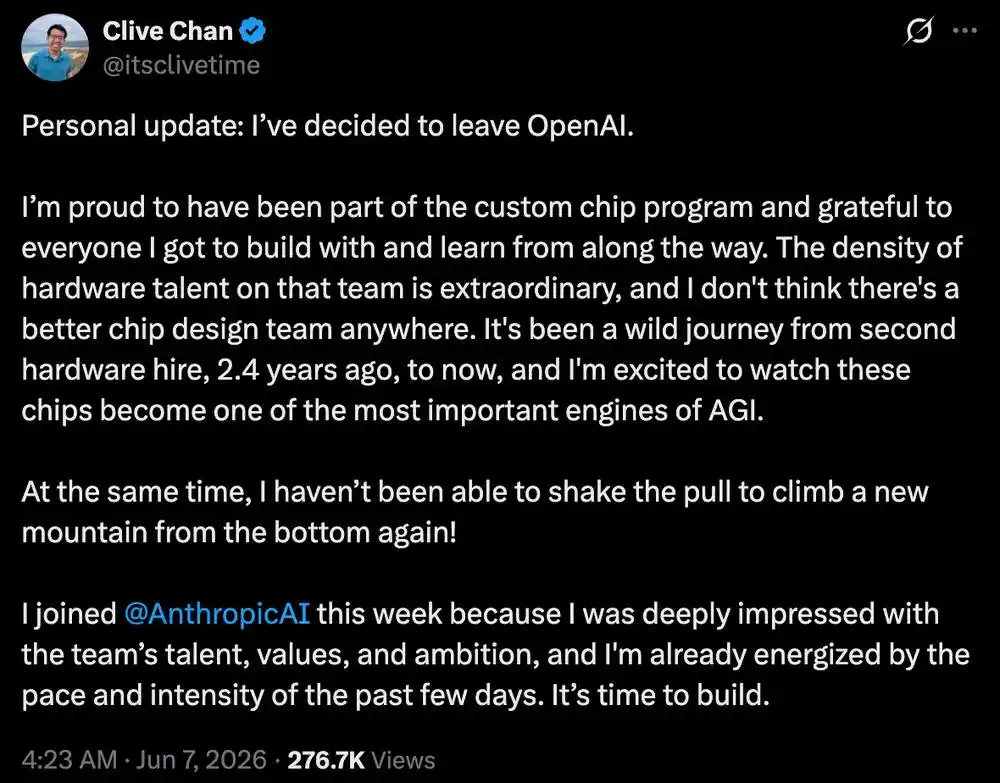
Zhidongxi, June 7, Report – Today, Clive Chan, the 'employee No. 002' of OpenAI's in-house chip project, announced on platform X that he has left OpenAI and officially joined Anthropic this week.

In his departure statement, Clive Chan reflected on his experience at OpenAI over the past two-plus years. He mentioned that he was the second hire for OpenAI's hardware team and witnessed the in-house chip project progress from its early formation to its current advancement. He commented that OpenAI's chip team has an incredible density of talent and that he does not believe there is a better chip design team in the world.

Regarding the future, he looks forward to seeing these chips grow into one of the most important engines for AGI.

However, Clive Chan also wrote that he could never shake the impulse to 'climb a new mountain from its base again'. This is precisely why he ultimately chose to join Anthropic.

He mentioned that the talent, values, and ambition of the Anthropic team deeply impressed him. In the short few days since joining, he has already felt the extremely high-intensity work pace, stating: "It’s time to build."

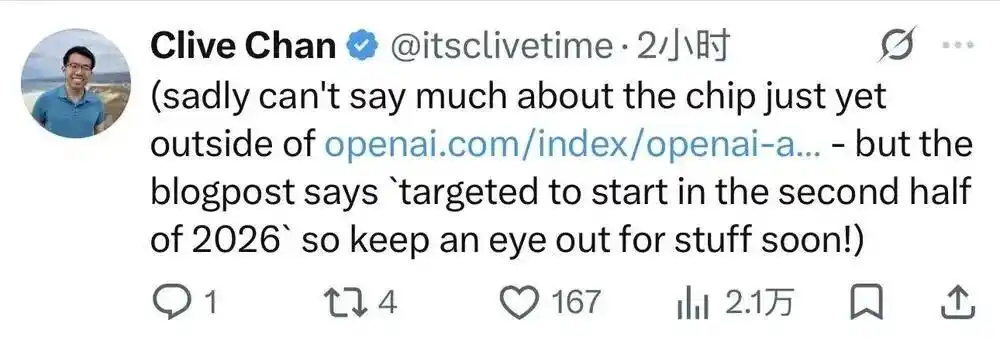
After announcing his departure, Clive Chan was questioned by netizens about the latest progress of OpenAI's in-house chip project. He responded that, apart from the information OpenAI has publicly disclosed, he cannot reveal more details at this time.

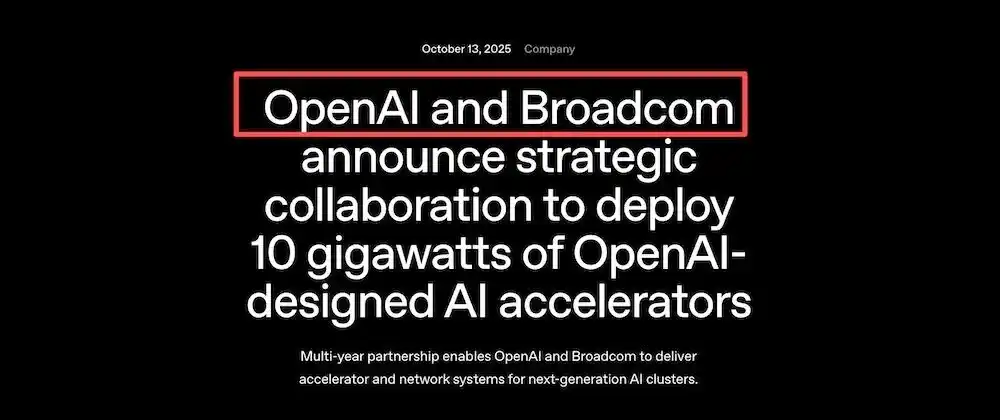
He specifically mentioned, however, the collaboration blog post previously released by OpenAI and Broadcom. According to the information disclosed in the blog, related deployment plans are targeted to commence in the second half of 2026. Clive Chan also mentioned that the outside world will soon see more related progress.

This blog post was published in October 2025. At that time, OpenAI and Broadcom announced a strategic collaboration to jointly build a total scale of 10GW for OpenAI's self-developed AI accelerator systems. OpenAI is responsible for chip and system design, while Broadcom is responsible for accelerator and network system development and deployment. The first racks are planned to begin delivery in the second half of 2026, with the entire project expected to last until the end of 2029. This marked the first time OpenAI officially disclosed a clear timeline for its self-developed AI chip project.

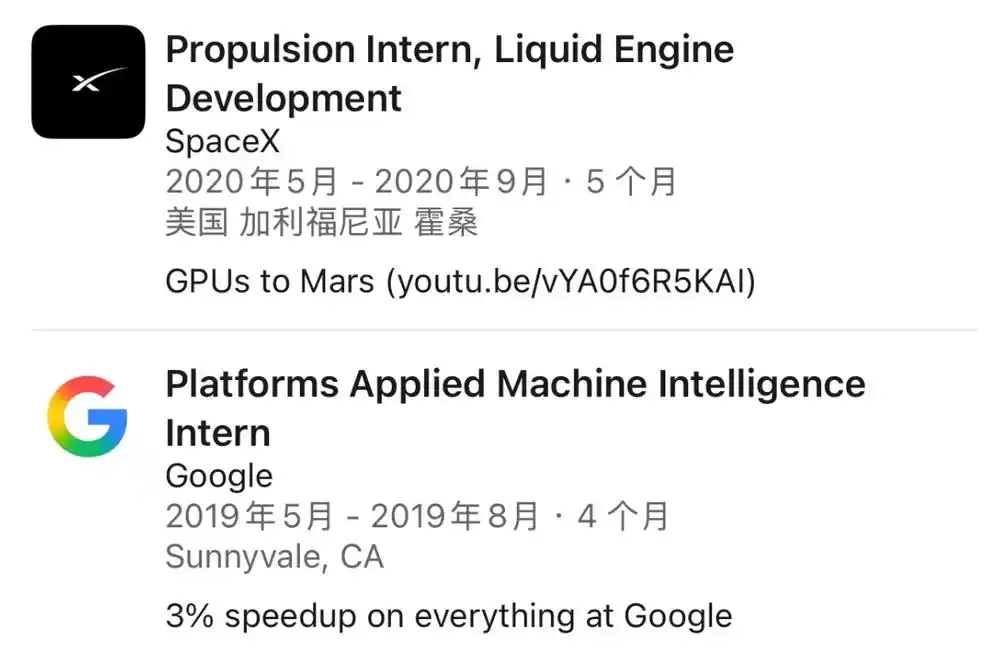
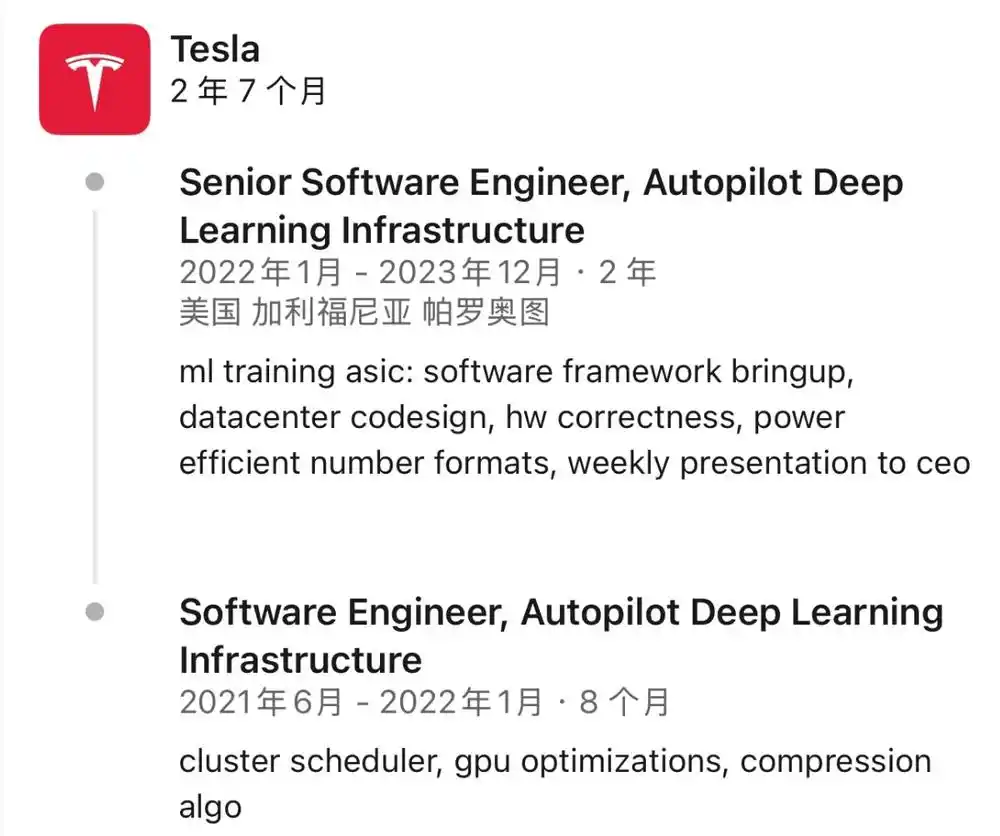
Looking closely at Clive Chan's career, he has worked or interned at several prominent companies including OpenAI, Tesla, Google, and SpaceX, with long-term involvement in AI infrastructure-related work.

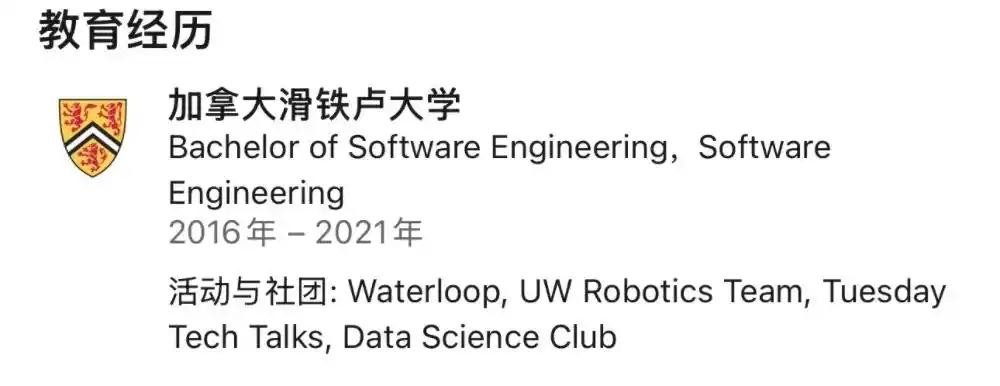
Clive Chan graduated from the University of Waterloo in Canada in 2021. During his time there, he was also involved in the establishment of a Canadian Hyperloop-related student organization and served as co-founder and advisor for the Canadian Hyperloop Conference.

Before and after graduation, he interned or worked at Google, SpaceX, and the quantum computing company QuEra. During his time at Google, he worked on machine learning infrastructure, and at SpaceX, he participated in liquid rocket engine related projects.

After graduation, he joined Tesla's Autopilot deep learning infrastructure team. Over nearly three years, he successively held the positions of Software Engineer and Senior Software Engineer, responsible for GPU optimization, cluster scheduling, data center software, and training infrastructure.

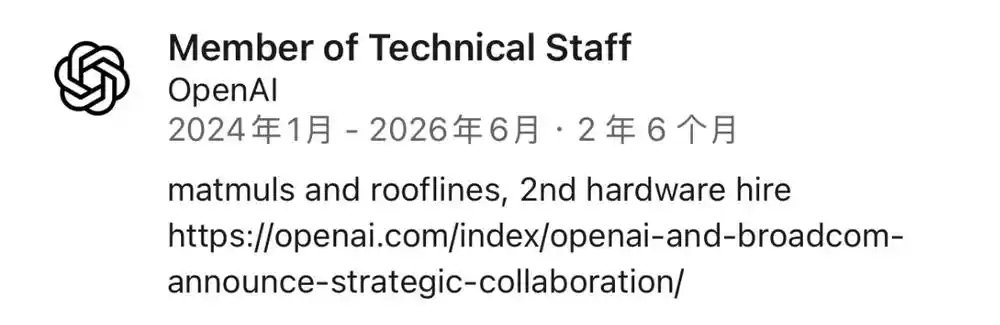
In January 2024, Clive Chan officially joined OpenAI as a member of the technical staff, responsible for matrix multiplication (Matmul), performance analysis (Roofline Analysis), and hardware-related work, and participated in the construction of OpenAI's self-developed AI chip project.

After Clive Chan announced joining Anthropic, Tony CW Liu, an Anthropic employee responsible for GPU performance optimization work, quickly appeared in the comments section with a message: "Congrats and welcome!"

Meanwhile, this job change also sparked some banter from netizens. One netizen said: "Now, every time I see 'I've decided to leave OpenAI', I know the next sentence will definitely mention Anthropic."

Another netizen made a soccer transfer analogy: "It's like leaving Real Madrid to join Barcelona."

Another netizen questioned Clive Chan's statement about "starting from the base of the mountain" in his departure announcement. Anthropic's valuation is almost a trillion dollars, how can that still be considered starting from the base?

Just on June 1, Anthropic announced the completion of a massive $65 billion Series H funding round (approximately RMB 4,397.7 billion), with a post-money valuation reaching $965 billion (approximately RMB 6.53 trillion), just one step away from the trillion-dollar club.

Conclusion: Talent Flow Between OpenAI and Anthropic Continues

It seems now that Anthropic has become one of the most important destinations for talent from OpenAI. From researchers and product leads to chip engineers, the flow of talent between the two companies has consistently attracted attention.

In May of this year, OpenAI co-founder and renowned AI researcher Andrej Karpathy announced joining Anthropic, sparking widespread discussion in the industry. One month later, Clive Chan, who participated in OpenAI's in-house chip project, also chose to join this former "competitor".

For frontier AI companies, talent remains one of the most core assets. For Anthropic, which is continuously expanding its team, this list may well grow longer.

This article is from the WeChat public account "Zhidongxi" (ID: zhidxcom), author: Jiang Yu.

Связанные с этим вопросы

QWho is Clive Chan and what significant career move did he announce?

AClive Chan is the second hire on OpenAI's in-house chip development team, often referred to as employee '002'. He announced that he has left OpenAI and officially joined Anthropic.

QWhat reasons did Clive Chan give for leaving OpenAI and joining Anthropic?

AHe stated he was driven by an impulse to 'climb a new mountain from the bottom again.' He was also impressed by Anthropic's talent, values, ambition, and the intense work pace he experienced after joining.

QWhat did Clive Chan reveal about the progress of OpenAI's in-house AI chip project?

AHe said he could not reveal details beyond what OpenAI has publicly disclosed. He specifically pointed to the October 2025 collaboration blog with Broadcom, which targets the first racks for the 10GW AI accelerator system to start delivery in the second half of 2026.

QWhat significant milestone did Anthropic recently achieve regarding its valuation?

AOn June 1, Anthropic announced it completed a $65 billion H-round of financing, reaching a post-investment valuation of $965 billion, putting it on the verge of joining the trillion-dollar club.

QHow have online commenters humorously reacted to this career move?

ASome compared the move to a football transfer from Real Madrid to Barcelona. Others joked that every time they see 'I've decided to leave OpenAI,' they know the next sentence will mention Anthropic. A user also questioned how joining the highly valued Anthropic could be considered 'starting from the mountain bottom.'

Похожее

Uncovering the Truth About Agent Commerce, Payments, and Infrastructure

Decoding Agent Commerce, Payments, and Infrastructure: The Reality Over the past year, I've been building infrastructure for the Agent economy, engaging with major players like Stripe, Visa, Coinbase, Google, and dozens of startups. A clear conclusion emerges: true, large-scale demand does not yet exist. Startups face structural challenges. Data points illustrate this gap. Stripe's Agent commerce platform has over 1,000 merchants but only single-digit transacting agents. Visa's Agent payment token requires 9-month KYC and a $250M revenue threshold, accessible only to giants like Amazon. On-chain analysis reveals actual daily Agent transaction volume is around $17k, half of which are test transactions. The article analyzes four potential markets: **1. Agent-to-Merchant (A2M):** Current AI shopping UX is often inferior to traditional e-commerce for visual, comparison-heavy purchases (clothing, electronics). Chat interfaces are a step back. Real merchant interest is defensive "Agent Engine Optimization," fearing future obsolescence, not current demand. Potential exists in high-frequency, low-decision purchases (e.g., food delivery) or simplifying terrible UX (complex checkouts, non-native shoppers), but these require massive consumer distribution channels dominated by giants like DoorDash and Amazon. **2. Agent-to-API (A2A):** Developers already have subscriptions and billing for core APIs (compute, data). The argument for micro-payments via crypto for sub-dollar API calls is addressed by pre-paid balances today. The deeper issue is supplier resistance; major SaaS firms rely on enterprise contracts, not fractional cent pricing. Opportunity lies in the long tail of niche services, but this is a smaller market catering to developers, a historically low-paying group. **3. Agent-to-Agent (A2A):** This remains a theoretical long-term vision with near-zero current transaction volume. It involves unique challenges: discovery, trust, negotiation, dispute resolution. When it materializes, it will require a fundamentally new settlement infrastructure for high-speed, variable-value, multi-party transactions. It's a real long-term bet, but not the current market. **4. Agent-to-Finance (A2F):** This is the only category with existing, paying demand. Integrating AI into financial workflows (trading, portfolio management) is a natural evolution and enables new capabilities like autonomous rebalancing. However, competition favors incumbents with regulatory licenses, compliance infrastructure, and existing client relationships. **The Real Issue:** Why is infrastructure still being built? Incumbents can afford long-term bets, and payment companies see every problem as a nail for their payment hammer. However, payment is just one piece. The core challenge is *coordination*—orchestrating work between Agents and humans, verifying outcomes, and settling results. Payment is part of settlement, which is part of coordination. Companies that solve the coordination problem will subsume payments, not the other way around. Startups lack the infinite runway of giants and must find today's real market, which, after a year of exploration, lies outside these four categories—in an area with real, growing, and underserved activity.

marsbit2 ч. назад

Uncovering the Truth About Agent Commerce, Payments, and Infrastructure

marsbit2 ч. назад

Kalshi, MTS, and a16z's Ambition

The article "Kalshi, MTS, and a16z's Ambition" explores prediction markets as a focal point of excitement in 2025 for investors, crypto enthusiasts, and media. It traces their intellectual lineage from Friedrich Hayek's ideas on dispersed knowledge and market coordination to Robin Hanson's Logarithmic Market Scoring Rule (LMSR), which incentivizes truthful information sharing. The piece argues that a16z's significant investment in prediction market platform Kalshi (valued at $220B) transcends mere financial speculation. a16z frames prediction markets as a new form of "media" that provides "presence"—a way for individuals to actively engage with and influence world events through financial stakes, countering postmodern detachment. By wagering on outcomes, users become "super observers," and the market's aggregated probabilities gain authoritative power to define event truth and importance. The article uses media company MTS ("Monitoring The Situation") as a case study of a16z's "new media" strategy: rapidly producing high-intensity, multi-format content to "take over the timeline." However, prediction markets like Kalshi are presented as the ultimate piece in this media empire. Their real-money, crowd-sourced probabilities possess a unique "reality distortion field" and perceived objectivity, potentially swaying public opinion and granting a private company unprecedented interpretive power over reality. Ultimately, Kalshi's immense valuation is attributed not just to its exchange model, but to its role as a foundational component in a16z's envisioned new media landscape, where prediction markets define narrative and truth.

链捕手2 ч. назад

Kalshi, MTS, and a16z's Ambition

链捕手2 ч. назад

Торговля

Спот
Фьючерсы

Популярные статьи

Как купить CHIP

Добро пожаловать на HTX.com! Мы сделали приобретение USD.AI (CHIP) простым и удобным. Следуйте нашему пошаговому руководству и отправляйтесь в свое крипто-путешествие.Шаг 1: Создайте аккаунт на HTXИспользуйте свой адрес электронной почты или номер телефона, чтобы зарегистрироваться и бесплатно создать аккаунт на HTX. Пройдите удобную регистрацию и откройте для себя весь функционал.Создать аккаунтШаг 2: Перейдите в Купить криптовалюту и выберите свой способ оплатыКредитная/Дебетовая Карта: Используйте свою карту Visa или Mastercard для мгновенной покупки USD.AI (CHIP).Баланс: Используйте средства с баланса вашего аккаунта HTX для простой торговли.Третьи Лица: Мы добавили популярные способы оплаты, такие как Google Pay и Apple Pay, для повышения удобства.P2P: Торгуйте напрямую с другими пользователями на HTX.Внебиржевая Торговля (OTC): Мы предлагаем индивидуальные услуги и конкурентоспособные обменные курсы для трейдеров.Шаг 3: Хранение USD.AI (CHIP)После приобретения вами USD.AI (CHIP) храните их в своем аккаунте на HTX. В качестве альтернативы вы можете отправить их куда-либо с помощью перевода в блокчейне или использовать для торговли с другими криптовалютами.Шаг 4: Торговля USD.AI (CHIP)С легкостью торгуйте USD.AI (CHIP) на спотовом рынке HTX. Просто зайдите в свой аккаунт, выберите торговую пару, совершайте сделки и следите за ними в режиме реального времени. Мы предлагаем удобный интерфейс как для начинающих, так и для опытных трейдеров.

377 просмотров всегоОпубликовано 2026.04.21Обновлено 2026.06.02

Как купить CHIP

Обсуждения

Добро пожаловать в Сообщество HTX. Здесь вы сможете быть в курсе последних новостей о развитии платформы и получить доступ к профессиональной аналитической информации о рынке. Мнения пользователей о цене на CHIP (CHIP) представлены ниже.

活动图片