Bitwise Seeks to Acquire Chorus One to Dominate Institutional Staking as BMIC Momentum Builds

bitcoinistОпубликовано 2026-02-04Обновлено 2026-02-04

Введение

Bitwise, a major asset management firm, is reportedly seeking to acquire Chorus One, a leading European institutional staking provider, signaling a strategic move to dominate the crypto yield infrastructure. This acquisition highlights the growing institutional focus on staking as a key revenue stream. However, this consolidation raises concerns over centralization risks and vulnerabilities, such as potential "Harvest Now, Decrypt Later" quantum attacks. In response, projects like BMIC ($BMIC) are gaining attention for offering a quantum-secure finance stack designed to protect digital assets against future cryptographic threats. BMIC's presale has already raised significant funds, reflecting strong market interest in next-generation security solutions.

The institutional race to capture the crypto yield economy just entered a new, aggressive phase. Reports indicating that asset management giant Bitwise seeks to acquire Chorus One, a leading European institutional staking provider, signal a pivotal shift in market structure.

This isn’t merely about accumulation, it’s a battle for control of the infrastructure itself.

Bitwise (already a heavyweight in the ETF sector) appears to be positioning itself vertically within the crypto stack. By targeting Chorus One, which operates validators for over 60 networks and secures billions in assets, Bitwise is moving beyond simple asset exposure.

They’re aiming to capture the technical ‘yield layer’ of the blockchain ecosystem. Why? Because it validates the thesis that staking, not just trading, is where the next trillion dollars of institutional capital will flow.

With Bitcoin hovering near $76K and Ethereum dominance holding steady, the market appetite for yield-bearing infrastructure is insatiable. But let’s be honest: this consolidation of staking power brings new risks.

As centralized entities amass validator keys, the attack surface for bad actors grows. This centralization paradox is driving capital toward decentralized, next-generation security solutions that can protect assets even as the stakes get higher.

While the giants fight for today’s yields, forward-looking investors are positioning themselves in protocols like BMIC ($BMIC), which addresses the existential threat looming over all digital assets: quantum decryption.

Buy $BMIC here.

The Quantum Threat to Institutional Staking Infrastructure

The potential acquisition of Chorus One by Bitwise underscores a critical reality: digital assets are only as valuable as the cryptography securing them.

As institutions lock up billions in staking contracts, they become prime targets for ‘Harvest Now, Decrypt Later’ (HNDL) attacks. State actors and sophisticated syndicates are already hoarding encrypted data, waiting for quantum computing power to mature enough to shatter current encryption standards like RSA and ECC.

Here is where the narrative shifts from simple accumulation to survival. If the underlying cryptographic signatures of a validator are compromised, the entire stake is at risk. The industry is finally waking up to the fact that legacy wallets and staking mechanisms, regardless of who owns them, are built on math that has an expiration date.

BMIC ($BMIC) tackles this vulnerability head-on.

Unlike traditional wallets that merely store keys, BMIC offers a full quantum-secure finance stack. By integrating ERC-4337 smart accounts with proprietary post-quantum cryptography, the project ensures that user keys are never exposed during transactions or staking activities.

This creates a defensive moat that appeals to both retail users fearing wallet drains and enterprise players looking to future-proof their operations against the inevitability of quantum computing.

Learn more about BMIC here.

BMIC Offers ‘Harvest Now, Decrypt Later’ Protection as Presale Surges

While Bitwise focuses on aggregating current market share, BMIC is engineering the safety rails for the next decade of crypto. The project’s unique value proposition centers on eliminating public key exposure, the primary vector for both current phishing attacks and future quantum breaks.

Through its Quantum Meta-Cloud and AI-enhanced threat detection, the platform creates an ecosystem where users can transact, stake, and govern without the perpetual anxiety of private key management.

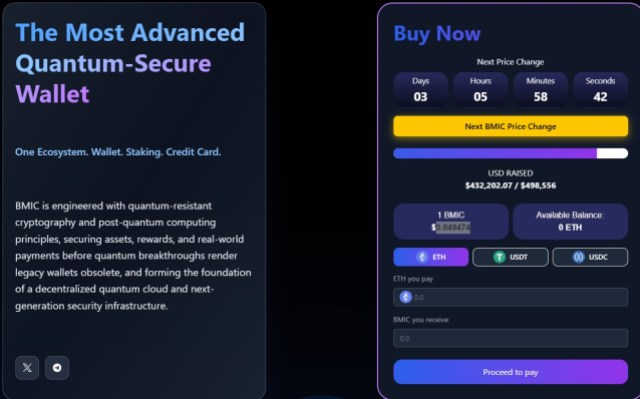
The market has responded sharply to this utility. The BMIC presale has already raised over $432K so far, a figure that suggests a significant appetite for security-first infrastructure. With tokens currently priced at $0.049474, early participants are betting on the transition from legacy wallets to quantum-resistant architectures.

What distinguishes BMIC from standard wallet providers is its recognition of the ‘burn-to-compute’ economy and governance utility. It isn’t just a storage solution; it’s ecosystem fuel designed to power a secure, decentralized computing layer.

As the industry watches giants like Bitwise consolidate the staking layer, the smart money is hedging against the technical debt of that very infrastructure by backing the only platform built to withstand the post-quantum era.

Visit the BMIC presale page.

Disclaimer This article is for informational purposes only and does not constitute financial advice. Cryptocurrency investments carry high risks, including total loss of capital. Always conduct your own due diligence.

Связанные с этим вопросы

QWhat is the main strategic move by Bitwise discussed in the article, and what is its significance?

AThe article discusses Bitwise's move to acquire Chorus One, a leading European institutional staking provider. This signifies a pivotal shift in market structure, representing a vertical integration into the crypto stack and a battle for control of the yield infrastructure itself, not just asset accumulation.

QAccording to the article, what is the 'Quantum Threat' to institutional staking infrastructure?

AThe 'Quantum Threat' refers to 'Harvest Now, Decrypt Later' (HNDL) attacks, where state actors or sophisticated syndicates hoard encrypted data, waiting for quantum computing to mature enough to break current encryption standards like RSA and ECC, thereby compromising validator signatures and putting entire stakes at risk.

QHow does the BMIC ($BMIC) protocol claim to address the vulnerabilities of traditional staking and wallets?

ABMIC offers a full quantum-secure finance stack by integrating ERC-4337 smart accounts with proprietary post-quantum cryptography. This ensures user keys are never exposed during transactions or staking, creating a defensive moat against both current threats and future quantum decryption.

QWhat market response is cited as evidence of appetite for BMIC's solution?

AThe article cites that the BMIC presale has raised over $432K, suggesting a significant market appetite for its security-first infrastructure, with investors betting on the transition from legacy wallets to quantum-resistant architectures.

QWhat centralization risk does the article associate with the consolidation of staking power by entities like Bitwise?

AThe article states that as centralized entities amass validator keys, the attack surface for bad actors grows. This centralization paradox increases risk and is driving capital toward decentralized, next-generation security solutions.

Похожее

Has Hook Summer Really Arrived? sato, Lo0p, FLOOD Ignite the New Narrative of Uniswap v4

"Hook Summer" Arrives? Sato, Lo0p, FLOOD Ignite Uniswap v4 Narrative Amidst a slight market recovery, attention within the Ethereum ecosystem has shifted to Meme coins built on Uniswap v4's Hook protocol. Following ASTEROID, tokens like sato, sat1, Lo0p, and FLOOD have become market focal points, with market caps ranging from millions to tens of millions, bringing concentrated liquidity to a narrative-dry market. Uniswap v4 Hooks are "plugin smart contracts" that allow developers to inject custom logic at key points in a liquidity pool's lifecycle (initialization, adding/removing liquidity, swaps, etc.), making the AMM programmable. Recent representative projects include: * **sato**: Market cap peaked over $38M; uses a v4 curve mechanism for minting/burning, locking ETH as reserve. * **sat1**: Market cap briefly exceeded $10M, positioning as an "optimized sato," but later declined significantly. * **Lo0p**: Market cap neared $6.6M; a "lending AMM protocol" allowing users to borrow ETH against deposited LO0P tokens without immediate selling pressure. * **FLOOD**: Market cap approached $6M; channels trading reserves into Aave v3 to generate yield, which is retained in the pool. The emergence of these Hook-based tokens could drive long-term growth for the Uniswap ecosystem by attracting users and liquidity to v4 pools. Combined with Uniswap's activated fee switch (partially used to burn UNI), the long-term outlook for UNI appears positive. However, short-term UNI price appreciation is not directly guaranteed. Factors include the sustainability and lifecycle of these new tokens, their price volatility, overall market conditions, and regulatory pressures. Currently, Uniswap v4's TVL ($595M) lags behind v3 and v2, indicating Hook adoption still requires time to mature. In summary, the Hook ecosystem serves as "long-term nourishment" for UNI, but acts more as a "catalyst" than a direct "booster" in the short term. Note: These are early-stage experimental tokens and may carry unknown risks.

marsbit3 мин. назад

Has Hook Summer Really Arrived? sato, Lo0p, FLOOD Ignite the New Narrative of Uniswap v4

marsbit3 мин. назад

Has Hook Summer Truly Arrived? sato, Lo0p, FLOOD Ignite the New Uniswap v4 Narrative

With the broader market showing signs of recovery, a new wave of interest has emerged around Ethereum-based meme coins. Following ASTEROID, tokens like sato, sat1, Lo0p, and FLOOD, built upon the Uniswap v4 Hook protocol, are capturing market attention. Their market capitalizations range from millions to tens of millions of dollars, injecting much-needed focused liquidity into a market lacking narratives. This article explores whether this trend signifies an incoming "Hook Summer" and its potential impact on UNI's price. Hooks are essentially plug-in smart contracts for Uniswap v4 liquidity pools, allowing developers to inject custom logic at key points in a pool's lifecycle (like initialization, adding/removing liquidity, swaps). This transforms the AMM into programmable building blocks. Key highlighted projects include: * **sato**: Peaked over $38M market cap. It utilizes a v4 curve for minting/burning; buying locks ETH as reserve to mint new tokens, while selling redeems ETH from the reserve and burns tokens. * **sat1**: Market cap briefly exceeded $10M, promoted as an "optimized sato," but later declined significantly. * **Lo0p**: Reached nearly $6.6M. It's a lending AMM protocol where buying LO0P tokens locks them as collateral, allowing users to borrow ETH from the pool reserve at 40% LTV, aiming to improve capital efficiency for idle ETH in LPs. * **FLOOD**: Peaked near $6M. Its mechanism directs asset reserves from buys into Aave v3 to generate yield, with fees and interest retained in the pool to potentially influence the token's price long-term. In the long term, the development of the Hook ecosystem can attract users and liquidity to Uniswap v4, benefiting UNI's fundamentals—especially combined with the recent activation of the protocol fee switch, where a portion of fees is used to burn UNI. However, in the short term, these Hook-based tokens are unlikely to directly drive significant UNI price appreciation. Their impact is moderated by factors like token sustainability, price volatility, and broader market and regulatory conditions. Currently, Uniswap v4's TVL ($595M) still trails behind v2 and v3, indicating adoption and growth will take time. The article concludes that while the Hook ecosystem provides long-term "nourishment" for UNI, its short-term role is more of a "catalyst" than a "booster." Readers are cautioned that these are early-stage experimental tokens and may carry unknown risks.

Odaily星球日报15 мин. назад

Has Hook Summer Truly Arrived? sato, Lo0p, FLOOD Ignite the New Uniswap v4 Narrative

Odaily星球日报15 мин. назад

Interview with Michael Saylor: I Did Say I Would Sell Bitcoin, But Never a Net Sale

Interview with Michael Saylor: I Said We'd Sell Bitcoin, But Never Be a Net Seller In a recent podcast, MicroStrategy Executive Chairman Michael Saylor clarified the company's stance on potentially selling Bitcoin. Following MicroStrategy's earnings call statement about being prepared to sell BTC to fund dividends for its STRC (Strategic) credit product, Saylor emphasized the distinction between selling and being a "net seller." Saylor explained the core business model: MicroStrategy sells credit instruments like STRC and uses the proceeds to buy Bitcoin, which is viewed as "digital capital" expected to appreciate around 30-40% annually. A portion of these capital gains can then be used to pay the dividends on the credit products. He stressed that even if the company sells some Bitcoin for dividends, it simultaneously buys much more with new credit issuance. For example, after raising $3.2 billion from STRC sales in April, the dividend obligation was only $80-90 million, making the company a net buyer. The clarification aims to counter market narratives questioning the value of Bitcoin on MicroStrategy's balance sheet if it were never sold, and to dismiss claims of a "Ponzi scheme." Saylor reiterated his personal philosophy for investors: "Don't be a net seller of bitcoin" and ensure your Bitcoin holdings increase each year. Saylor also discussed Bitcoin's role as the foundation for "digital credit," noting that STRC has become the largest and most liquid preferred stock issue in the U.S., offering high risk-adjusted returns (Sharpe ratio). He highlighted Bitcoin's deep liquidity, stating that even large purchases by MicroStrategy do not move the market significantly, which is driven by macro factors, geopolitical tensions, and capital flows from ETFs and credit products. Finally, Saylor reflected on his early inspiration from sci-fi books, which motivated his path to MIT, and maintained his fundamental thesis on Bitcoin remains unchanged: it is superior digital capital enabling superior digital credit.

链捕手19 мин. назад

Interview with Michael Saylor: I Did Say I Would Sell Bitcoin, But Never a Net Sale

链捕手19 мин. назад

Beaten SK Hynix Employees in China: Year-end Bonus Less Than 5% of Korean Staff's

"SK Hynix Chinese Staff Hit Hard: Bonuses Less Than 5% of Korean Counterparts" Driven by the AI boom, South Korea's SK Hynix is experiencing record performance, with media reports predicting massive year-end bonuses for its employees, making them highly desirable in the matchmaking market. However, this prosperity starkly contrasts with the situation for the company's Chinese employees. According to reports, SK Hynix operates under a rule allocating 10% of operating profit for employee bonuses. While projections suggest Korean employees could receive bonuses reaching millions of RMB, a Chinese employee with over a decade of technical experience revealed the disparity: "If they get 3 million, Chinese staff get less than 5% of that." After adjustments based on KPI ratings, this employee's highest bonus was slightly over 100,000 RMB. Bonuses are paid annually in Korea but semi-annually in China. During the industry downturn in 2023-2024, Chinese employees received no bonus at all. The gap extends beyond bonuses. Recruitment posts for SK Hynix's Chinese factories (in Wuxi, Dalian, Chongqing) show engineer monthly salaries ranging from 10,000 to 35,000 RMB, with a 13th-month salary promised. Chinese employees also receive standard benefits like annual leave but lack stock incentives, which are reportedly unavailable to them. Furthermore, management positions in China are predominantly held by Korean personnel, though industry observers note a gradual increase in local middle managers over time. SK Hynix has confirmed the 10% bonus rule but cautioned that specific future bonus amounts remain unpredictable. The company forecasts strong demand for HBM and other high-value enterprise products for the next 2-3 years, driven by AI infrastructure investment. This focus on business-to-business markets may continue to constrain supply for consumer products, potentially prolonging price increases for components like memory.

链捕手33 мин. назад

Beaten SK Hynix Employees in China: Year-end Bonus Less Than 5% of Korean Staff's

链捕手33 мин. назад

Торговля

Спот
Фьючерсы

Популярные статьи

Как купить ONE

Добро пожаловать на HTX.com! Мы сделали приобретение Harmony (ONE) простым и удобным. Следуйте нашему пошаговому руководству и отправляйтесь в свое крипто-путешествие.Шаг 1: Создайте аккаунт на HTXИспользуйте свой адрес электронной почты или номер телефона, чтобы зарегистрироваться и бесплатно создать аккаунт на HTX. Пройдите удобную регистрацию и откройте для себя весь функционал.Создать аккаунтШаг 2: Перейдите в Купить криптовалюту и выберите свой способ оплатыКредитная/Дебетовая Карта: Используйте свою карту Visa или Mastercard для мгновенной покупки Harmony (ONE).Баланс: Используйте средства с баланса вашего аккаунта HTX для простой торговли.Третьи Лица: Мы добавили популярные способы оплаты, такие как Google Pay и Apple Pay, для повышения удобства.P2P: Торгуйте напрямую с другими пользователями на HTX.Внебиржевая Торговля (OTC): Мы предлагаем индивидуальные услуги и конкурентоспособные обменные курсы для трейдеров.Шаг 3: Хранение Harmony (ONE)После приобретения вами Harmony (ONE) храните их в своем аккаунте на HTX. В качестве альтернативы вы можете отправить их куда-либо с помощью перевода в блокчейне или использовать для торговли с другими криптовалютами.Шаг 4: Торговля Harmony (ONE)С легкостью торгуйте Harmony (ONE) на спотовом рынке HTX. Просто зайдите в свой аккаунт, выберите торговую пару, совершайте сделки и следите за ними в режиме реального времени. Мы предлагаем удобный интерфейс как для начинающих, так и для опытных трейдеров.

651 просмотров всегоОпубликовано 2024.04.12Обновлено 2025.06.06

Как купить ONE

Обсуждения

Добро пожаловать в Сообщество HTX. Здесь вы сможете быть в курсе последних новостей о развитии платформы и получить доступ к профессиональной аналитической информации о рынке. Мнения пользователей о цене на ONE (ONE) представлены ниже.

活动图片